The key findings presented in this article were produced using a new interactive tool that generates estimates of the number of children likely affected by parental detention. These figures are estimates and should be interpreted accordingly. To learn more about the methodology and explore the tool yourself, click here.
The Trump administration has made detention and deportation the centerpieces of its immigration policy. Around 60,000 people are being held in detention currently, and around 400,000 people have been booked into Immigration and Customs Enforcement (ICE) detention from an interior arrest since the administration began. Detention capacity is likely to expand, with $45 billion allocated to expanding detention facilities in the One Big Beautiful Bill Act.
Though it is mostly adults who are detained and deported, many children are impacted by separation from their parents. However, there are no reliable data on how many detainees or deportees have children in the U.S., nor on what happens to them once their parent is taken into custody. Here we focus on detainees, about whom we have better information than deportees. Even a short separation from a parent is likely traumatic for a child, but a majority of detentions are not short-lived separations. A ProPublica study following ICE arrests of mothers of U.S. citizen children over the first seven months of the administration found that 60% had been removed and 17% remained in custody at the study’s conclusion.
To estimate the number of children affected by parental detention, we rely on demographic characteristics of detainees matched with likely unauthorized immigrants in the American Community Survey. Our analysis (detailed below) suggests that more than 145,000 U.S. citizen children have likely experienced a parent booked into detention since the administration began, with more than 22,000 of those experiencing detention of all their co-resident parents. In the accompanying interactive, we allow users to explore how the estimates change when the underlying assumptions are varied. Regardless of the assumptions used, it is clear that tens of thousands of children have faced parental detention since January 2025.
Estimating the number of affected children
Since the administration began, there have been around 400,000 immigrants detained after an interior arrest, but the share with children at home is unknown. The ICE Detained Parent Directive, updated in July 2025, still requires that ICE affirmatively ask about the parental status of those it takes into custody. Anecdotal evidence suggests immigrants are often not asked about their children, and some immigrants avoid mentioning their children if asked for fear of adverse consequences. The Department of Homeland Security (DHS) reports a fiscal year total number of detainees with U.S. citizen children, but the published FY 2025 total of 18,277 parents is almost certainly a substantial undercount.
We use an alternative approach, inferring the likely number of children based on the known demographic characteristics of adult detainees obtained from the Detention Data Project. We match the detainees’ country or region, age, sex, and marital status to likely undocumented individuals surveyed in the American Community Survey (ACS), a nationally representative household survey. This exercise implies that about 27% of detainees are the co-residential parent of a minor child, and 20% have citizen children in the home. We also use this method to assess whether individuals are in one or two parent families, the likely status of the detainee’s co-parent, and the average number of children per parent in each demographic group.
Overall, likely undocumented adults in the ACS have a 38% likelihood of being the parent of a minor child and a 27% likelihood of being the parent of a minor U.S. citizen child. However, the detained population tends to have demographic characteristics that are associated with lower rates of parenthood.
Using this method, coupled with an estimate of 400,000 detentions from interior arrests between January 20, 2025 and April 9, 2026, we estimate the total number of children affected by parental detention to be around 205,000 and the number of U.S. citizen children affected to be around 145,000. As shown in the accompanying interactive, even extrapolating from the under-reported official DHS statistics suggests that around 60,000 citizen children have faced parental detention in the administration to date.
Characteristics of affected children
Using our baseline approach, we can describe some characteristics of affected families to date. Here we focus on the estimated 146,635 citizen children with any parent detained.
Figure 1 shows the age breakdown, suggesting that 36% of affected children are under age 6.
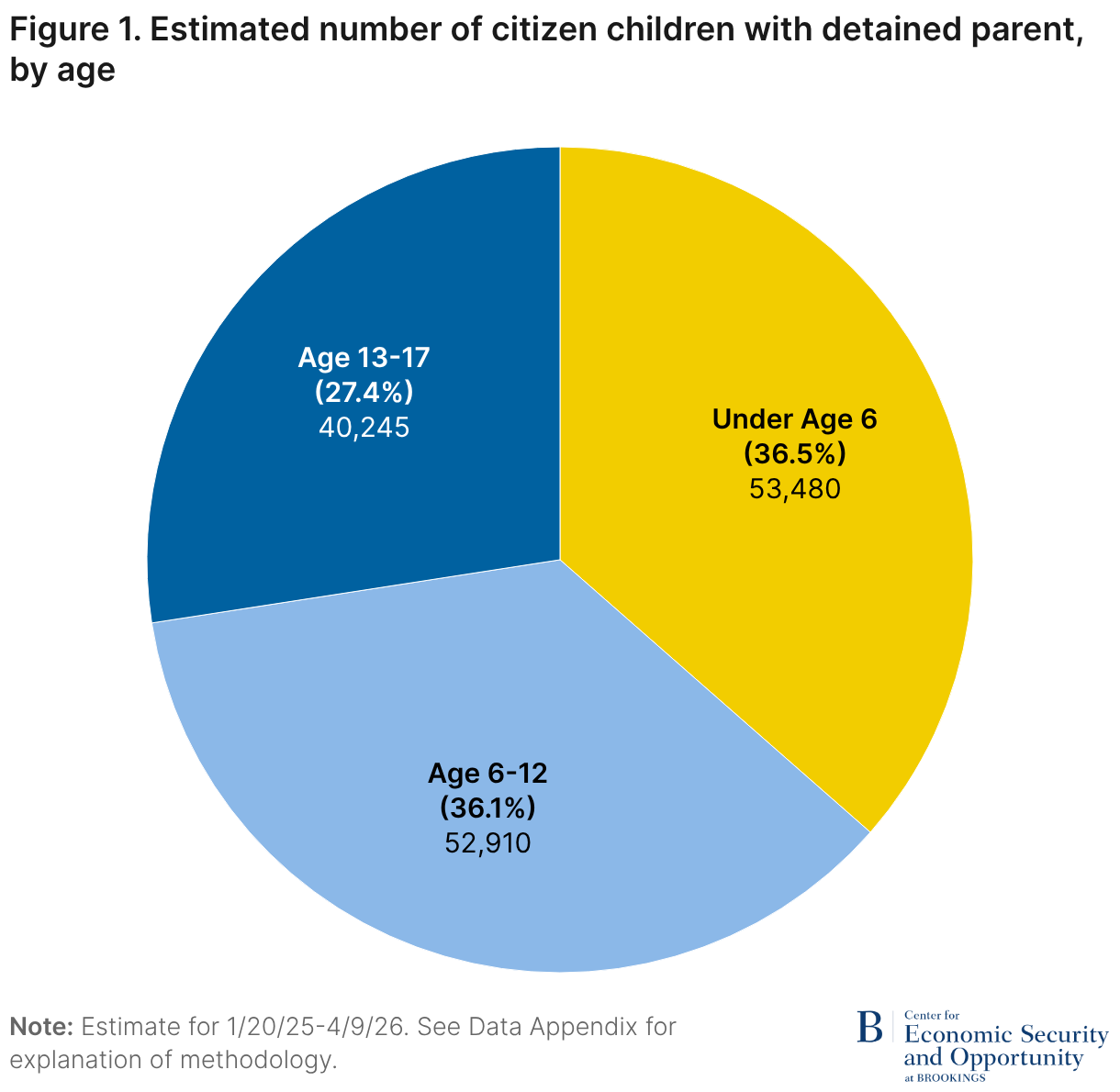
Figure 2 shows the country or region of origin of the detained parents. The largest share of citizen children (almost 54%) have a detained parent from Mexico, with substantial numbers having parents from Guatemala and Honduras (combined more than 25%).

Figure 3 uses place of arrest information to infer the likely state of residence of the affected children. Washington, D.C. and Texas have the highest share of U.S. citizen children with an affected parent, with more than 5 per 1000 facing a parental detention.

Where are the children now?
We know surprisingly little about what happens to children of detainees. Children who are themselves unauthorized may face detention or deportation, but most children of detainees are U.S. citizens. In some cases, the child may travel to the parent’s origin country with a deported parent, but the government does not publish systematic data on its transportation of U.S. citizen children to foreign countries and we do not know how commonly this happens.
Parents wishing their children to remain in the United States are encouraged by community partners to have a family preparedness plan, specifying a close friend or relative who will care for the child if the parent cannot. In many of these cases, the government is unaware of children left behind, and most parents prefer to avoid contact with the child welfare system even if they have only substandard care options.
Caregivers are sometimes able to access supports through the child welfare system. Sometimes supports may be available without a formal child welfare case being opened—e.g., when prevention resources are available. The child welfare system typically becomes more deeply involved only when a care arrangement becomes unsustainable or the abuse or neglect of a child comes to the attention of authorities. Some children, a small minority of those with detained parents, will end up in foster care. Even when a child welfare case is opened, or a child enters foster care, the case may not be identified or documented as immigration-related.
In our baseline scenario, we estimate around 22,000 citizen children are left without any parent in the home due to detention. We assume only 5%, or around 1,000, of these children have received services from the child welfare system. Based on interviews with community organizations and child welfare agencies, it appears that most children of detainees are living with family and friends or perhaps leaving the country, with child protection as a last resort.
The bottom line is that there is no systematic approach to protecting the children of those detained by ICE. ICE does not directly involve itself in safeguarding the well-being of a detainee’s children, and only refers to child protection if children are present at an arrest and no alternative care is immediately available. Parents also prefer to avoid engaging with child protective services, especially in a heightened enforcement environment when those in their caregiving networks may be at risk of apprehension. Child protection agencies likewise prefer to avoid engaging with families when there are no concerns about maltreatment, and some avoid collecting or documenting information that could identify children of detained parents for fear of exacerbating the child’s situation. Additionally, some child welfare agencies lack data systems capable of systematically identifying and tracking children who come to the attention of the child welfare system solely due to immigration enforcement-related family separation.
What next?
The number of citizen children facing the threat of family separation is much higher than the estimated ~145,000 who have experienced it during the administration so far. There are an estimated 13 million adults who are undocumented or have a liminal status with only partial protection. Their families include more than 4.6 million U.S. citizen children living with a parent who is at risk of deportation, including approximately 2.5 million children who, in a worst-case scenario, could face the detention of all parents in their household.
For both logistical and political reasons, the administration will not achieve its stated goal of removing every unauthorized immigrant from the United States. But hundreds of thousands of children are likely to be directly impacted by the current immigration enforcement policy. Policymakers must reckon with the fact that many children are left without one or both parents as the result of immigration enforcement, that this is unlikely to change in the near term, and that no government entity is responsible for their well-being.
At a minimum, DHS should collect and publicly report accurate data on the number of parents facing detention or deportation, as well as the number of U.S. citizen children who leave the country following a parent’s removal. The absence of consistent and comprehensive data obscures the true scale of children affected by immigration enforcement and undermines the ability of policymakers, service providers, and communities to adequately assess and respond to their needs.
Most children affected by parental detention and deportation are U.S. citizens. As immigration enforcement expands, ensuring that affected children have access to basic supports and protections should be understood not as optional, but as a necessary governmental responsibility tied to the foreseeable consequences of family separation and displacement. When we detain or deport a child’s parents, the nation has a clear obligation to recognize, account for, and safeguard the child’s well-being.
Related Content

2026
Authors



The Brookings Institution is committed to quality, independence, and impact.
We are supported by a diverse array of funders. In line with our values and policies, each Brookings publication represents the sole views of its author(s).