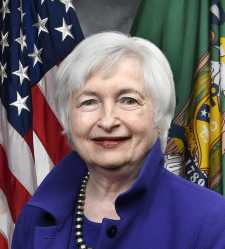
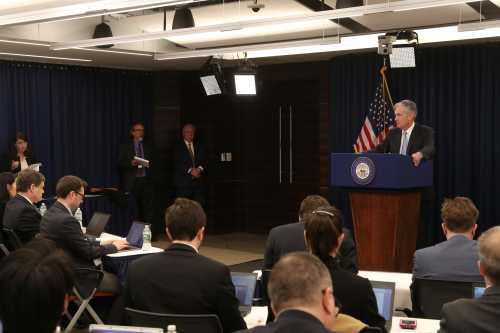
Janet L. Yellen gave these remarks at the Hutchins Center on Fiscal & Monetary Policy event, “The Powell years at the Fed: A retrospective,” on June 2, 2026. (Video of the event, including this speech, is available at that link.)
Thank you, David. You’ve organized a genuinely illuminating conference.
After an excellent paper from Christy and David Romer and two very interesting panels, let me conclude with a few lessons I draw from Jay Powell’s tenure, filtered through my own experience at the Fed and at Treasury. I should confess that it’s hard for me to be fully objective. I had the privilege of working with Jay for almost six years before he became chair, and of collaborating with him—always with respect for the separate roles of the Treasury and the Fed—during my four years at Treasury.
Jay Powell is a person of exceptional integrity and competence. He has served the American people with distinction under circumstances none of us fully anticipated. The continuing soundness of our financial system and the resilience of our economy owe no small debt to his leadership. His defense of Federal Reserve independence, as Christy and David said, has been heroic. I am grateful for his willingness to continue serving as a governor to help counter the threats that remain. I consider Powell’s performance as chair to have been extremely successful—and for that reason, an honest assessment of the lessons learned is all the more important.
I will offer three lessons, concerning monetary policy, financial stability, and Fed independence.
First lesson: Monetary policy cannot tame supply-driven inflation without exacting unacceptable unemployment costs. Looking through supply shocks should remain the default strategy unless inflation expectations are at genuine risk of becoming unanchored.
The 2021-2022 inflation episode has, deservedly, received considerable attention today. Economists widely agree that the Fed was late to raise rates. The FOMC waited until unemployment had declined well below all estimates of the natural rate, and labor markets were tighter still on alternative measures, such as the ratio of vacancies to unemployment. A chronically overheated labor market could ultimately have generated a wage-price spiral and unanchored inflation expectations. When the Fed finally responded, it did so aggressively and skillfully. Labor market pressures eased; no recession ensued; the unemployment rate has remained low; inflation expectations stayed anchored; and inflation fell sharply in 2023 as the supply shocks that drove the surge faded.
How serious, then, were the consequences of the Fed’s delay in tightening? Careful work by David Reifschneider, consistent with the findings of Bernanke and Blanchard that supply shocks or constraints, rather than wage pressures, were the main cause of the inflation, shows that a quicker or larger Fed response based on a variety of Taylor-type rules would have raised unemployment meaningfully while reducing inflation by only a few tenths of a percentage point. The Fed did need to tighten—but loose monetary policy did not cause the inflation, and tighter policy could not have meaningfully alleviated it without imposing a heavy unemployment toll.
So what is the lesson concerning the appropriate Fed response to supply shocks? For decades, the Fed has typically looked through supply shocks expected to cause a one-time movement in the price level, on the grounds that inflation expectations have been well anchored since the mid-1980s and the unemployment cost of fully offsetting such a shock would be unjustifiably high. Some are now calling that strategy into question. I am not. The moral I draw from this episode is that looking through supply shocks should remain the default strategy unless inflation expectations are at genuine risk of becoming unanchored—even when, as in 2021-2022, demand played some role in creating the shock by boosting prices in supply-constrained sectors. The real income losses the public suffers from supply-driven inflation are painful, but they are largely unavoidable. A careful welfare analysis does not support a more activist monetary policy response when expectations remain anchored.
Second lesson: Financial stability demands rapid, forceful responses to runs—but the deeper imperative is a supervisory culture willing to confront risks before they become crises.
The Fed was created in response to the Bank Panic of 1907 to stem bank runs. In recent years it has been called on to provide liquidity to systemic firms and markets on all too many occasions.
The COVID shock of March 2020 produced one of the most severe liquidity crises in modern financial history—arguably more acute in its initial velocity than 2008. Money market funds broke the buck or came close, Treasury markets became dysfunctional, corporate credit markets seized up, and the dollar funding system showed severe strain globally. Powell’s response was fast, decisive, and institutionally creative. The Fed deployed an extraordinary range of emergency facilities in a matter of days, extending its lender-of-last-resort function deep into nonbank markets. The willingness to act preemptively—before many of the facilities were even used—was itself stabilizing. This was Powell at his best as a crisis manager.
Powell responded with similar decisiveness to the collapse of Silicon Valley Bank (SVB) in March 2023—in most respects, an old-fashioned bank run accelerated by modern technology and social media. With large uninsured deposits across the banking system and many banks carrying significant unrealized mark-to-market losses, the potential for contagion was enormous. The Fed, in coordination with the FDIC and Treasury, rapidly invoked the systemic risk exception to provide full deposit insurance coverage. The Bank Term Funding Program, backstopped by Treasury’s Exchange Stabilization Fund, was an ingenious mechanism that allowed banks to borrow against securities at par rather than market value—directly addressing the specific vulnerability driving the panic. Contagion was contained; a broader banking crisis was averted.
The lesson is that the Fed under Powell demonstrated an impressive capacity to act quickly and aggressively to stem financial crises, and it devised ingenious and innovative tools to do so. But crisis management is not a substitute for prevention. Such episodes must become less frequent, and that requires strengthening both bank supervision and broader financial regulation to address the underlying vulnerabilities that cause runs in the first place.
Sound supervision is mostly invisible: It is the crisis that does not happen, the institution that does not fail, the vulnerability addressed before it becomes systemic. Those successes do not hold press conferences. That makes the culture of supervision—the willingness to push back, to escalate, to act in a timely way, to accept the discomfort of being unpopular with the supervised—all the more important. The Fed’s own post-mortem on SVB identified a supervisory culture in which the burden of proof for escalating concerns had drifted too high, in which examiners were reluctant to act against rapidly growing institutions, and in which formal findings did not reflect the actual risks being observed. My predecessor and our colleagues identified this same issue in our review of the 2008 crisis and took steps to address it. During both Trump terms the focus has instead been on financial deregulation and reduced supervisory intensity. The 2019 regulatory changes diminished the liquidity stress testing and interest rate risk scrutiny facing a bank the size of SVB. I worry that the continuing deregulatory push may be further undermining a culture that has not sustainably improved. These problems predate Powell, and they remain serious.
Third lesson: Fed independence is critical to good economic performance, and preserving it requires ongoing effort by the Fed and a broader coalition.
Jay Powell has borne relentless attacks for much of his tenure. They pertained first and foremost to interest rate decisions. Other chairs have also faced political pressure, albeit less publicly. But these attacks were broader. They were an attempt to redefine the Federal Reserve: to treat it as an executive agency whose policy should reflect the preferences of the sitting administration, rather than as an independent institution whose mandate is set by Congress and whose decisions are made on economic grounds. This conflict has already affected the conduct of bank supervision and regulation within the Fed and could ultimately affect monetary policy as well. Resisting it required a kind of steadiness that good monetary policy judgment alone does not provide. Jay Powell had that steadiness in abundance.
Powell’s response was, in my judgment, exemplary. He absorbed the criticism. He declined to respond to provocation with provocation. He built relationships with Congress—quietly, persistently—that created at least some political buffer. And critically, he did not allow political pressure to visibly distort the FOMC’s decisions. The temptation, when a central bank is under attack, is to demonstrate independence by tightening more than the data warrant; or forgoing cuts that are appropriate, as a signal of autonomy. That temptation should be resisted, and Powell resisted it. Genuine independence means doing what the data and the dual mandate require, regardless of political pressure in either direction. When the attacks crossed from criticism into direct institutional assault—the attempted firing of Governor Cook, the subpoenas, the threats of criminal investigation—he responded with precise, proportionate, and factually grounded pushback.
The broader lesson is that central bank independence requires continuous investment: in relationships with Congress, in clear public communication about why independence matters, and above all in conducting policy well enough that the institution’s credibility is its own best protection. It also requires a broader coalition—courts willing to uphold the legal foundations, members of Congress willing to defend an institution whose decisions they sometimes dislike, and economists, former officials, and informed citizens willing to speak clearly about what is at stake when monetary policy is subordinated to political will. The Fed cannot defend itself alone. What the past several years have demonstrated, in ways I find both alarming and ultimately somewhat reassuring, is that this broader coalition—imperfect and slow to mobilize as it is—exists, and it can be rallied.
Let me close with a thought about what we are really doing when we hold conferences like this one. The lessons we draw from the Powell era will shape how the next chair approaches the genuinely difficult decisions ahead—navigating an inflation not yet fully extinguished, a fiscal trajectory that raises fiscal dominance concerns, geopolitical disruptions that continue to generate supply shocks, and a political environment in which the Fed’s independence remains at risk. The best thing this conference can contribute to that future is exactly what it has done today: rigorous, honest, good-faith analysis of what worked, what did not, and why.
Powell has left the Fed sound. He has left it independent. He has left the economy, despite everything, in better condition than the challenges he inherited might have led us to fear. Those three sentences are not trivial. Together, they constitute a record worthy of this retrospective—and of our deep and genuine gratitude.
Author
Related Content
2026
The Brookings Institution is committed to quality, independence, and impact.
We are supported by a diverse array of funders. In line with our values and policies, each Brookings publication represents the sole views of its author(s).
Commentary
Remarks by Janet L. Yellen at “The Powell years at the Fed: A retrospective”
June 2, 2026