The most important social welfare program in the United States faces imminent insolvency. Social Security has promised more benefits than workers have paid for since the program’s inception during the Great Depression. As highlighted by this week’s release of the 2026 Social Security Trustees Report, absent congressional action, the Social Security Old-Age, Survivors, and Disability Insurance Trust Fund (OASDI) will be depleted in 2034. At that point, without congressional action, benefits for retirees and their dependents and survivors cannot exceed incoming revenue, and benefits would need to be cut by 17% or its equivalent across the board.1
The storyline of congressional inaction may sound familiar, but the policy problem is getting worse. Not only have policymakers largely failed to engage with the problem, Congress and the president have recently enacted laws and pursued policies that worsen the program’s financial status. Absent imminent crisis, recent presidents and lawmakers have had little incentive to address Social Security’s long-term fiscal deficit. With insolvency looming, policymakers might actually welcome a crisis to force their hands to forge a fix for Social Security. But a real, durable solution will require painstaking work to reach a consensus among policymakers and buy-in from the public.
Financial problems highlighted by the 2026 Trustees Report are not new
As shown in figure 1a, the Social Security Board of Trustees has been warning that the trust fund would be depleted over the 2030s for some time. From 1994-1997, the Trustees projected that the trust fund would be depleted in 2030 or earlier. And while changes in the data and modeling assumptions have moved the forecast around, since 2009 the Trustees have consistently projected depletion before 2040.


The Trustees, including cabinet members of both political parties, have repeatedly advocated for timely reforms of Social Security’s finances. As they wrote in the 2000 Trustees Report, “It is important to address both the OASI and DI problems well before any necessary changes take effect, to allow time for phasing in such changes and for workers to adjust their retirement plans to take account of those changes.”
Figure 1b illustrates the consequences of inaction. The financial shortfall of the program has grown over time, as measured by the 75-year actuarial balance of the OASDI Trust Fund. This amount shows the difference between the income rate and the cost rate of the program over a 75-year window as a share of the taxable payroll used to fund benefits. In 2000, when the Trustees issued that call for reform, the actuarial deficit was 1.89% of taxable payroll. That amount has more than doubled to 4.42% today, meaning that the size of the reform needed to keep the program financially sound over the next 75 years has also doubled as a share of the tax base used to fund the program.
Policymakers have dragged their feet for decades
On the heels of the 1977 reforms that prioritized increasing the tax rate and taxable wage basis, Congress and the president in 1983 enacted cuts for both current and future beneficiaries, restoring trust fund solvency for decades. Congress was perhaps a victim of its own success: Few lawmakers felt the need to impose pain again to extend the fund’s solvency.
What’s more, when some presidents made serious efforts to put reform back on the agenda, lawmakers largely refused to engage. In his 1999 State of the Union, President Clinton, during a time of federal budget surplus, proposed a sovereign wealth fund in which a share of the budget surpluses would be set aside for future Social Security. This represented an effort to increase national saving rather than budget surpluses or lower taxes. In his 2005 State of the Union, President Bush proposed voluntary personal retirement accounts, where part of younger workers’ Social Security contributions would be diverted to a personal account and invested, to be paired with other reforms to improve solvency. Both acknowledged the need to address Social Security’s long-term financial challenges; Congress refused to bite.
By President Obama’s administration, momentum to address Social Security’s finances stalled with the prolonged economic downturn triggered by the financial crisis. For the first time, general revenue transfers were used to plug a sizeable gap in Social Security’s finances. These transfers were used to offset lost payroll tax revenue when Congress lowered employees’ payroll taxes by two percentage points in 2011 and 2012 as a means to stimulate the economy – just as the first members of the baby boom generation were reaching age 65.
Although the measures were temporary, the use of general fund transfers marked a willingness by policymakers to finance obligations outside the program, avoiding imposing direct, visible costs on constituents by raising future payroll taxes or cutting future benefits after the holiday expired. The move also further pushed the costs of reform, as well as how to achieve it, to future generations. While Obama supported the payroll tax holidays, he also later proposed reducing benefits by limiting inflation indexing of benefits. If adopted, such changes would have slightly improved trust fund solvency.
That was the last time a sitting president wrestled with the hard choices of financing Social Security in the long term. In their own State of the Union addresses, President Trump vowed to “always protect your Social Security,” while President Biden said that Social Security was “not to be touched.”
Both presidents then went a step further: They supported congressional efforts to weaken Social Security’s finances even as insolvency moved closer. Biden signed the bipartisan Social Security Fairness Act, which increased benefits for some retirees and surviving spouses but raised no new revenues. On the heels of Trump’s 2024 campaign promise to eliminate the tax on Social Security benefits, Republicans’ “One Big Beautiful Bill” increased the standard deduction for senior citizens, lowering but not eliminating the tax on Social Security benefits.
Few electoral incentives for Congress to engage… yet
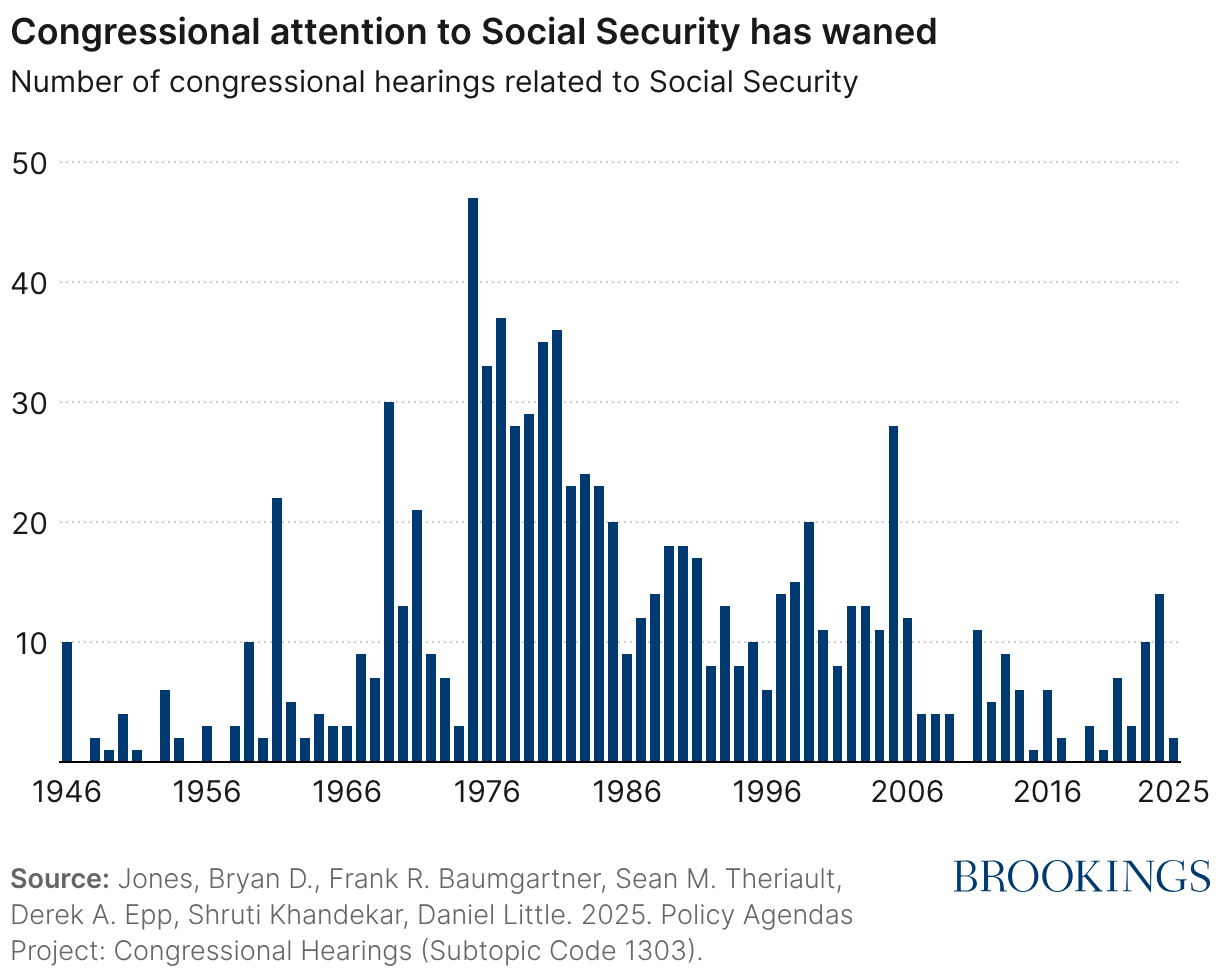
One might expect Congress to pay more attention to the problem as the depletion date nears. As shown in figure 2, however, the number of congressional hearings focused on Social Security has declined: Since President Bush’s reform attempt in the early 2000s, there has been little interest on Capitol Hill, save for a brief flurry in the lead up to passing the Social Security Fairness Act in December 2024. Last year, however, lawmakers held only two Social Security-related hearings, a clear sign of disengagement.
Why so little attention?
First, following political scientist David Mayhew’s seminal work, members of Congress are first and foremost “single-minded seekers of re-election.” No matter what other goals lawmakers hold, they must get re-elected to pursue them. That makes lawmakers loath to take unpopular positions—including casting votes that would impose visible, immediate pain on constituents. It also likely dissuades lawmakers from developing policy expertise in potential reforms. In short, only a solvency crisis seems likely to compel lawmakers and their leaders to impose costs today to protect future beneficiaries.
Second, rising partisanship and exceedingly slim majorities have made it harder (albeit not impossible) to build bipartisan majorities to solve salient public problems. As a result, fixing Social Security without a crisis has become even less likely. Crises typically focus political minds on Capitol Hill and can propel both parties to the bargaining table, lest one party shoulder the blame for “losing” Social Security.
Third, lawmakers have faced little public pressure to act. Like Congress, voters are also disengaged and have significant knowledge gaps about the program. According to Gallup, only about half of non-retirees in 2023 believed they will get a Social Security benefit at retirement, even though most or all beneficiaries would still receive about 80% of promised benefits under the worst-case scenario that benefits are cut across the board when the trust fund is depleted. At the same time, around 80% said it would be a major or minor source of income for them in retirement, showing inconsistency in their beliefs about the program.
If anything, voters have become less informed about Social Security over time. A Harris Poll found that the share of adults who know that Social Security provides benefits for spouses or children, or for divorced adults based on their ex-spouse’s records, fell by over 10 percentage points between 2015 and 2024. Still, Americans do express concern about Social Security’s future, with nearly three-quarters of Gallup poll respondents saying they worry about Social Security “a great deal” or “a fair amount,” which indicates an understanding that something must be done.
How can policymakers move forward?
While the combined OASDI Trust Fund has enough funds to pay benefits into 2034, the separate OASI Trust Fund financing benefits for retirees and survivors and dependents will be depleted in 2032, with incoming revenue sufficient to only cover 78% of benefits. Therefore, senators elected in the 2026 election cycle will need to vote on Social Security reforms in their upcoming 6-year term or stand by and watch benefits be cut by 22%. But there is little sign that would-be senators are paying any attention to the program. Few candidate websites mention the program’s financial difficulties, and only 7 out of 56 candidates describe their policy stance on improving Social Security’s finances. As the first people elected who will be required to fix Social Security, this election season would be a good time to put reform on the agenda to force candidates to engage and to raise public awareness.
We suggest three sets of questions that policymakers should answer – and to which the public should demand responses:
- What should the goal of the Social Security program be? Candidates should explain what they think Social Security as a program should achieve in the coming decades. For example, do they envisage it as primarily a mechanism to partly replace earnings during retirement? Should it predominantly serve a social insurance function that provides a cushion against risks that cause hardship at older ages? Or is its main purpose to prevent poverty? These three different visions give rise to different program design and different approaches to addressing insolvency.
- How should the burden be spread across and within generations? Previous and current beneficiaries received more in benefits than they paid in taxes; that is a debt they cannot pay back, and is the source of Social Security’s financial problems. Whether the debt is paid back through increases in revenue or reductions in benefits has important implications for current and future generations. This year’s Trustees Report projects that the future population will be smaller, thanks to lower birth rates and lower immigration. If these projections materialize, the burden of paying back legacy debt will be more difficult for future generations with fewer people over whom to spread it – another factor to be considered in the timing and structure of reforms.
- What will ensure durable and bipartisan reforms? Consensus on a reform package has eluded policymakers for the last thirty years, and both presidential leadership and bipartisan commissions have failed to deliver reform. Since Social Security legislation requires 60 votes in the Senate, any reform package must be bipartisan. This is much more likely to occur if policymakers do not put themselves in a box by ruling out different types of reforms. Lawmakers should avoid a short-term patch that merely delays reform, such as relying on general revenue transfers. While that would be the easiest fix politically, kicking the can down the road is unfair to future generations. Not only would future generations have to bear the entire burden of paying for the reform, they would also face the uncertainty that stems from planning their own futures without knowing what kind of program they can rely on when they need it.
Related Content


Authors



-
Footnotes
- Social Security actually has two trust funds, the Old Age and Survivors Insurance (OASI) Trust Fund, which finances benefits for older Americans, their survivors, and their dependents, and the Disability Insurance (DI) Trust Fund, which finances benefits for disabled workers. Although the trust funds are separate, their finances are often described together in a combined OASDI Trust Fund. Congress has in the past reallocated tax revenue between the two trust funds when one trust fund has approached insolvency. Currently, the OASI Trust Fund is projected to be depleted first, in the fourth quarter of 2032. At that point, incoming revenue would be sufficient to pay 78% of scheduled OASI benefits.
The Brookings Institution is committed to quality, independence, and impact.
We are supported by a diverse array of funders. In line with our values and policies, each Brookings publication represents the sole views of its author(s).



Commentary
Moving backwards on Social Security reform
June 10, 2026