
Summary
The shift from traditional pensions to individual savings accounts profoundly changed the retirement experience of most Americans. Under traditional pensions, retirees received ongoing fixed annuity payments from their plan that they knew would continue through the rest of their lives and their spouse’s. Most retirement savings accounts, by comparison, do not ensure or even offer guaranteed lifetime income payments: retirees know how much is currently in their account but not how much of it they can spend each month without risk of running out. This shift has led to a sharp decline in the portion of retirees that receive any lifetime retirement income other than Social Security.
Despite multiple U.S. government policies to increase the availability and use of guaranteed lifetime income in the now-dominant defined contribution system, its use remains low and appears to be declining. Even when Social Security is taken into account, we show that the share of retirement income carrying a lifetime guarantee is declining among individuals age 65 and older. Our analysis from the Health and Retirement Study (HRS) reveals that guaranteed lifetime income from all sources (Social Security, defined benefit pensions, and private annuities) accounted for just over half of total income for Americans age 65 and older in the early 2000s, but that share had declined to approximately 43% by 2022. Private annuities play a minimal role, with only about 6% of older Americans receiving any income from this source.
Economic analysis and survey research suggests that many retirees would benefit from annuitizing at least a portion of their retirement savings. Retirees and prospective retirees consistently report a preference for a dependable lifetime paycheck in retirement, and concern about longevity risk — the fear of running of outliving your assets in old age — remains widespread. Researchers have found that retirees with guaranteed lifetime income maintain higher spending levels and greater satisfaction throughout retirement compared to those relying solely on withdrawals from savings accounts. Yet few are offered a chance to purchase guaranteed lifetime income annuities at institutional rates and few of those that have the option choose them, creating what economists call the “annuity puzzle.”
We explore many factors that contribute to the lack of low annuitization rates. While preferences and rational explanations could explain part of low annuitization rates, we find considerable support for both institutional barriers that prevent employers from offering such options and behavioral biases that result in few retirees choosing an annuity when one is available. For example, Federal regulations concerning employer-sponsored plans have imposed heavier burdens on offering such plans relative to other options, so relatively few employers offer an annuity option. In addition, there is also extensive research that decisions to annuitize are affected by behavioral biases, lack of information or trust, or reluctance to undertake the complex decision making involved when choosing among the details of varied guaranteed income products. These findings suggest that many retirees would benefit from more guaranteed lifetime income, even though they do not individually undertake the effort to select and purchase it.
Federal policies have for decades attempted to encourage the inclusion of lifetime income options in defined contribution plans. The Pension Protection Act of 2006, the SECURE Act of 2019, and SECURE 2.0 of 2022 all represent bipartisan legislative efforts that included provisions designed to facilitate annuity offerings in workplace retirement plans. However, their impact has been limited: fewer than 10% of plans offer in-plan annuities, and uptake among participants who have access remains minimal.
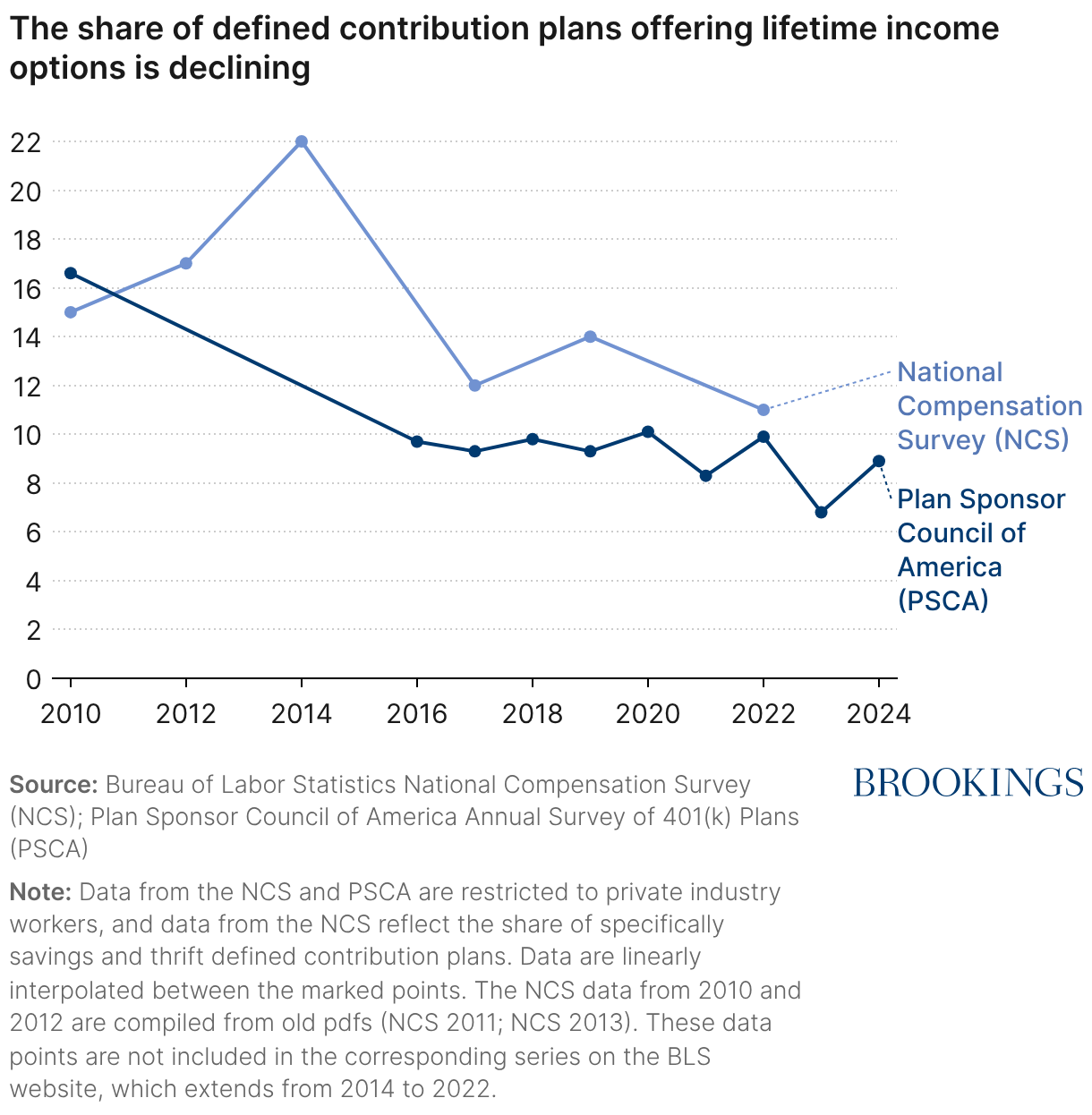
For policies to significantly increase the adoption of lifetime income, they must effectively address the institutional factors preventing employers from offering annuity options and the many frictions in decision-making that result in people not choosing them even when they are offered. This could be achieved by:
- Elimination of employer liability for including annuities in retirement plans, combined with alternative effective measures to control costs and provide protection for retirees; and
- Inclusion of annuities in default investment options, combined with ways to preserve retiree flexibility.
Higher rates of annuitization could meaningfully impact the well-being of older adults by providing additional security against the risk of outliving one’s assets and reducing rates of poverty among widows.
Related Content



Authors




-
Acknowledgements and disclosures
We are grateful to the following individuals for their comments and insights: Jason Fichtner, Michael Finke, William Gale, J. Mark Iwry, Michael Kreps, Olivia S. Mitchell, Nick Nefouse, Cassandra Roth, Norman Stein, Andrew Stumacher, Tamiko Toland, Gareth Turner. All errors are our own.
The Brookings Institution is committed to quality, independence, and impact.
We are supported by a diverse array of funders. In line with our values and policies, each Brookings publication represents the sole views of its author(s).