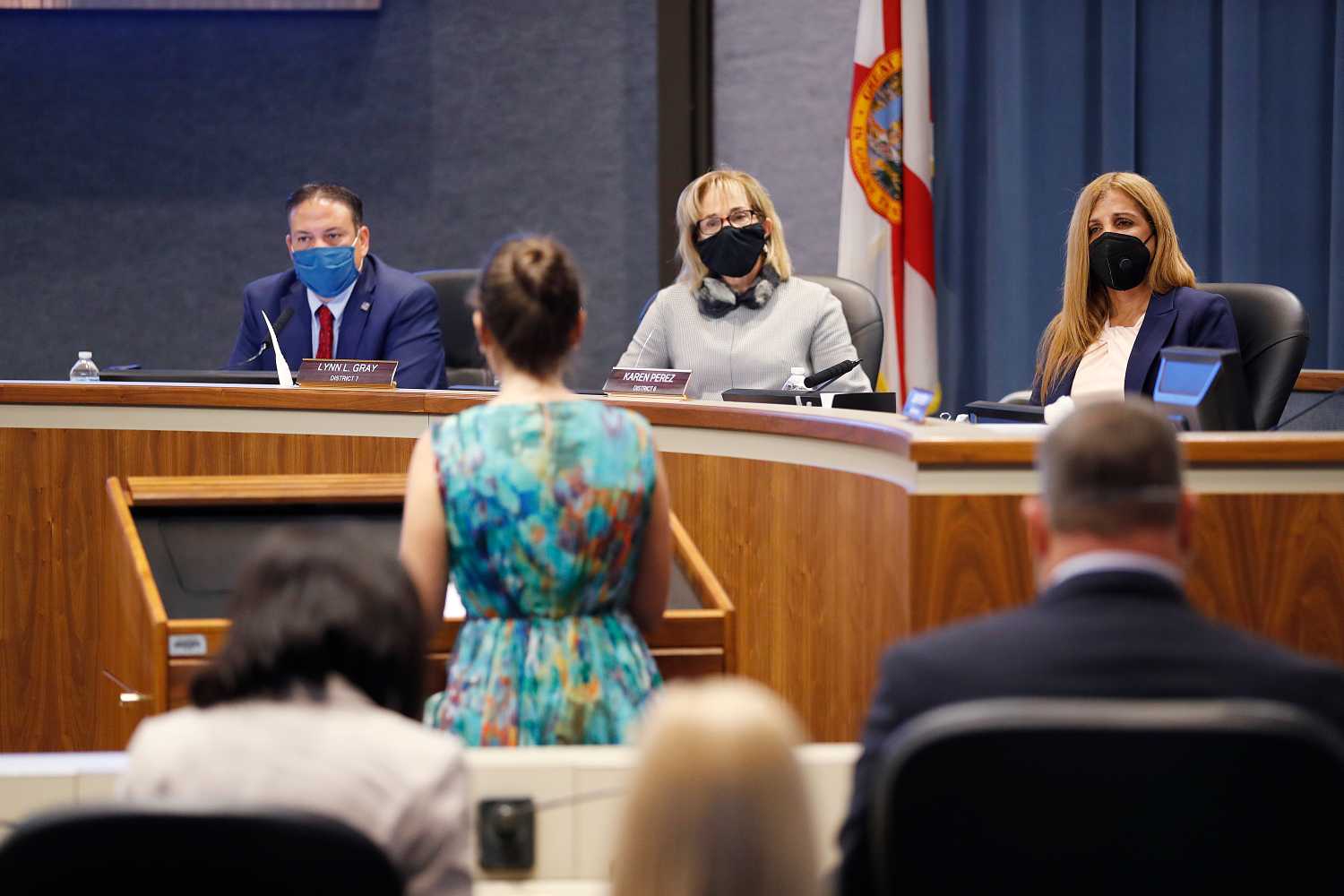
Here, we describe notable findings from each section of the school board member survey. This summary does not cover every item. For the complete set of results, we encourage readers to review the survey results tables.
We report survey results with and without enrollment weights. In sections where we are primarily interested in reporting on board members’ views and experiences, we highlight results without enrollment weights. These estimates give equal weight to all school districts, and we interpret them as nationally representative of school board members.1
In sections where we are primarily interested in learning about the communities or settings where students learn, we use results with enrollment weights. These estimates give equal weight to all U.S. public school students (e.g., more weight to large districts than small districts).
Additional information about the weighting strategy is available in the methodological appendix. The survey tables contain results with and without enrollment weights. These tables include some items that are not discussed in this brief report.
Demographics and background
We begin by examining who serves on U.S. school boards—and how the characteristics of school board members compare to the characteristics of the students and communities they serve.
We present the results in this section both with and without enrollment weights. This is because each set of results is useful for answering certain questions. Estimates without enrollment weights are designed to facilitate statements such as, “4% of U.S. school board members are Black.” Estimates with enrollment weights are designed to facilitate statements such as, “On average, public school students are represented by a board that is 13% Black.”2
Table 1 compares the demographic profile of our survey respondents—with and without enrollment weights—to profiles of the general population and public school student population. The table contains four columns:
- “Students” shows data on the public school student population from the National Center for Education Statistics. Data on students are available for some characteristics (e.g., race/ethnicity) but not others (e.g., political orientation).
- “U.S. population” shows data on the entire population for certain characteristics (gender and race/ethnicity) and the adult population for others (LGBTQ+ identification, age, education, household income, and political orientation). These data come from various sources, including Gallup and the U.S. Census Bureau.
- “Board members (no enrollment weights)” shows survey responses without applying enrollment weights. These results give equal weight to districts regardless of their student enrollment.
- “Board members (enrollment weights)” shows survey responses after applying enrollment weights. These results give more weight to districts that enroll more students.
Board members are disproportionately female.
We estimate that 54% of U.S. board members are female. This comes from models without enrollment weights. This is larger than the female share of the U.S. population and the public school student population.
We also find that, on average, U.S. students are represented by school boards that are 63% female. This estimate comes from models with enrollment weights. It is larger than the unweighted estimate, which suggests that high-enrollment districts tend to have a larger share of female board members than low-enrollment districts.
Board members are less likely to identify as LGBTQ+ than U.S. adults.
Regardless of whether we apply enrollment weights, we find that relatively few board members identify as LGBTQ+. We estimate the share to be less than 4%, which is well below the 9% that Gallup estimates for U.S. adults. It is also well below the share of U.S. students and teachers who identify as LGBTQ+.
Board members are (much) older than the U.S. adult population.
Regardless of whether we apply enrollment weights, we find that board members are considerably older than U.S. adults—and very unlikely to be younger than 35 years old. For example, without enrollment weights, we find that half (50%) of board members are 55 or older, while only 2% are under 35. In contrast, 39% of the adult population is 55 or older, while 44% of U.S. adults are under 35.
Board members are disproportionately white. However, the average public school student is represented by a board that is racially and ethnically representative of the adult population.
Turning to race and ethnicity, we see how different weighting approaches can lead to different conclusions. The U.S. population is about 58% white, 19% Latino, and 12% Black, with the remaining 11% identifying as another race or ethnicity. When we look at our estimates with enrollment weights, we find a similar profile. That is, on average, public school students are represented by board members who are 62% white, 18% Latino, 13% Black, and 6% other race. This suggests that school board members roughly mirror the racial demographics of the communities they represent. In contrast, without enrollment weights, we estimate that 83% of board members are white, 6% are Latino, and 4% are Black. This pattern arises from a disproportionately large share of white school board members coming from small districts with low student enrollment (as seen in Q4 of the survey results tables).
This is not the only source of complexity in assessing demographic representation. As seen in Table 1, the racial demographics of public school students differ from the demographics of the general population. Public school students skew more Latino and less white than the general population.3 This means that school board members are not racially or ethnically representative of the public school student population regardless of whether we apply enrollment weights.
Board members come from higher-income households than most U.S. adults—and have higher levels of educational attainment.
Two other patterns are clear whether we look at results with or without enrollment weights.
First, board members come from relatively high-income households. For example, 29% of members come from households earning more than $200,000 per year, compared to only 13% of the adult population. They are also much less likely than the adult population to come from households with incomes below $50,000.
Second, board members have very high levels of educational attainment. A little more than half (52%) of board members have a graduate degree, and roughly another one-quarter (28%) have a bachelor’s degree. These rates far exceed the corresponding percentages for U.S. adults (14% and 21%, respectively).
Roughly equal shares of school board members identify as politically moderate, conservative, and liberal. However, the average public school student is represented by a board that leans more liberal than the U.S. population.
The last section of Table 1 provides self-reported information about political orientation. We estimate that 35% of U.S. board members identify as moderate, 32% as conservative, and 31% as liberal. These estimates come from models without enrollment weights.
When we incorporate enrollment weights, we find different patterns. The average public school student is represented by a board that leans to the left of the U.S. population (37% liberal, 38% moderate, and 24% conservative). This suggests that large districts tend to have more liberal board members than small districts—likely because small districts are disproportionately concentrated in rural areas that lean Republican.
Nationally, the vast majority of board members have children or grandchildren, about one-third have worked as a teacher, and less than two-thirds have full-time jobs.
Along with asking about demographic characteristics, we asked about board members’ family background and employment status. Figure 1 illustrates the findings. Here, we describe results without enrollment weights.
A large majority (93%) of board members have at least one child of their own. However, only about half (43%) have at least one child currently enrolled in grades pre-K to 12. Of those with school-age children, most enroll their children in the district where they serve.
More than one-third (36%) of board members have at least one grandchild of their own. Many of these grandchildren are in grades pre-K to 12. However, the grandchildren of board members are less concentrated in their grandparents’ school districts (relative to the children of board members).
Finally, we estimate that 58% of board members have a full-time job, 10% have a part-time job, and 28% are retired. Many board members have experience working as a teacher: 7% currently and another 25% in the past.
Readers can find the full set of results in the survey tables. This includes results for some items not discussed in this summary (e.g., the share of board members who were born outside the U.S. or speak a language other than English at home). Additionally, the Fordham Institute recently released a detailed report that focuses on the representativeness of school board members.
Experiences as a candidate and board member
The second set of items examines board members’ experiences running for and serving in office. It focuses on what it takes to get elected, how much time members put into their board work, whether they plan to seek another term, and what reasons they have for wanting—or not wanting—to stay on the board.
In this section, we emphasize the results without enrollment weights to show the perspectives of a nationally representative sample of board members.
Nationally, most board members report relatively easy electoral victories, though members in large districts report having more challenging races.
Most board members in this sample were last elected (or reelected) to office between 2022 and 2024. Two-thirds of the sample (67%) report their last victory was “Very easy” or “Somewhat easy,” while only 17% report it was “Very difficult” or “Somewhat difficult.” However, the responses to this item vary by the size of the district where board members serve. Members representing large districts were much more likely than members representing small districts to say their races were very or somewhat difficult (32% versus 7%, respectively). This is consistent with research showing that large, urban districts are more likely than other districts to have contested elections.
Board members in large districts spend considerably more money on campaigns than members in small districts.
We also see sharp differences between large and small districts in the amount of money spent on school board campaigns. This includes money from the candidates themselves and their campaign committees. In small districts, most candidates (67%) report spending less than $100 on their most recent campaign. In contrast, in larger districts, most candidates (55%) report spending more than $5,000. These findings appear in Figure 2.
Board members in large districts spend more time on board service.
Differences between large and small districts extend to board members’ experiences in office. A large share of board members serving in large districts (30%) report spending at least 40 hours per month on board-related work. This far exceeds the share in small districts reporting the same workload (3%). More generally, few board members report putting in hours that approach the hours of a full-time job—though, in fairness, few are paid an amount that resembles a full-time salary, even in most of the nation’s largest school districts.
About half of board members plan to pursue another term, one-quarter do not plan to pursue another term, and the remaining quarter are undecided.
We asked board members whether they intend to pursue another term on the school board—and why or why not. Figure 3 shows that about half (52%) of members said “Yes, definitely” or “Yes, probably.” More than one-quarter (27%) said “Maybe.” The remaining 21% said “No, probably not” or “No, definitely not.” In general, the responses to this question look similar across different types of school districts.
Board members who plan to run again cite a belief that they are making a positive impact, while those who do not plan to run again report a wide variety of reasons.
Board members who said they are likely to pursue another term were asked to select all that apply from a list of possible reasons why. Their responses appear in Figure 4. The most common response—both overall (88%) and for every school district subgroup—is “I believe I’m making a positive impact.” Next, at 77%, is “Being on the board allows me to represent my community,” followed (at 71%) by “I enjoy being on the school board.” In contrast, the least commonly selected reason, at only 5%, is “I enjoy running in school board elections.”
Board members who said they are unlikely to pursue another term were asked to select all that apply from a list of possible reasons why they would not (Figure 5). The most common response, at just 39%, was “Other.” Write-in responses indicate a wide range of other reasons, with many noting their age (e.g., “My age, 79 when term expires”), health (“Medical issues”), or retirement plans (e.g., “I want more time to enjoy retirement”). Of the provided options, the most selected was “Time constraints / Too busy” (34%) followed by “I accomplished what I set out to” (20%). The distaste for board elections ranks fifth for all board members. It was especially common for members in large school districts.
School board politics
This section of the survey explores the politics of school board elections and governance. It includes questions about party labels on election ballots, factions within school boards, and the level of conflict that board members experience with various stakeholders.
In this section, we emphasize the results without enrollment weights to show the perspectives of a nationally representative sample of board members.
Few board members participate in elections where candidates’ party labels appear on the ballot, but political parties engage in other ways in school board elections.
Whether to display school board candidates’ party affiliations on election ballots has been a subject of debate and, on occasion, state referendum. Most states have laws that prohibit party affiliations from appearing on election ballots. However, a few states allow or require districts to hold formally partisan elections.
Our survey responses indicate that only 12% of board members are in districts where board members’ party affiliations appear on the ballot. Another 19% report that party labels do not appear on the ballot but that “parties are involved (e.g., endorse candidates).” This type of informal party involvement is especially common in large and urban districts.
School board members are strongly opposed to candidates’ party labels appearing on the ballot.
After asking about whether candidates’ party labels appear on the ballot, we asked board members for their opinions on that practice (Figure 6). We found overwhelming opposition to party affiliations appearing on the ballot: 74% opposed the idea (64% strongly, 10% somewhat) and 11% supported it (7% strongly, 4% somewhat). This opposition is evident across district types and candidates’ own political orientation.
The one exception is that we found mixed feelings from board members in districts with partisan elections. Still, 30% of these board members oppose party labels even though many (if not all) of these members were elected with labels on the ballot.
Most board members support on-cycle elections held at the same time as higher-profile elections.
We asked for opinions on another debate surrounding school board elections: whether elections should be “on cycle” to coincide with national or statewide races. Proponents of on-cycle school board elections point to higher voter turnout and voters who are more representative of their broader communities.
We find that most (60%) board members support on-cycle elections (47% strongly, 13% somewhat). Less than one-fifth (18%) oppose the idea (10% strongly, 8% somewhat).4 These patterns are similar across district types and candidates’ political ideology. In fact, even in districts with off-cycle elections, about half of board members would like to see elections moved on cycle (Figure 7).
More than one-third of school board members report factions on their board, and a majority of students are in districts where board members report factions.
The survey included two items about the presence of factions on school boards, where certain groups of members tend to side against one another for important decisions.
About 38% of school board members said “Yes” (15%) or “To some extent” (23%) when asked if their board is divided into factions. Factions are especially common in larger districts. As a result, enrollment-weighted responses indicate that most public school students are in districts where board members answered “Yes” or “To some extent.”
Board members reported that the most common dividing lines are political party or orientation. These results appear in Figure 8.
Most board members report at least some conflict with community members and parents in the past year, with members in larger districts reporting more conflict.
The final items in this section asked board members about the amount of conflict their board experienced with various stakeholders over the last year. Conflicts with community members and parents were most common. About 37% of board members reported at least some conflict with community members (13% “A lot,” 24% “Some”), and 37% reported at least some conflict with parents (9% “A lot,” 28% “Some”). Again, we see differences between large and small districts. Board members in large districts were more likely to report conflicts—in particular, with members of their community (26% “A lot,” 28% “Some”).
We also asked about conflicts with several other groups: state officials, students, superintendents, and teachers (or their unions), along with intra-board conflicts. Among these, the most common types of other conflicts reported were intra-board conflicts between members (11% “A lot,” 14% “Some”) and conflicts with teachers or their unions (7% “A lot,” 15% “Some”). Here, too, these conflicts were more commonly reported by board members in large districts.
In Part VI, we discuss results that focus on conflicts that arose in response to the COVID-19 pandemic and culture-war battles over race, gender, and sexuality.
Evaluations of local and national public schools
As part of this survey, we asked board members to assign a letter grade to the performance of public schools in their district and public schools across the United States. We also asked about their optimism or pessimism for the future of their local schools and U.S. public education more broadly.
Here, we emphasize the results without enrollment weights to show the perspectives of a nationally representative sample of board members.
Board members give better grades to public schools in their district than public schools across the country, but only about one-quarter of board members give their own district an “A.”
For decades, researchers have asked the American public to rate the performance of public schools using a school letter grade scale (A, B, C, D, or F). Two trends have emerged. First, Americans rate their local schools more favorably than schools across the country. This pattern is evident among both the general public and teachers. Second, Americans’ ratings of schools—especially schools across the country—have declined sharply over the last decade. Much of this drop is attributable to changes in Republicans’ views of U.S. schools.
We asked board members to assign a grade of A, B, C, D, or F to schools in their district and schools across the country. The results appear in Figure 9.
Consistent with surveys of other stakeholders, we find that board members judge their local schools more favorably than schools across the country. About one-quarter (25%) of board members give their local schools an A and about half (47%) give their schools a B. The remaining share give their schools a C (22%), D (6%), or F (1%). Board members who identify as conservative rate their schools slightly more harshly than liberal or moderate members—though a majority of conservative members still give their schools a favorable grade (64% of conservative members give their schools an A or B; 79% of liberals and 75% of moderates do the same).
When asked about the nation’s schools, we see lower marks across the board. Hardly any board members (1%) give an A, one-quarter (23%) give a B, half (55%) give a C, and the rest give a D (16%) or F (5%). Conservative board members give the nation’s public schools especially low marks. For example, 38% of conservatives give public schools across the country a D or F. This far exceeds the corresponding numbers for liberals (12%) and moderates (11%).5
Board members are generally optimistic about the future of public schools in their district but pessimistic about the future of public schools across the country.
Looking to board members’ assessments of the future, we again see that they are more positive about their districts’ schools than public schools nationwide. These results appear in Figure 10.
When asked about local schools, four-fifths report being “Very optimistic” (38%) or “Somewhat optimistic” (41%). Few are “Very pessimistic” (2%) or “Somewhat pessimistic” (10%).
Board members are not nearly as optimistic about the future of U.S. public schools. Fewer than half are “Very optimistic” (7%) or “Somewhat optimistic” (33%), and a similar share are “Very pessimistic” (9%) or “Somewhat pessimistic” (30%).
Stakeholders’ priorities
For the next set of items, we asked board members to identify what they and their constituents believe are the most important issues for the school board to address. We asked, specifically, about their own highest priorities, the highest priorities of their community as a whole, and the highest priorities of the most vocal members of their community. We also asked which issues consume the largest share of board members’ time. Respondents could select up to three issues from a list of topics provided (along with options for selecting “Other,” “None,” or “I don’t know”). The questions were identical except where the text specified the group about which it asked (e.g., the community as a whole or the most vocal members of the community).
Unlike previous sections, this part focuses on results with enrollment weights. That is because these responses can inform us about the settings and communities where U.S. students learn. They offer information about the stakeholder priorities that might shape students’ experiences. Therefore, in this section, we prioritize the results that give equal weight to each student, not to each school district or board member. (Readers can see the results without enrollment weights in the results tables or by clicking the “No enrollment weights” button in the figures.)
Figure 11 depicts the results for all four questions from this section.
The largest share of students are represented by board members whose top priorities are: academics, safety, curriculum, teachers, and student mental health.
With enrollment weights, we find that the largest share of students are represented by board members whose top priorities are post-COVID academic recovery (43%), safety (37%), curriculum and course offerings (32%), teacher staffing (31%), and student mental health (26%).
Similarly, we find that half (50%) of students are in a district where board members report that safety is one of their community’s top three priorities. This is followed by: post-COVID academic recovery (35%), teacher staffing (33%), student mental health (30%), and curriculum and course offerings (25%).
The most vocal community members may be more likely to emphasize culture-war issues.
We asked separately about the “most vocal members of your community” to assess whether board members believe the loudest voices they hear are representative of their broader communities (with respect to which issues they would like their school boards to address).
The results show both similarities and differences. The top issues for vocal community members are similar to what we see for the community as a whole. Farther down the list, however, differences arise from two topics that have been prominent in culture-war conflicts: LGBTQ+ rights and racial equity. Specifically, many students are in districts where the most vocal community members are focused on (1) restricting LGBTQ+ access and visibility and (2) restricting DEI and critical race theory. We did not observe this pattern when we asked about the broader community’s priorities.
Because these are enrollment-weighted results, this means that many students are in districts where a vocal subset of community members is pushing their boards to focus on culture-war issues. This is especially true for students in politically “purple” areas, as shown in Figure 12.
Many students are in districts where their boards spend the most time on financial planning and facilities.
We see differences between which issues board members would like their boards to prioritize and which issues consume the most time. The largest share of students are in districts where board members report spending the most time on financial planning (46%) and facilities (40%). Neither of these issues is among the top five responses we observed when we asked about board members’ own priorities. This might suggest a disconnect, but time spent on financial planning has direct implications for academics and other board member priority areas.
COVID-19 and culture wars
With this survey, we also sought to document school board members’ perspectives on a tumultuous period that saw widespread conflicts over schools’ responses to COVID-19 and various “culture-war” issues involving race, gender, and sexuality. In an accompanying report, we take a closer look at these conflicts—as they pertain to school boards—from several vantage points (board member surveys, media reports, and election outcomes). Here, we highlight a few findings from the survey questions on COVID-19 and culture wars.
This section emphasizes results with enrollment weights. That is because we are especially interested in what the responses in this section teach us about the settings and communities where students learn. By weighting each public school student equally, we can better understand the share of students that have been exposed to various types of conflicts in recent years.
Most U.S. students are in districts where conflicts between school boards and community members spiked from the pre-pandemic (2017–2019) to pandemic (2020–2022) period. This occurred in politically red, blue, and purple areas.
We observe sharp increases in reported conflicts from the pre-pandemic period (2017–2019) to the pandemic period (2020–2022) for most students. The conflicts subsided in the years that followed (2023–2024), though not down to their pre-pandemic levels. These results appear in Figure 13.
Overall, nearly half (47%) of students are in a district where board members reported “A lot” of conflict with community members during the pandemic. Notably, this spike was not unique to conservative, liberal, or moderate communities. It was evident across all of them.
Conflicts during the pandemic years were common, and many students are enrolled in districts where board members experienced harassment, threats, and outbursts.
Figure 14 illustrates the specific types of conflicts that board members experienced. We find that most students (62%) are in districts where board members reported one or more of the following: harassment of board members; protests or planned disruptions; threats against board members; disruptions that led to meetings being stopped; violent outbursts; or the removal or arrest of board meeting attendees.
Many, but not most, students are in districts where board members say that COVID-19 and culture-war conflicts have negatively affected the board’s ability to govern.
We find that 28% of students are in districts where board members say that conflicts undermined their board’s ability to govern. Board members cited wasted time, wasted resources, harm to relationships between board members and the community, and harm to relationships among the school board. These results appear in Figure 15.
Our accompanying report, “Local control, national conflict: School boards in the COVID and culture-war era,” contains a fuller description of the findings from this section of the survey. This includes board members’ reports about the specific issues that caused conflicts in what was clearly a difficult period for many school boards across the country.
Authors



-
Acknowledgements and disclosures
The Brown Center on Education Policy at Brookings is grateful for the support of the Spencer Foundation.
The research reported in this report was made possible by a grant from the Spencer Foundation (#202300189). The views expressed are those of the authors and do not necessarily reflect the views of the Spencer Foundation.
Brookings is committed to quality, independence, and impact in all of its work. Activities supported by its donors reflect this commitment, and the analysis and recommendations are solely determined by the scholars.
The authors thank Purnima Aggarwal, Kelsey Brown, Rosalia Dalton, Elizabeth Gellman, Gabrielle Harris, Alex Hubbard, Annabelle Kim, Jamie Klinenberg, Emma Mills, Brianna Paliz, Sally Park, Analisa Pines, Ayanna Platt, Estan Rodriguez, Simon Rosenbaum, Brock Schultz, Claire Siegel, Sana Sinha, and Rebecca Wagner for their excellent research support.
-
Footnotes
- Our results are nationally representative of school board members under certain assumptions—specifically, that the size of a school board (number of members) is not correlated with the responses to a particular item.
- These two approaches—weighted and unweighted—use the same underlying data. The seemingly different estimates (4% and 13%) come from larger districts tending to have greater representation of Black school board members.
- This is largely a product of two factors: 1) Younger Americans are more likely to be Latino—and less likely to be white—than older Americans; and 2) white children are likelier than Latino children to enroll in private schools.
- Percentages may not add up because of rounding.
- Results by political orientation are not pictured but are reported in Q36 of the survey results tables.
The Brookings Institution is committed to quality, independence, and impact.
We are supported by a diverse array of funders. In line with our values and policies, each Brookings publication represents the sole views of its author(s).