Since Sanae Takaichi became Japan’s prime minister one year ago, her ruling coalition has carried out a strikingly ambitious national security reform agenda.
During the first 10 months of 2026, the Takaichi government raised Japan’s defense-related spending to reach a 2% of GDP target (two years ahead of schedule), significantly loosened a long-standing prohibition on lethal arms exports, oversaw Japan’s first deliveries of U.S. Tomahawk missiles, enacted stricter critical technology supply-chain protection measures, announced major investments in “strategic sectors,” and launched a new National Intelligence Bureau.
By year’s end, the government will also revise what policy analysts call the “three security documents”—Japan’s national security strategy (NSS), national defense strategy (NDS), and defense buildup program (DBP). All three documents were last updated in December 2022 under Prime Minister Fumio Kishida.
Following months of intragovernment reviews, final deliberations within the ruling coalition have just begun. Takaichi will receive an expert committee’s final report in early December. After that, it is up to her and her cabinet to decide the final content and release the documents publicly.
This is the first entry in a Brookings series examining Japan’s forthcoming “three security documents.” It provides an overview of the reasons for Japan’s significantly accelerated revision timeline, the recent domestic political realignment that will shape the outcome, and several defense priorities likely to feature prominently in the new documents.
Why now? Why so far ahead of schedule?
That the current “three documents” are set to be revised this year is itself significant. All three were updated less than four years ago. The NSS and NDS were originally intended to remain in effect for roughly a decade. Even the DBP, meanwhile, was a five-year plan.
Calls to significantly accelerate the revision timeline began circulating long before Takaichi took office and were already mainstream by mid-2025. Thus, by the time she made the official announcement after becoming prime minister, support was widespread. The reasons were hardly a state secret. The 2022 NSS had already defined Japan’s security environment as the worst since World War II; by the end of 2025, circumstances had significantly worsened.
In explaining the rationale for moving up the revision timelines, the 2026 Defense White Paper stressed the urgency of strengthening Japan’s “comprehensive national power,” encompassing its diplomatic, defense, economic, technological, intelligence, and human resource capabilities. Stated motivations include:
- Challenges to the “free and open international order based on the rule of law” (hō no shihai ni motozuku jiyū de hirakareta kokusai chitsujo), such as Russia’s invasion of Ukraine and nuclear saber-rattling.
- China’s and North Korea’s military buildups, deepening Sino-Russian and Russia-North Korea security cooperation, and China’s repeated “attempts to unilaterally change the status quo” in the East China Sea and South China Sea.
- Lessons learned from the war in Ukraine, especially the proliferation of inexpensive unmanned assets and the urgent need for more robust munitions stockpiles and resilient defense production and technological bases.
Providing additional impetus for the expedited review have been growing concerns, especially since early 2025, about the United States’ mercurial foreign policy and treatment of its allies.
Against this backdrop, the new documents are all but certain to seek further “fundamental reinforcement of Japan’s defense capabilities” through significantly higher defense spending, and to accelerate progress along the three tracks at the heart of Japan’s 2013 and 2022 national security strategies: (1) strengthening Japan’s own capabilities; (2) bolstering ties with its U.S. ally; and (3) expanding security cooperation with third parties, particularly Australia, the U.K., and other U.S. allies in the Western Pacific and Europe. The new strategies also seem primed to marry the Japanese government’s long-standing emphasis on “deterring unilateral changes to the status quo by force or coercion” with calls for “denial defense/deterrence by denial”—thereby aligning with the recent U.S. and Australian defense strategies.
Although the three documents’ defense-related aspects will attract the greatest attention in Washington and other capitals, the overarching NSS itself addresses a much broader range of issues. As a hint of what’s likely to come, the Liberal Democratic Party’s (LDP) revision proposal highlighted diplomatic and economic concerns, including “the weaponization of economies” (keizai no bukika). Accordingly, economic security considerations will likely loom large and will be the focus of a separate piece in this series. The proposal additionally emphasized diplomacy, multilateral cooperation, and building up Japan’s production capacity—and not only in the defense space.
A political tailwind for an ambitious security reform agenda
There has been remarkably limited domestic backlash to Japan’s striking defense spending increases and substantial policy shifts since the Kishida government released the 2022 documents, including the Takaichi government’s own bold moves. This relative lack of widespread or sustained opposition is a testament to how much Japan’s worsening security environment and corresponding shifts in public opinion have reshaped the political environment over the past 15 years.
Although many of the headline-making defense-related developments of the past year stemmed from decisions and seeds planted before Takaichi took office, next month’s strategic updates offer her government its clearest—and likely most legacy-defining—opportunity to put its stamp on the future of Japan’s foreign and defense policy.
Two bold and consequential political decisions Takaichi made last autumn and winter are particularly salient for understanding the transformed political context in which the ruling coalition is carrying out these reforms:
First, in October 2025, after Komeito, the LDP’s longtime coalition partner, abruptly left the ruling coalition following Takaichi’s election as LDP president, the soon-to-be prime minister invited a conservative Osaka-based party, the Japan Innovation Party (Nippon Ishin no Kai, or “Ishin”), to take its place. In so doing, Takaichi replaced Komeito and its largely pacifistic support base—which had frustrated security policy reforms under LDP prime ministers for nearly a quarter-century—with a reformist party more ideologically aligned with her and the LDP’s conservative wing. In fact, on several key defense-related issues, Ishin’s positions are more forward-leaning than the LDP mainstream.
Put another way: whereas Komeito had for decades acted in the defense space as a “brake” (hadome) on ambitious LDP prime ministers like Shinzo Abe, Ishin functions more as an accelerant.
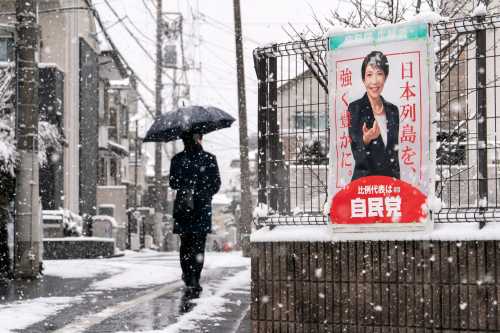
Second, in January 2026, Takaichi made the extraordinary decision to capitalize on her personal popularity and call a snap election. When voters went to the polls on February 8, they granted the LDP the largest Lower House supermajority of any political party since World War II.
Despite this apparent political wind at their back, Takaichi and her allies will continue to strike a careful balance on the most contentious issues in the months and years ahead. For starters, the LDP lacks a majority in the Upper House, and neither the party (with a 22.1% support rate at the time of writing) nor its policy agenda is nearly as popular as its Lower House supermajority suggests. Meanwhile, although Takaichi is only the latest in a long line of LDP prime ministers since the party’s 1955 founding to call for revising the 1947 Japanese Constitution’s famous Article 9 “peace clause,” doing so remains an extremely tall order politically. Political pragmatism, legal constraints, and Japan’s sobering fiscal situation all counsel caution as they chart the way forward.
Spaces to watch in the national defense strategy
Japanese elite and public recognition of Japan’s worsening security environment, the LDP’s lower house supermajority, and preelection coalition realignment, as well as significant pressure from Washington to “do more,” all provide a significant political tailwind for the Takaichi government’s ambitious reform agenda.
Space constraints prevent a full accounting of the wide array of policies, platforms, capabilities, and institutional reforms under consideration for inclusion in the new “three documents.” Specific to Japan’s defense strategy, the first of the aforementioned “three tracks”—Japan’s efforts to bolster its own capabilities—is likely to receive the greatest investment and attention. Details have yet to be finalized, and the LDP and Ishin must still iron out their differences on several key issues. Nevertheless, the LDP’s June proposal to the government is highly suggestive of what’s to come. In addition to strengthening the U.S.-Japan alliance and expanding security cooperation, industrial collaboration, and exercises and training with the United States and other like-minded partners, several key priorities will likely be:
- Improving the Self-Defense Forces’ ability to respond to “new ways of warfare” (atarashii tatakaikata), including artificial intelligence and the mass deployment of inexpensive unmanned assets.
- Bolstering long-range, precision-strike, air defense, and cross-domain capabilities, including in space, cyber, and the electromagnetic spectrum.
- Addressing vulnerabilities in sea lanes, especially so-called “gaps” (areas) in the Western Pacific where Japan’s ability to defend its interests is limited.
- Ensuring “combat sustainment capabilities” (keisen nōryoku iji), including robust munitions stockpiles, necessary for a prolonged conflict.
- Investing in a robust and effective human talent base through reforms to recruitment, compensation, and organizational culture.
- Strengthening domestic production and technology bases, promoting equipment transfers, and boosting surge capacity and supply chain resilience.
- Enhancing cooperation and communication with local communities.
The LDP and Ishin submitted separate proposals to the government this past summer, rather than a joint one, raising questions about what will ultimately be included. In recent weeks, three as-yet-unresolved issues have attracted particular attention in Tokyo:
- What, if any, concrete pledge will the government make regarding defense spending? For decades, Japan kept its core defense budget pegged to the normatively symbolic figure of 1% of GDP. The Kishida government’s 2022 commitment to surge that budget by roughly two-thirds over five years was a game-changer and laid the foundation for much of the progress achieved over the past four years. The Takaichi government is well aware of the Trump administration’s demands that allies pledge to reach 3.5% of GDP for core defense spending by the mid-2030s. But Tokyo has repeatedly indicated that it will make its own sovereign decision.
If the government does offer a specific spending or percentage-of-GDP target in the new documents, will it apply to core defense spending or to a broader category of what the government often refers to as “defense-related” or “national security-related” spending? The distinction is hardly academic. Four years ago, widespread—but erroneous—assertions that Japan had pledged to “double its defense budget” obscured the differences between the two categories. Meeting the 3.5% target for core defense spending would be extremely difficult for Japan given its fiscal, demographic, and other challenges. Nevertheless, a commitment to significant spending increases seems likely. Regardless of the precise figure, Japan increasing investments effectively and efficiently, including in coordination with the United States and other partners, matters more for deterrence than any arbitrary “percentage-of-GDP” target.
- What, if anything, will the documents say about “nuclear-powered” submarines and the 1967 prohibition on introducing (presumably U.S.) nuclear weapons onto Japan’s territory? These are two issues where Ishin’s entry into the ruling coalition has immediately reshaped Japan’s defense policy debate, and in which its differences with the LDP mainstream may be significant. (Note: Contrary to widespread misunderstanding, neither of these questions relates to Japan itself developing or acquiring nuclear weapons.)
The operational desirability and feasibility of Japan acquiring nuclear-powered submarines remains heavily contested. Such a move would also raise important political and legal questions and carry significant opportunity costs; for instance, construction costs alone could be 10 times greater than those of Japan’s most advanced diesel-powered submarines. If the documents include any references to nuclear-powered submarines, precise wording will matter: a pledge to merely “consider” or “conduct research” should not be understood as a commitment to acquire them. As for whether the documents may explicitly modify the third of Japan’s “three non-nuclear principles”1 to allow, say, nuclear-armed U.S. vessels to enter Japanese ports or waters, the jury is still out.
Japan and the United States face immense challenges in a rapidly worsening East Asian and global security environment. As Tokyo and Washington chart the way forward into 2027, more proactive, positive, and constructive U.S.-Japan cooperation—including alongside other U.S. allies and partners—will be critical to strengthening deterrence in an increasingly unstable region and world.
The first 10 months of 2026 have marked a significant year for Japan’s national security and defense policy. With the Takaichi government’s revision of the “three security documents” around the corner, it is sure to be one for the history books.
Watch this space.
Author

Related Content
-
Footnotes
- These principles, introduced in 1967, state that Japan will neither possess nor produce its own nuclear weapons, nor allow another country’s (e.g., U.S.) nuclear weapons to be introduced into Japanese territory. The current debate regards only the third principle.
The Brookings Institution is committed to quality, independence, and impact.
We are supported by a diverse array of funders. In line with our values and policies, each Brookings publication represents the sole views of its author(s).
Commentary
Japan’s forthcoming national security and defense strategies: Watch this space
November 16, 2026