The share of intra-African merchandise exports in Africa’s total merchandise exports is usually presented as a measure of continental integration. It is easy to remember, easy to compare with Europe or Asia, and easy to turn into a political target that prominent voices such as the Director-General of the WTO, Africa’s richest man, development agencies, and assorted consultants and analysts can cite to press for faster progress on integration. That salience is its great strength; it is also the source of its danger.
The statistic is the ratio s = I / (I + E), where I is intra-African exports, and E is Africa’s exports to the rest of the world.
The higher this “golden ratio,” the greater the comfort that integration is advancing. When subjected to the tests expected of a serious policy indicator, the ratio does not hold up.
The ratio is uncertain
Five reputable international sources—BACI, IMF, UNCTAD, Comtrade, and ITC—produce materially different measures of the ratio, as often highlighted by the African Continental Free Trade Area (AfCFTA) Secretariat’s Roland Leudjou. Between 2014 and 2024, the average annual spread was about 5 percentage points on a mean of roughly 18%. In other words, which source you choose creates uncertainty equal to nearly 28% of the headline number (without even accounting for the indeterminate contribution of informal trade). Yet targets are still discussed in one decimal place.
Figure 1. The ‘Golden Ratio’ is unstable in level and contaminated in movement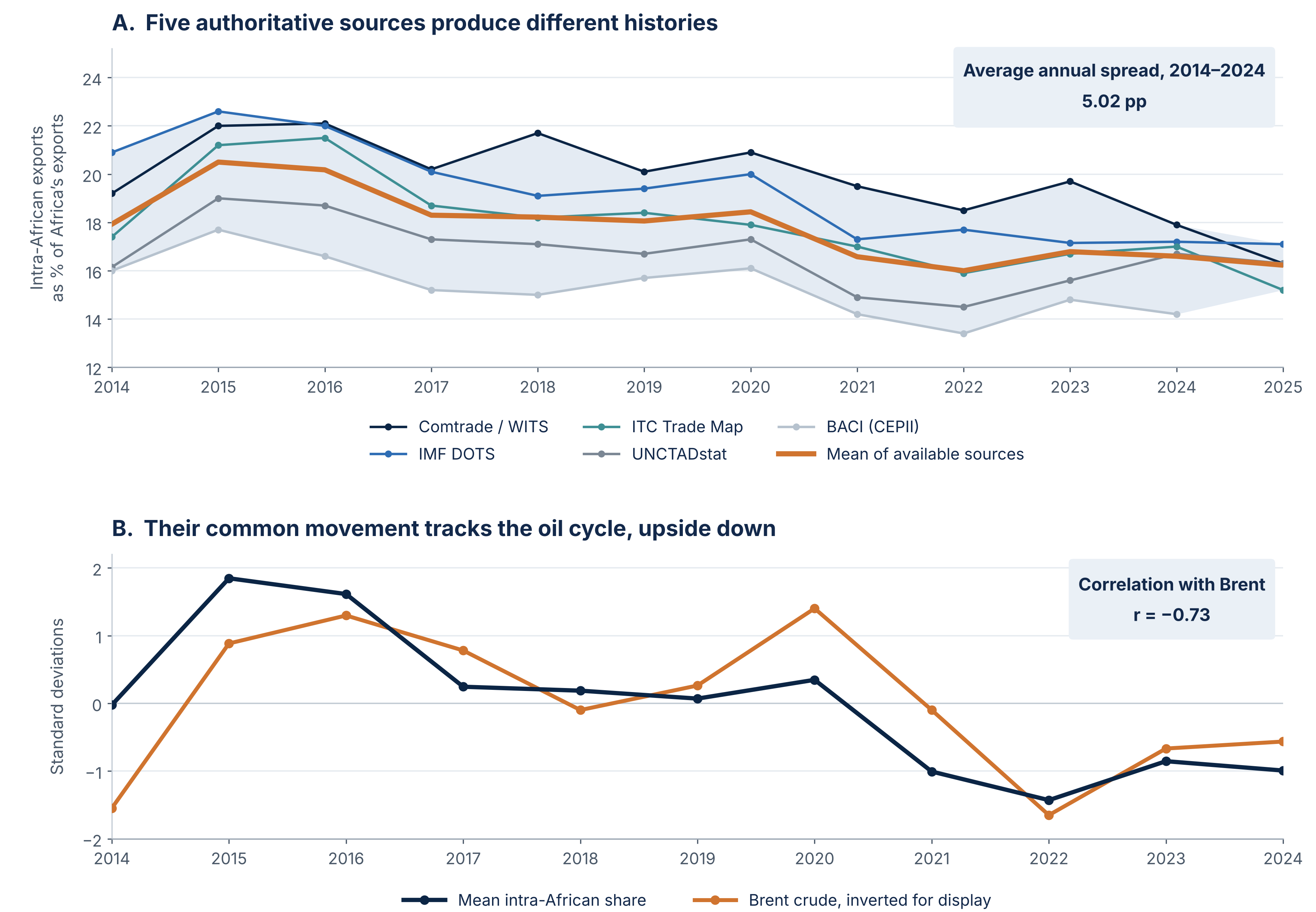 Note: The five-source range and the inverted Brent comparison. Sources: BACI (CEPII), IMF DOTS, ITC Trade Map, UNCTADstat, and U.N. Comtrade/WITS analysis benefits from the insights of Roland Leudjou; Brent annual averages; and author calculations.
The ratio is sensitive to idiosyncratic factors
The deeper problem is not merely disagreement over the level, however. Most of the year-to-year movement is common across the databases. The challenge is that the common signal tracks the world oil price cycle upside down.
The first principal component of the five standardized series explains 86.6% of their movement and correlates at -0.73 with Brent crude, a major global oil price benchmark. In simple terms, volatility in world oil prices strongly shapes how we view trade among African countries.
The principal component distills five series into the dominant rise and fall they share; 86.6% is the proportion of their combined variation captured by that pattern (not necessarily the share of trade). The oil connection has a straightforward denominator logic: when African crude sold largely outside Africa becomes more expensive, E rises faster than I and s falls, even if regional shipments do not change. Oil exporters’ relatively small intra-African export shares exacerbate that condition.
The ratio generates arbitrary progress lines
Measuring progress with such an indicator can become arbitrary quickly. Assume that the current level of the ratio is 17%. A 10% increase in intra-African exports raises the ratio by about 1.39 percentage points. A 10% fall in extra-African exports raises it by about 1.54 points. In simple terms, as Africa gets worse at exporting to the rest of the world, the ratio mechanically interprets that result as an improvement in how well Africa is trading with itself, regardless of any actual increase in intra-African trade. Regional exports can contract while the indicator improves, so long as exports to the rest of the world contract faster. Meanwhile, a global commodity boom can make integration appear to deteriorate even when regional trade is expanding.
Policy attribution is suspect
The ratio also fails the most basic test of policy attribution. A shipment from Ghana to Kenya may be based on the exporter claiming an AfCFTA preference, using a legacy regional arrangement (such as the Economic Community of West African States, or ECOWAS), asserting most-favored-nation treatment, or receiving no preference at all. AfCFTA may have had nothing at all to do with it. Yet many people have taken to treating the ratio as an AfCFTA performance indicator.
Regional trade may even be lopsided by some measures
Here is another way of looking at the data. Buyers outside Africa source under 3% of their imports from African suppliers. Buyers inside Africa sourced 13.72% of their merchandise imports from African suppliers in 2024. That is several times the comparable share among buyers outside Africa (although the comparison depends on using matched years and import data), suggesting relatively stronger intra-African trade performance than is usually assumed. One may wish to adjust for distance. But one would then need to do the same for the continent’s poor infrastructure and high cost of trading. So, a proper gravity comparison must account for market size, the product mix, and effective trade costs before pronouncing regional trade unusually weak in comparison with, say, Europe.
Time for a rethink
The ratio should no longer serve as the governing yardstick of AfCFTA and African integration performance.
Because the African Union’s 2024-2033 plan aims for intra-African trade of at least 30%, while its 2025 annual report displays the export-share series alongside AfCFTA implementation, such a move will be difficult. Still, a better statistic should start from a harder question: What kind of intra-African trade is actually capable of transforming African economies?
The destination of a shipment is not enough. The same $1 billion in exports can represent rerouted imports, short-distance food trade, protected final goods, or repeated cross-border production involving specialized suppliers. These systems differ profoundly in productivity, learning, wages, resilience, and global competitiveness.
While emerging evidence shows that informal and small-consignment trade have genuine benefits, there is a need for more rigor in determining the “transformativity” of trade on the continent.
Much informal trade is often a rational adaptation to thin margins, unreliable institutions, and fixed compliance costs. Such trade is highly supportive of livelihoods, food security, and price discovery, yet generally untransformative.
Furthermore, trade can grow rapidly after tariffs fall and borders improve while capability growth still plateaus.
The most critical objective for African trade should be productive integration. By this, I mean repeated cross-border economic relationships that create additional production, deepen regional value added, build firm and worker capabilities, broaden participation, improve resilience, and strengthen competitiveness in third markets.
In that light, there is no magic continental threshold of 20% or 25% of intra-African trade that automatically maps to that positive scenario. Meaningful thresholds would instead relate to what trade does and what it consists of.
Supportive policies will also address more than liberalization, as the AfCFTA Secretary-General Wamkele Mene has often said. They should ensure that preference savings exceed compliance costs, that finance tenor covers the cash cycle for traders, and that suppliers can meet scale and quality requirements (“challenging demand”). It is also not often understood how important it is for trade transactions to repeat long enough for producers to actually learn and improve.
Three gauges for a more honest integration politics
A politically useful and salient replacement for the ratio cannot be a 40-variable technocratic dashboard. That would create a damaging divide between policy architects and policymakers. Africa needs a small number of memorable gauges that remain connected to richer analysis and bridge the policymaking and politics of trade’s connection to transformation.
I propose that the first gauge be AfCFTA preference utilization (i.e., for each corridor and eligible product, what share of trade actually claims AfCFTA treatment?). This is the cleanest available measure of policy use. It distinguishes trade with an African destination from trade caused or facilitated by the continental agreement. It also exposes whether rules of origin, documentation, and compliance costs make the preference commercially worthwhile.
The second gauge is trade finance. A trade-finance contract is a compressed diagnosis of the trading system. Approval, amount funded, collateral, tenor, currency, documentary conditions, and repeat survival encode much about logistics, standards, law, foreign exchange, buyer quality, and firm information. Finance is therefore an ex ante credibility gauge.
The African Development Bank reports that 73% of surveyed African bank trade-finance assets were unfunded instruments such as guarantees and letters of credit. Payment assurance can improve while inventory, payroll, inputs, and supplier upgrading remain starved of cash. The gap between payment assurance and funded credit therefore warrants close monitoring.
The third gauge is trade in advanced industrial intermediates. It reflects production networks linked to cross-border movement of specified inputs that connect one production stage to another.
World Trade Organization data already point to the deficit. In 2022, non-fuel intra-African intermediate-goods exports represented 12.8% of Africa’s total intermediate-goods exports, compared with 32.1% going to Asia and 31.1% to Europe. But those broad categories also mix raw minerals and generic supplies with technically demanding components, which is precisely why a sharper gauge is needed.
Packaging materials, pharmaceutical inputs, processed-food ingredients, textile inputs, industrial chemicals, electrical components, and selected machinery parts could form an initial portfolio.
Figure 2. Three sentinel gauges for Africa’s trade competitiveness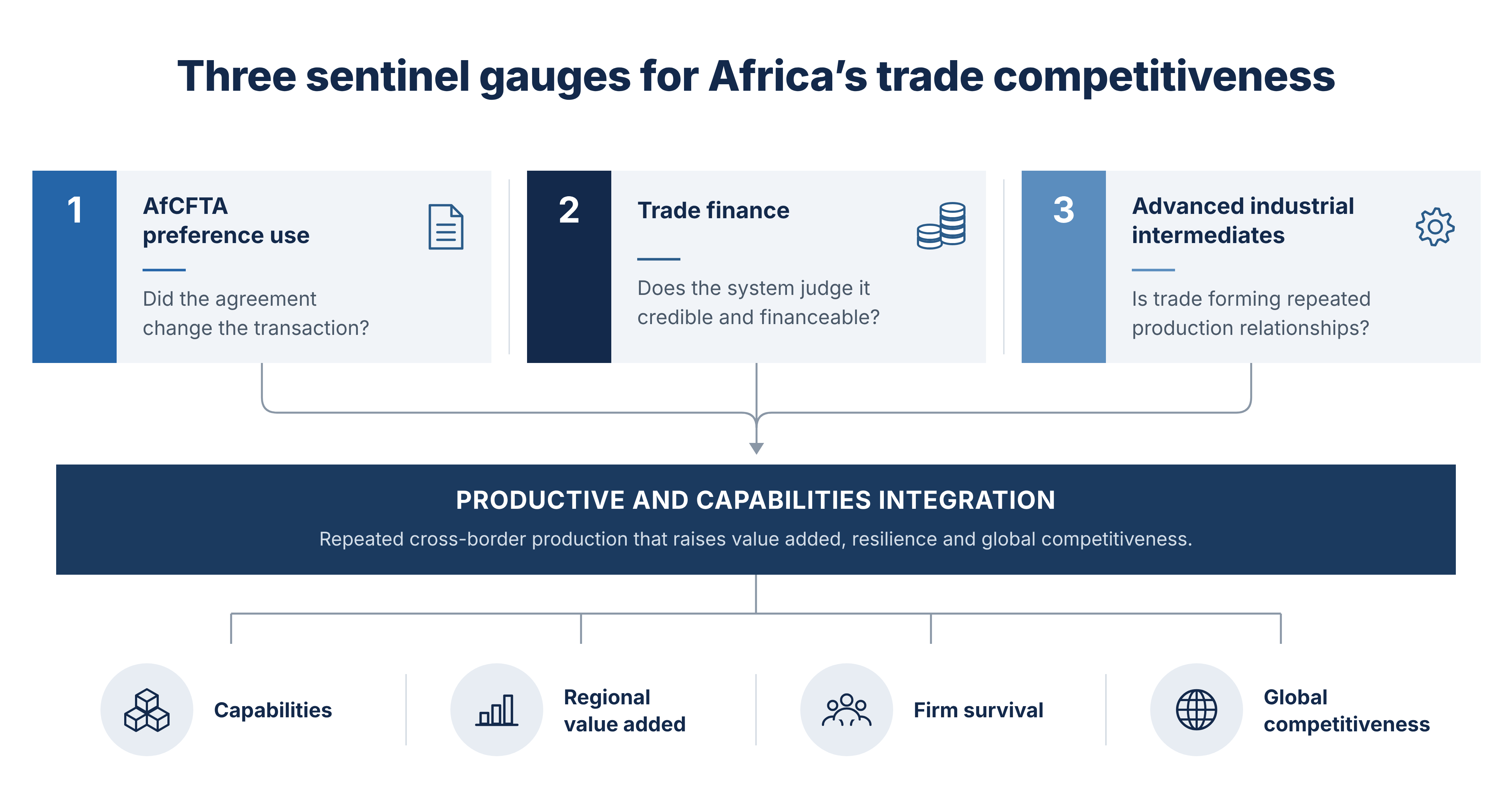 Note: Three sentinel gauges for measuring productive integration and the “transformativity” of trade. Source: Author.
We should be careful about composite scoring, however, because each of these gauges answers a different causal question.
Martin Ravallion’s warning about “mashup indices” applies here: a single score would let rising preference claims offset a collapse in funded credit or qualified inputs. Such an exchange rate requires a theory. Until one exists, the three readings should be tracked concurrently but kept distinct.
The synergy across financing production specifically destined for export, focusing on industrially critical inputs, and ensuring that a unified trading regime (AfCFTA) is gaining ground makes these proposed sentinels a powerful barometer of whether the continent is harnessing collective comparative advantages toward one integrated continental production system.
The trade-off is real, though. A ratio can mobilize because it tells a simple story. The task is not to replace simplicity with obscurity, but to replace false simplicity with disciplined salience.
Author

The Brookings Institution is committed to quality, independence, and impact.
We are supported by a diverse array of funders. In line with our values and policies, each Brookings publication represents the sole views of its author(s).



Commentary
Replace the intra-African trade share with a meaningful statistic about trade integration
October 13, 2026