At the time of writing this blog, international oil prices are hovering around $100 per barrel. That’s a 30% increase since the beginning of the most recent conflict in the Middle East. While current economic effects of high energy prices and possible future scenarios are widely discussed, there seems to be less attention to how governments are responding globally.
Here are three lessons from tracking social protection and related actions over the past two months.
First, most countries are hesitating on whether to respond.
As of May 7, 2026, about 256 responses have been recorded in 104 countries. This means that about half of the countries worldwide had planned or implemented some form of government measure to mitigate the crisis effects (Figure 1).
Figure 1. Half of the countries worldwide are responding to high energy prices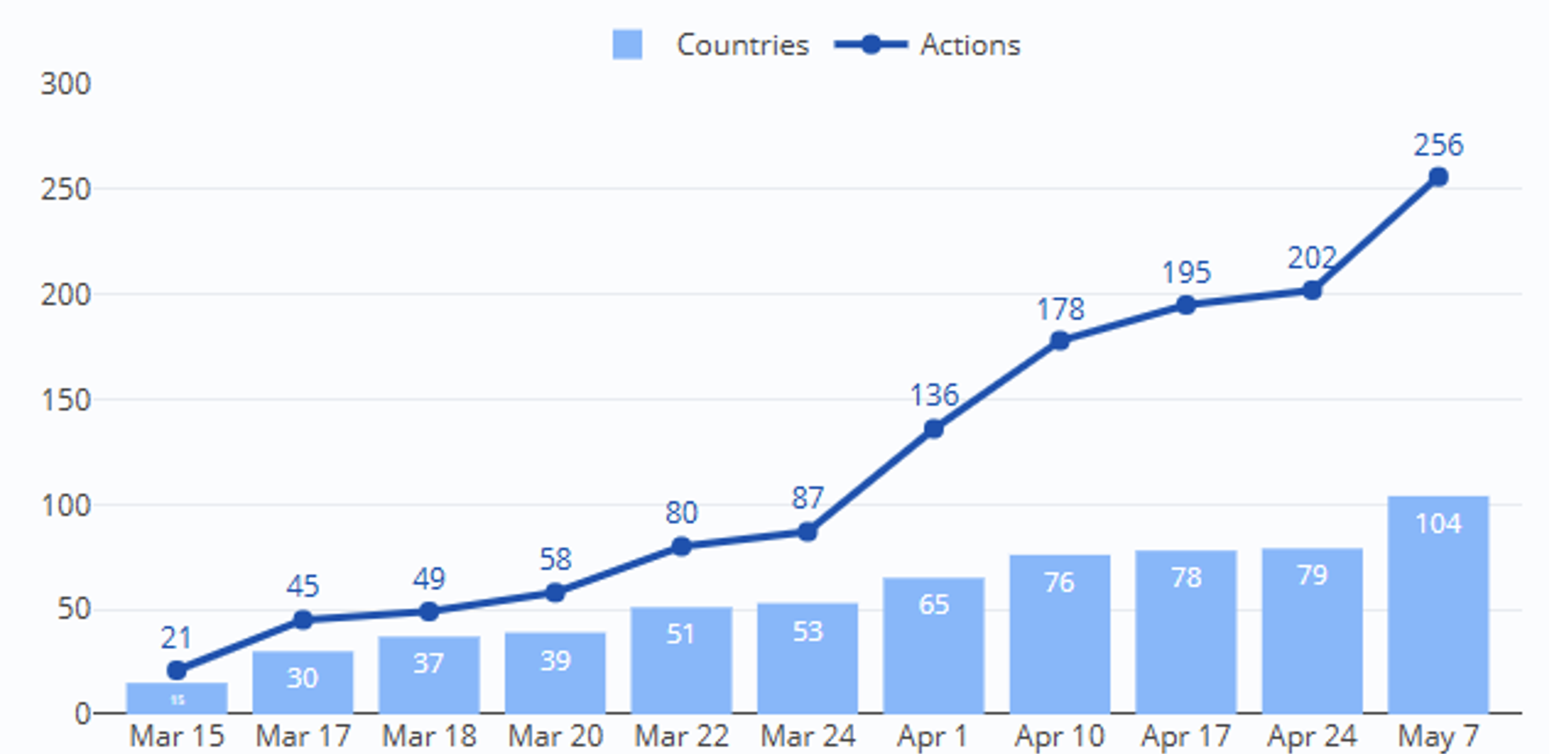 Source: Gentilini et al. (2026).
Why are some countries responding and others not, and what is holding many countries back? Two reasons stand out.
On one hand, interpreting the nature of the crisis is no easy task. Is it a temporary blip or a harbinger of a new era of global volatility? Contrasting narratives sow doubt: Prices could drop rapidly, as they did (by roughly 10-20%) following the April 8 ceasefire announcement. Yet there are growing calls about the long-lasting effects of the crisis. The head of the International Energy Agency dubbed it “the biggest energy crisis in history.”
Taking a long-term view may help. In the 15 years between the mid-1990s and the Great Recession of 2009-10, oil prices reached shock levels—or over $120 per barrel (the upper purple band on Figure 2)—just once. In the decade between 2010 and the 2020 pandemic, they did so twice; and in the five years following the emergence of COVID-19, they did so already four times. We might be witnessing an accelerated confluence of supply and demand shocks as well as a compounding of specific and systemic risks. As a result, volatility is on the rise, blurring the lines between transitory and permanent crises.
Figure 2. Oil prices are more frequently reaching shock levels
 Source: Author based on Finviz data (May 7).
On the other hand, the relationship between responses and the macro-risk of amplifying inflation should be considered.
The IMF recently warned that “fiscal policy should steer clear of discretionary demand stimulus … it would make inflation control by Central Banks harder.” This points to the need to closely coordinate fiscal and monetary policies.
During the COVID-19 pandemic, when inflation and interest rates were low, fiscal and (unconventional) monetary policies primarily converged around the idea of large-scale fiscal stimuli (including several cases of temporary universal basic income) to bolster demand. Yet as economies and labor markets rapidly recovered, concerns around the inflationary effects of large fiscal policy—“overheating”—animated a critical conversation on how best to dovetail and sequence monetary and fiscal levers during crises.
The bottom line is that the risk of fueling inflation is an important dimension when considering short and longer-term effects of responses on societies and economies. (Note: recent empirical work has shown that inflationary effects largely hinge on financing modality, the type of programs, and market context.)
A second lesson is that some countries are facing daunting fiscal constraints and, in some cases, limited price contagion.
Several countries may face a backlog of funding fatigue: Between 2020-23, a total of $4 trillion was spent on social protection responses to the pandemic and inflation globally. The fiscal hangover may yet have to dissipate.
In fact, “new” revenues may be limited: Singapore, which built reserves and is unleashing comprehensive responses, is partially funding its voucher programs by front-loading future expenditures. Some countries are even freezing or reducing public spending.
Importantly, in a range of instances, domestic prices remain relatively low, at least for now. In part, this could be because governments are absorbing, delaying, or redistributing the shock through subsidies and other price risk management instruments. In 32 cases, policymakers resorted to rationing and capping prices of energy and food commodities, a practice akin to measures taken during World War II.
These developments signal an elevated use of last-resort measures across a wide range of contexts. The ability of countries to cope with high energy prices is being stress-tested.
Third and finally, when countries do respond, subsidies are king.
Nearly half of current crisis responses are subsidies. This is not a new trend: From 2022 to 2026, the share of subsidies out of total responses has been over three times higher than that of cash transfers (Figure 3).
Figure 3. Subsidies dominated recent crisis responses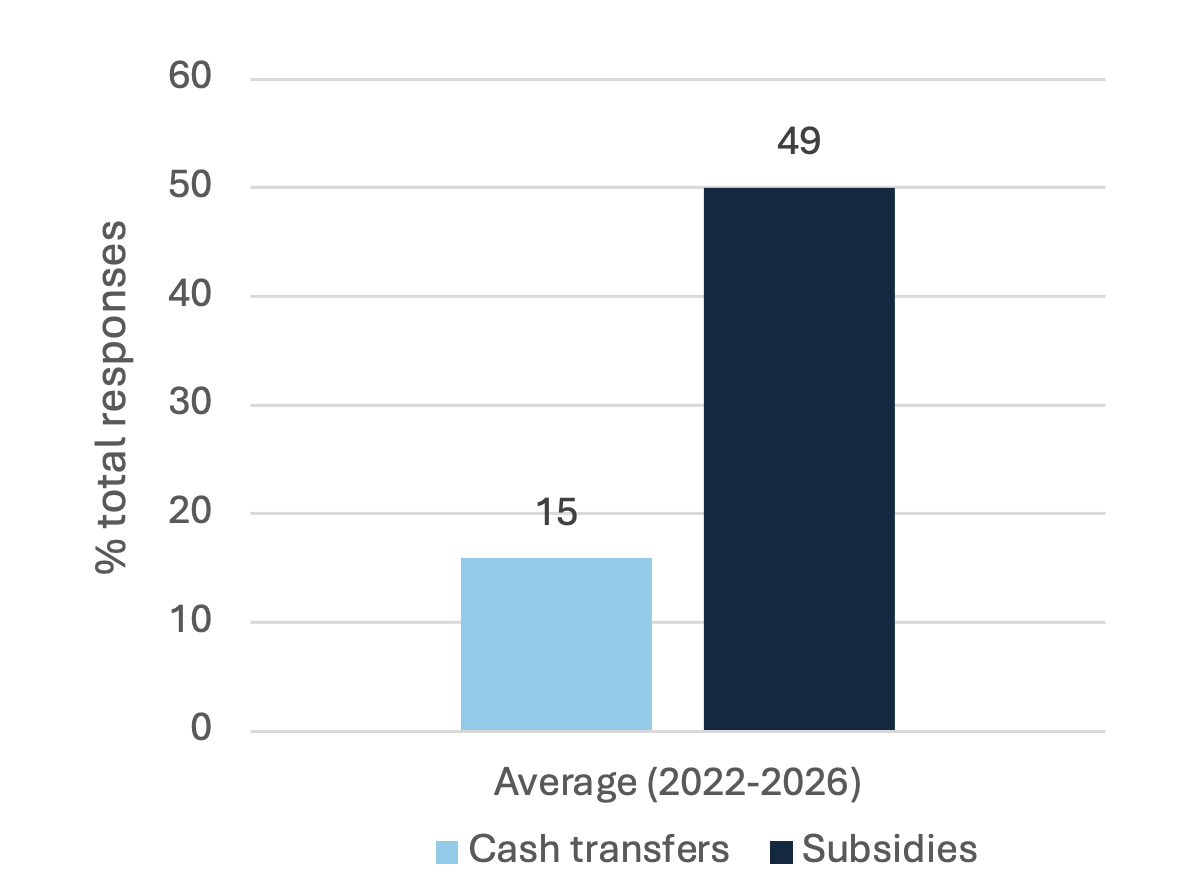 Source: Gentilini et al. (2026, 2023).
Why are subsidy programs popular despite widespread calls against them?
Subsidies can attain objectives that cash transfers cannot. As mentioned, they are deployed to help stop prices from rising. Also, not all subsidies are applied universally: Many are targeted toward specific sectors and may support the renewed focus on industrial policy. And some subsidies, like those for public transportation (such currently enacted in Australia, Lithuania, and Viet Nam) could have positive environmental externalities.
A further reason relates to political economy. In many cases, subsidies are a cornerstone of social contracts and reach the middle class, a salient aspect for their persistence. In fact, subsidies are already used on a large scale, they are easy to explain, and they are simple to administer.
There are downsides. Subsidies interfere with market mechanisms and the efficient allocation of resources. In other words, they obscure or suppress price signals that allow demand to adjust. In the case of energy, subsidies can affect jobs and the climate negatively. Subsidies also generate spillovers to trade partner countries, thereby facing higher adjustment costs. They can be expensive, and it is sometimes unclear how subsidies are paid for. For example, they can be offloaded to state-owned enterprises and, in some cases, hurt labor market dynamism. Finally, their regressive distributional effects are well established in the literature.
Another factor explaining the widespread use of subsidies relates to the limits of alternatives. This may sound counterintuitive, given extensive investments and a clear rationale for “adaptive social protection.”
In fact, programs like cash transfers have been successfully scaled up in response to specific shocks affecting part of the population, like in the case of droughts and floods. An important question is whether they can be ramped up when large crises affect wide segments of the population.
When those hazards occurred, again, like the pandemic of 2020-2021 and the cost-of-living crisis of 2022-2023, over 90% of crisis responses featured new programs. For example, routine cash programs in Brazil, Pakistan, and the Philippines played an important stabilizing role by continuing to support regular beneficiaries, but the heavy lifting in reaching new participants was carried out by ad hoc schemes. These initiatives partially used existing systems, supplementing them with standalone programs (Figure 4).
Figure 4. Large crisis responses often relied on new programs
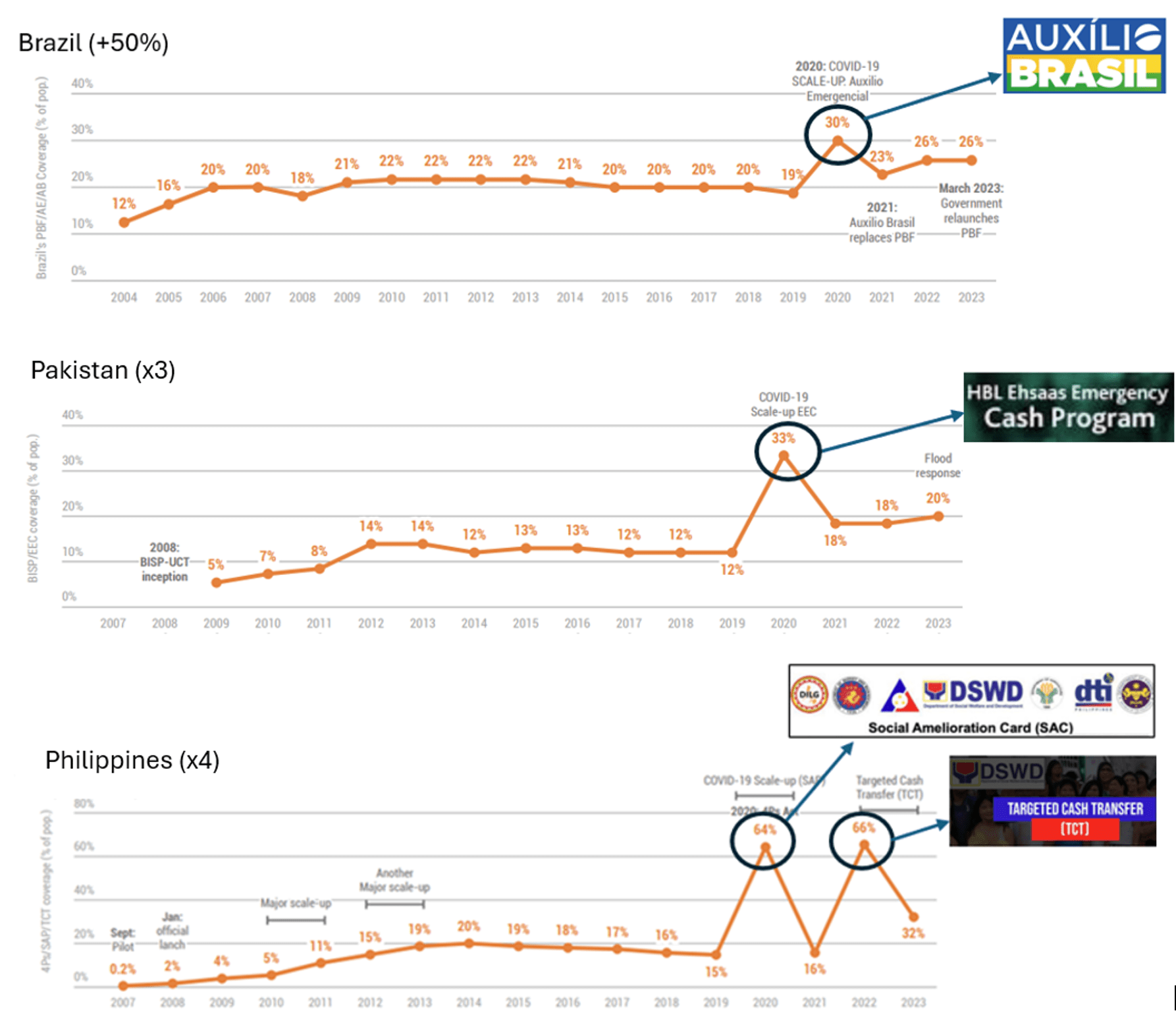
Source: Adapted from Wadie-Hobson et al. (2025).
What does this all mean? It means that there is a precious opportunity, but there’s work to do to seize it.
The opportunity is that social protection is climbing back as a top global priority; to meet expectations, three issues need to be addressed.
- Define the context and narrative. If we are in an era of persistent uncertainty and entrenched volatility, as opposed to simply facing a crisis, this changes the role of social protection in crises fundamentally, i.e., from emergency assistance to a system of crisis insurance.
- Crisis response frameworks may need to manage increasingly likely, frequent, and large global shocks. Countries don’t need to reinvent the wheel in every crisis, and they could be offered a credible “off the shelf” alternative to subsidies. This may include a crisis-readiness response mechanism that remains dormant during good times but can swiftly mobilize resources and reach most of the population nearly instantaneously when circumstances demand. A revamped crisis response framework may also entail further coordination between fiscal and monetary policies, and perhaps a fresh, nuanced approach to subsidies themselves.
- Embed innovations that countries themselves have started spearheading in recent years. A crisis module could be placed within national social protection systems. It could leverage existing infrastructure like outreach and payments, while maintaining a distinct “express lane” in crises, as was done in many cases during the pandemic. It should allow for scaling up rapidly and potentially achieve near-universal coverage or so—perhaps with clear triggers and minimal administrative requirements. This also entails navigating challenging financial trade-offs, such as balancing resource mobilization with debt sustainability, using automatic stabilizers versus discretionary spending, and choosing between general revenues and earmarked funds.
We have been here before: Every time, we wish that a simple, swift, and scalable mechanism for social protection response were in place. With new crises and volatility on the horizon, it’s time to establish it.
Author

Related Content

The Brookings Institution is committed to quality, independence, and impact.
We are supported by a diverse array of funders. In line with our values and policies, each Brookings publication represents the sole views of its author(s).



Commentary
Navigating uncertainty: Lessons from ongoing social protection responses to high energy prices
May 8, 2026