As the United States celebrates its 250th anniversary, there is much to be proud of, with the nation having evolved into a historically prosperous, multiracial, and multicultural society. To be sure, there have been periods of racial and ethnic division and strife, and many of the inequities driving those issues are still unresolved. But through various periods of our history, waves of immigrants from different parts of Europe—and more recently, from all parts of the world—have made positive contributions to the economic, political, and social fabric of our nation.
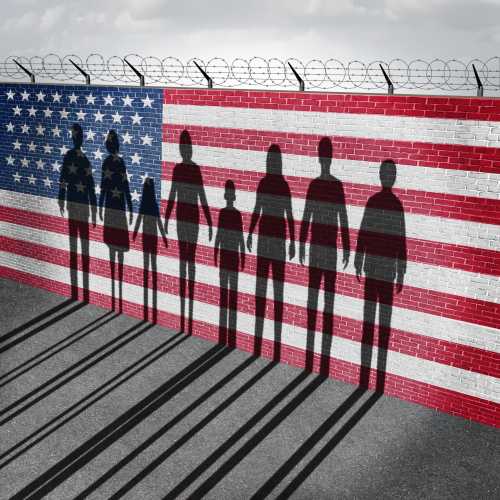
Yet at this juncture in our history, the future of immigration has again become a source of political contention, with many Americans subscribing to the views of the current presidential administration. That administration began its term by warning Americans of an “invasion” by illegal immigrants, and has continued with aggressive border restrictions and deportation actions, along with attempting to eliminate birthright citizenship for categories of immigrant children. In addition, it initiated policies designed to curtail legal immigration, such as instituting travel bans, cutting refugee resettlements, and restricting H-1B visas.
Now, with the administration only a year and a half in office, there has been a sharp drop in new immigrants; my Brookings colleagues estimate that net immigration to the U.S. could be negative in 2026. Clearly, this is a huge shift from the nation’s past, when immigration contributed greatly to national growth and well-being.
Related Content
A parallel set of policies the administration has instituted has been aimed at eliminating diversity initiatives, which disproportionately impact people of color (including a large share of immigrants), representing yet another means of currying favor with the president’s largely white, working-class political base. It might be argued that a good part of the immigration restrictions for unauthorized—and even legal—immigrants are meant to signal to this base the administration’s intent to make America less racially diverse.
From a purely demographic perspective, though, America is more in need of immigrants than ever before. The nation’s population is aging, and its levels of natural increase (the excess of births over deaths) may soon turn into a natural decrease, as deaths exceed births.
To make the case for why immigration will continue to be vital for the future of the United States, it is useful to compare the demographic profiles of what the nation could look like 25 years from now—at its 275th anniversary in the year 2051—under different scenarios with zero, low, or high immigration levels. These scenarios use the most recent U.S. population projections for the period from 2022 to 2051.1
What different immigration scenarios mean for US population growth or decline
The first scenario assumes zero net immigration over the 2022 to 2051 period. The most obvious change under this scenario will be a projected decline in the U.S population to 312 million people in 2051—down from 331 million in the 2020 census. An absence of immigration over this period would be much more impactful than in earlier years when immigration dipped, such as in the 1950s. That’s because, unlike then, deaths begin outpacing births in 2033 and each year thereafter. A significant part of this shift occurs within the foreign-born population, whose size would be diminished from 46 million in 2022 to just 23 million in 2051.

What about if immigration is not zero but just low? The projection is about the same level observed near the end of President Donald Trump’s first term, and shows a modest U.S. population gain to 345 million in 2051—not nearly as large as the gained observed in the 2000 to 2020 period. In fact, only a high immigration scenario—in which annual immigration levels exceed 1.5 million immigrants in future years—will maintain the nation’s past growth trajectory, reaching a population total of 385 million in 2051.
Immigration’s contributions to youth populations
Over the next 25 years, surviving members of baby boomer generation, Gen X, and the first part of the millennial generation will all reach age 65 or beyond—sharply increasing the size of that age group by 2051. Yet because new immigrants and their children are younger than the existing population, continued immigration will shift losses in the younger segment of the population to gains, especially for children and people in their earlier labor force years.


As Figure 2 shows, both a zero and low immigration scenario will lead to notable declines in the under-18 and 18- to 44-year-old populations. Yet the high immigration scenario leads to gains in these categories, as well as for older labor force age groups. A comparison of the U.S. population in the year 2051 under both the zero and high immigration scenarios, shown in Figure 3, makes plain how greatly high immigration will contribute to younger age groups. High immigration will add an additional 17 million children under age 15, and 50 million more people between the ages of 15 and 64.
Conversely, a severe shrinking of our labor force age population would have notable economic impacts, as it would reduce the workforce contributions to old age entitlement spending as the senior population continues to expand. Even today, immigrant contributions to the younger population are factored in to assess the near-term viability of Medicare and the Social Security trust fund. Over the longer run, immigration will affect other ways that younger people will contribute to the well-being of older populations, including as health care workers or as contributors to the nation’s overall economic productivity, as it will sharply alter the size of the consumer base.
Diversity will expand under all immigration scenarios
Many supporters of the administration’s immigration crackdown might be left with the impression that it is an attempt to hold down the size of the nation’s nonwhite population. And they can’t be blamed for thinking that after so much media coverage of immigrant raids in Latino or Hispanic communities and policies such as prioritizing the entry of white South African refugees while reducing refugee admissions from elsewhere. It is a fact that immigrants are far more racially diverse than the rest of the population: Among those arriving from 2020 to 2024, only 13% identified as non-Hispanic white, compared with 49%, 24%, and 10% that identified as Latino or Hispanic, Asian, or Black, respectively.2
Yet the nation is already becoming more racially diverse—and will continue to do so with or without future immigration. Between the 2010 and 2020 U.S. censuses, the nation’s white population registered an absolute decline—one that is continuing due to the excess of deaths over births in this aging population, which is not being countered by white immigration. And this will continue under different immigration scenarios, as shown in Figure 4.


Under zero, low, and high immigration scenarios, the white population will decline through the year 2051. This is not the case for other groups. The Latino or Hispanic population will show a marked increase without any new immigration due to the natural increase of this younger population. And under the low immigration scenario, each nonwhite group will show gains.
So, while the total size of the projected 2051 population will differ by immigration scenario, each scenario will yield a smaller white population than what was registered in 2026 (see Figure 5). For example, the biggest numeric differences across immigration scenarios will occur within Latino or Hispanic and Asian populations, as these two groups rise more greatly than others due to immigration. Moreover, the zero immigration scenario will yield the biggest numeric decline in the white population.
Another feature of the nation’s 2051 population under each immigration scenario is the fact that younger age groups become more racially diverse than older age groups. This was already the case in the 2020 census, which showed that only 47% of the under-18 population identified as white, and that the younger and even middle-aged white population registered population losses. Because accentuated aging is not “race-neutral,” younger and growing minority populations reduce or counter white population losses.

Once again, this increased diversity phenomenon by age group occurs in both the zero and high immigration scenarios when examining their projected year 2051 U.S. populations. Even with zero immigration through 2051, younger age groups are far more racially diverse than older groups, with both children and young working-age adults showing up as “minority-white.” The larger 2051 population under the high immigration scenario is somewhat more diverse, but still shows younger and older working-age groups to be minority-white.
While Census Bureau projections for 2051 may not turn out to be entirely precise with respect to which groups will comprise different population segments, they suggest that the nation is on the road to a much more racially diverse population under all immigration scenarios.
What kind of country will America be at 275?
For a country that has long relied so heavily on immigrant contributions to its social, economic, and political well-being, it seems extremely counterproductive for an administration to put the brakes on it at this particular time. From a purely demographic standpoint, a sharp long-term decline in immigration will slow the nation’s growth, particularly among its younger working-age population just as its older, senior dependent population still grows. Reducing immigration will also have a negative impact on our overall economy, as immigrants contribute substantially to the nation’s worker, consumer, and taxpayer populations.
Perhaps even more troubling is the implicit link that the administration has tried to make between immigration and the nation’s rising diversity, and its attempt to curtail both in order to appeal to its political base. For some time, I have been monitoring what I call the “cultural generation gap”—the divergent attitudes toward diversity between the nation’s young, growing, and racially diverse population that favors it, and the older, largely white population that struggles to come to grips with it. Especially during the Obama years and even in the early part of this decade, I felt the gap was closing. One of the reasons for this is the sheer force of change in the nation’s demographic makeup, as many more Americans experience day-to-day interactions with different racial groups, as documented in a recent Gallup survey analyzed by my colleague Andre M. Perry. And as shown above, the nation’s population will continue to diversify irrespective of immigration levels.
So let us fast-forward to America’s 275th anniversary in the year 2051. What kind of country will we be demographically, economically, and socially? Much will depend on our immigration laws and how they respond to our economic needs. It will be contingent on how the country’s institutions—both public and private—address the education, health, and social service needs of the nation’s highly diverse, immigrant-infused younger generations in the coming decades. Their success will rely not only on their own initiatives as individuals, but also on the opportunities for advancement that are made available to them. For this to occur, the current political divisions over immigration, diversity, and inclusion will need to wash away in the near future.
Demography does not fully determine the nation’s destiny. But it will surely shape it in powerful ways over the next 25 years.
Author

-
Footnotes
- This is an analysis of the most recent U.S. Census Bureau population projections, which assume different immigration scenarios for the years 2022 to 2051. The three scenarios examined here assume: zero immigration to the U.S. for that period; low immigration (annual net immigration between 357,000 and 534,000); and high immigration (annual net immigration between 1.5 and 1.6 million). To provide some context for these projections, actual net immigration to the U.S. between 2000 and 2018 ranged between 700,000 to 1.2 million annually, with subsequent declines to a low of 376,000 in 2020-21, followed by rising but fluctuating numbers through 2025.
- Calculations from the U.S. Census Bureau’s 2024 one-year American Community Survey
The Brookings Institution is committed to quality, independence, and impact.
We are supported by a diverse array of funders. In line with our values and policies, each Brookings publication represents the sole views of its author(s).