The U.S. Postal Service (USPS) is running out of cash. Since 2007, it has posted net losses nearly every year as letter mail, its core revenue source, has fallen by half. It has now hit its statutory borrowing limit, and its leadership has warned that it could be out of cash within the year, save for extraordinary measures. In Washington, the debate is no longer about trimming costs at the margin, but about how deeply to restructure the Postal Service’s operations or overhaul its funding model. Lost in that debate are more basic questions: How big is USPS? And, how much of the economy runs through it?
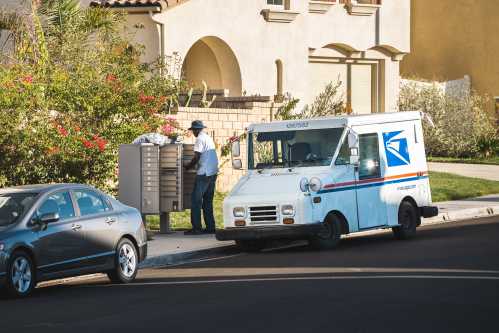
That reach is a matter of law, not choice. USPS is bound by law to a duty that no private company shares: a Universal Service Obligation (USO) that requires it to deliver to every address, six days per week, at uniform and affordable prices. For millions of households in rural and low-density communities, that guarantee is a lifeline, carrying prescription medications, ballots, online purchases, and the shipments that keep small businesses running.
Any plan to restructure the Postal Service has to reckon with what it actually is: one of the largest institutions in the American economy. Its size reflects what the law requires of it, not how it chooses to run. Where a private company might scale back or drop the routes that lose money, cutting its workforce, shrinking its fleet, and reducing its footprint until it produces a profit; USPS cannot. It’s a public operation required by law to reach every address, and its scale is what meeting that requirement takes.
Start with employment. With about 600,000 workers, USPS is the third-largest employer in the United States, behind only Walmart and Amazon (Figure 1). But this ranking undersells what those jobs are and where they sit. Postal jobs offer middle-class pay and federal benefits, often without requiring a college degree, and they have long been a reliable ladder into the middle class, especially for Black Americans. Nearly 30% of postal workers are Black, more than double their share of the national labor force. A workforce of this size means the Postal Service’s finances aren’t only a budget question. They’re also a labor-market question, and the communities with the fewest alternatives have the most at stake.

USPS isn’t just large for a private company; it’s also large for a government agency. Only the Department of Defense employs more people, and the Postal Service workforce comes close to the size of Defense’s entire civilian arm (about 685,000).
The Postal Service’s labor-market footprint reaches well beyond its current payroll. Alongside the workers on its rolls today, more than 700,000 retirees and survivors draw a USPS pension. Together, well over one million people rely on the Postal Service for their income.
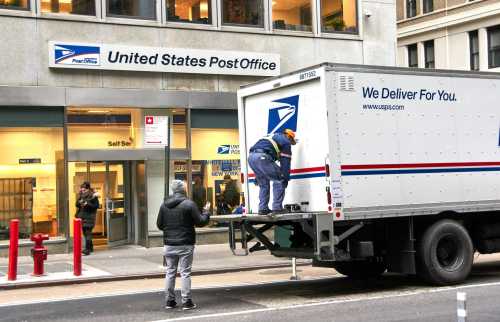
The same mandate that carries mail to every address gives USPS more retail locations than any company in the country. Its network of roughly 33,700 post offices outnumbers every private chain, with thousands more locations than Subway or Dollar General, the largest by store count, and more than twice as many as McDonald’s (Figure 2). Because these locations exist to serve universal delivery, they reach places private retailers may not serve profitably. In many rural communities that have lost bank branches and pharmacies, the post office is often one of the few outlets left.

By revenue, too, USPS runs with the largest private carriers. In fiscal year 2025, it took in $81.4 billion in revenue, on par with FedEx ($87.9 billion) and UPS ($88.7 billion). But its rivals also build the postal network into their own operations. UPS alone hands USPS nearly a million packages a day to finish the last mile, deliveries it cannot make as cheaply itself. USPS is at once a competitor to the private carriers, a service they pay for, and part of the backbone that their own networks run on.
None of this settles how to fix USPS’s finances. But it shows what a fix has to account for. The Postal Service is big—but how big matters less than how much depends on it: the post office that remains open in a town that’s lost its bank or pharmacy; the 600,000 people it employs and the 700,000 retirees it supports; the million packages a day it delivers for its own competitors. A plan that balances the books but overlooks all of that has done only part of the job.
Authors


Related Content
The Brookings Institution is committed to quality, independence, and impact.
We are supported by a diverse array of funders. In line with our values and policies, each Brookings publication represents the sole views of its author(s).


Commentary
How big is the US Postal Service? Among the largest in business or government
August 6, 2026