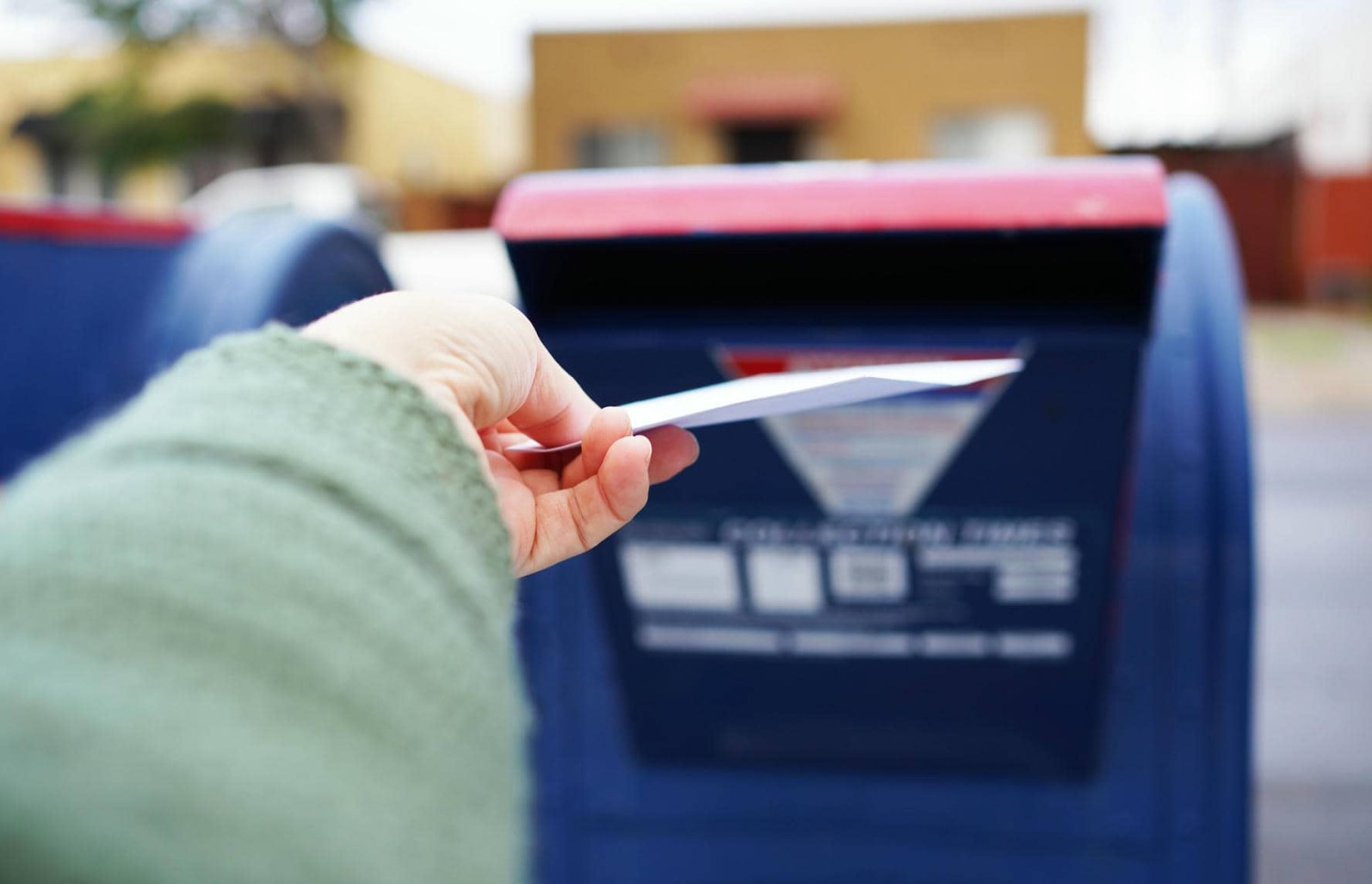
Every election cycle, tens of millions of Americans vote without setting foot in a polling place. Their local election office mails them a paper ballot, they mark it at home, and they hand it back to a letter carrier to return. Over the past three decades this has grown from a niche convenience into how almost a third of the country votes: the share of voters casting a ballot by mail rose from 7.8% in 1996 to 21% in 2016, surged to 43% in the pandemic election of 2020, and settled at 29% in 2024 (Figure 1). In that election, the U.S. Postal Service (USPS) carried roughly 99 million ballots to and from voters.

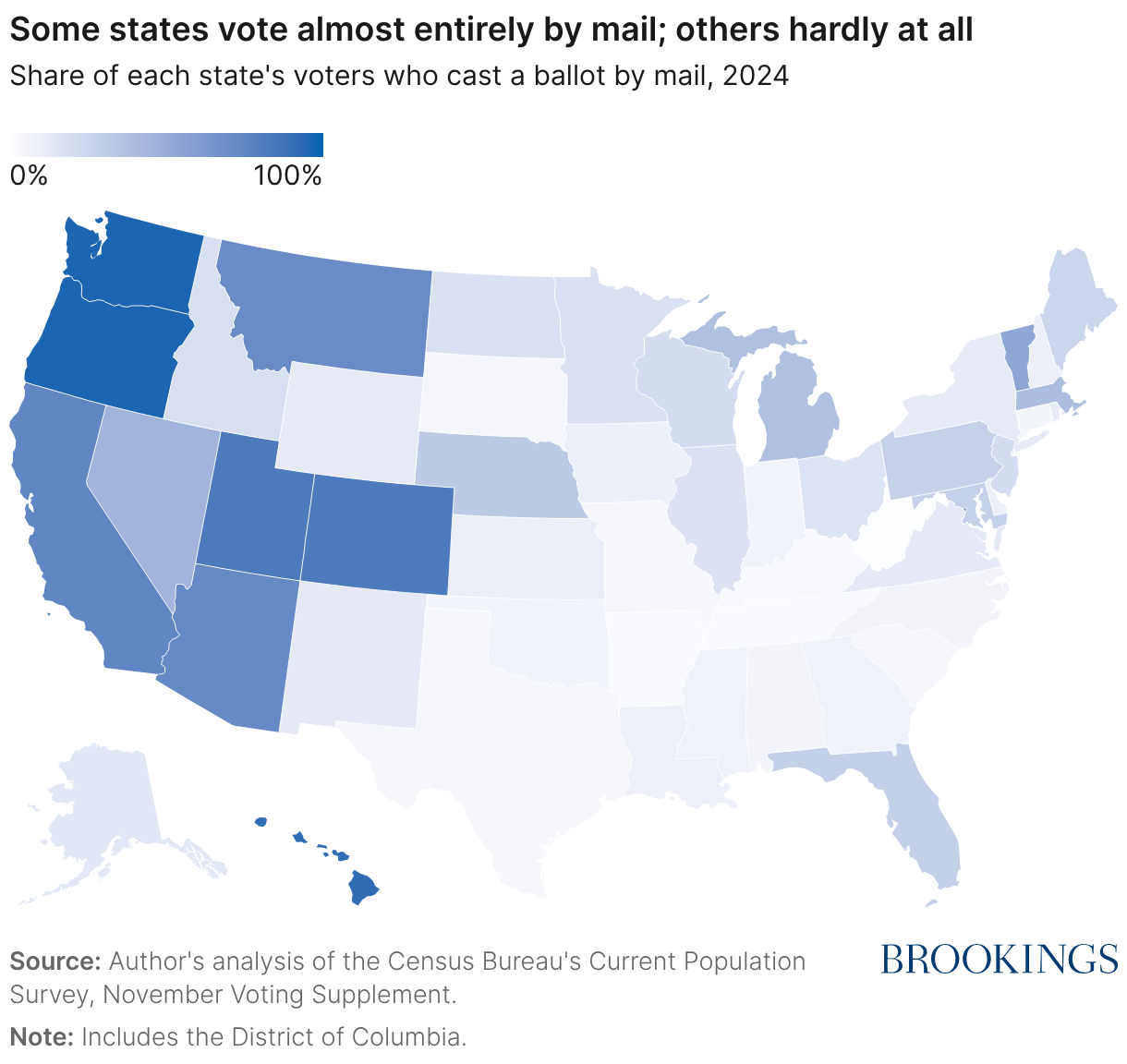
That national average masks wide variation among the states: in Oregon and Washington, more than 95% of voters cast their ballots by mail, while in West Virginia and Tennessee fewer than 3% do (Figure 2). Eight states and the District of Columbia now mail a ballot to every registered voter, while elsewhere voters must request one, often only if they have a specific reason for doing so. That approach began in the West, where Oregon became the first all-mail state in 2000 and much of the region followed. What determines a state’s mail-voting rate is this policy, not its geography: where a ballot arrives automatically, most voters use it; where it must be requested, as in rural West Virginia and Tennessee, far fewer do.
That scale turns a question most people never think about into an urgent one: what, exactly, is the Postal Service’s job in an election? The short answer is that USPS is a carrier, not an election administrator. It moves ballots quickly, neutrally, and at scale when states choose to run elections by mail, but it does not decide who may vote, how ballots are designed, or which ones count.
Several recent developments are converging on that narrow role. A Supreme Court ruling has reaffirmed that states can rely on postmarks as proof of timely voting at the same time the Postal Service’s own cost-cutting network overhaul has widened the gap between when voters hand a ballot to the post office and when it gets postmarked. A deepening financial crisis in the postal service, the reason for the overhaul, leaves the agency with little slack to absorb anything new. And a 2026 Trump administration executive order would push USPS to do the one thing it has always insisted it does not do: judge who may vote by mail, and refuse to carry the ballots of those who don’t comply.
The Postal Service moves ballots quickly, but on terms that others choose
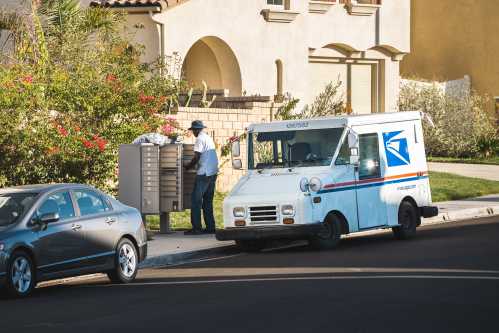
The Postal Service’s role is to deliver the mail. That’s the core mission. When states choose to run elections by mail, USPS’s job is to move ballots reliably and without favor, just as it handles every other piece of mail. Mail-in voting has been part of that delivery since 1864.
USPS doesn’t treat ballots as a special class of mail. Ballots travel to voters as either First-Class Mail, which has a shorter delivery window and can go by air, or Marketing Mail, which has a longer one and travels by ground. Election officials make that choice, not USPS. In 2020, more than 70% of outbound ballots went as Marketing Mail, the slower option. That choice, like nearly all other consequential decisions about how ballots move, belongs to the thousands of local election officials who use the mail, not to the Postal Service.
When election officials want better handling, USPS offers a formal toolkit outlined in the Election Mail Kit. Election officials can apply for the Official Election Mail logo on their envelopes, a visual signal to postal workers that a piece is a ballot. USPS can assign each ballot a unique barcode that allows real-time tracking. Election officials get a free design review from a USPS Mailpiece Design Analyst to optimize delivery speed. USPS offers Informed Visibility tracking, so officials can see exactly when ballots arrive and from where. And the Postal Service assigns dedicated Election Mail Coordinators to larger jurisdictions to help with planning and logistics. These tools are “strongly recommended” but optional.
In the weeks before Election Day, USPS shifts into an operational mode designed for ballots. Election Mail gets priority treatment regardless of which class an election official chose. USPS conducts daily facility sweeps to identify and extract ballots from the mail stream. Extra transportation runs move ballots directly from processing facilities to election offices, bypassing the normal regional sorting network. USPS processes mail on Sundays, something it doesn’t normally do. Ballots get expedited handling equivalent to Priority Mail Express. This operational surge comes at a cost. In 2020, extraordinary measures drove transportation trips up 35% and overtime costs up 30% in October and early November.
The result in 2024 was swift delivery: ballots reached election officials roughly one day on average after voters handed them to the mail. These speed figures, however, capture only ballots USPS could identify and track. By the Postal Service’s own estimate, nearly 40 million ballots it moved to and from voters that year went untracked.
The Postal Service is a carrier, not an election administrator
For all that it does, the Postal Service is not an election administrator, and it says so plainly. “The Postal Service’s role is clear,” the agency wrote after the 2024 election. “We deliver the mail.” In the same report, USPS set out the decisions that are not its to make: election laws and deadlines, ballot envelope design, ballot counting, and “the extent to which election laws rely on a postmark in determining whether a ballot is timely.”
A postmark, though, is two different things depending on which system is reading it.
To the Postal Service, a postmark is simply part of standard mail processing: the mark is typically applied to void a stamp—an action termed cancelation—so it can’t be reused. It’s typically applied at the processing facility, dated to the first automated processing operation. However, USPS doesn’t postmark every piece: some mail, like bulk mail, receives no postmark at all. In December 2025, USPS added a new section to its Domestic Mail Manual, “Postmarks and Postal Possession,” formally acknowledging that a postmark’s date “does not inherently or necessarily align with the date on which the Postal Service first accepted possession of the mailpiece,” and that this “lack of alignment has and will become more common” as its network changes.
Authority over American elections is highly decentralized. The Constitution assigns it to the states, which in turn hand most of the administration to local officials. There are more than 10,000 election jurisdictions in the United States, and USPS coordinates with roughly 8,000 local election boards. The rules vary not just from state to state but from one jurisdiction to the next within a single state.
Nearly every choice that determines how a ballot moves belongs to those officials, not to USPS. They design the ballot and the envelope. They pick the mail class, First-Class or the slower Marketing Mail. They decide whether to use USPS’s voluntary tracking tools, whether to prepay return postage, who receives a ballot, and, critically, when to mail ballots out. That last choice can be decisive: in 2024, officials sent 150,630 ballots to voters in the final week before the election, 31,260 of them on Election Day itself, leaving little time for those voters to return them by mail. State law, in turn, sets the request and return deadlines, whether a postmark governs timeliness, who is eligible, whether drop boxes are allowed, and whether voters can fix a rejected ballot. USPS carries, processes, and delivers what those thousands of jurisdictions hand it, to whatever standard they chose.
For more than a century, this division of labor has been stable: the Postal Service carries, and states and localities administer. That arrangement is now under pressure from several directions at once: a Supreme Court decision that leans on the postmark, a network redesign that undermines it, a financial crisis that constrains what the agency can absorb, and an executive order that would recast the carrier as a gatekeeper.
The postmark became decisive just as it became less reliable
One of the choices the Postal Service does not make is whether a postmark makes a ballot timely. That choice belongs to the states, and they are divided. In 33 states, a mail ballot must be in the election office’s hands by Election Day to count (Figure 3). In 17 states and the District of Columbia, it counts as long as it is postmarked by Election Day and arrives within a set window afterward. (Counting states that extend that grace period only to military and overseas voters, the number is closer to 30.) In that second group, the postmark is not a convenience. It is the evidence that decides whether a vote counts.

In June 2026, the Supreme Court affirmed that states may keep counting those ballots. In Watson, Mississippi Secretary of State v. Republican National Committee decided 5 to 4, the Court held that federal law fixes a single national Election Day for the act of voting but says nothing about when ballots must be received. Writing for the majority, Justice Barrett reasoned that the electorate’s choice “is made when voting is complete, not when ballots are received,” and that receipt is therefore left to state law. In effect, the postmark becomes the proof that a voter acted in time. Yet the case was not about the Postal Service: the plaintiffs did not challenge how USPS handles ballots, and the Court did not examine its operations.
That determination is far from a formality. In the 2018 midterm election, an estimated 114,000 mail ballots were rejected because they arrived too late to count. In the grace-period states, the postmark is the evidence that decides which ballots fall on which side of the deadline.
But all of this assumes that the postmark reliably records when a voter mailed the ballot, and increasingly it does not. A postmark is a byproduct of how the Postal Service processes mail, and that processing has changed. Under a network consolidation called Delivering for America (DFA), USPS now routes mail through roughly 60 regional centers in place of the nearly 200 processing plants it once used. For the rural post offices hit hardest by the change, mail now travels an average of 139 miles to reach one of these centers before it is sorted and postmarked, and sometimes more than 500; offices more than 50 miles out have dropped to a single morning dispatch. A ballot deposited on one day may not be postmarked until a day or more later, at a plant in another part of the state.
The strain is already visible. In the June 2024 primary in Iron County, Utah, thousands of ballots arrived bearing postmarks dated after the state’s mailing deadline; local officials first delayed certifying the results, then voted to certify without counting them, concluding that state law gave them no discretion. The Postal Service does not dispute the drift. Beyond the December 2025 manual change already noted, its election guidance now advises states to weigh “whether to rely solely on postmarks” in judging timeliness, and its inspector general has noted that many ballots do not ordinarily receive a postmark at all.
This tension surfaced inside the Supreme Court itself. In making the postmark the proof of timely voting, the majority did not address whether the postmark can reliably establish when a voter actually mailed a ballot. The dissent did. Writing for four justices on this point, Justice Alito asked: “May States use something other than a ballot’s postmark to determine when someone voted?” Some already do, he noted, relying on the date a voter signs the ballot envelope rather than the postmark. He asked what happens when a voter drops a ballot in the mailbox after the day’s last pickup—a delay consolidation only compounds—and pointed out that the Postal Service lets customers recall mail in transit, which raises the question whether a vote is “truly final” the moment it enters the mail. The majority’s rule, he warned, “opens Pandora’s box.”
The result is a mismatch at the center of election law: the postmark has become more legally decisive than ever, at the very moment the Postal Service’s own operations have made it less reliable than ever. For decades, the two readings of the postmark stayed aligned, because the date a ballot was postmarked was, in practice, the date it was mailed. As processing has become more centralized, that alignment is breaking down, opening a gap that at least four justices have already flagged.
A cash-strapped Postal Service cannot refuse or price a new mandate
The network changes that have pulled the postmark away from the mailing date were never about elections. They are part of DFA, a 10-year plan the Postal Service launched in 2021 to modernize its operations, improve efficiency, and cut costs. Consolidating mail processing into fewer, larger regional centers was central to that plan; ballots were incidental to it.
The plan has not closed the gap. The Postal Service has lost money every year since 2007, and it ended fiscal year 2025 with about $8.2 billion in cash, enough to run the agency for roughly 33 days. It has reached its statutory borrowing limit of $15 billion, a ceiling unchanged since 1992, so it cannot borrow its way out. In June 2026, Postmaster General David Steiner told the Senate the agency was “out of cash,” borrowing from its employees’ retirement funds to keep operating.
Unlike a private carrier, the Postal Service cannot manage its way around a new cost. FedEx or UPS might phase out or minimize a line of business that loses money, or raise prices to cover it. The Postal Service, bound by its universal-service obligation to serve every address at a uniform price, can typically do neither. Whatever new duties it is handed, it must absorb the cost out of current resources.
An executive order would turn the carrier into a gatekeeper
That new duty now has a specific form. In March 2026, Executive Order 14399, “Ensuring Citizenship Verification and Integrity in Federal Elections,” directed the Postal Service to write a rule under which it “shall not transmit” a mail-in or absentee ballot from any voter unless that voter has been enrolled on a state-specific list. Its stated aim is to keep ballots from reaching people who are not eligible to vote. Mail voting has divided sharply along party lines since 2020, though research on states that adopted it universally finds the method has not measurably helped either party. A proposed rule would carry the order out: each mailing of ballots would be checked against the list when it is presented for acceptance, and noncompliant mailings would be turned back.
For the first time, the Postal Service would judge whose ballots it will carry. Its leadership has said as much. Asked in June 2026 whether the agency would deliver ballots for a state that had not complied, Postmaster General David Steiner told the Senate, “We would tell the state that we need the manifest.”
Most of what the rule requires is not new in concept. Its standards for envelope design, the Official Election Mail logo, and ballot barcodes largely restate the practices USPS already recommends in the voluntary toolkit described earlier. The rule, however, would make voluntary standards mandatory. The consequential addition is the list. Each state would give USPS a Mail-In and Absentee Participation List, a roster of the voters approved to receive a mail ballot. When an election office brought its outbound ballots to the Postal Service to be mailed, USPS would check the mailing against that list before accepting it, and refuse to carry any addressed to a voter not enrolled. The gate falls on the first leg of the trip, before ballots reach voters at all.
This is a striking place to put a checkpoint. The rule is framed as a safeguard against ineligible voting, yet the gate does not fall on any voter. It falls on the election office, at the moment it hands the Postal Service the ballots that it has already decided to send. The Postal Service would refuse to carry a ballot that a local election administrator has already chosen to issue, checking the administrator’s own mailing against a list before letting it move.
Behind the participation list stands a federally built determination of who is eligible. The order directs the Department of Homeland Security to compile a “State Citizenship List” for each state, drawn from Social Security records and a federal immigration database called SAVE, and to transmit it to state officials before each election; the participation lists the Postal Service would enforce are meant to reflect it. This would move a basic decision about who may vote to the federal government. That decision has long belonged to the states and their local officials; under the rule, the federal government would build the list of eligible voters, and the Postal Service would enforce it.
The list, however, would be built on unreliable data, and it would leave the Postal Service holding records it has never kept. SAVE has misidentified citizens as noncitizens, at an error rate of 14% in one Texas county, and the Social Security Administration’s own general counsel has described its citizenship records as “merely… a snapshot of the individual’s citizenship status at the time of their interaction” with the agency. Under the rule, an error in that data would not just misflag a voter; it would stop that voter’s ballot from being mailed. And to run the check at all, USPS would compile and retain information it does not now hold. As one legal analysis put it, the agency would have “a trove of information about not only who is eligible to vote but also who voted, barcode by barcode.“
Whether the federal government can direct the Postal Service to do any of this is being tested in court. As of early July 2026, two federal courts had blocked the rule from taking effect. One, in a suit brought by California and more than twenty other states, declared the relevant parts of the order legally void and barred their enforcement in the states that sued, finding that the order intruded on the states’ authority over elections. A second court, enforcing a separate nationwide settlement that requires the Postal Service to maintain its established election-mail practices, extended the block across the country. The administration has appealed the first ruling to a federal appeals court and is continuing to defend the order; for now, the rule has not taken effect.
Four pressures now test one principle: ballots delivered without judgment
The Postal Service’s role in elections has always been narrow: it moves ballots, and it leaves to others the questions of who may vote and which ballots count. That role is now under strain from several directions at once. The Supreme Court has made the postmark decisive in close elections, even as the Postal Service’s own consolidation makes it a less reliable marker of when the agency actually received a ballot. The agency’s finances leave it little room to take on new obligations. And an executive order would recast the carrier as a gatekeeper, asking it to decide whose ballots move.
How much of this endures is unsettled. The rule may be revised, withdrawn, or struck down, and the litigation over it, with its unresolved questions about federal and state authority, may travel further. But the pressures beneath the rule will not resolve with it. The Postal Service will still be short of cash, and the postmark that election law relies on will still lag the day a ballot reaches the mail.
What is finally at stake is a simple assumption, one older than mail voting itself: that the carrier delivers ballots without judging them. Whether that assumption holds through the current pressures is, for the first time in a long while, an open question. For policymakers, the value of seeing these developments together is that they are not four separate problems. They are strains on a single institution, and on the expectation that the Postal Service can be counted on to carry the nation’s ballots, neutrally, wherever they are addressed.
Author

Related Content


The Brookings Institution is committed to quality, independence, and impact.
We are supported by a diverse array of funders. In line with our values and policies, each Brookings publication represents the sole views of its author(s).