Introduction
In our previous edition of Global Currents, we discussed the concept of the U.S. convenience yield, which is the borrowing-cost advantage the U.S. enjoys because investors value the safety and liquidity of Treasuries. There are different ways to measure this. One way is to compare Treasuries to other domestic debt securities and look at how the difference in yields between these two has evolved. Another is to look at U.S. Treasury yields versus yields on government debt in other advanced countries. This is the metric we examined in the previous post.
The U.S. convenience yield by this measure has disappeared over time. In the early 2010s, the U.S. was able to issue 10-year Treasuries on average over 10 basis points below its peers across advanced economies. This has flipped to a premium of over 10 basis points, i.e., U.S. debt issuance is now more expensive than that of its peers once you hedge foreign yields back into U.S. dollars. This erosion of the U.S. convenience yield has not been sudden and correlates most obviously with greater supply of Treasury debt, i.e., which suggests this may come down to our large deficits that are eroding the scarcity and specialness of U.S. Treasuries. This is something that’s been documented elsewhere, including in Jiang et al. (2025).
However, the calculations underlying convenience yields are really just a transformation of underlying asset prices, and financial markets are famously volatile. What is true today may not be true tomorrow because financial markets change their mind. Today’s follow-up post compares the U.S. convenience yield with those of two other countries that are traditionally considered safe havens—Switzerland and Germany—to gain more perspective on what is going on with this metric. Both countries have low public debt. Switzerland stands just below 40% of GDP, while Germany is around 65% of GDP, but recently softened its debt brake to help finance rearmament in the wake of Russia’s invasion of Ukraine. These debt levels are significantly below that of the U.S., which is approaching 130%. If rising public debt underlies the erosion of the U.S. convenience yield, this comparison may therefore offer some insight.
The comparison with Switzerland and Germany helps build intuition on how convenience yields behave. As eurozone debt worries have built this year, the convenience yield on Swiss government debt has unambiguously risen, while the picture for Germany is more complicated. Its convenience yield has eroded in recent years, especially since early 2025 when the debt brake was softened. More recently, the return of debt worries in the eurozone has lifted Germany’s convenience yield, but it remains low in historical perspective. In the recent escalation of sovereign debt concerns in Europe, the convenience yield (or premium) for the U.S. has been unaffected. This helps underscore that U.S. safe haven status is no longer what it once was.
A refresher on the U.S. convenience yield
Figure 1 shows the difference between the 10-year U.S. Treasury yield and a trade-weighted average 10-year yield on government bonds in Germany (DE), Japan (JP), the United Kingdom (GB), Canada (CA), Switzerland (CH), Sweden (SE), and Australia (AU), where 10-year currency forwards are used to hedge yields on these government bonds into dollars. This differential is therefore purely in dollar terms and a good proxy for how “special” markets think Treasury debt is compared to debt from similarly advanced economies. When this difference is positive, it means the 10-year Treasury yield is above the trade-weighted average of its peer economies, signaling that there is no convenience yield on U.S. Treasuries. Instead, the opposite is the case: markets are demanding a premium to hold U.S. debt. If the difference is negative, the U.S. is able to issue 10-year debt more cheaply than its peers after adjusting for currency denomination differences.

Figure 1 shows that the U.S. used to issue on average over 10 basis points more cheaply than the trade-weighted average of the selected countries, but this convenience yield eroded steadily and turned positive in 2018, meaning the U.S. began to pay a premium over its peers. This erosion continued until 2022, after which the premium the U.S. pays stabilized over 15 basis points and has edged down to around 10 basis points since 2025. This is likely because the rise in global interest rates since COVID-19 has shone a light on the precarious state of public finances globally, with high-debt countries in Europe looking especially vulnerable. This is helping the U.S. look better on a relative basis, but—of course—this does not mean borrowing costs in an absolute sense are falling. They are rising, just that they are rising elsewhere too. Du et al. (2026) have documented the sharp erosion in the U.S. convenience yield in recent years, though they find that the convenience yield for the U.S. dollar remains robust, underscoring that U.S. status as an investment destination and potential safe haven remains intact.
The behavior of the U.S. convenience yield—or now premium—is simultaneously intuitive and counterintuitive. It has been clear for a long time that fiscal policy in the U.S. is on an unsustainable path, so the convenience yield’s gradual erosion of the and its transformation into a premium makes sense. The switch in sign to a premium suggests that foreign demand for Treasuries is weaker than it once was—all other things equal—which means potential upward pressure on U.S. borrowing costs. At the same time, it is somewhat counterintuitive that the premium has fallen in recent years, even though U.S. foreign and domestic policy have been quite erratic. You would have expected—all else equal—the risk premium on Treasury debt to keep growing and not compress as it has actually done.
Looking at the convenience yields of Switzerland and Germany
Figure 2 is the exact analogue to Figure 1 for Switzerland. It shows the difference between the 10-year yield on Swiss government bonds and a trade-weighted average 10-year yield on government bonds in Germany (DE), Japan (JP), the United States (U.S.), Canada (CA), the United Kingdom (GB), Sweden (SE), and Australia (AU), where 10-year currency forwards are used to hedge yields on these government bonds back into Swiss francs. So just like in the U.S. case, this metric is in local-currency terms and therefore an exact replica of Figure 1 for Switzerland.
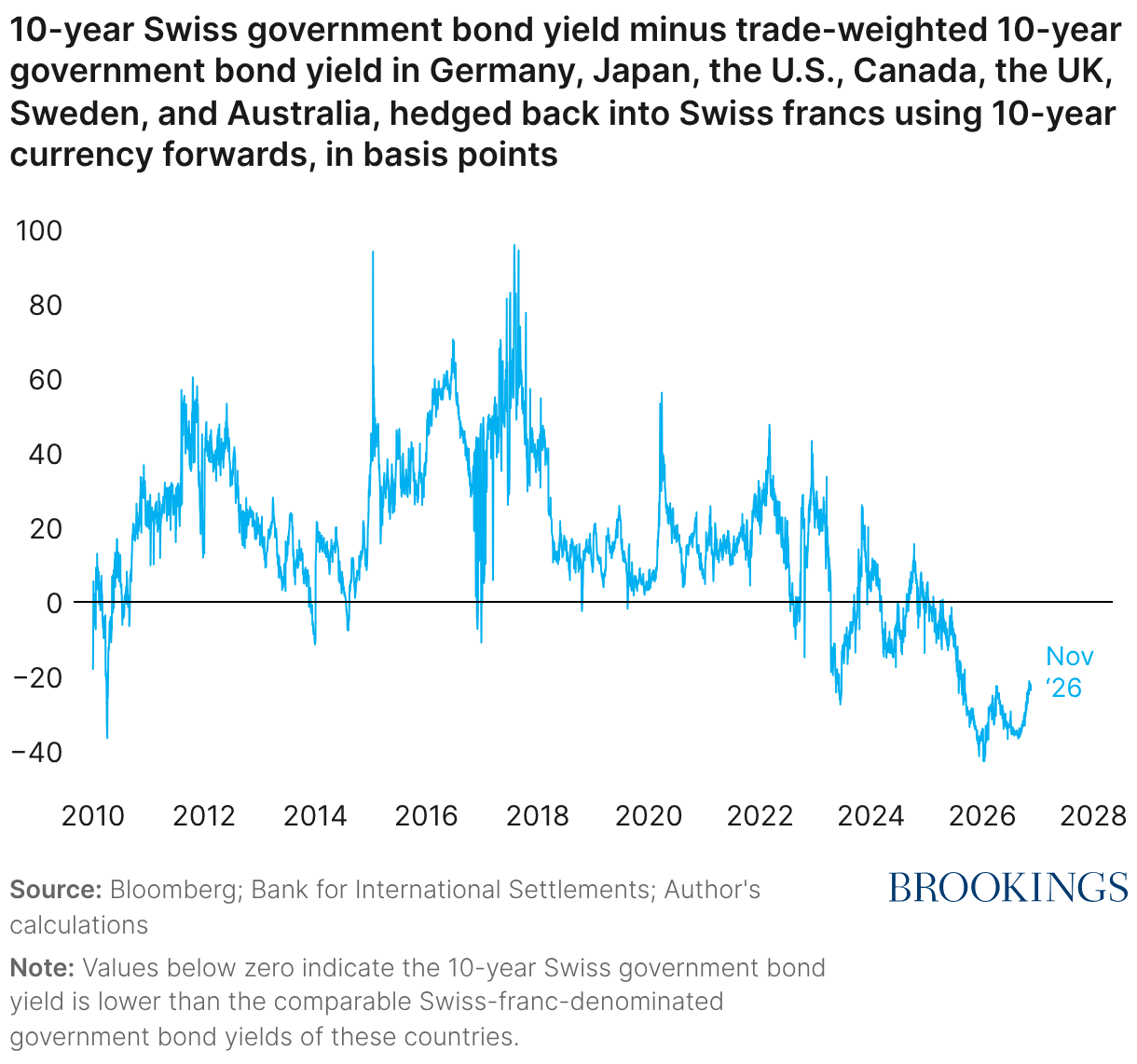
Swiss public debt stands below 40% of GDP, and the remarkable thing is that this metric suggests Switzerland has not generally had a borrowing-cost advantage relative to the countries in this sample. Figure 2 shows that there are two episodes when Switzerland did have a large convenience yield, i.e., in 2010 when the sovereign debt crisis in the eurozone first began and again in recent years as policy volatility in the U.S. increased and sovereign debt stress in the eurozone came back. This underscores two points. First, being a safe haven does not necessarily get you a convenience yield when global markets are calm. Switzerland has on average had to pay a premium on its debt issuance, which is quite remarkable. Markets don’t necessarily reward low debt and sound fiscal policy. Second, when the world becomes more volatile and demand for safe havens goes up, Switzerland benefits. The convenience yield in recent years has risen to near its historical highs.

Figure 3 is the same analysis for Germany and adds further intuition to the behavior of convenience yields, in particular, as the convenience yield for Switzerland has risen in recent years on greater volatility in global markets and the reemergence of debt stress in the eurozone. In contrast, Germany’s convenience yield has eroded in recent years, especially with the softening of Germany’s debt brake and large issuance needs to finance rearmament. It is true that the reemergence of sovereign debt fears in the eurozone has caused the German convenience yield to rise again this year, but it remains at historically low levels. This international comparison helps put the U.S. convenience yield (or premium) in perspective. The convenience yield is strongest for Switzerland where public debt is low and stable. It is on an eroding trend for Germany but the recent rise in debt worries has temporarily arrested that trend. In the U.S., the premium has not fallen further this year even as geopolitical risk has risen.
Conclusion
The international comparison in this post makes three big points on convenience yields. First, these measures are volatile, so—at any point—it is not the level that is informative but its evolution over time. In this regard, the trend has been unfavorable for the U.S., favorable for Switzerland, and a mixed bag for Germany. These differences map roughly onto the fiscal policy trajectories in the three countries.
Second, monetary tightening clearly plays a role in these measures. The COVID-19 hiking cycle penalized the U.S., driving the premium on 10-year Treasuries far above government debt elsewhere, while it benefited Switzerland and Germany. Monetary policy cycles therefore impact these measures on top of geopolitical and other risks.
Third, the fact that the U.S. premium has shrunk in recent years, which is counterintuitive, is effectively demonstrated through the lens of Switzerland and Germany, which, like the United States, are traditionally considered safe havens. Both countries saw their convenience yields rise as global uncertainty went up after 2022. This global uncertainty seems to have also benefited the U.S. to some degree, helping compress the premium it had been paying on Treasury debt in prior years.
The big takeaway from all of this leans in the direction that sound fiscal policy gets rewarded. That is why Switzerland and Germany have convenience yields and the U.S. pays a premium. It is also consistent with the erosion of Germany’s convenience yield in recent years as its debt brake has been softened. All that said, these measures are volatile because they capture financial market sentiment embedded in asset prices, which can vary from one day to the next.
Author

Global Currents
The Brookings Institution is committed to quality, independence, and impact.
We are supported by a diverse array of funders. In line with our values and policies, each Brookings publication represents the sole views of its author(s).



Commentary
Convenience yields and US safe haven status
November 20, 2026