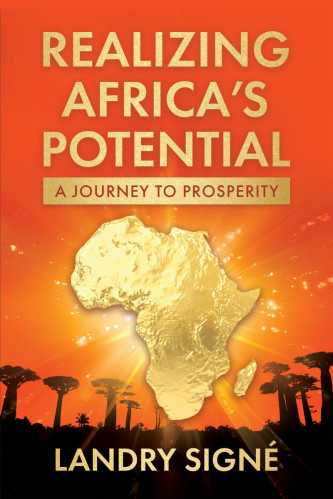
This commentary is part of the “Realizing Africa’s Potential” blog series. Purchase the related book by Landry Signé here.
Introduction
When Zimbabwe declared it would ban lithium concentrate exports by 2027, it joined a growing list of African nations attempting to rewrite the rules of resource extraction in advocating for more local processing. Zambia and the Democratic Republic of the Congo are building cross-border economic zones for electric vehicle (EV) batteries (whose global market is expected to grow from 8.8 trillion in 2025 to 46 trillion in 2050). Meanwhile, Namibia is laying the groundwork for its industrialization into a “green manufacturing hub” by 2050, a transition it estimates will quadruple national exports, create 250,000 new jobs, and add $10 billion to the country’s GDP. These moves signal a continent no longer content to remain the world’s quarry. Instead, as I explore in my book, “Realizing Africa’s Business Potential: A Journey to Prosperity,” Africa is positioning itself as a strategic partner in the supply chains of the future, including as a major player in the clean energy transition, leading to unprecedented investment opportunities on the continent.
The drivers
Global demand for minerals is surging: by 2050, lithium demand will rise tenfold, demand for cobalt will triple, and copper and nickel revenues could generate up to $16 trillion globally. Africa, with 30% of the world’s reserves, is and will be a main source for the minerals used to power advanced technologies used in automotive and aeronautical systems, defense technologies, AI hardware, medical devices, energy storage, and more. To meet the demand for clean energy technologies alone, the World Bank estimates that the production of minerals such as graphite, lithium, and cobalt “could increase by nearly 500%.”
The DRC already supplies 72% of global mined cobalt, South Africa is the world’s largest producer of platinum, and Zimbabwe is Africa’s lithium leader. Geostrategic competition adds momentum: China controls 87% of global refined rare earth production and invests between 37-46% of its total $21.7 billion in Africa in critical minerals specifically. Meanwhile, Europe and the U.S. scramble to diversify supply chains and lag in terms of investment (only 4% ($300 million) of the U.S.’s investment in Africa went to critical minerals). The U.S. is attempting to close this gap through strategic engagements with mineral-rich African countries, as illustrated with the selective U.S.-Africa summit which brought the presidents of Gabon, Guinea-Bissau, Liberia, Mauritania, and Senegal to the White House in July 2025. It is also pursuing targeted partnerships on critical minerals, including with the DRC. And regionally, the AfCFTA and initiatives like the Zambia-DRC Battery Corridor and Namibia’s hydrogen-linked policies create new foundations for value-added growth.
Related Content
The challenges
Despite having 30% of global critical mineral reserves, Africa’s share of global revenues from critical minerals sits at just 10%, reflecting key limitations and challenges.
Policy gaps can undermine credibility. Zimbabwe’s lithium ban is bold, but its current lack of refining capacity risks a repeat of the dominance of raw exports. Financing remains a persistent and elusive challenge. McKinsey estimates that less than 10% of the $9 billion in critical mineral projects on the continent have been financed. Revenue leakage through tax avoidance is costing African nations between $470 to $730 million annually, which is a huge detractor to potential fiscal benefits.
Governance issues such as weak institutions, corruption, and identity-based conflicts are also consistent challenges. The resource curse can be a challenge: encouraging rent-seeking in leaders and macroeconomic vulnerability due to export dependence. Direct job creation remains limited, with mining directly employing only 1-4% of the formal workforce in mining-heavy countries, a figure that will likely shrink as automation advances. Meanwhile, infrastructure gaps in power, logistics, and refining make the cost of mining significantly higher (250%) in Africa than the global average.
The opportunities
Yet even amidst these challenges, the window for transformation is wide open for investors and African countries alike. Boston Consulting Group estimates that for every $1 billion invested in mining and processing, 3,000-6,000 jobs are created (direct, indirect, and induced jobs), $100 million is spent on regional infrastructure, $210-280 million is added to annual GDP in steady state, and $70-100 million is added to government revenue in steady state.
Africa can leapfrog legacy systems by building transparent; environmental, social, and governance compliant; and digital-first supply chains. While full-scale production of EVs is unrealistic for every country, early-stage processing of copper and lithium can anchor industrial ecosystems. Regional specialization offers a potential path forward. Zambia and the DRC have begun co-developing a battery corridor, while Morocco positions itself as a phosphate hub and Rwanda pioneers traceability systems. Smart use of mining revenues can build resilience and broad-based growth. Most importantly, the global race for minerals gives Africa unprecedented leverage to demand technology transfer, infrastructure, and fairer terms in exchange for access.
Recommendations
To seize the moment, Africa’s leaders must act decisively and investors should be involved via public-private partnerships to streamline regulations, strategies, and information sharing. Countries with existing infrastructure and technical support for the mining sector (such as Botswana, the DRC, South Africa, Namibia, and Tanzania) offer investors a reliable location while countries with less infrastructure (such as Ghana, Zambia, Mozambique, and Kenya) offer high returns for first movers. Each country and investor will require targeted strategies that play to each individual country’s strengths whether by adding value through refining, component manufacturing, or services. Accelerating regional integration will also be key, using the AfCFTA to build distributed value chains where one nation extracts, another processes, and another manufactures. Advanced technologies also offer investors new opportunities across the supply chain, including using renewable energy capacity at mining sites themselves.
All in all, Africa’s critical minerals are the building blocks of the clean energy future, unlocking opportunities for both investors and African countries to mutually benefit from Africa’s prosperity. The mining industry now requires leadership, foresight, and the will for governments, civil society, and investors to act collectively to turn the opportunities into tangible outcomes.
Author

The Brookings Institution is committed to quality, independence, and impact.
We are supported by a diverse array of funders. In line with our values and policies, each Brookings publication represents the sole views of its author(s).
Commentary
How Africa can benefit from the global mineral rush
June 4, 2026