On July 23 the EU announced its 21st package of Russia sanctions. The energy-related measures included a freezing of the price cap on crude oil at $44 per barrel through July 2027, restrictions on transactions with select Russian oil refineries, monitoring of sales of liquefied natural gas (LNG) tankers for Russian trade, and bans on the transport of Russian LNG—although this ban was undercut by an exemption for Greek ships to transport arctic-sourced Russian LNG.
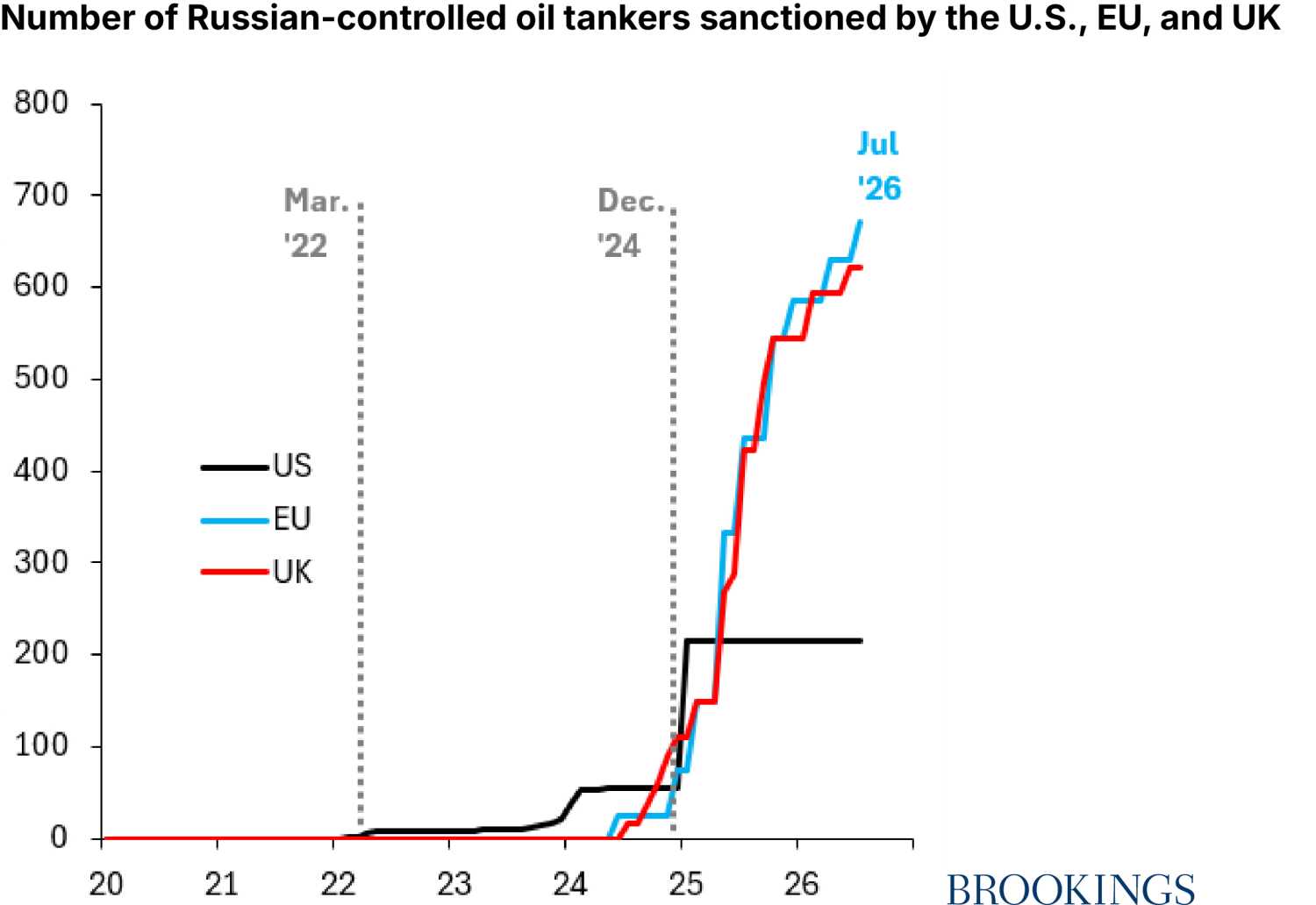
The latest package also sanctioned an additional 40 “shadow fleet” vessels, a massive fleet built by Russia to circumvent the G7 price cap and export oil on its own terms. Over the past two years, we have carefully tracked shadow fleet sanctions progress across the G7, documenting the dramatic shift in approach across EU, UK, and U.S. sanctioning authorities. At the end of the Biden administration, the U.S. was leading the effort to sanction shadow fleet tankers, designating 216 such ships compared to 75 and 110 for the EU and UK respectively. However, an aversion to Russian tanker sanctions by the Trump administration, coupled with relatively aggressive actions by European authorities, has made the EU and UK the global leaders in shadow fleet sanctions.
The disparate approach to tanker-based sanctions has shed new light on the efficacy of coordinated sanctions. As we have shown in previous empirical work, comparing the activity of U.S.-sanctioned tankers to those sanctioned only by the EU and/or UK suggests that a United States designation carries outsized weight on the ability of a tanker to transport Russian oil. In this post, we update both the relative progress across jurisdictions as well as the overlap across various authorities. We conclude by listing promising sanctions actions to slow Russia’s ability to profit from the oil trade.
Europe’s wave of shadow fleet sanctions
Over the past two years, Europe has emerged as the clear leader in terms of the number of shadow fleet ships sanctioned. Figure 1 plots the number of vessels sanctioned by the EU (blue line), the UK (red line), and the U.S. (black line). As of July 2026, the EU sanctioned a stunning 671 ships, a level that stood at 25 ships as recently as July 2024. The UK has achieved similar progress and now sanctions 621 ships; vastly higher than the 17 ships it had sanctioned as of July 2024. The EU and UK sanctions wave stands in stark contrast to the U.S., which hasn’t sanctioned any Russian shadow fleet vessels since the conclusion of the Biden presidency.
The indifference towards the shadow fleet has been compounded by the Trump administration’s general lack of action on Russian sanctions. The most notable exception is when the administration joined Europe in sanctioning major Russian energy companies Rosneft and Lukoil, a move that sharply reduced demand for Russian oil and thus markedly widened the discount on Russian crude. However, price pressures owing to the war with Iran prompted the administration to issue waivers for the sale of Russian oil stranded in seaborne storage, which increased demand for Russian crude and offset much of the impact of the initial measure. In addition, while the Lukoil sanction was designed to spur the sale of the company’s assets, the U.S. Treasury has yet to approve a buyer and Lukoil has been allowed to continue much of its operations in the meantime.
Source: Foreign, Commonwealth & Development Office, Official Journal of the European Union, and the U.S. Treasury
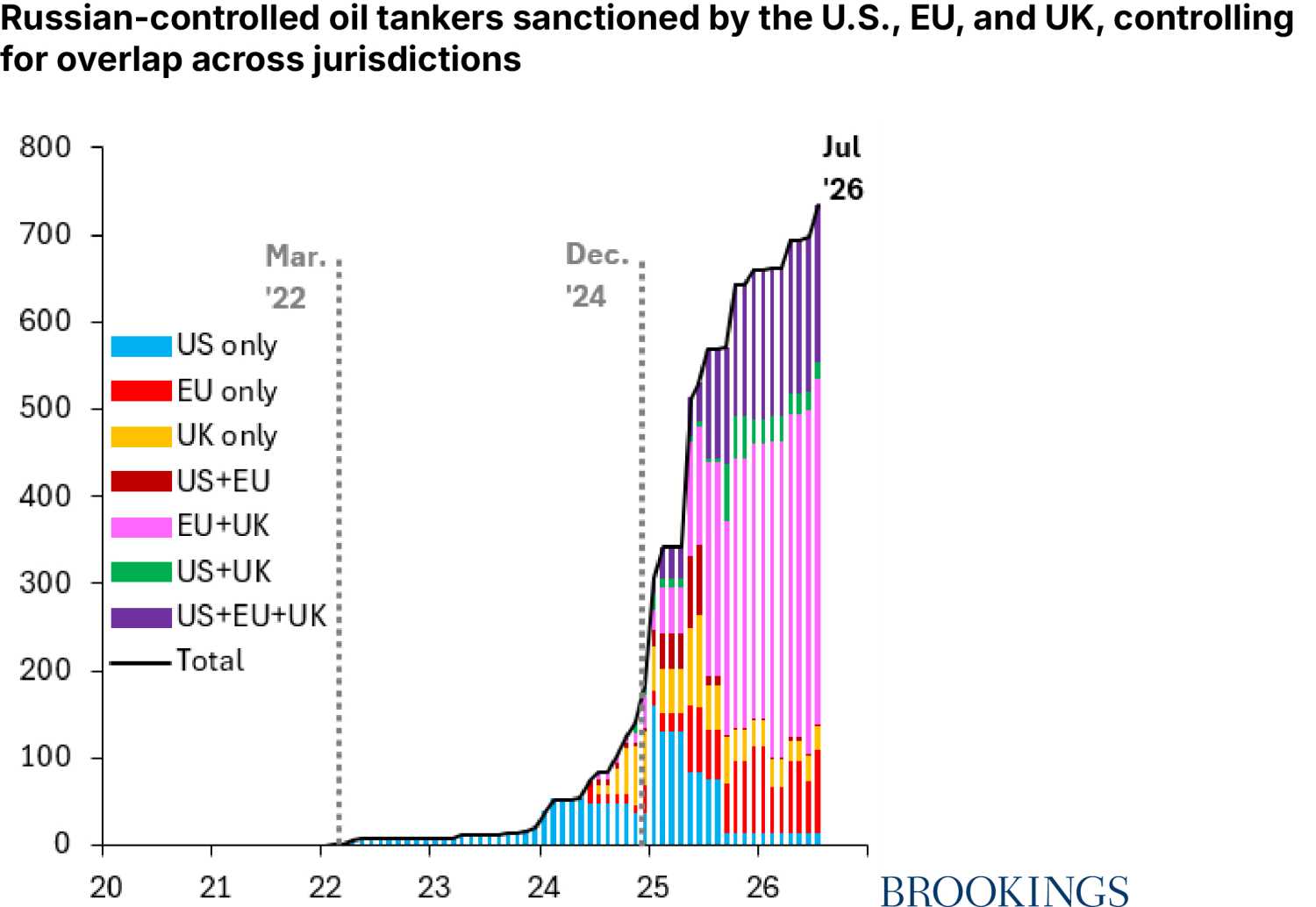
Our prior work emphasized the extent of the overlap in shadow fleet sanctions across the U.S., UK, and EU, focusing in particular on the outsized progress by Europe relative to the U.S. The European sanctions wave over the past two years has led to two important changes in the pattern of sanctions coordination. One, Europe has substantially increased overlap with existing U.S. sanctions by designating most of the tankers targeted by the Biden administration. Figure 2 shows that the number of vessels sanctioned jointly by the U.S., UK, and EU has grown to 178 ships as of July 2026 (purple bars), up from zero in July 2024. Two, the EU and UK have moved in the direction of coordinating their sanction activity more and now jointly sanction 395 additional vessels (pink bars), up from seven in July 2024.
Source: Foreign, Commonwealth & Development Office, Official Journal of the European Union, and the U.S. Treasury
The problem of weak sanctions efficacy
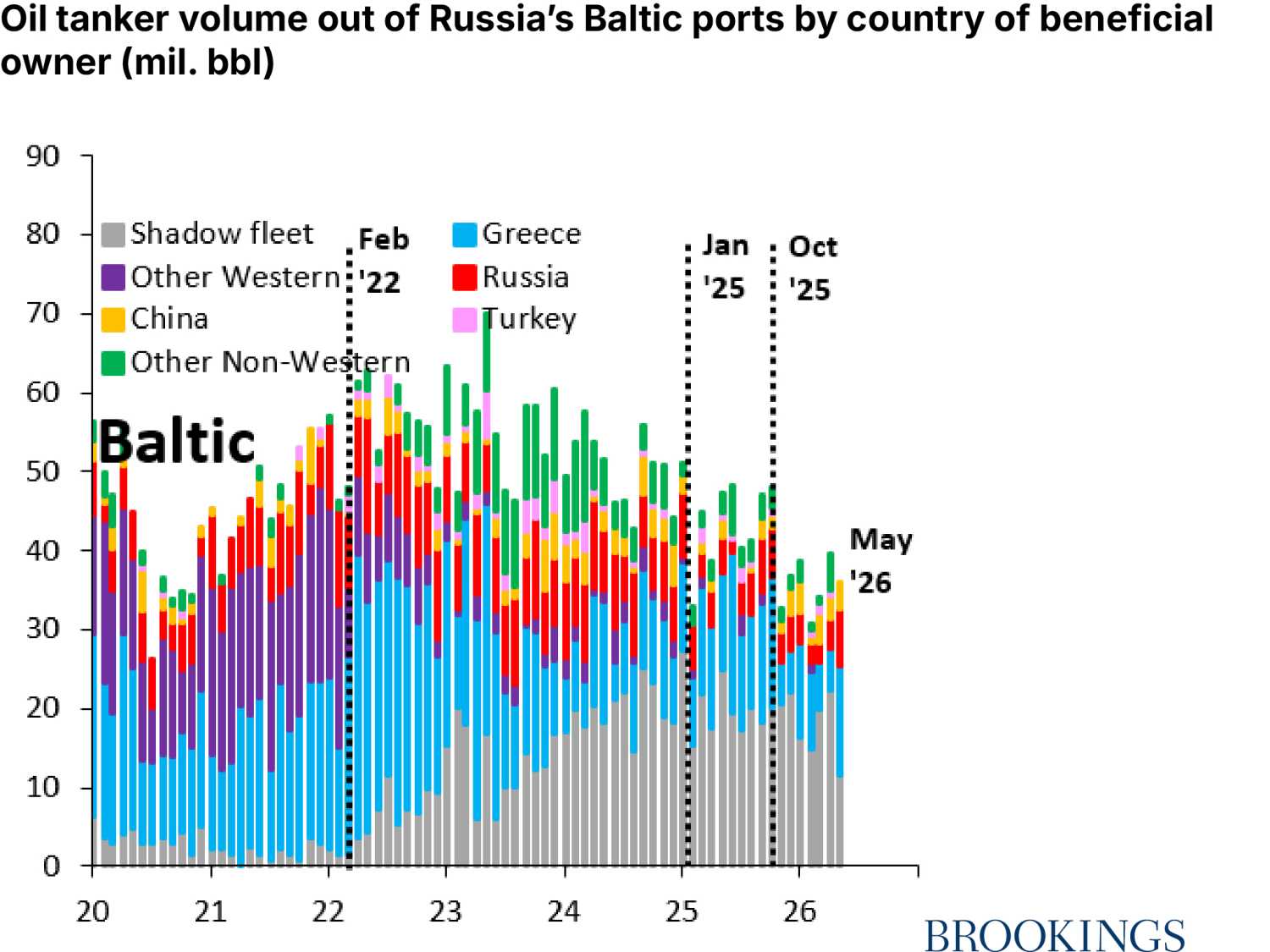
While progress on sanctioning shadow fleet vessels and the improved coordination are undeniable, Europe’s shadow fleet sanctions have had only a limited impact on Russian oil exports—likely due in part to the lack of U.S. involvement. The limited impact can be seen by monitoring oil tanker activity out of Russian ports in the Baltic Sea, the exit point for about half of Russia’s seaborne oil exports. Figure 3 shows monthly oil export volumes out of Russia’s Baltic ports broken down by country of ownership. The gray bars represent our proxies for shadow fleet vessels—ships for which we cannot identify the owner and that don’t carry western insurance. Over the course of Russia’s war on Ukraine, shadow fleet activity and that of non-western ships has grown sharply, rising from roughly 25% of total capacity out of the Baltic to 70% in 2025. While we cannot observe a counterfactual outcome in which no tankers are sanctioned, the shadow fleet continues to carry a substantial share of Russian oil exports from the Baltic, suggesting that European sanctions alone have not significantly constrained its exports.
Source: Bloomberg
Potential further actions against Russian energy
Perhaps the most promising way to put greater pressure on Russia’s revenue from seaborne oil exports would be for the U.S. to sanction all the ships now sanctioned by the UK and the EU. As we discussed in earlier work, vessels sanctioned by the U.S. have substantially larger reductions in shipping activity than EU-only or UK-only, a difference that may reflect the deterrent effect of U.S. secondary sanctions, for which there’s no parallel in Europe. To achieve comprehensive coverage across these jurisdictions, the U.S. would need to sanction an additional 518 tankers currently sanctioned by the EU and UK. This would likely immediately impact shadow fleet activity in the Baltic and force Russia to either increase use of western ships that adhere to price caps or reduce its export volume.
While such an action by the U.S. Treasury seems unlikely given its established record since January 2025 and the continued pressure on oil prices from the closure of the Strait of Hormuz, congressional activity may force the issue. The U.S. Senate recently advanced the Shadow Fleet Sanctions Act as part of a larger effort to target the Russian military and energy sector. This legislation would mandate the U.S. sanction shadow fleet tankers that circumvent western sanctions and introduce measures that better align American and European sanctions against the shadow fleet, while also targeting a host of other deceptive elements of the Russian oil trade.
Whether or not Congress ultimately mandates additional U.S. designations, Europe has a strong interest in reinforcing the efficacy of its own sanctions regime. One promising option would involve cracking down on shadow fleet activity by holding states like Panama, Liberia, and Barbados accountable for their oversight of flagged vessels. In recent work with scholars at Yale Law School, we elaborate on this strategy and estimate that, if enforced stringently, this approach could reduce Russian revenues from Baltic ports by 14%. Collectively, these actions could significantly strengthen enforcement of the G7 price cap and further constrain Russia’s oil revenues.
Authors


Global Currents
The Brookings Institution is committed to quality, independence, and impact.
We are supported by a diverse array of funders. In line with our values and policies, each Brookings publication represents the sole views of its author(s).

Commentary
An update on Europe’s Russia sanctions
August 6, 2026