The Thucydides trap captures the increased risk of conflict as an incumbent power is challenged by a rising power. Coined by Graham Allison, the term harks back to the ancient Greek historian Thucydides who wrote that the threat perceived by Sparta, the established hegemon, from the rise of Athens made economic conflict and eventually a war—the Peloponnesian War—inevitable.
The Kindleberger trap, a term coined by Joseph Nye, captures the risk of a leadership vacuum and economic instability when the international power structure shifts. It recalls the economist Charles Kindleberger who argued that the decline of British power in the 1930s and the unwillingness of the United States, the rising power, to assume global leadership as the world economy faced shocks contributed to the Great Depression.
Fast forward to the present, and we see this history flashing warning signs again. The Thucydides and Kindleberger traps loom large over global economic governance today.
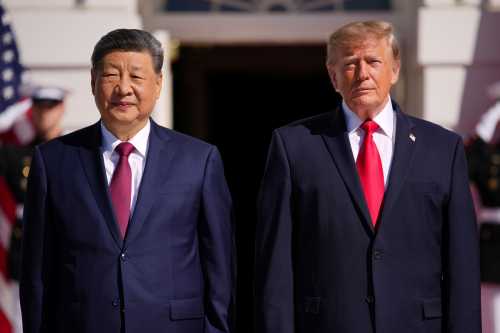
The world is seeing an epochal geopolitical transition. The rise of China, and other new economic powers, is ending the postwar unipolar world order led by the United States. Intensifying international power rivalries, particularly between China and the United States, and populist politics are fueling economic nationalism. Economic interdependence is being weaponized, and geopolitical power plays are supplanting rules-based frameworks for international engagement. The dominant neoliberal policy paradigm is being upended: Nationalist industrial policies and protectionism are on the rise even in economies—notably the United States—that had been the champions of free markets and open trade. The U.S.-China trade war is the most vivid illustration of major-power geopolitical rivalry translating into economic conflict.
The postwar multilateral system for economic cooperation is threatened by its very architect—the United States—as the Trump administration’s “America First” agenda pivots sharply from multilateral engagement toward unilateral action. An alternative “benevolent hegemon” is not in sight, with China both unable and unwilling to step up to the responsibilities of a global leadership role.
Related Content
Global economic governance thus faces a destabilizing mix of major-power conflict and leadership vacuum. Some of its harmful effects are already evident—in the increasing fragmentation of the global economy, as trade and investment shift along geopolitical lines, and the fracturing of its governance. These effects may well intensify, producing outcomes that have no winners and leave all worse off.
How should global economic governance adjust to the changing world order? The agenda involves action across three levels: global, plurilateral, and national.
First, at the global level, the governance architecture is likely to become less centralized and more distributed, as the legacy global multilateral institutions increasingly share governance space with an array of subglobal entities and initiatives. With the shift toward a multipolar world and the erosion of the neoliberal policy paradigm, global economic governance is also likely to become less prescriptive and more reflective of the heterogeneity of preferences and policy choices across nations. This evolution must still be grounded in core shared principles, most fundamentally the need to base international economic interactions on agreed rules rather than simply power. And the distributed governance architecture must ensure that the world has the collective ability to address common challenges, not least the potentially catastrophic consequences of climate change. The role of global institutions will continue to be important in these dimensions.
But to remain effective, the global institutions need major reform. In finance, for example, multilateral institutions, notably the IMF and the World Bank, must revamp their policy frameworks, sharpen their focus on the provision of critical global public goods such as financial stability and climate sustainability, and enhance their legitimacy through more representative governance structures. In trade, the WTO must embrace more flexible modalities of cooperation among countries and modernize the rule book to better address today’s issues around competition policy, national security interests, and the digital transformation of international commerce.
Second, forging universal consensus on big issues will be difficult in the context of intense strategic competition between major powers amid an unfolding geopolitical transition. But groups of countries can still find viable domains for cooperation through a variety of plurilateral initiatives that preserve rules-based international engagement and offer pathways to address today’s pressing challenges in managing interdependence in trade and finance, governing artificial intelligence, and stewarding the global commons, Such “pathfinder multilateralism” can bypass major-power gridlock and catalyze action and wider cooperation down the road. Promising current plurilateral initiatives among coalitions of countries range from trade agreements to climate clubs.
Alliances among middle and small powers, which are more vested in the advantages afforded by a rules-based order, can provide ballast against geopolitically driven fracture of global governance. Such rules-supporting countries can act as a stabilizing “third pole” in the emerging multipolar world. Furthermore, intergovernmental forums that cut across geopolitical and economic divides, notably the G20, can convene major actors around common global challenges and help manage interpower rivalry.
Third, countries must bolster the resilience of their own economies. De-risking national economies in a volatile geopolitical environment is not a choice but a necessity. This includes building trade resilience but also reducing macrofinancial vulnerabilities. The adage that strong international economic engagement begins at home holds even truer today.
The Thucydides and Kindleberger traps present clear and present risks as the world order shifts. But they are not destiny. History also shows that at challenging times nations can come together to build new forms of cooperation. There are opportunities in the current transition to rebuild global economic governance for the 21st century.
Author
The Brookings Institution is committed to quality, independence, and impact.
We are supported by a diverse array of funders. In line with our values and policies, each Brookings publication represents the sole views of its author(s).
Commentary
Global economic governance: Navigating the Thucydides and Kindleberger traps
August 11, 2026