Introduction
President Donald Trump’s “America First” trade policy did not just produce the largest increase in tariff rates in decades. It also marked a structural change in how U.S. tariffs are used and governed, altering their scope, function, and governance in ways that are likely to last beyond the end of the president’s term. The Trump administration relied on multiple statutory authorities, deploying country- and industry-specific measures toward a range of objectives, while introducing novel design features such as tariffs based on the value of embedded inputs and tariffs contingent on firm-specific commitments. Over time, exemptions and adjustments to country-level tariffs further reshaped their effective coverage.
The result is a tariff regime that is more administratively complex and less predictable than the system that preceded it—less anchored in fixed commitments and more contingent on presidential discretion. Market access is more conditional across partners and more responsive to political and economic pressures. This more flexible and active approach has given the administration a powerful tool of economic statecraft, turning tariffs from primarily economic policy instruments into tools for pursuing a broader and more discretionary set of foreign policy and national security goals.
For firms making long-term decisions about sourcing, hiring, investment, and production, the implications extend beyond the level of duties to higher compliance costs. Origin, classification, and eligibility are now central to strategic decisionmaking for manufacturers and downstream firms alike. This new approach also introduces greater uncertainty over the duration, scope, and application of tariffs. A framework intended to promote domestic manufacturing capacity, economic security, and bargaining leverage may, in practice, introduce costs and instability that undermine those objectives.
All this represents a significant break from the assumptions and practices that governed the post-war trading system. It is the baseline that the next set of decisionmakers will inherit. It will shape choices within this administration, in the next presidential administration, and in Congress as it considers the role of legislation in defining trade authority. It will also shape how the United States interacts with trading partners, how firms organize production and investment, and how economic tools are used in geopolitical competition.
The baseline: A brief detour into trade policy past
For most of the postwar period, U.S. tariff policy operated within a multilateral framework anchored in carefully negotiated commitments. Tariff rates were set through successive rounds of multilateral negotiations and applied on a most-favored nation (MFN) basis, with lower preferential rates extended through a network of free-trade agreements. These agreements were negotiated by the executive branch, approved by Congress, and embedded in domestic law. This system provided a high degree of predictability for firms and trading partners, with tariff levels and market access anchored in negotiated commitments and adjusted through established legal processes under multilateral rules.
Any increase in tariffs was typically narrow and targeted, applying to specific products, countries, or firms to address defined trade problems. Most often, these measures were used as remedies for harm to a domestic industry or for violations of trade agreements. They were imposed through established legal processes with clear standards and institutional checks. For example, antidumping and countervailing duties—typically initiated by domestic industries—are investigated and adjudicated by independent agencies, while tariffs on specific trading partners were usually authorized following dispute-settlement findings under the World Trade Organization (WTO) or other agreements. In practice, raising tariffs was limited in scope and subject to a high procedural bar, whether for protection or retaliation.
This framework was not without tension. Even within a rules-based system, trade policy was used to pursue national interests, and the balance between multilateral commitments and unilateral action was often contested. At the same time, bipartisan concern grew over the domestic effects of globalization and China’s integration into the world economy, particularly its impact on manufacturing employment, industrial communities, and the distribution of economic gains. Disputes over enforcement, the limits of WTO processes, and the scope of permissible policy interventions reflected an ongoing tension between rules-based governance and more discretionary approaches to economic policy.
The first Trump administration moved unilateral, executive-driven tariff actions from the margins to the center of U.S. trade policy. Congress had delegated substantial trade authority to the executive branch over time, in part out of concern that legislators would be more susceptible to protectionist pressures and industry-specific demands. The administration imposed additional duties on a broad swath of imports from China under Section 301 of the Trade Act of 1974 (Section 301), using an expansive justification and bypassing the WTO process that had largely governed bilateral disputes since 1995. These measures were framed as responses to longstanding concerns about China’s trade practices, but they were implemented through a process that was self-initiated and outside established dispute-settlement channels. The result was a cycle of tariff increases and retaliatory measures that defined the U.S.-China “trade war.”
The administration also elevated rarely used statutory authorities—Section 232 of the Trade Expansion Act of 1962 (Section 232) national security tariffs and Section 201 of the Trade Act of 1974 (Section 201) safeguard tariffs—into active instruments of industry protection. Neither had been central to U.S. tariff policy in recent decades. Their use in 2018 was controversial because it relied on authorities designed for specific contingencies—national security threats and import surges—to justify measures that critics viewed as protectionist and trading partners viewed as undermining the rules-based order.
Rather than reversing this shift, the Biden administration retained the Section 301 tariffs on China and the Section 232 tariffs on steel and aluminum. While it adjusted their application—negotiating arrangements with allies to reduce Section 232 tariffs and conducting the required statutory review of Section 301 measures—it did not return to the prior WTO-centered approach. The continued use of these authorities since 2018 has effectively normalized their use as part of the U.S. trade policy toolkit.
How trade policy unfolded after January 2025
The tariff actions of 2025 were not simply an expansion of existing policy tools, but a reconfiguration of how tariffs are used—layering multiple authorities across countries and sectors and deploying them as instruments of economic and geopolitical strategy. Tariffs have been used to reshape the structure of domestic production, rebalance relationships with trading partners, and exert leverage on issues that extend beyond trade.
The reconfiguration of the trade regime pursued by the second Trump administration has three main components: country-level tariffs, industry-level tariffs, and bilaterally negotiated agreements that adjust tariff exposure in exchange for policy concessions.
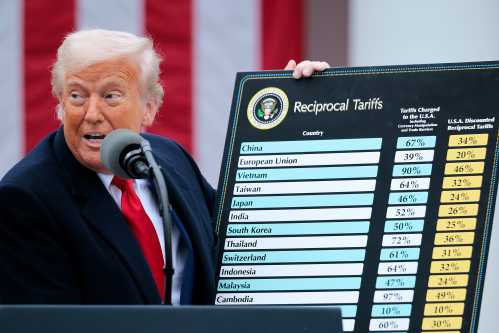
Country-level tariffs, initially imposed under the International Emergency Economic Powers Act (IEEPA), placed broad surcharges on imports from nearly all U.S. trading partners, including the across-the-board tariffs announced on “Liberation Day.” These measures departed from the MFN principle and established a new, country-specific tariff baseline that could be used as leverage in negotiations. In some cases, these tariffs were also used for partner-specific actions tied to discrete foreign policy objectives. For example, the administration imposed a 40% tariff on imports from Brazil in 2025, framed as a response to “unusual and extraordinary” threats. Similar threats were directed at other partners in the context of immigration and territorial disputes. The announcement of the broadest measures also triggered sharp market reactions, contributing to subsequent adjustments and partial retreats from some of the most extreme proposals. Although the Supreme Court invalidated the use of IEEPA for broad-based tariffs, the administration has sought to preserve a similar structure through other authorities. At the same time, exemptions and exceptions allowed the administration to adjust the domestic economic impact of these tariffs while maintaining their value as a tool of external leverage, effectively turning them into a flexible instrument of economic statecraft.
Facing the prospect of higher tariffs, several countries entered bilateral negotiations to reduce their tariff exposure. These agreements have been negotiated on a country-by-country basis with terms that vary across partners. In principle, they address bilateral trade imbalances through adjustments to market access and other policy commitments. In practice, they often address longstanding bilateral irritants—issues that had persisted for years in U.S. trade policy reviews, such as regulatory barriers and market access restrictions—while also securing commitments for purchases or investment that relied on government direction rather than market mechanisms. Beyond economic outcomes, these agreements were also used for national and economic security priorities, further blurring the line between commercial policy and strategic objectives.
In parallel, the administration deployed industry-level tariffs under the national security authority, Section 232, as a central tool of industrial policy. Under President Trump, national security has been defined to include domestic production capacity, industrial resilience, and technological leadership—framing economic capacity as a national security concern and expanding the scope for tariff intervention across a much broader set of sectors.
This broader definition supported a significant increase in both the number and range of Section 232 investigations, extending into areas that had not previously been treated as national security concerns. These measures are intended to increase domestic production in raw materials and priority industries. Although many investigations are motivated by concerns about China’s role in global supply chains, the resulting tariffs are generally applied across trading partners, extending their effects well beyond the countries that may have prompted the underlying action.
The administration also experimented with more targeted tariff designs intended to shape where and how production occurs within globally integrated supply chains. These designs seek to make tariffs more precise tools for influencing production decisions, but they also introduce substantial complexity and administrative burden.
How firms experience an unsettled tariff regime
For firms, the use of tariffs as a tool of economic statecraft changes the calculus of how and where to produce, invest, and trade, often shifting the costs of achieving the Administration’s policy objectives onto firms themselves. Firms now operate in an environment where U.S. tariff coverage, exemptions, and eligibility rules can change rapidly through negotiation, investigation, or executive action, forcing trade policy to be treated as a variable rather than a fixed parameter. This shift not only affects sourcing, but also pricing— whether firms absorb higher costs through lower profit margins or pass them on—as well as longer-term decisions about investment, hiring, inventory management, supply-chain organization, and market participation. Firms must behave in ways that allow them to remain profitable and continue to operate, hire, and invest. They respond by shifting sourcing, relocating production across borders to minimize tariff exposure, delaying investment, or redirecting trade toward less exposed markets. In globally integrated industries, these adjustments can reorganize production in ways that do not translate cleanly into the policy objective of expanding domestic output.
In practice, firms encounter this shift most directly through country-level tariffs, where broad coverage and discretionary adjustment introduce substantial uncertainty into pricing and investment decisions. Country-level tariffs imposed under IEEPA operated as broad bilateral shocks, with rates that could be modified through negotiation or executive action without clear criteria or guaranteed duration. Importing firms therefore faced uncertainty about the level and persistence of tariff costs. That uncertainty is itself economically costly: It leads firms to delay investment, limit entry, and avoid committing to new sourcing or production arrangements.
Section 232 tariffs are intended to protect targeted domestic industries and expand U.S. production. In practice, they operate simultaneously as protection for upstream producers and as input-cost shocks for downstream firms. Because these effects pull in different directions, the resulting signal to manufacturers is indirect and may not align with the objective of expanding domestic production. While some upstream industries benefit, higher input costs for downstream producers can reduce competitiveness and offset those gains. The result is not a straightforward expansion of domestic production, but a reallocation of activity across stages of production, as cost shocks propagate through supply chains.
The effects extend beyond imports to export demand. Even without sustained retaliatory escalation, many trading partners have responded to U.S. tariff volatility by reducing their exposure to the U.S. market through supply-chain diversification, alternative sourcing, and deeper trade and investment relationships elsewhere. These “de-risking” strategies can gradually shift investment and procurement away from U.S.-linked supply chains. The result is that U.S. exporters may face weaker export demand not only because of tariffs, but also because of the gradual reallocation of trade and investment toward partners perceived as more stable or predictable.
The result is a business environment in which trade policy is uncertain, contingent, and reversible within and across presidential administrations. This raises costs not only through the tariffs themselves, but through the procurement, compliance, and planning burdens associated with operating in a constantly shifting policy environment. In effect, firms absorb part of the cost of using trade policy as a tool of domestic restructuring and geopolitical leverage.
Country-level tariffs: IEEPA and beyond
The uncertainty and flexibility firms face under country-level tariffs reflect how those tariffs are implemented and sustained. In 2025, country-level tariff policy was driven primarily through IEEPA, which allowed the president to impose and adjust sweeping duties with minimal procedural constraint. By declaring successive national emergencies, the administration applied across-the-board tariff surcharges on all trading partners—including longstanding allies—bringing a large share of U.S. imports under discretionary tariff coverage. Within days of tariffs taking effect, the administration exempted goods from Canada and Mexico that qualified for preferential treatment under the United States-Mexico-Canada Agreement (USMCA) amid sharp market reactions and widespread concern about disruption to deeply integrated North American supply chains. The defining feature of this approach was its speed and discretion.
In February 2026, the Supreme Court curtailed the use of IEEPA for broad-based tariff actions, limiting its availability as a tool for imposing tariffs of broad scope and indefinite duration. The shift that followed was not away from country-level tariffs but toward other legal authorities that could sustain a similar structure with different constraints. The administration moved quickly to unprecedented use of Section 122 of the Trade Act of 1974 (Section 122)—a temporary authority intended for balance-of-payments emergencies—imposing a 10 % global tariff while signaling its intention to rely more heavily on Section 301 investigations to establish a more durable legal basis for country-specific measures. Subsequent court decisions also cast doubt on the administration’s use of Section 122, reinforcing the extent to which the legal basis for broad tariff actions remained contested.
These authorities differ in the tradeoffs they impose between speed, flexibility, and durability. IEEPA offered speed and discretion. Section 122 provides speed but is time-limited and does not allow country differentiation. Section 301 is slower and procedurally constrained but may support more permanent tariffs once investigations are complete. The administration’s approach has been to use each authority for what it provides: rapid imposition, interim coverage, or longer-term durability. In effect, tariffs are sustained by shifting across legal authorities as constraints emerge, preserving their function even as their legal basis changes.
The expansion and increasing complexity of industry-level tariffs
The application of Section 232 has operationalized the broader national security framing of trade policy described above, extending tariff intervention into a wider range of sectors (see appendix table 1 for a summary of Section 232 investigations). Rather than applying tariffs as broad price instruments, the administration has used Section 232 to target specific products and supply chains within this expanded definition.
Although many of these actions are motivated by concerns about specific supply chains—often linked to China—the resulting tariffs are not applied narrowly by country of origin. Instead, their application increasingly depends on how goods are produced, how they are used, and, in some cases, on firm-specific commitments. This shift from country-based to product- and use-based targeting is central to how Section 232 operates in practice.
Complexity emerges from how these tariffs are designed and implemented. In actions covering metals (copper, steel, and aluminum) and wood products, tariffs were extended beyond primary inputs to a broad set of downstream derivative products. Because these inputs are embedded in a wide range of goods, this expansion significantly increased effective coverage. The challenge for firms now lies not only in broader coverage, but in determining whether specific products are included and how they are classified, raising compliance risks and administrative burdens.
In the metals actions, some tariffs were initially applied only to the value of the covered input within a downstream product. This required firms to estimate and document the embedded value of copper, steel, or aluminum in each import—a process that proved difficult to administer. Subsequent modifications removed most value-based calculations and reduced the list of derivative products, but applied full tariffs to the remaining categories. This simplified administration but increased the average tariff rate.
In other sectors, tariffs have been applied conditionally rather than uniformly. In the semiconductor and pharmaceuticals sectors, tariffs may depend on product classification and other factors such as end use, production location, and firm-level commitments. These approaches move beyond classification-based tariffs toward contingent application, where tariff treatment can depend on firm-specific characteristics such as the identity of the producer, the location of production within a firm’s supply chain, or commitments to expand domestic production.
The automotive sector illustrates how these features combine in practice. Section 232 tariffs on vehicles and parts were applied alongside existing tariffs on steel and aluminum, raising input costs at multiple points in the supply chain. Because production is globally integrated, tariffs applied to any one segment of that chain can shift production across borders rather than increase domestic output. Additional adjustments—such as limits on stacking multiple tariffs and provisions tied to domestic production—were introduced to mitigate cost increases, but added further administrative requirements and uncertainty.
The resulting regime is not a settled design but an evolving set of approaches applied unevenly across sectors. Efforts to make tariffs more targeted have been introduced, modified, and in some cases reversed, as policymakers test how to influence production decisions in practice. Complexity arises from this experimentation itself, as firms must navigate a shifting set of rules, coverage decisions, and compliance requirements.
What changed—and how much?
The tariff actions of 2025 produced the largest single-year structural shift in U.S. tariff levels in decades. We estimate the statutory, trade-weighted U.S. tariff rate using pre-tariff import shares to isolate changes in the rate from changes in the composition of imports induced by higher tariffs. These estimates reflect statutory tariff exposure rather than realized tariff payments, which depend on firm-level exemptions and behavioral responses. Because exposure depends not only on headline rates but also on administrative determinations—through exemptions, preferential treatment, and product-level coverage—we present a range of estimates. We also present tariff rates under various counterfactuals to unpack the relative contributions of different policy instruments to the overall tariff rate.
Figure 1 presents the full statutory range since January 2025. Our central estimate of the trade-weighted average tariff rate rose from 2.6%% in January 2025 to 13.4% by January 2026, with the full range of estimates spanning 11.1 to 15.8%. Following the Supreme Court’s decision on IEEPA, tariffs briefly fell before rising again to a central estimate of 9.1% under Section 122, with the range narrowing to 7.6 to 11.6%. The subsequent restructuring of Section 232 metals tariffs in April 2026 shifted coverage away from value-content treatment, increased the central estimate further, to around 11.1%, but narrowed the range of estimates to 7.6 to 11.3%.
The range reflects uncertainty about practical coverage, especially USMCA utilization and the treatment of products subject to value-content rules while those rules were in effect. We model alternative value-content assumptions for the metals actions, but do not separately estimate semiconductor or pharmaceutical measures because coverage depends on firm-level exemptions, end-use conditions, and negotiated arrangements that cannot be observed in the data.
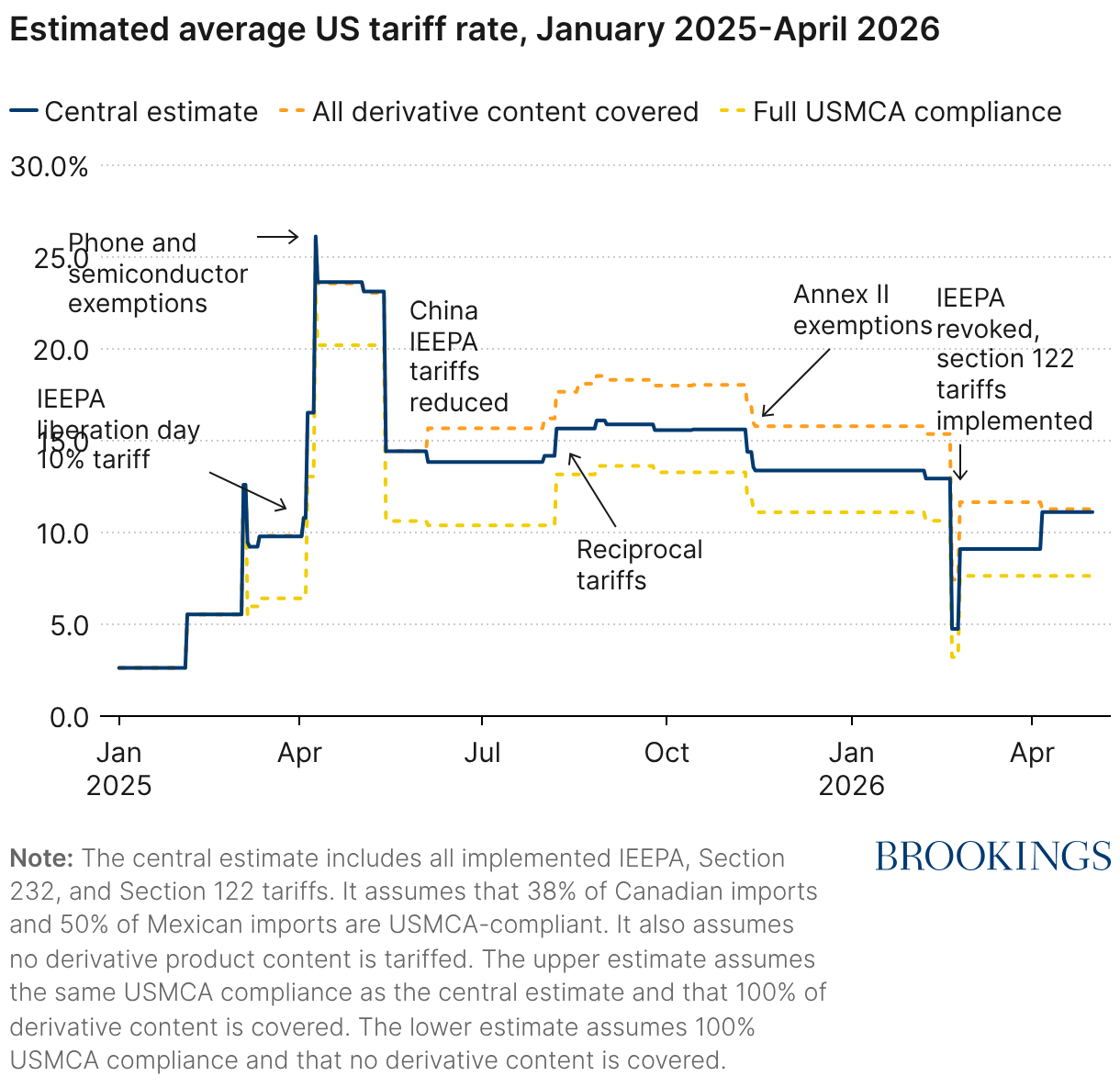
Although no single average captures the full architecture of the 2025 measures, the aggregate statutory estimates clarify two important points. First, the increase in 2025 was historically large. Second, much of that increase reflects the broad reach of country-level surcharges, whose economic effect depends heavily on negotiated exclusions and preferential treatment. Industry-level measures add comparatively less to the headline average but can have very large effects in the specific industries and bilateral trade relationships where they are concentrated.
Figure 2 illustrates how the statutory average evolved as exemptions and preferential treatment expanded. By December 2025, exemptions had lowered the average associated with IEEPA actions by roughly 5 percentage points. Following the transition to Section 122 tariffs, exemptions reduced the post-ruling average from 11.9% to approximately 9.1%. Notably, although the post-ruling Section 122 rate is nominally the same 10% that was imposed on Liberation Day, the average is substantially lower than it was in August, when comparable nominal rates applied but fewer exclusions were in place.
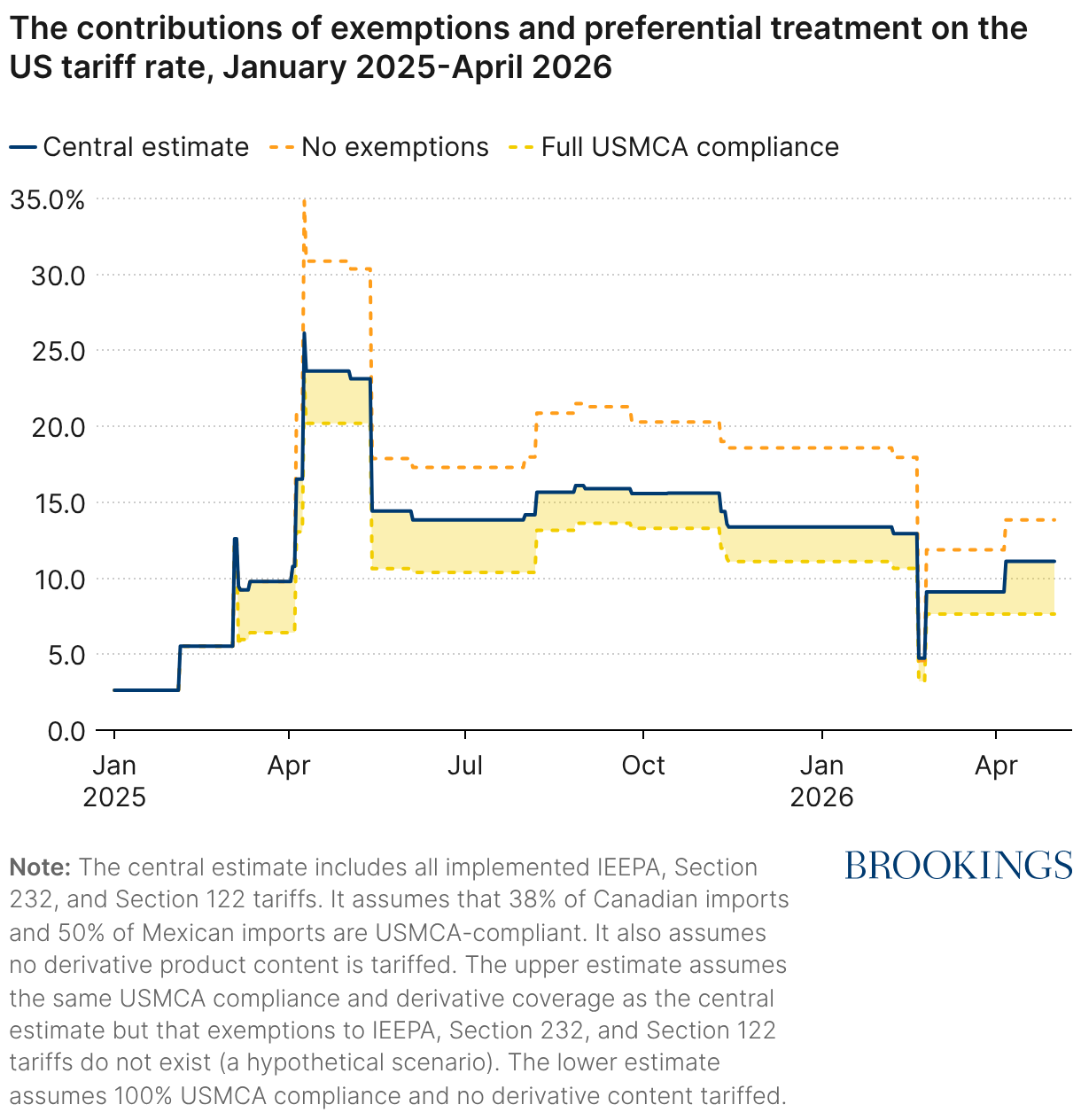
Figure 3 highlights the outsized role of China in the overall statutory average. China entered 2025 with elevated tariffs due to Section 301 measures imposed beginning in 2018 and subsequently faced some of the largest additional increases under IEEPA. As a result, China amplifies the rise in the trade-weighted average. Excluding China, the trade-weighted statutory average increases from 0.8% in January 2025 to 10.8% in December 2025 and 9.2% by April 2026.

Section 232 contributes less to the aggregate statutory increase than the country-level surcharges, but it does so through a distinct and more structurally complex design. In many cases, tariffs apply only to specific inputs or portions of a product’s value, and coverage depends on classification, content, or conditional rules. Figure 4 shows that the contribution of Section 232 measures varies significantly depending on how these design features are interpreted. Broader application of derivative coverage or value-based rules would increase overall tariff exposure without any change in headline rates.

Because these measures are concentrated in upstream industrial inputs and, in some cases, extend to downstream products, their effects are disproportionately felt in specific supply chains and bilateral relationships. The aggregate average therefore understates their impact on particular industries and trading partners. Section 232 may add only modestly to the overall U.S. tariff rate, but it can substantially reshape the distribution of tariff exposure across sectors and partners.
The broader tariff regime has nevertheless reshaped trade patterns. Imports from China have declined significantly, while supply chains and sourcing have shifted toward other trading partners. But there is little evidence thus far that the tariffs substantially reduced the overall U.S. trade deficit or produced a broad-based resurgence in manufacturing employment.
What does this mean for the direction of U.S. trade policy?
The use of Section 301 and Section 232 during the first Trump administration marked a departure from prior practice, and their retention under President Biden reinforced a shift toward a more active, executive-led tariff policy. The second Trump administration pushed that approach significantly further, expanding tariff actions across countries, sectors, and authorities. Over the past year, tariffs have been used not as targeted measures, but as a broad instrument of economic and national security strategy—implemented almost entirely through executive authority. This marked a significant break from the assumptions that had governed the postwar trading system.
The tariff schedule itself has become contingent. It can be expanded, modified, or reversed through executive action. For firms and trading partners, this means operating in an environment where trade policy is flexible but unpredictable. Even in the absence of sustained retaliatory escalation, partners have begun reducing exposure to U.S. policy volatility through supply-chain diversification, alternative sourcing, and deeper trade and investment relationships elsewhere. These adjustments may reshape trade patterns over time, affecting exporters as well as importers.
At the same time, this system produced some outcomes that the United States had sought from trading partners for years but often struggled to achieve within the rules-based trading system. Tariffs were used to secure market access, influence investment decisions, and push partners toward alignment on economic security issues. Policymakers are observing that a more flexible, contingent, and leverage-based approach can shape behavior in ways the previous system often could not. That observation alone is likely to matter for future trade policy debates, even if the current system proves costly or unstable.
The developments of 2025 transformed them into a fundamentally different system. The next set of decisionmakers will not be choosing between “free trade” and “tariffs.” They will be making choices within a system that already has higher tariffs, more active policy, and weaker constraints.
Those choices will be made along a few key margins.
First, where tariff levels settle. Tariffs are already higher and more broadly applied. The question is not whether they automatically return to previous levels, but what policymakers choose to preserve as the new baseline.
Second, how much differentiation to allow. Policy is increasingly conditional and negotiated, moving further away from MFN-style treatment and toward country-, sector-, and even firm-specific arrangements. The question is how far that goes, and how fragmented the system becomes in practice.
Third, whether leverage continues to work. Tariffs are being used to shape behavior, including alignment on strategic issues. But the effectiveness of that leverage depends on how firms and governments adapt over time, and whether trading partners continue to view access to the U.S. market as worth the costs and uncertainty associated with this system.
Fourth, how much complexity the system can sustain. Efforts to reshape parts of an integrated economy without dismantling it introduce administrative and operational complexity. Firms respond by adjusting where they invest, how they source, and how much complexity they are willing to absorb. At the margin, these adjustments are manageable. At scale, they become a persistent source of cost and uncertainty that is difficult to measure in the aggregate but consequential for productivity and growth.
What comes next will depend both on U.S. choices and on the response of trading partners. So far, many have adapted without escalating into full-scale trade conflict, often by maintaining existing rules while diversifying away from U.S. policy risk. Further dismantling of those rules could change that equilibrium and impose additional costs.
The durability of this system will depend not only on political choices, but also on how courts interpret and constrain the use of existing tariff authorities. Ongoing legal challenges mean that courts are actively shaping the boundaries of executive trade power. Their decisions will determine what future administrations can do—and how far this more discretionary approach can be sustained. Many of these choices will also implicate Congress, particularly if the balance between executive flexibility and statutory discipline is reconsidered.
Until those decisions are made, firms and trading partners will operate in a system shaped as much by shifting institutional design and procedural authority as by the nominal level of tariffs themselves.
Related Content

Authors



-
Acknowledgements and disclosures
The authors thank David Wessel, Sasha Snyder, Dozie Ezi-Ashi and Liam Marshall for their comments and factchecking assistance.
The Brookings Institution is committed to quality, independence, and impact.
We are supported by a diverse array of funders. In line with our values and policies, each Brookings publication represents the sole views of its author(s).