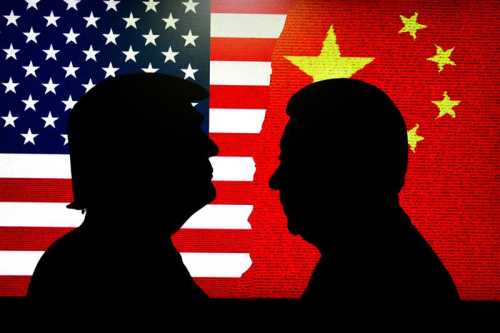
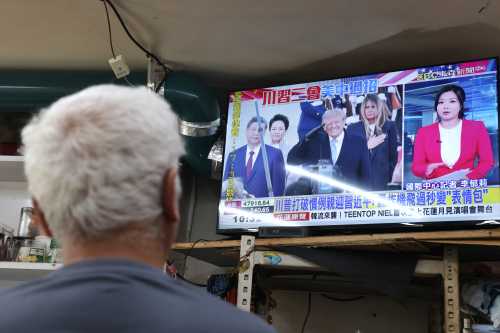
For weeks, it has been unclear whether President Donald Trump would travel to Beijing as planned for his postponed meeting with Chinese President Xi Jinping. Despite ongoing uncertainty in the Strait of Hormuz, Trump appears intent on moving forward, even suggesting he expects a “big, fat hug” from Xi.
Five issues will be worth watching at the Trump-Xi meeting:
Trade: An extension of the truce or something more?
Trade will take center stage at the summit, reflecting the focus of most preparatory efforts. The most likely outcome is an extension of the current trade truce: continued Chinese exports of rare earths and purchases of U.S. agricultural products in exchange for partial tariff relief and a pause on measures like the Bureau of Industry and Security’s “affiliates rule,” which in October 2025 expanded export restrictions to subsidiaries of firms on the Entity List.
Trump will seek headline-grabbing pledges of large-scale Chinese purchases of U.S. goods, including agriculture, energy, Boeing aircraft, and semiconductors. His administration has also floated new mechanisms, such as a “board of trade” and “board of investment,” to channel bilateral economic engagement in nonsensitive sectors.
But while the U.S. side is enthusiastic about trade, there is less clarity on Chinese investment. Trump has broadly welcomed any foreign investment that creates factories in the United States and jobs for American workers, including from China. But others in his administration and the broader Washington policy community remain less enthusiastic. U.S. Trade Representative Jamieson Greer has downplayed expectations for a major bilateral investment framework, suggesting the board of investment would serve as a “venue” to discuss “discrete investment-related issues.” Commerce Secretary Howard Lutnick has drawn hard lines in sectors such as autos.
Beijing’s priorities include extending the truce, preserving access to U.S. technology, and relaxing or at least preventing the further tightening of U.S. export controls. While Chinese firms remain interested in investing in the United States, it is unclear how forcefully Beijing will push to ease restrictions and facilitate investment, given uncertainty about the relationship’s trajectory.
Taiwan and the risk of rhetorical concessions
Alongside trade, Taiwan remains a core priority for Beijing, and there is speculation that Chinese officials may press Trump for concessions on U.S. Taiwan policy. Beijing has already signaled displeasure with a roughly $11 billion U.S. arms sales package for Taiwan approved late last year, reportedly now stalled within the State Department.
Trump has repeatedly described Taiwan more as an economic competitor than as a democratic friend and strategic partner. Earlier this year, Trump indicated he had consulted Xi about U.S. arms sales to Taiwan—a sharp departure from long-standing U.S. policy not to seek Beijing’s approval on such transfers. He has suggested he trusts Xi not to attack the island, at least while he remains president.
Even subtle shifts in U.S. declaratory language—such as “supporting peaceful unification” rather than calling for a peaceful resolution of cross-Strait differences, or “opposing” rather than “not supporting” Taiwan independence—would be meaningful. These distinctions may seem semantic, but they shape expectations and influence how Beijing calculates risk. Aligning U.S. policy more closely with Beijing’s official position could constrain future U.S. responses to Chinese coercion against the island. It would also shake confidence not just in Taipei but across America’s entire network of allies, if Washington appears willing to trade its partners’ security interests at the negotiating table with Beijing.
Defining the U.S.-China relationship: a new framework?
Beijing may not press too hard at this summit for changes to U.S. policy language on Taiwan. Its near-term objective is to keep bilateral ties stable, and pushing Trump too far could risk unsettling the relationship. The Trump team also appears far more interested in discussing trade than Taiwan.
Chinese officials are more likely to encourage rhetorical movement in how the U.S.-China bilateral relationship is framed—laying groundwork that could shape future discussions. Beijing has long urged the United States to “correct its views” of China and to endorse a set of guiding principles for the bilateral relationship: “mutual respect,” “peaceful coexistence,” and “win-win cooperation.” While these phrases sound benign, they carry specific meaning in Beijing’s diplomatic language.
Implicit in them is U.S. acceptance of China’s claims on what it defines as its “core interests,” including Taiwan. For that reason, previous U.S. administrations have resisted formally adopting this language. The question heading into this meeting is whether Trump would be more open to such a formulation.
Trump has often spoken about Xi—and about China more broadly—in more accommodating terms than his predecessors, and he has shown less interest in the nuances of established policy language. From Beijing’s perspective, that may signal an opportunity—not necessarily for a single concession, but for gradual movement that could shape U.S. policy over time, particularly as both sides look toward additional leader-level meetings later this year.
Global crises and wider strategic tensions
Iran and other global crises will most certainly come up, even if they are not the central focus.
One question is whether Trump will again press China to play a more active role in stabilizing global hotspots. Early in the Iranian blockade of the Strait of Hormuz, Trump suggested China should help open the critical waterway as he postponed his trip to Beijing. Administration officials quickly walked this back, stating the delay was for logistical reasons, not a pressure tactic against Beijing.
Subsequent developments followed a similar pattern. Trump threatened to impose a 50% tariff on China following reports that China might be considering providing anti-aircraft missiles to Iran. That threat did not last long. Trump later said Xi had assured him China was not providing weapons to Iran. His response to the U.S. naval interdiction of an Iranian vessel carrying Chinese-origin dual-use chemicals was muted. While indicating he believed there had been an understanding with Xi, he added, “But that’s all right. That’s the way war goes.”
Nevertheless, U.S. policy has moved in a more confrontational direction. The Treasury Department has imposed sanctions on dozens of Chinese shipping firms and vessels, as well as a Chinese oil refinery, in an effort to crack down on China’s economic ties with Iran.
This raises the question of how Xi will respond. Will he press Trump on U.S. actions that Beijing sees as damaging its interests—not just in Iran but globally? Recent crises in the Middle East and Latin America have exposed a gap between China’s expanding global footprint and its ability to protect its overseas interests. Beijing has responded by sharpening its legal and economic tools to penalize foreign firms that comply with U.S. sanctions and harm Chinese companies. Whether Xi issues a blunt warning or tempers his message will reveal how confident he is about openly pressuring Trump.
Artificial intelligence (AI) is likely to feature in the summit discussions. U.S. officials have suggested that the two leaders will address AI safety and risks from nonstate actors. The last major agreement came in November 2023, when President Joe Biden and Xi agreed to keep AI out of nuclear weapons during their San Francisco summit. Whether that understanding is reaffirmed—uncertain given Trump’s tendency to scorn agreements reached by his predecessors—and whether the two sides can advance substantive cooperation on AI risks remains to be seen.
Arms control is another open question. Trump has repeatedly called for a trilateral nuclear framework involving the United States, China, and Russia—an idea Beijing has rejected. Whether Trump chooses to raise this issue in Beijing will signal his ambitions beyond trade.
North Korea may also come up. Chinese Foreign Minister Wang Yi recently traveled to Pyongyang, and there has been a noticeable uptick in China-North Korea economic and diplomatic activity ever since Kim Jong Un’s visit to Beijing last November. Trump has expressed interest in meeting Kim again, and there was speculation that the two leaders could meet during Trump’s travels to Asia last fall. While North Korea has since receded from the spotlight, it remains a topic that could resurface in leader-level discussions.
What comes next?
Finally, a key question is what follows this visit. Trump administration officials have suggested Trump and Xi may meet several more times this year—including a possible state visit by Xi and his wife to Washington in September, Trump traveling to Shenzhen for the Asia-Pacific Economic Cooperation summit in November, and Xi returning to Miami in December for the G20—though Beijing has not confirmed any of these plans.
What will be important to watch is what this summit sets into motion: which working-level processes are launched, what issues are carried forward, and whether there are clearer signals of what lies ahead.
The most likely outcome is a year focused on stability—extending the trade truce and avoiding escalation while both sides strengthen their positions. It could, however, evolve into something more ambitious, with expanded cooperation on trade or strategic issues—or shift in a more adversarial direction if Trump walks away dissatisfied with the results of the trip.
Author

Related Content

The Brookings Institution is committed to quality, independence, and impact.
We are supported by a diverse array of funders. In line with our values and policies, each Brookings publication represents the sole views of its author(s).

Commentary
Five things to watch as Trump goes to Beijing
May 4, 2026