




Ahead of Africa Day 2026, Host Landry Signé sits with H.E. Mathilde Mukantabana, ambassador of Rwanda to the U.S. and dean of the African Diplomatic Corps in Washington, D.C., to discuss how African governments are coordinating their diplomatic efforts in response to new priorities and opportunities.
Transcript
MUKANTABANA: African countries really consistently prioritize moving beyond aid toward trade and investment, and that’s what United States also has been moving to do with our countries. So we agree on that formula. And I’ve seen the shift taking place.
[music]
SIGNÉ: Hello. Welcome to season five of the Foresight Africa podcast. As always, I am your host and executive producer, Landry Signé, senior fellow in the Global Economy and Development Program and the Africa Growth Initiative at the Brookings Institution.
In this season of Foresight Africa podcast, we are looking beyond the headlines to see how global shifts in economy, technology, culture, and politics are shaping the relationship between African countries and the United States. In today’s episode, we are also commemorating Africa Day, May 25th, which celebrates the founding of the Organization of African Unity, or OAU, in 1963, a predecessor of the African Union.
Africa Day is celebrated around the world as a symbol of Pan-Africanism, resiliency, and progress. The African Union has announced the theme of Africa Day 2026 to be the Year of Water Sustainability, calling on its members and partners to promote sustainable and equitable management of the continent’s water resources.
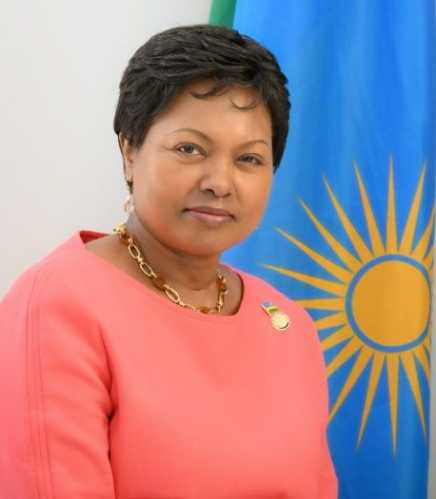
To discuss this theme, Africa Day, and how African countries are cooperating to assert their shared priorities vis-à-vis the United States, I am joined by our very distinguished guest, Her Excellency Mathilde Mukantabana, ambassador of Rwanda to the United States. As well as the longest serving ambassador from an African country, she also serves as the dean of the African Diplomatic Corps in Washington, D.C., representing the missions of African countries with a diplomatic presence in the city.
Welcome, Your Excellency, and thank you so much for joining us today.
MUKANTABANA: Thank you so much, Professor Signé, and and I thank you for organizing this very much needed dialogue.
[3:21]
SIGNÉ: So we know you are the smartest ambassador in in Washington, D.C., advancing African issues, so that is why we are so glad that you have made time to join us today.
Your Excellency, drawing on your experience as an ambassador for over a decade, what priorities do African countries share in your engagement with the U.S., and what have been the biggest accomplishments in addressing these priorities?
[3:55]
MUKANTABANA: Thank you so much, and really talking about being here for a long time, I’ve seen a fundamental shift in African engagement with the United States. African countries really consistently prioritize moving beyond aid toward trade and investment, and that’s what United States also has been moving to do with our countries. So we agree on that formula. And I’ve seen the shift taking place.
And this includes attracting United States private sector capital and infrastructure in energy, critical minerals, and of course lately in digital economies more and more.
So initiatives like AGOA, and you know very well about AGOA, the growth, and the growth of the United States International Development Finance Corporation financing increased participation of U.S. companies in sectors such as, you know, LNG, critical minerals, have helped also to shift the conversation towards more commercially driven partnerships more than before.
The most important achievement in my view has been the gradual reframing of the U.S.-Africa relations from a predominantly aid-based model to a more strategic partnership. That is grounded in mutual interests, economic growth, security, and global competitiveness.
So of course, there are still gaps, but we’ve seen a definite shift as we have started to promote trade not aid in that sphere.
So where is the the gap? We are still trying to match aspiration and operation. So we are still sometimes more aspirational, particularly in scaling investment, ensuring policy consistency, and aligning timelines between public commitments and private sector delivery. But we are in a good shape.
[6:05]
SIGNÉ: Amazing, Excellency. What role does the African Diplomatic Corps play in coordinating how individual embassies and the African Union engage with the U.S., and how do you support this coordination as a dean?
[6:26]
MUKANTABANA: So the African Diplomatic Corps plays a very, very important role in coordinating all the mechanisms between our governments and Washington, D.C. We are not a formal decisionmaking body, but a platform for alignment, amplification, and access that helps to ensure that African voices are heard more clearly and coherently in the U.S. political policy space. So it’s a very important part of what United States does with the entire continent.
It provides the space where ambassadors can exchange views on key issues and where possible converge around shared messaging. So as a unit, as Africa, this is really particularly useful, especially when we are preparing, we have major engagements such as the Africa-U.S. Summit, or we are talking about AGOA or many other thing like the Africa Day you are talking about.
SIGNÉ: Absolutely.
[7:30]
MUKANTABANA: We are going to be celebrating on the 3rd of June because it was falling during the Memorial Day weekend.
But that’s a very important thing. It’s a very important voice. The African Diplomatic Corps serves as a collective entry point to engagement with the U.S. administration, with Congress, with the think tanks, and other sociopolitical entities in Washington and beyond.
But we we are the entry point. Whether we organize roundtables, briefings, informal dialogues, it allows U.S. counterparts to engage a representative across sector section of African perspectives more efficiently once we go as a group. And our unit is well-organized. As you know, we have a meeting every month.
And also, the the other important thing that you need to do, it’s a, it’s a vibrant entity because we also have committees. Within the African diplomatic corps, we have different committees, and we meet every month to bring all the ideas we’ve put that are coming from those committees.
And finally, maybe what I can say is that the African group works in close coordination with the African Union mission. That’s where we have all our meetings. Our monthly meetings are taking place at the African Union.
[8:52]
SIGNÉ: Fantastic, Excellency. Speaking for Rwanda or more broadly for the African diplomatic corps, how do diplomats create mutual benefits for the U.S. and for their own countries?
[9:08]
MUKANTABANA: Whether I speak about Rwanda or Africa, because really one thing you have to understand, we are true Pan-Africanist. Absolutely. When I, so when I talk about Rwanda, it can also be relatable to African colleagues. , But our engagement with United States is increasingly structured around key pillars.
The first is economic partnership investment. As I mentioned before, and the focus today is on moving from aid to trade, while mobilizing U.S. private sector investment in key sectors, and we are hoping to see a two-way investment and value chains that benefit both sides. We are looking for a win-win situation between what we do with United States and African countries.
The second is the peace and security cooperation. Many African countries are key partners with United States, whether they are fighting against terrorism, whether it’s engagement in peacekeeping, like my country. So there are many areas with a shared interest. So it’s not just a security objective when we talk about that, but also a prerequisite for economic growth. Right? And investment. You can’t have those without peace and security.
The third I’m mentioning is health and human development. Longstanding programs such as PEPFAR, that is a a signature, you know, program that United States has started. That was a lifesaver; has demonstrated the impact of a sustained partnership. So as now, with U.S., we are now building on that, on the PEPFAR and those successes to strengthen the health systems, pandemic preparedness, but also local capacity, development of local pa- capacity when it comes to health and many other thing.
And the fourth that I mentioned briefly is technology and innovation. There’s a growing alignment around digital transformation, AI, and energy transitions.
So these are the areas where African countries offer both opportunity and strategic relevance, particularly in the context of global supply chains.
And how do the diplomats create a mutually beneficial approach? I’m going to talk briefly about two things. One is we align national priorities with U.S. strategic interests. For instance, positioning Africa’s critical minerals or energy potential with U.S. economic and security objectives in what we call mutually beneficial relationships. So Africa benefit and the United States benefit.
The second is that we facilitate connections and bring together U.S. investors, policymakers, and institutions with credible opportunities back home.
And the last that is as important is that we shape the narrative. You know, Africans in United States shape a positive narrative on Africa, Africa not seen through the lens of risk, but of opportunity and partnership.
[12:19]
SIGNÉ: Amazing, Excellency. I really like the comprehensive, structured response, and as well as the idea of shaping the narrative for engagement in mutually beneficial ways.
Your Excellency, Rwanda was an early signatory of the AfCFTA and ratifying it back in 2018. Rwanda has also allowed visas on arrival for citizen of any AU country. What has been the impact of these policies on your economy and on your relationships with other countries?
[13:00]
MUKANTABANA: One thing maybe I needed to say overall is that Rwanda is a country that walks the talk.
As a matter of fact, the Africa Continental Free Trade was signed in Rwanda when our president was the head of African Union. 2018. But we needed also to be, again, to translate the aspiration into operations, and Rwanda was in the forefront of doing that. So we we had the early commitment to continental integration through ratifying the African Continental Free Trade Area and implementing visa on arrival for all African citizens. And that has been a very positive move on our economic and strategic impact.
On the economic side, I’m going to talk briefly about the positioning of Rwanda as an open and accessible hub within Africa. The African Continental Free Trade provide the framework for expanding intra-African trade, and Rwanda has moved early to align our logistics. We are talking about logistics, infrastructure, customs processes, and services sector to take advantage of that larger market.
Like, one example I can give you is that RwandAir, because many countries in Africa are not really connecting
SIGNÉ: absolutely
[14:25]
MUKANTABANA: even by infrastructure. But when we started to expand our RwandAir was to go to African capitals to ease the movement of people and goods and so on and so forth. So we are already seeing increased movement in services, aviation, meetings and conferences, regional value chains.
Kigali, for instance, has become a preferred destination for continental and international events, which has driven tourism in what also we call Visit Rwanda initiative that we have pushed investment and business linkages.
As we speak, Professor, as we speak right now, Rwanda is hosting a big conference on the CEO. CEO Forums. And these are more than thousands of people. Many heads of state from Africa are there in this big CEO forum. Many people from U.S. are attending right now as we speak.
So on the diplomatic and regional side, these policies have reinforced Rwanda’s reputation as a champion of African integration and openness.
Also, if you go a little bit closer to Africa, they have deepened bilateral relationships across the continent by making Rwanda more accessible to governments, citizens, investors, institutions alike. And in many ways, it has shifted engagement from formal diplomacy to practical, everyday connectivity, you know, in our countries and the countries around.
[15:59]
SIGNÉ: Amazing, Excellency. And I can understand how Rwanda is an amazing host as well. I recall when I attended the World Economic Forum meeting on Africa in Kigali. So when I arrived from the airport to my hotel and back, the service was simply unmatched. And the event itself, so the the ability to host event is recognized. People know that things happen according to the plans. So.
Your Excellency, and you have shared many of those ideas already, but overall, what important shifts do you see or do you observe in the U.S.-Africa relations in the past years, and how are they affecting the relations between the U.S. and African countries?
[16:53]
MUKANTABANA: Hmm. That’s a very important question. And so when I look, for instance, the the implementation of the African Continental Free Trade and the policies that are facilitating, you know, the movement of people and the goods on the African continent, they are also reshaping how United States is engaging with African continent. And also individual African countries.
First, it’s obvious that now more and more it’s making Africa a more compelling economic partner. A more integrated market of 1.3 billion people changes the scale of opportunity for U.S. investors.
Second, they create also efficiency for U.S. engagement. For the U.S. government and private sectors, for instance, it becomes easier to engage when regulatory environments, standards, and the movement of people and goods are more predictable for people who want to invest in Africa.
Third, the shift of relationship toward partnership rather than assistance, the one that I mentioned, you know, trade not aid in what we are doing.
And fourth, maybe the last I can talk about, is the open space for deeper collaboration on global priorities. So once you start with commerce, you also engage in other things. You know, we are talking about educational systems. We are talking about peace and security and many other thing that I mentioned previously.
[18:29]
SIGNÉ: Amazing.
The African Union has declared 2026 as the year of, and I quote, “Assuring sustainable water availability and safe sanitation systems to achieve the goals of Agenda 2063.” Excellency, what does this year’s theme around water access and sustainability mean for the African Union’s member states and for Rwanda as well in particular?
[19:03]
MUKANTABANA: I talk in general. The African Union decision to designate 2026 as the year of assuring sustainable water availability and safe sanitation system to achieve by 2063. It’s one part of the Agenda 2063, the bigger agenda. It’s both strategic and urgent. You know, water is is essential, it’s existential. And for AU member states, this theme elevates water and sanitation from a developmental issue to a foundational pillar of economic transformation and human security.
So it’s, it’s a bigger one, and it’s not… you know, you’ve heard, for instance, about the water, the Nile water, and what happens between the countries like Egypt, Ethiopia, and so on and so forth. Water is the fundamental. So to be able to talk about the water, the water issue, it’s a very important one. That’s why now it’s a part of this whole economic transformation and so on.
But it also reinforces the need for implementation and investment, mobilizing its primarily domestic resources, strengthening governance of water, and attracting international partnerships.
SIGNÉ: Amazing. This has been a truly insightful conversation, and I would like to thank you for joining us today, Excellency.
MUKANTABANA: Thank you so much for allowing me to come and have this conversation.
[music]
SIGNÉ: I am Landry Signé, and this has been Foresight Africa. Thank you listeners for joining me today.
The Foresight Africa podcast is brought to you by the Brookings Podcast Network. Send your feedback and questions to podcasts at Brookings dot edu.
My special thanks to the production team, including Ike Blake, supervising producer; Fred Dews, producer; Dafe Oputu, Izzy Taylor, and Aysha House, associate producers; Gastón Reboredo, audio engineer; and Daniel Morales and Teddy Wansink, video producers. The show’s art was designed by Shavanthi Mendis.
Additional promotional support for this podcast comes from my colleagues in Brookings Global and the Office of Communications at Brookings.
Participants

- Subscribe to Foresight Africa on Apple, Spotify, Afripods, or wherever you listen to podcasts.
- Listen to previous episodes.
- Watch episodes on YouTube.
- Learn about other Brookings podcasts from the Brookings Podcast Network.
- Sign up for the podcasts newsletter for occasional updates on featured episodes and new shows.
- Send feedback to [email protected].
The Brookings Institution is committed to quality, independence, and impact.
We are supported by a diverse array of funders. In line with our values and policies, each Brookings publication represents the sole views of its author(s).

Commentary
PodcastAfrica Day: Strengthening US-Africa relations through a continental approach
Listen on
Foresight Africa Podcast
May 20, 2026