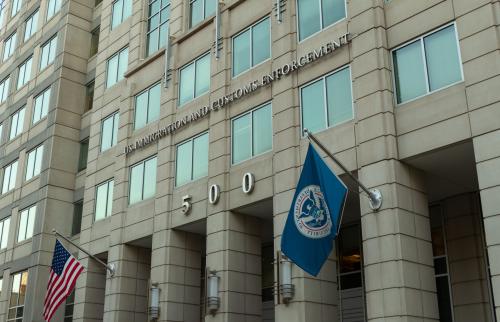
The actions of Immigration and Customs Enforcement (ICE) have significantly impacted communities across the country and contributed to a decreased flow of immigrants into the United States. An indirect consequence of the sharp rise in deportation enforcement is its chilling effect on civic engagement; by intimidating immigrants into withdrawing from public life, these policies not only undermine their sense of belonging but also fundamentally obstruct their ability to pursue the American Dream.
The pursuit of the American Dream remains a central tenet of U.S. culture. The American Dream is often defined as the idea that all individuals can achieve prosperity, upward mobility, and happiness through hard work, determination, and initiative, regardless of their social class or birthplace. Immigrants have arguably been a primary force sustaining the perception that upward mobility is accessible through dedicated effort. In fact, historical accounts suggest the American Dream is largely driven by cultural narratives focused on newcomers to the nation. The popular 19th-century author Horatio Alger Jr. is widely credited with shaping understandings of the American Dream through his prolific “rags-to-riches” stories. Across these narratives, protagonists rise from poverty through hard work, persistence, self-reliance, and discipline. However, intensified enforcement under the Trump administration has tarnished this ideal, rendering the rags-to-riches trajectory exclusive to those with secure legal standing rather than a possibility accessible to all newcomers.
Policy climate and the erosion of immigrant civic life
A forced withdrawal from civil society is alienating these communities from the American Dream and fracturing their connection to the political process. This alienation is particularly significant given that naturalized immigrants now represent 10% of the U.S. electorate—including roughly 20% of eligible voters in California, New Jersey, New York, and Florida. As a result, this demographic constitutes a formidable voting bloc with the decisive power to swing electoral outcomes.
Beyond the ballot box, immigrants maintain a robust history of civic engagement. These communities have historically wielded significant influence through labor movements and mass social protests, as exemplified by the 2006 nationwide demonstrations in response to the Sensenbrenner Bill. This scale of participation underscores the capacity of immigrant populations, regardless of citizenship status, to mobilize collectively and demand institutional change.
Despite facing several structural barriers, some immigrant subgroups tend to exhibit relatively high participation rates across most forms of political engagement, including voting. While U.S.-born Americans generally vote at higher rates than naturalized citizens, this trend does not hold across all segments of the electorate. For both Latinos and Asian Americans, naturalized immigrants have voted at higher rates than their U.S.-born counterparts. Naturalized immigrants were also highly engaged in the 2024 election. According to Census Bureau data, approximately 58% of them and 66% of U.S.-born citizens voted in 2024.
The current sociopolitical climate has generated concerns that federal immigration policies may undermine civic engagement and political participation among immigrants. A national survey of Latino immigrants identifies that 25% of respondents reported avoiding protests, demonstrations, or rallies specifically due to announced deportation operations. Given that these data were collected early in the administration’s term, the avoidance of civic engagement among some immigrant populations may be more pronounced now.
The case for proactive immigrant inclusion policies
The increase in enforcement is having an immediate political impact, as immigrants distance themselves from civic engagement in our democracy. In response to concerns regarding widespread deportations and the prevailing sociopolitical climate, this analysis outlines key policy interventions to address these challenges, as immigrants are critical to the national economy and fill vital roles in the labor market. Their ability to achieve upward economic mobility has been vital to the nation.
Congress should examine photo-ID laws and ICE presence at polling stations
A key policy debate with significant consequences for immigrant ballot access involves national photo identification requirements. The Trump administration has increasingly signaled an intent to implement such requirements ahead of the 2026 midterm elections, whether approved by Congress or not. Social science research indicates significant inequalities in access to photo identification and the underlying documents required to obtain it across the electorate.
Prior research has found that naturalized citizens are disproportionately harmed by strict photo-ID laws due to this inequality in access to required documentation. Implementation of such policies could not only impact immigrants’ ability to vote but also signal to these communities that their participation in the democratic process is discouraged. The administration’s rationale for a national photo-ID requirement centers on concerns regarding noncitizen voting. Given the lack of empirical evidence of widespread election fraud, a full congressional debate on the implications of the proposed law would be a constructive next step. Similarly, suggestions to use ICE officers to monitor polling locations in the upcoming midterms signal that immigrants are unwelcome in the democratic process, spreading fear and likely depressing voter turnout.
States can take action to integrate immigrants into their economies
States such as Colorado and New Mexico have introduced legislation and dedicated state-level departments to integrating new residents, including immigrants, into their economies. Developments over the past year have demonstrated that the federal immigration climate can shift dramatically, underscoring the need for states to consider proactive steps to welcome immigrants within their borders.
DREAMers are symbolic of the erosion of the American Dream
Finally, a discussion regarding the nuances of the American Dream for immigrants must include “DREAMers,” or individuals brought to the United States as children without documentation. In many cases, these people were brought to the U.S. by parents who believed so profoundly in the American Dream that they upended their lives for the promise of a better future.
The Department of Homeland Security recently confirmed that more than 80 DREAMers were deported in 2025 after the Trump administration rescinded several protective enforcement policies for this subgroup. This shift reflects an enforcement strategy that increasingly disregards the established rights of those with authorized status, further destabilizing individuals whose legal standing was already precarious. The legal uncertainty facing these young adults underscores the systemic barriers that prevent many residents from pursuing their own version of the American Dream.
Latino immigrants’ optimism in achieving the American Dream is waning
In their in-depth interviews with immigrant families, Portes and Rumbaut (2001) document high levels of ambition, optimism, work ethic, and a strong belief in upward mobility—factors vital to sustaining the American Dream and the U.S. economy. In their 2014 qualitative study of Mexican immigrants, Vollmer Hanna and Ortega find that participants expressed strong attachment to work, even when it involved menial or undesirable labor.
This work ethic is partially driven by Latino immigrants’ belief that it will lead to economic mobility, as social scientists have consistently found that Latino immigrants, in particular, demonstrate a strong belief in the American Dream. This is reinforced by scholars who suggest that such optimism among undocumented Latinos could sustain the demographic diversification seen in the early 2000s. Consequently, this optimism has led Latinos to be more confident about achieving the American Dream than Americans overall; 47% of Latinos, compared to 36% of the general public, report they are on their way to attaining it.
Based on our recent national survey of Latino immigrants, we are able to offer fresh perspectives and nuanced insights about the American Dream. Overall, 26% of Latino immigrants report having already realized it, while another 40% indicate they are working toward it.
However, the data also raise important concerns about the impact of the current policy climate on Latino immigrants’ perceptions of the American Dream. When asked whether achieving the American Dream had become easier or harder following the 2024 election, a robust 73% of respondents reported that the election outcome has made achieving the dream harder—nearly half (45%) indicate it has become “much harder” and another 28% “somewhat harder.”
Similarly, when asked if the 2024 election results had influenced their views of the American Dream, just over a third (32%) of Latino immigrants reported believing it was once attainable but no longer is. Another 6% believe it has never been possible.
These themes continue to resonate in contemporary political discourse, where the American Dream is often viewed as a cornerstone of economic policy. U.S. presidents frequently employ the concept in appeals for economic reform. For example, in his 2014 State of the Union address, former President Obama addressed economic inequality by framing it as a challenge to the American Dream: “What I believe unites the people of this nation, regardless of race or region or party, young or old, rich or poor, is the simple profound belief in opportunity for all—the notion that if you work hard and take responsibility, you can get ahead.”
Since the 2024 election, the political landscape has shifted toward a more nationalistic approach to policy and rhetoric. This surge in enforcement carries profound cultural consequences, widening the chasm between immigrant communities and the promise of the American Dream. This is particularly evident for those striving to integrate into a society that increasingly prioritizes exclusionary barriers over inclusive growth. Until federal policy acknowledges civic engagement as an essential pillar of integration and dismantles the structural hurdles to upward mobility, the American Dream will remain a functional impossibility for millions.
Related Content
Authors

The Brookings Institution is committed to quality, independence, and impact.
We are supported by a diverse array of funders. In line with our values and policies, each Brookings publication represents the sole views of its author(s).
Commentary
Eroding the American Dream through federal policy shifts
March 30, 2026