You have to hand it to President Donald J. Trump: His State of the Union was a master class in showmanship. It featured American heroes from all walks of life, from the men’s U.S. hockey team that won the gold medal at the Olympics, to military heroes being awarded their medals right there in the chamber, to the surprise reunion of a freed Venezuelan political prisoner with his niece, and the honoring of a 100-year-old Korean War veteran. Rather than sitting passively in their seats, they walked through the doors to the galleries to thunderous applause.
But did the showmanship alter the President’s political challenges and put his party on firmer footing ahead of the midterms? At the time of his speech, his job approval had fallen by 10 percentage points since he took office last year, and groups that had flocked to support him in the 2024 election—including Hispanics, young adults, and independents—expressed growing discontent. While the president maintains support for his handling of the southern border, majorities disapproved of his performance on every other issue, including his overall immigration record. On the most important issue—inflation and high prices, which politicians have termed “affordability”—his approval stands at 36%. On health care, another top issue, it is 37%. And because the fortunes of the president’s party in midterm elections are strongly influenced by his job approval, Republicans trail Democrats by 5 percentage points nationally in this fall’s contest for the House majority.
President Trump’s supporters expected him to focus heavily on the already high and rising costs of food, housing, energy, health care, and other basics of middle-class life. However, they have been disappointed to see him focusing more on other issues while the affordability crisis persists.
Against this backdrop, the question is whether Mr. Trump addressed the challenges facing his presidency and his party, and if so, how effectively. Did he reach out to former supporters who have moved away from him? Did he refocus his agenda on affordability? And did he distance himself from the policy specifics that have eroded his standing?
The broad answer to these questions is no, not really. He did not address the reasons why many of the Hispanics, independents, and young people who supported his 2024 campaign have turned against him. He did not acknowledge the concerns of ordinary families who believe they are losing ground and that the president has not focused on their plight. And he doubled down on the most unpopular elements of his agenda, including tariffs and tough immigration enforcement tactics that most Americans oppose. This was a speech to rally his base rather than reach out to swing voters, continuing the dominant political strategy of the past year.
The speech, which began in a relatively restrained tone, grew more confrontational toward Democrats as it proceeded. But despite the president’s social media denunciation of the Supreme Court justices who struck down his tariffs, he moderated his tone last night, calling the tariff decision “unfortunate” and moving on. The fact that he has other key cases before the court this term may explain his rhetorical strategy.
Responding to public concerns that he had shifted focus away from the economy, President Trump spent the first 20 minutes of the speech highlighting positive economic statistics. He noted that inflation and core inflation were down, as were the prices of gasoline and eggs. He cited falling mortgage rates, highs in the stock market, and new construction jobs. His promise to make AI companies pay for the energy used in new data centers acknowledged that high energy prices have affected household budgets.
Trump’s list of accomplishments echoed Joe Biden’s 2024 State of the Union, where the then-president boasted about an economy he described as the envy of the world, noting new jobs, the creation of small businesses, and a declining rate of inflation.
What the two presidents had in common was a collection of economic statistics that fell on deaf ears. In both cases, polling suggested Americans did not believe the litany of statistics captured the reality of their daily struggle to fit rising costs for food, shelter, health, child care, and transportation into limited household budgets.
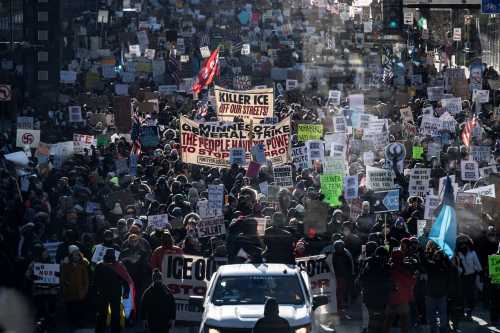
From then on, the State of the Union fell into familiar territory—a blueprint for the 2026 elections. Throughout the speech, Trump emphasized the importance of the Republican-led Congress and returned to an issue that has served him well in the past: illegal immigration. While polling shows many Americans support securing the border, surveys also indicate deepening reservations about his mass deportation policy. Concerns include Immigrations and Customs Enforcement (ICE) policies regarding entry into homes without court orders, the arrest of immigrants who have no criminal records in the U.S., the use of mass detention centers, and deportations without due process. But what seems to have captured the most attention is the killing of two American citizens in Minneapolis.
The difference between the economic and immigration sections of his speech was notable. While Republican reaction to the president’s economic policies was measured, lawmakers roared their approval when the president addressed Democrats directly on illegal immigration and sanctuary cities. This reflects a trend in recent polling: While a majority of Americans identify the cost of living as their most important issue, Republicans are more likely to name immigration as their top concern.
In addition to the tactics of ICE agents, several of the president’s key policy initiatives have faced opposition from a majority of Americans. These include the expiration of Biden-era health care subsidies, significant cuts to Medicaid, and the imposition of tariffs that most Americans believe increase consumer prices. Trump addressed health care, an issue that has been central to Democratic platforms for more than a decade. However, his pledge to “… stop all payments to big insurance companies and give that money to the people so they can buy their own health care” is only the latest in a series of Republican plans that have yet to resolve public concerns regarding protection against the costs of catastrophic illnesses.
Throughout the speech, Democrats remained in their seats, following instructions from party leadership. Trump frequently highlighted their choice not to stand. This dynamic continued until he asked those in attendance to stand if they supported the proposition that “the first duty of the American government is to protect American citizens, not illegal aliens.” While Democrats remained seated, Trump noted their response several times for the viewing audience.
In the end, Trump returned to themes from his 2024 campaign: characterizing immigrants as a criminal threat, suggesting Democrats intend to interfere with election outcomes, and criticizing Democratic positions on gender identity.
The foreign policy section of the speech was extensive, though critics described it as lacking in substance. The president stated that his diplomacy had facilitated the return of all Israeli hostages from Gaza, including those deceased, but he did not address reports that a central aim of the administration’s framework—the disarmament of Hamas—remains unfulfilled. He devoted a brief portion of the address to the war in Ukraine without outlining a specific path toward a resolution. Additionally, while the U.S. has increased its military presence in the Middle East, Trump did not detail the administration’s objectives for that force should current negotiations with Iran fail. He also omitted mention of his proposal regarding the acquisition of Greenland, an initiative that has sparked significant diplomatic friction with Denmark.
The president concluded his address by framing American history as a narrative of expansion and achievement, disregarding the economic, social and moral challenges the country has faced. He made few references to the Declaration of Independence, and he did not discuss the document in the context popularized by Abraham Lincoln—as a guide for an imperfect nation. The speech did not address the views of Americans who consider the principle of equality an unfulfilled aspiration. The 2026 State of the Union ended as it began: focused on the administration’s specific supporters and policies without a broader appeal to national unity around founding principles.
Related Content

Authors


The Brookings Institution is committed to quality, independence, and impact.
We are supported by a diverse array of funders. In line with our values and policies, each Brookings publication represents the sole views of its author(s).

Commentary
VideoTrump relies on showmanship and base appeal in State of the Union address
February 25, 2026