As of January 1, 2026, the nation’s first baby boomers have started to turn 80 years old. Once subscribing to the slogan “Don’t trust anyone over 30,” this formerly giant group of Americans—numbering 79 million in its peak year—has made a huge impact on all aspects of the nation’s social, cultural, and economic life. During their younger years, baby boomers advanced the causes of civil rights and women’s equality, setting the stage for broader shifts among later generations. They have affected the business world and popular culture in ways that still endure, and represented four U.S. presidents, each serving two terms.
With baby boomers now entering a new decade, it’s worth looking back to understand how they compare to both the generations before and after them, as well as how their influence may change in the coming years.
Baby boomers will inflate the size of the nation’s oldest population group
Members of the baby boomer generation were born between 1946 and 1964. Thus, those born in 1946 and still alive will be turning 80 this year. Among this group are celebrities such as Dolly Parton, Sylvester Stallone, Cher, and Steven Spielberg, as well as presidents Bill Clinton, George W. Bush, and Donald Trump. As more baby boomers pass this milestone, the nation’s age 80-plus population group is projected to double, from 14.7 million in 2025 to 29.4 million in 2045 (see Figure 1).
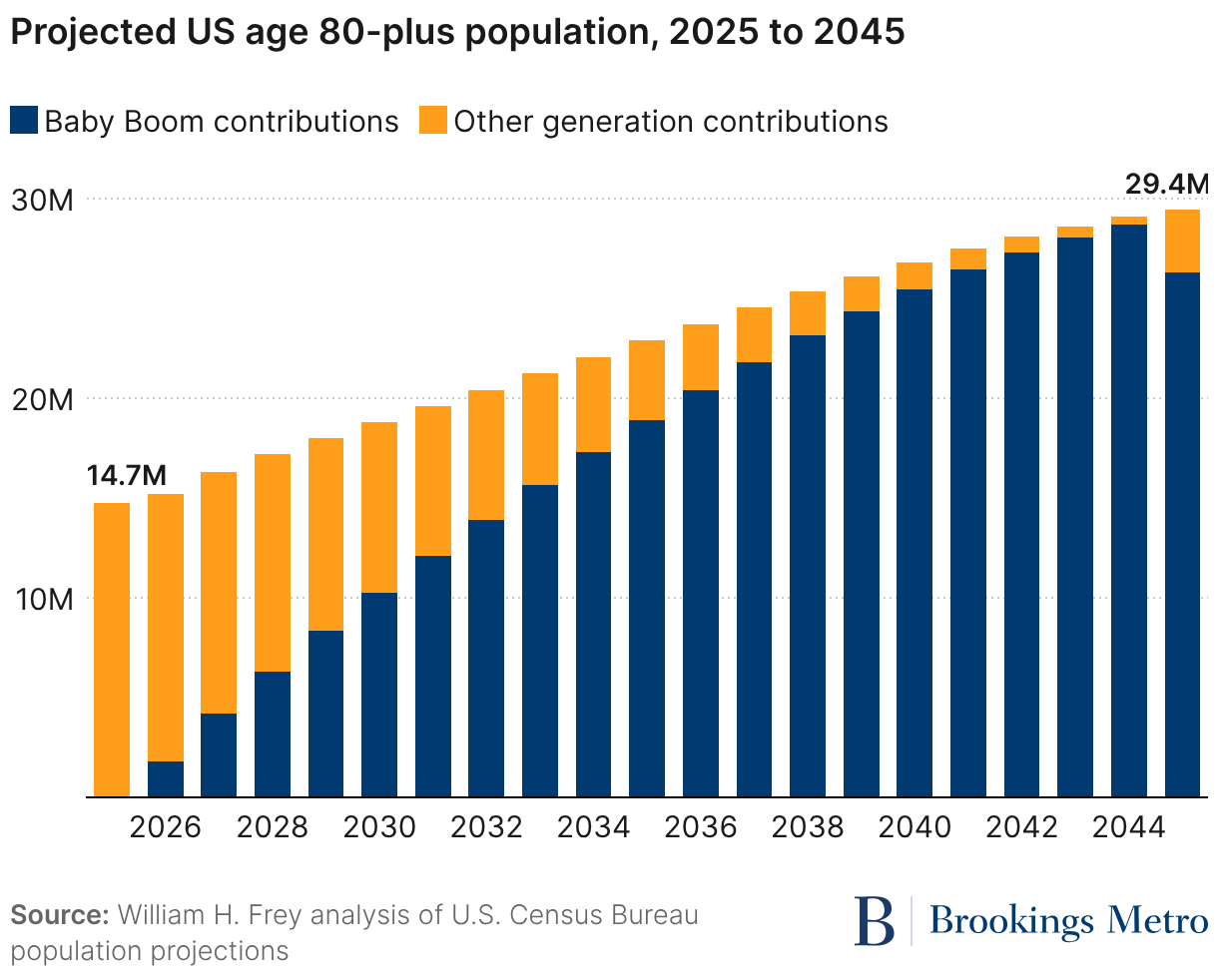
Often termed “the pig in the python,” the baby boomer generation demonstrated its demographic power by sustaining high numbers of births for 19 years following World War II—a product of postwar prosperity and the embrace of family life. Because this followed more than a decade of low fertility, the baby boomer generation continued to increase the size of the age groups it rose into. And because it was followed by somewhat fewer births in the subsequent Gen X cohort, the groups baby boomers aged out of showed decreases.
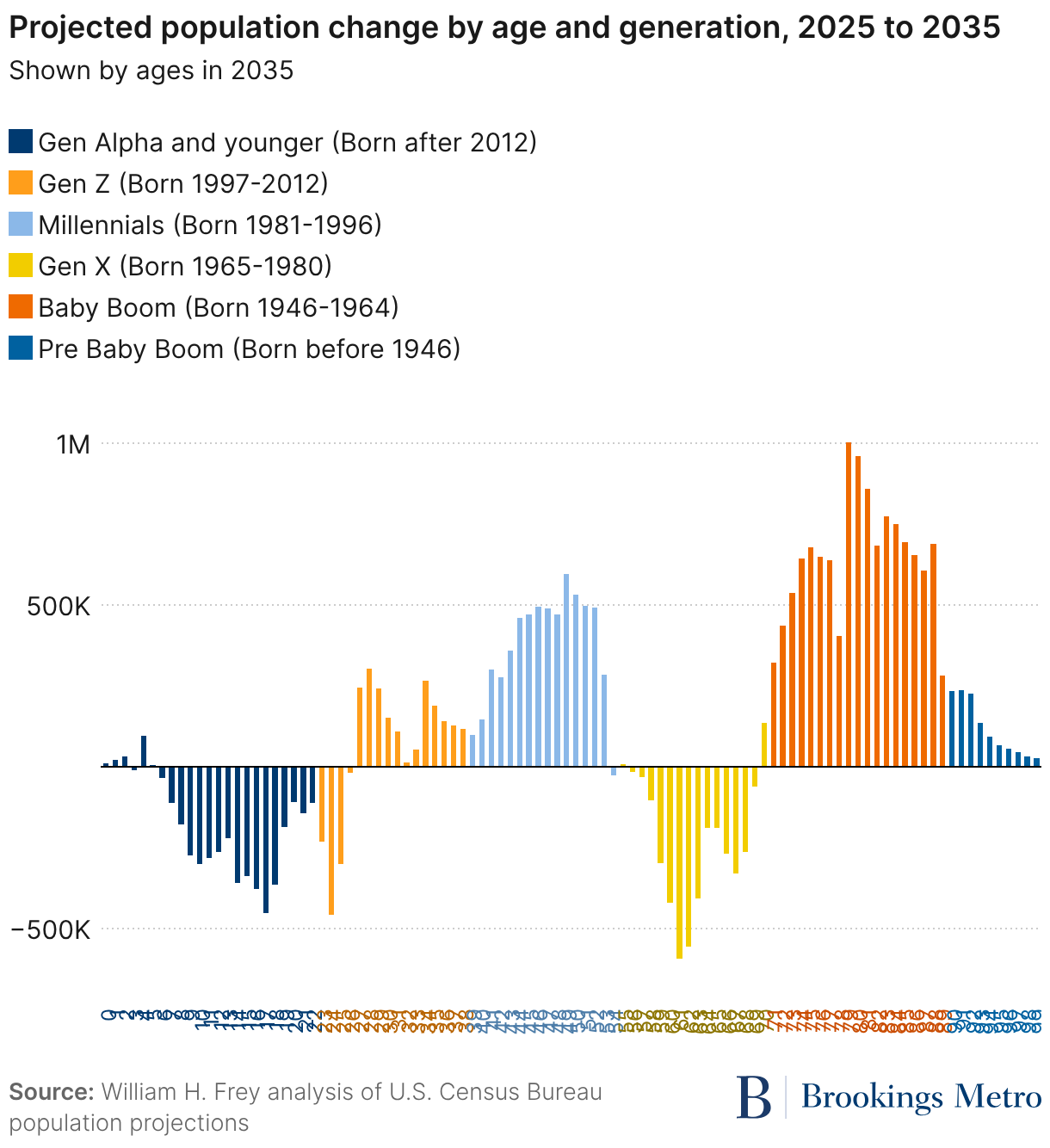
Figure 2 illustrates this, showing that over the 10-year period from 2025 to 2035, there is projected to be a noticeable rise in the population aged 71 to 89, as baby boomers begin moving into these ages. At the same time, there should also be a decline in the population aged 55 to 70, as the baby boomer generation ages out of this group. Figure 2 also shows positive shifts in 2035 for the 39-to-54 age group (gains associated with the somewhat larger millennial generation); more modest gains for the 27-to-38 age group (the older part of Gen Z); and declines for the under-26 age group. Overall, though, the biggest positive changes occur for those age groups the baby boomer generation is moving into—reflecting the “pig in the python” phenomenon.
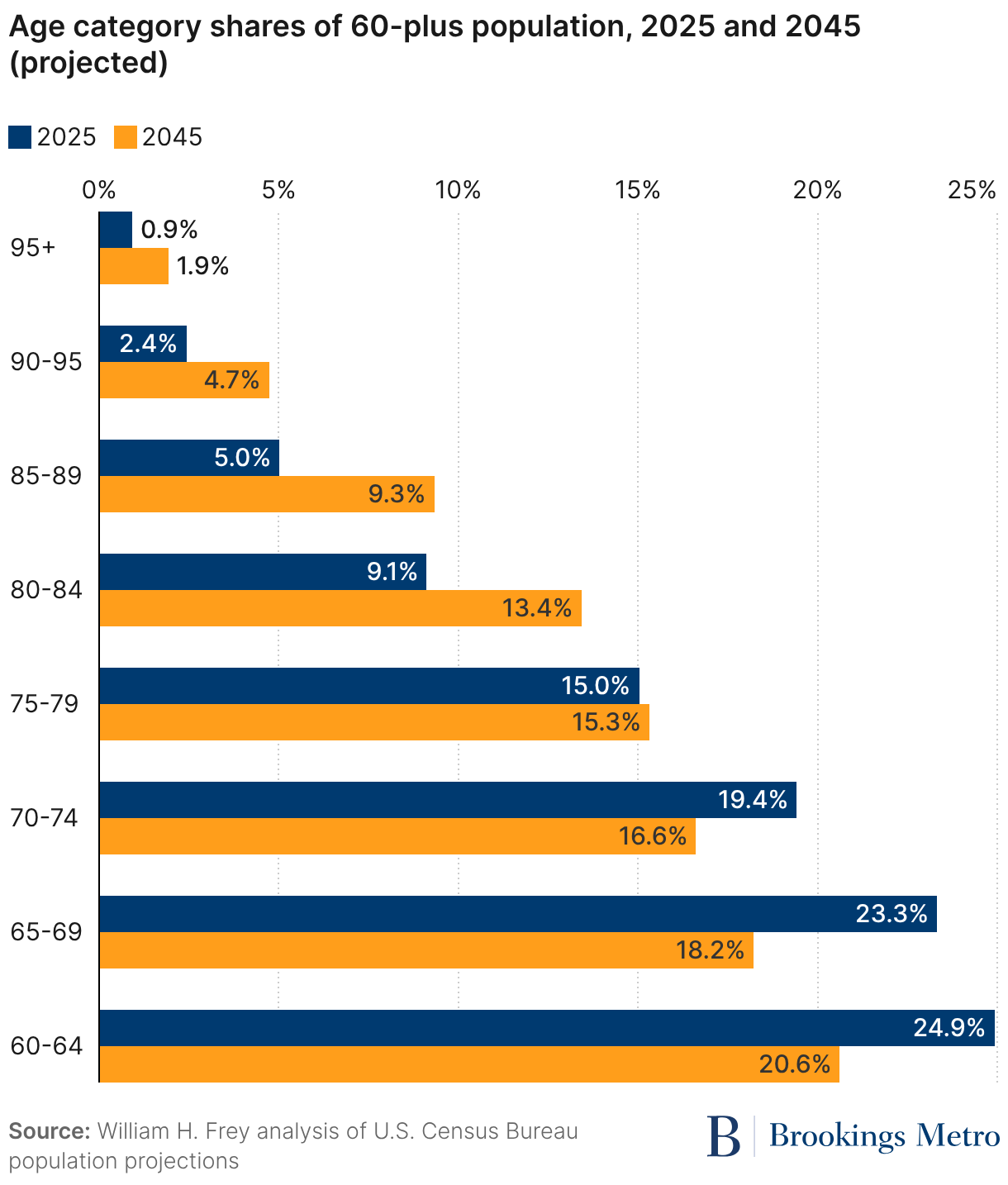
In fact, over the next 20 years, this dynamic will make the nation “old” population even older. Figure 3 shows that in 2025, nearly half (48%) of the age 60-plus population was younger than age 70. By 2045, this share shrinks to 39%. Over those same 20 years, the share of people over age 80 rises for each group over age 60. In 2045, 29% of people in the 60-plus age group will be age 80 or older, compared with just 17% in 2025. Clearly, the baby boomer population will noticeably inflate the size of the “older old” senior population. This is a group that is more prone to chronic health conditions and will require greater long-term care services either at home or in senior housing.

Of course, over this time, the overall U.S. population will continue to age as the growth of younger age groups slows. The nation’s youth population showed an absolute decline between the 2010 and 2020 census—a decline projected to continue into the foreseeable future. This leads to a shift from what demographers term a “youth-dependent” population to an “age-dependent” population—that is, a shift in which populations will be more dependent on the working-age population. While the 65-plus population is typically thought of as the group that is of retirement age and therefore dependent on the working-age population, one might speculate that as baby boomers stay more healthy and able to work longer, the 70-plus population might comprise the new “senior dependent” population.
Even with this assumption, census projections depicted in Figure 4 show that in the year 2034, the share of the nation’s 70-plus population will eclipse the size of the under-15 population—making baby boomer seniors a central focus of the next decade’s senior dependent population. Moreover, likely declines in the younger working-age population—particularly among those working in health care—will make caring for older seniors more of a challenge.
Baby boomer seniors are more racially diverse and highly educated than their predecessors
Just as they did in earlier age groups, baby boomers bring something different to the table in terms of demographics as they move into seniorhood. These “boomer senior” attributes will shape the way they deal with each other as well as other parts of American society. Two important ways that baby boomers differ from prior senior generations are their racial and ethnic diversity as well as their level of education.
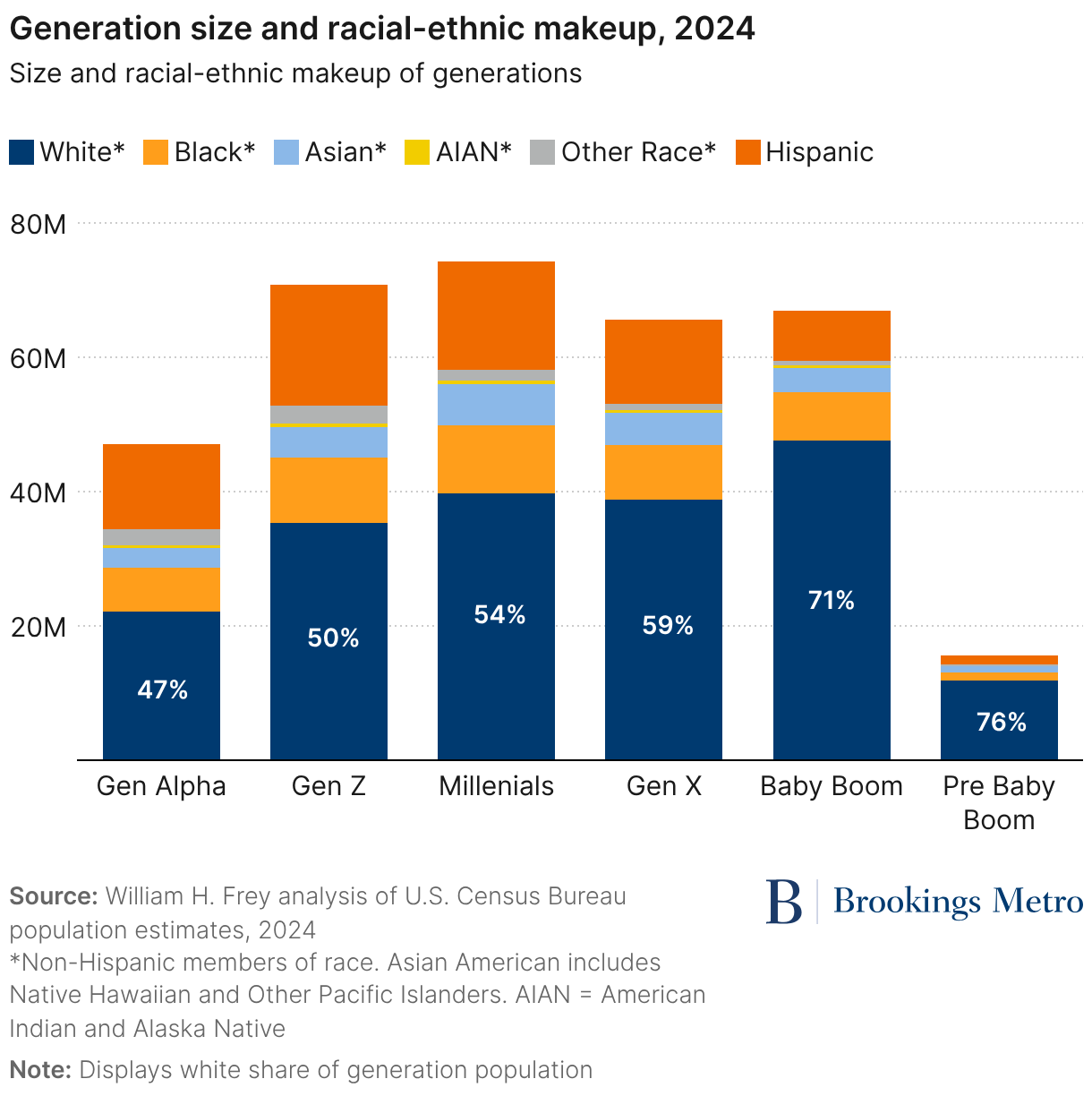
Baby boomers, as seniors, are already more racially diverse than their predecessors. In 2025, the entire baby boomer generation was 71% white, 11% Latino or Hispanic, 11% Black, and 6% Asian American, with the remainder being other races, according to Census Bureau’s Current Population Survey data. This shifted from the previous generation, which at the same age in 2005 was 80% white, 7% Latino or Hispanic, 9% Black, 3% Asian American, and the remainder other races. The larger minority population of baby boomers at this age reflects growing up at a later time, in years that saw new and large immigrant populations that augmented the baby boomer population as it aged.

This is made even more apparent in the projections displayed in Figure 5, which show that by the time all baby boomers are over 80 (which will be in 2045), the 80-plus population will be more diverse (30% nonwhite) than it was in 2025, before baby boomers entered this age group.
Indeed, the baby boomer generation is the most racially diverse older population to date. This will permit government and private sector programs directed to the care and well-being of seniors to broaden their focus to the needs of older individuals from different backgrounds, languages, and family networks—thus opening the gates to wider efforts for even more racially diverse future generations when they reach their senior ages.
An equally important attribute of baby boomer seniors is their much higher level of educational attainment than prior generations. In their younger years, baby boomers benefited greatly from postwar programs in the 1950s and 1960s that supported public schools, as well as federal government programs such as the Higher Education Act of 1965, which enabled them to attend college in historic numbers at a reasonable cost.
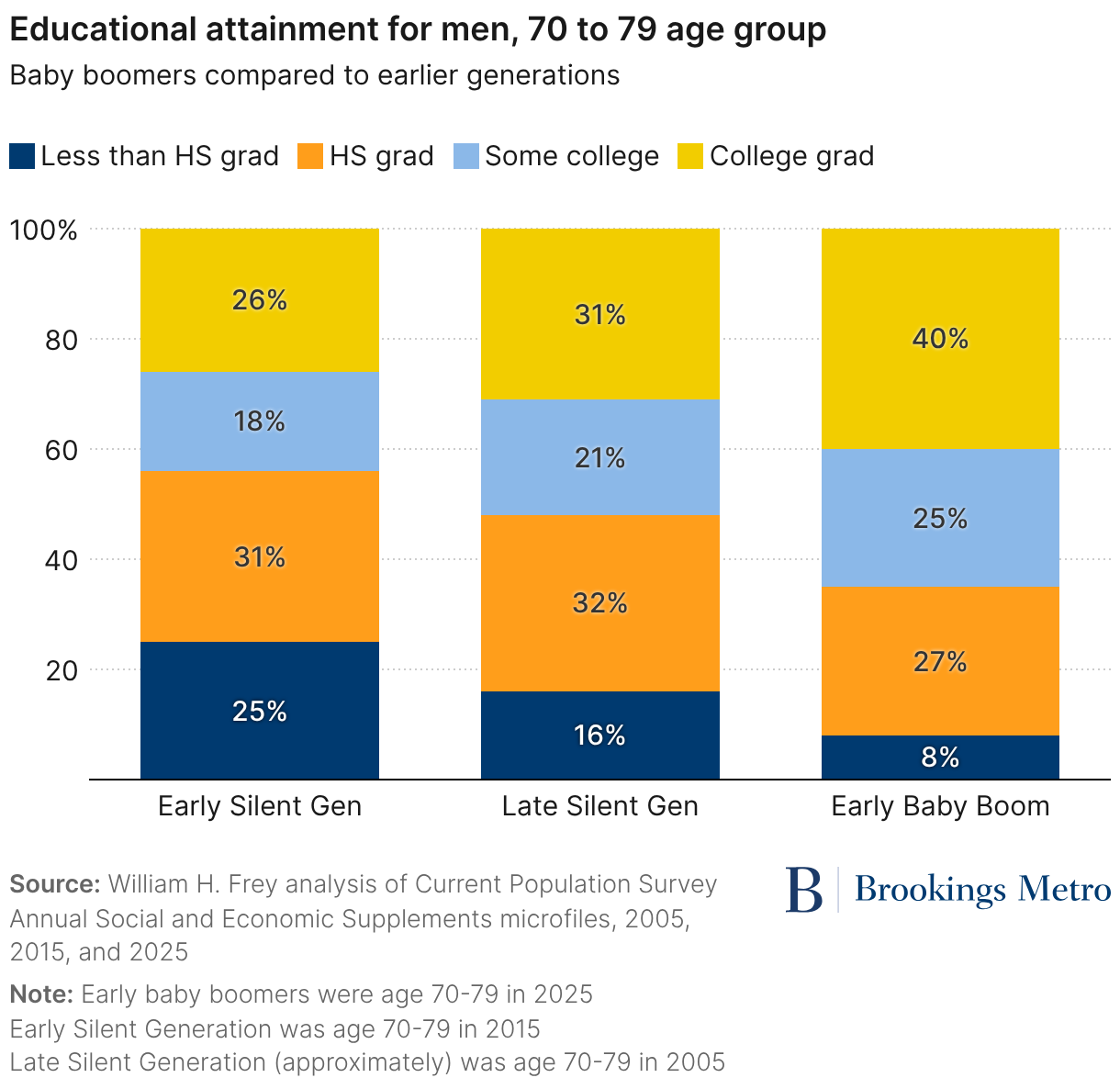
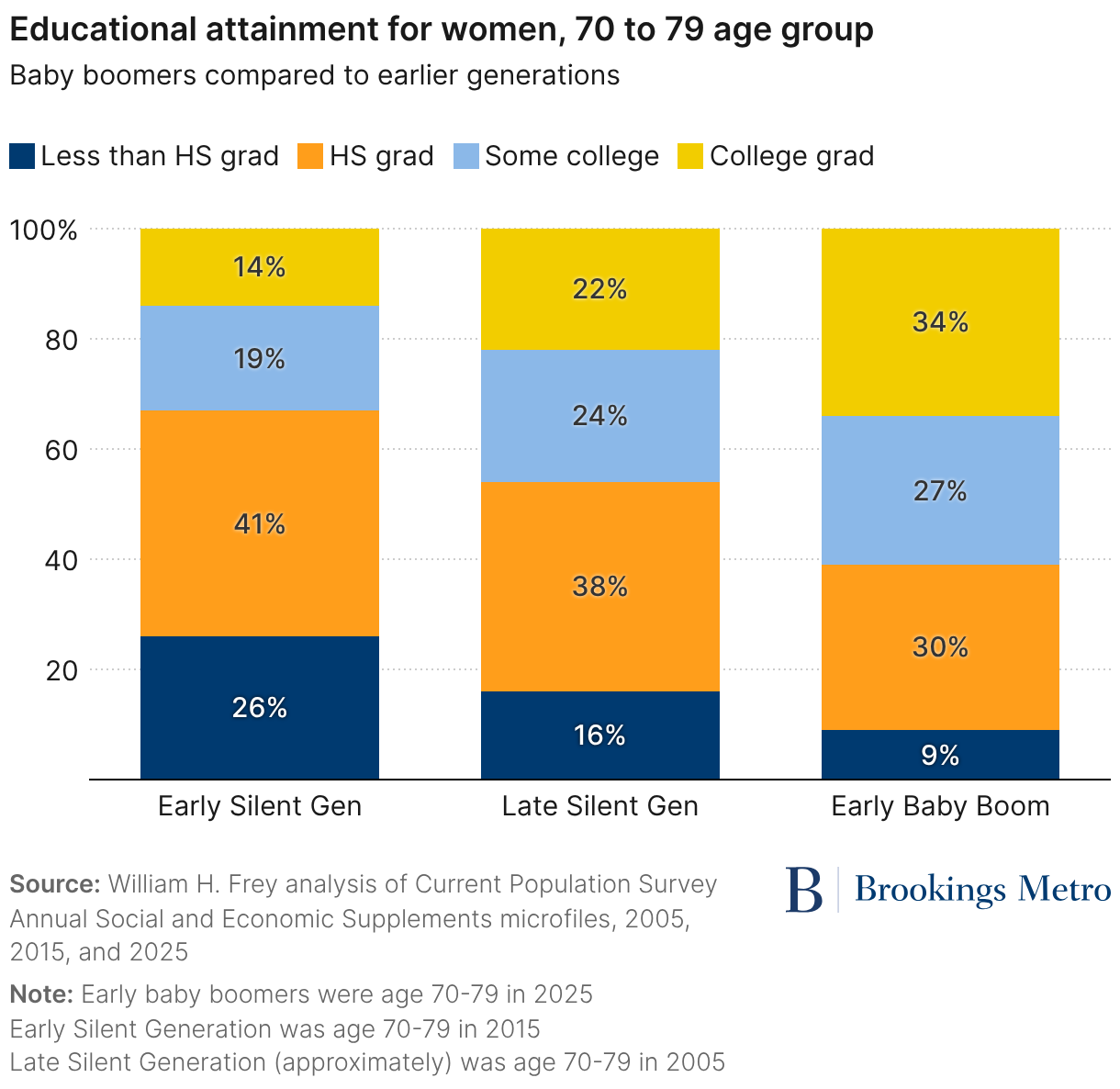
The rising education among seniors due to baby boomers can be seen in Figures 6 and 7, which display the education attainment of seniors age 70 to 79, for both early and late Silent Generation adults (in 2005 and 2015, respectively) along with those of early baby boomers in 2025. The charts are shown separately for men and women, both of whom show great progress in achieving higher shares of post-high school and college education, especially among the baby boomer generation.
The rise in educational attainment among women is especially notable, even as their absolute levels remained lower than those for men. At ages 70 to 79, just 14% of early Silent Generation women were college graduates. This rose to 22% for late Silent Generation women in this age group, and then to 34% for early baby boomer women. This rise in women’s educational attainment is consistent with broader shifts in women’s roles, including greater attention to careers and changes in family structure associated with their greater independence.
The higher education of baby boomers entering old age should put them in a better position than earlier generations of seniors to choose among different work, volunteer, and leisure opportunities, as well as take advantage of various government and private sector programs that provide them with wellness and medical assistance.
Baby boomers’ influence on successor generations
With all the attention that baby boomers received during the late 20th century, many Americans grew up with the notion that this generation would continue to be the nation’s largest. Certainly, by the time the last baby boomer was born in 1964, this generation—then comprising 37% of the total U.S. population—was seen a demographic phenomenon. This continued as the generation began to age and grow in size via new immigrants, to 79 million in 1999. Meanwhile, baby boomers’ impact on the nation’s labor force, tax base, consumer culture, and politics endured.
However, over time, the generation began to slowly decline due to greater numbers of deaths overriding the arrival of new immigrants. And while the immediate succeeding generation, Gen X, was smaller in size due to fewer births during the years 1965 to 1980 (a period of lower fertility and relatively slow immigration), the size of its successor, the millennial generation, showed bigger gains both via births (many to baby boomer parents) and immigration. Thus, in 2019, the millennial generation, born between 1981 and 1996, surpassed the baby boomer generation in numbers, and since then, so has Gen Z (those born in 1997 and after).
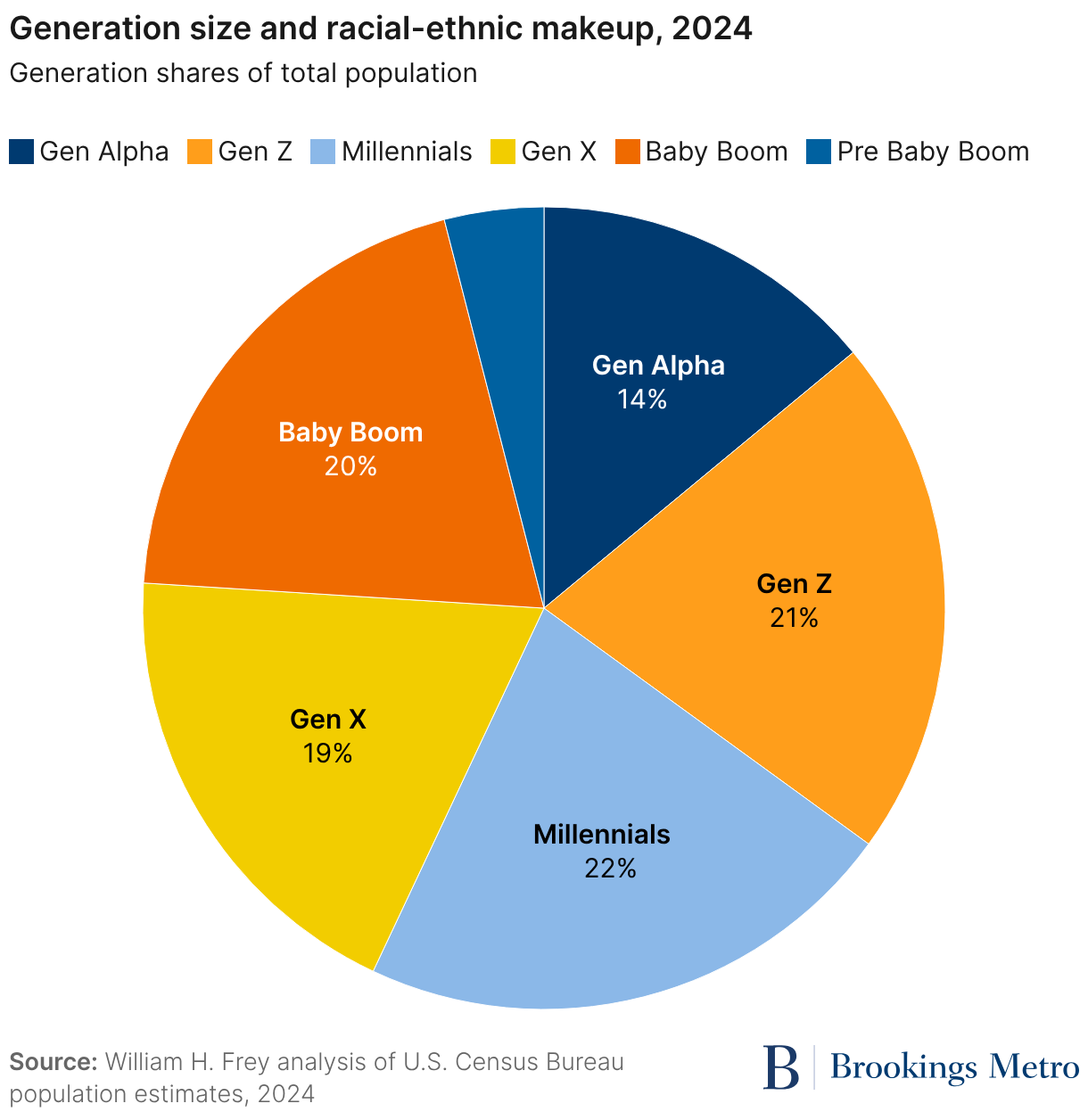

At the time of latest U.S. census estimates in 2024, the baby boomer generation, with 20% of the population, is the third-largest generation behind the millennials (22%) and Gen Z (21%), though still ahead of Gen X (19%) (see Figure 8). However, this was not the case in all states. As Map 1 shows, baby boomers still comprise the largest generation in 15 states, including the New England states of Maine, New Hampshire, Vermont, and Connecticut, as well as swath of states though the Midwest to the East: Wisconsin, Michigan, Ohio, West Virginia, Pennsylvania, and Delaware. Especially notable is Florida, the most populous state in this group, where the large baby boomer population size can be attributed to senior migration to this retirement destination. Yet in many other states, the baby boomer population, while smaller than other generations, is still close to them in size. A notable exception is Utah, where baby boomers represent just 14% of the population, compared to 27% for Gen Z and 22% for millennials.
Its size notwithstanding, there are several areas where it might be said that the baby boomer generation led the way. One of these is racial diversity. As noted above, baby boomers were more racially diverse than generations preceding them, and the generations that followed are becoming even more racially diverse, as Figure 9 shows. One reason for this is the rise of immigrant populations and their children, who identify with a broad set of racial and ethnic groups. In addition to their direct contributions via immigration, they also tend to be younger, with a higher share of women in prime child-bearing ages. From a demographic standpoint, this is a welcome source of growth in light of the nation’s aging white population. In a similar way, younger generations—notably, the millennials—extend the trends inaugurated by the baby boomers, such as higher levels of education, greater trajectories for women’s careers, and the formation of a broader array of family types.
Of course, many of these generational changes have created some of today’s young-old divides, especially with respect to views on immigration and race (something I have termed the “cultural generation gap”). But it should be recognized that baby boomers and their children helped to initiate several societal shifts that were taken up by their successors.
The baby boomer generation still has political clout
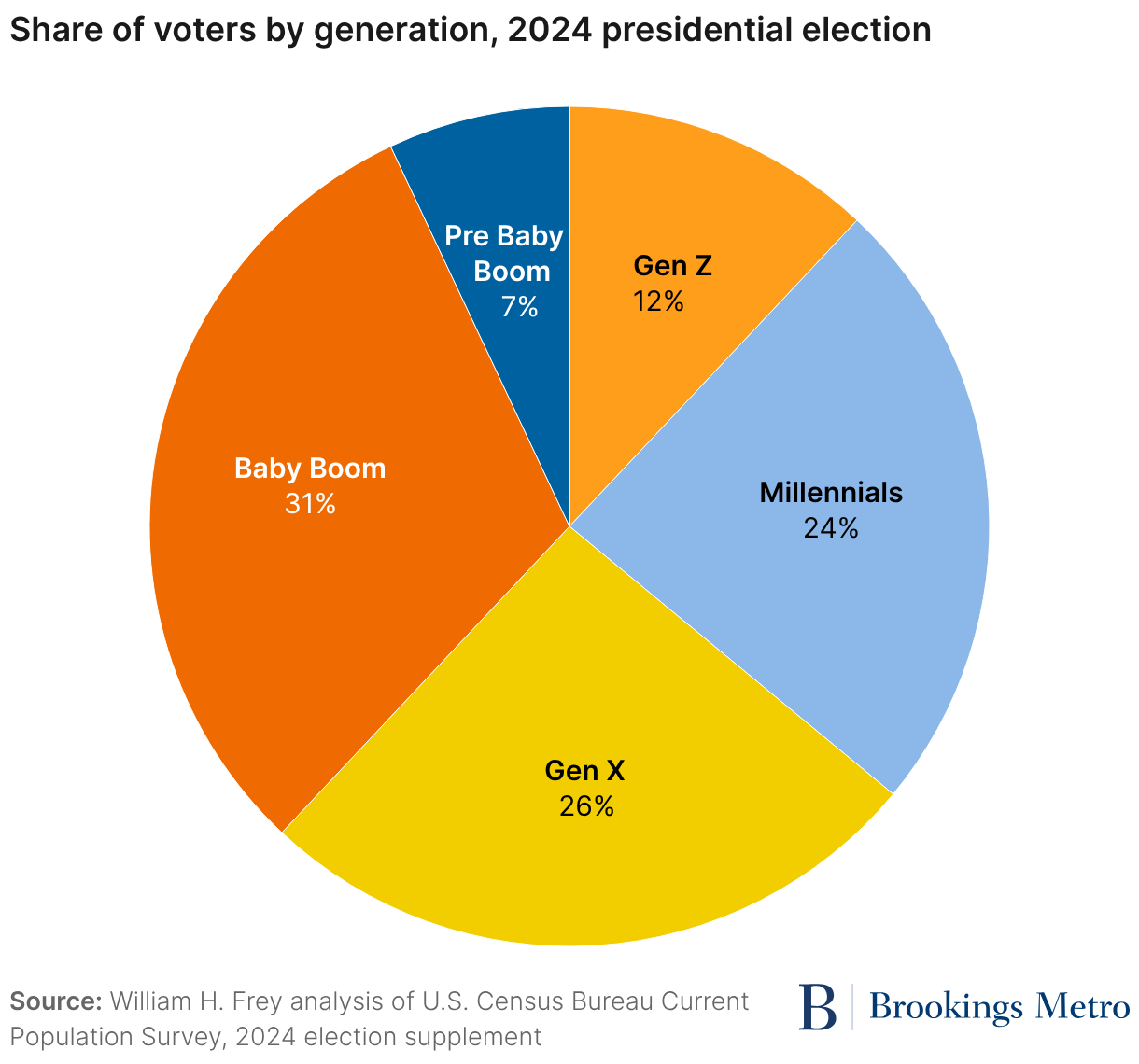
One fact that remains especially true is the baby boomer generation’s large say in who gets elected in national politics by way of its large share of the voting population. This was clearly the case in the 2024 presidential election, when baby boomers comprised 31% of all voters—a larger share than that of any other generation (see Figure 10). This is a higher share than baby boomers’ share of the total population, because voters include only citizens over age 18 who vote, and because older voters—of whom baby boomers are a large part—show markedly higher turnout rates than younger voters.


What is especially interesting about the 2024 election results is that even though Republican candidate Donald Trump bested Democratic candidate Kamala Harris, the young-old voting patterns were less consistent than many anticipated. This was an election with many surprising results, in which the economy and cost of living were high on people’s agendas. Still, with Trump being well known for promoting immigrant deportations and other policies to deter the changing demographics of America, one would have expected his strongest support to come from the oldest age group of 65-plus voters. Yet the data in Figure 12, taken from 2024 Edison Research exit polls, show that it was the 45-to-64 age group that gave Trump the greatest support of all broad age groups, with a D-R margin (the percent voting Democratic minus percent voting Republican) of -10. Meanwhile, the 65-plus age group supported Trump by a D-R margin of just -1.
Moreover, when comparing sub-populations within these age groups, Trump actually lost to Harris across 65-plus Latino or Hispanic, white college graduate, and women voters, despite winning these groups among 45- to 64-year-old voters. And though all Black age groups voted heavily for Harris, 65-plus Black voters gave her the strongest support, with a D-R margin of +87.
While the 65-plus age group is a broad one, about three-quarters of its voters were from the baby boomer generation, so it seems reasonable to say that baby boomer voters were far less favorable to Trump than other seniors. This was confirmed in a separate analysis of validated voters conducted by the Pew Research Center, which found that among all senior groups, only those born in the 1950s—the central decade of baby boomer births—showed a positive margin for Harris (D-R margin of +1), compared with strong Trump support (D-R margin of -10 or greater) for those born in the 1930s, 1940s, and 1960s.
There may have been many reasons for the tepid or negative Trump support among 2024’s baby boomer voters, including differing views on the cost of living, health care, and other issues. But the fact that some of the strongest anti-Trump older voters were baby boomers who were women, minorities, or college-educated suggests much of this generation’s sensibility about race relations, women’s rights, and diversity—formed during its youth—could have something to do with their voting patterns.
One thing is for certain, though: The clout of baby boomer voters will not soon be reduced. Estimates based on population projections and past midterm elections suggest that baby boomers will comprise more than 30% of all voters in the 2026 midterm elections due to even greater old age group turnout advantages in midterm elections. Both Republican and Democratic candidates should take heed.
Baby boomers aren’t going away quietly
As they begin to turn 80, the baby boomer generation is now entering into the “oldest old” age category. Yes, its overall population size will continue to diminish, and there are younger groups, including the “okay boomer” crowd, who have sharply different views from baby boomers on the economy, the environment, and other issues. Yet the baby boomer generation has a history of making its mark in ways that surprise people, often for the better.
Certainly, that will include altering senior lifestyles and living facilities, along with raising their voices about having better health care through both government and private sector programs. But they also have more in common with today’s youth than the senior generations they are replacing. They are the most racially diverse older generation to date, as well as the most enlightened when it comes to women’s issues and roles. We should keep an open mind about the possibility that the former “don’t trust anyone over 30” generation will again draw on its vast experience by building bridges with today’s younger generations.
Author

The Brookings Institution is committed to quality, independence, and impact.
We are supported by a diverse array of funders. In line with our values and policies, each Brookings publication represents the sole views of its author(s).