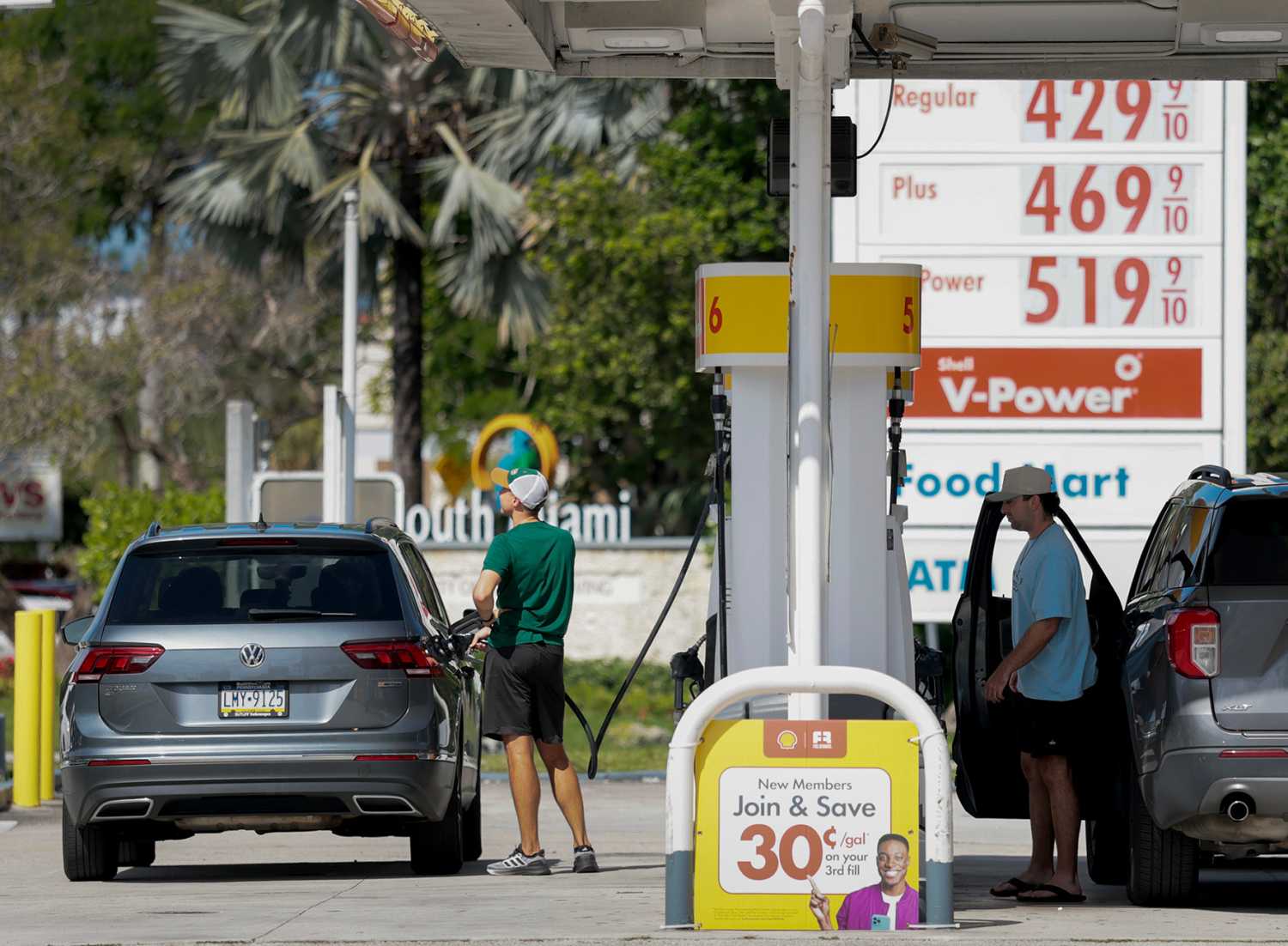
Since Israel and the United States attacked Iran on February 28, American drivers have been feeling the economic pinch. By the start of April, the average national price of a regular gallon of unleaded gas had surpassed $4. That’s an increase of over $1 in just one month.
And the pain at the pump is unlikely to go away anytime soon. If shipping lanes continue to operate at limited capacities for an extended period, experts predict global crude prices could reach $150 a barrel—up significantly from the roughly $100 prices seen in March and April. Even if shipping lanes were to fully reopen tomorrow, it will still take weeks for oil tankers to reach their destinations across the globe. It’s also likely to take years to repair damaged production capacity in Iran and other impacted Middle Eastern countries, leaving some level of supply side constraints long after any military actions stop.
Of course, this isn’t the first time gasoline costs jumped due to Middle Eastern conflicts. Yet much has changed since the 1970s oil crisis and its infamous images of long lines of cars waiting for rationed supplies of gasoline. In particular, today’s more fuel-efficient vehicles help households travel much further on the same gallon of gas. It’s worth asking, then: Are higher prices at the pump still a big deal for American drivers?
The answer is a definitive “yes.” After decades of planning and building neighborhoods primarily around automobiles, most households have no easy alternatives to driving long distances. The result is a real strain on household budgets, and the impacts will be most pronounced for residents of more sprawling metro areas and rural places, lower-earning households that must continue to drive, and people who fit into both categories.
Combined with other inflationary costs and a sluggish labor market, elevated gasoline prices are likely to cause political headaches in the 2026 midterms for many incumbents and other candidates who face guilt by association. Many Republican House members in Congress could be especially threatened; their average constituent drives 26% more miles than a Democratic member’s average constituent.
Experience shows there are no short-term policy fixes for higher gasoline prices. We simply need to wait for global market prices to fall, whenever that may happen. However, oil crises such as this one can inspire policy reforms that deliver change in the long run, including new fuel economy standards for vehicles and new ways to promote alternatives to driving. Those reforms won’t be considered until after the midterms, making this election season especially important for the future of American transportation.
Why most Americans can’t quit gasoline
American households have long relied on their vehicles to accomplish most everyday activities. Over 91% of U.S. households have access to a private vehicle—one of the highest rates in the world. Among U.S. workers in 2024, 78% used a private vehicle to get to work (with another 13% working from home). And for decades, Americans have used a private vehicle for around 90% of their shopping and personal errands, and 80% of the time for social and recreational activities.
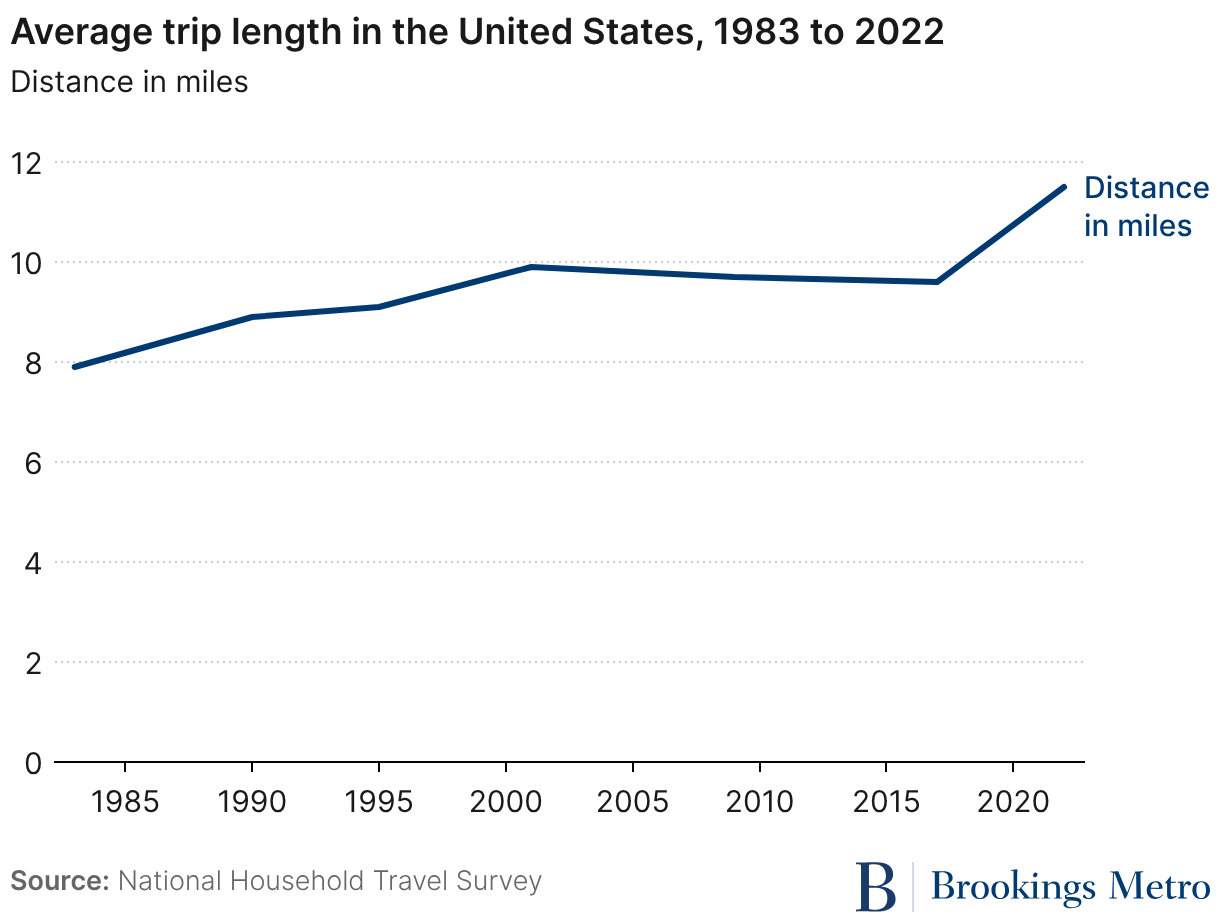
There’s no question that American households use their vehicles at high rates. Yet what’s often overlooked is how little choice they have in terms of what transportation mode to use. The average trip length is over 9 miles, and has been since the 1990s. The continued outward growth in communities of all sizes keeps stretching the distances between where people live and where they want to go. Those land use patterns leave people with poor substitutes for driving if they need to cover long distances in a reasonable amount of time.
In other words, it’s the lack of transportation choice that leaves many households addicted to gasoline. In economic parlance, demand for gasoline is relatively price inelastic: Consumption of the product will go down at a rate slower than the increase in prices. The exact elasticity rate for gasoline is debatable, and lower-income households are more sensitive to price shifts than their higher-earning peers—but gasoline is still considered an inelastic good by any measure and for every income quintile. Simply put, many households can’t easily stop driving.
More expensive gasoline impacts regions differently
It’s easy to frame more expensive gasoline as a national economic story. Crude oil makes up over half of the price of a gallon of gasoline, meaning every nonelectric vehicle driver must confront the dynamics of the global marketplace. After that, though, regional variation quickly takes over.
Some factors are beyond any household’s control. State gas taxes vary considerably, from $0.09 per gallon in Alaska to $0.71 per gallon in California. The characteristics of regional refineries and in-state fuel quality also impact what someone pays at the pump. Even during stable moments in the global marketplace, the price spread of regular unleaded gasoline between the cheapest and most expensive U.S. regions is at least $1 per gallon.
What a household does control is where they choose to live. Based on data from Replica (and looking only at individuals who use a private vehicle for at least some of their daily trips), there is an enormous range in weekly driving distances among residents of different metro areas. Per capita vehicle miles traveled (VMT) in more densely designed metro areas such as New York, Boston, Chicago, and Seattle tend to fall below 175 miles per week. But VMT can jump to over 225 miles per week in more sprawling metro areas such as Atlanta, Nashville, Tenn., and Austin, Texas.

The variation in VMT creates real consequences for consumers’ wallets. The Federal Highway Administration reported the average fuel economy of all light-duty vehicles in 2024 was 23.4 miles per gallon. Using that figure as a consistent input, we can estimate how much someone’s driving distances impact their current spending—and how that may change based on new gasoline prices.


Looking at the middle column of Table 1 (roughly the all-metro-area average of 200 miles driven per week), a driver’s monthly gasoline bill rose $36 as gas prices jumped from $3 to $4 per gallon through March. That may not seem like a big difference, but consider other conditions. For a household with two drivers traveling similar distances, that’s really a $72 increase. Since the median household earned $72,330 after taxes in 2024, the increase in gas prices equates to over a 1% loss in income for a typical two-driver household.
There are drivers who can avoid the price jumps, especially if they travel shorter distances overall, drive an electric vehicle, or have reasonable alternatives available such as transit or safe bicycling routes. Yet there are many people who own less fuel-efficient vehicles or travel much farther per week. Consider the average two-driver household in Jackson, Miss., or Raleigh, N.C., that drives over 500 miles a week combined, or many rural residents who drive even farther. Those households may be feeling a far bigger budgetary pinch than others across the country.
Lower-earning households are particularly burdened by more expensive gasoline
For many American households, more expensive gasoline is an annoyance, but one they can afford. Maybe they dip a bit more into their typical monthly savings; maybe they splurge a little less on nice meals. Those aren’t options so easily available to lower-earning households.
The two lowest quintiles of household earners already spend a greater share of their income on gasoline than their higher-earning peers. And if we isolate only those households with a vehicle, relative spending on gasoline grows considerably. In 2024, households in the lowest-earning income quintile who had access to a car spent 10.3% of all pre-tax income on gasoline. The gasoline spending share for the second-lowest income quintile was 5.2%. Figure 2 shows these higher rates are consistent over many years.

It’s these households that will bear the biggest burden from the recent price jumps. Based on Bureau of Labor Statistics data from 2024, the average pre-tax income for the lowest income quintile is $16,658. If a household with two drivers pays an extra $72 at the pump in a given month, that would equate to a roughly 5.2% loss in their monthly income. That would be a real shock to any household, but especially those with lower available savings to compensate.
It’s little wonder, then, that lower-earning households demonstrate more sensitivity to gasoline prices (or higher elasticity of demand) than their higher-earning peers. This isn’t a uniquely American phenomenon: Global comparison studies confirm the income skew, both in the short and long term.
Putting the geographic and income data together, it’s easy to see why the recent price jumps present an authentic economic stressor in the heavily suburbanized U.S. Lower earners who currently use private vehicles, households with low savings rates, and those who live in the lowest-density places will all have to make difficult choices. It may require shifting to infrequent transit service and bearing longer travel times. For others, it may be the extra social legwork to find a ride with someone else. Maybe most concerning are the households who will need to take on short-term debt to keep driving, which could compound the cost burden many felt before the conflict started. None of these are attractive choices.
How higher gasoline prices could filter into politics and policy
The economic fallout from the Iran conflict is clear in the numbers. The University of Michigan reported that consumer sentiment hit an all-time low in April. Annualized inflation jumped 0.9 percentage points in the first Consumer Price Index report since the conflict started. The public also opposes the conflict by a nearly 2-to-1 margin. This was all fairly predictable, as paper after paper demonstrate how gasoline prices still impact consumer economic sentiment. Households may spend relatively less on gasoline today than they did in the 1970s or even the 2000s, but people still feel trapped and powerless when prices jump. That’s a recipe for economic anxiety.
The president’s party typically loses congressional seats in midterm elections, but these economic conditions look especially difficult for Republican candidates this November. And we can use people’s driving levels to flag where higher gasoline prices could become an especially resonant issue in specific federal campaigns.
Map 2 shows weekly driving distances for the average driver in each of the 435 congressional districts, with darker blue or darker red colors corresponding to longer average driving distances. Based on our analysis, many of the districts where people drive the furthest are currently represented by members of the Republican Party. Expect campaigns in many of these districts to make gasoline a big issue, whether that’s Republicans playing defense or Democrats hammering the issue.

The political fallout from higher gasoline prices isn’t limited to federal elections. This is a huge year for governorships, with 36 on the ballot. Candidates in some of those races, such as California and Nevada, are already making gasoline a major issue. Then there’s the thousands of state legislative seats also up for election. Expect states where typical driving distances are long and where gas prices are highest to be the ones where gasoline could emerge as a major campaign issue. And while candidates for governor may not take a formal position on the conflict in Iran, it will be important to watch whether voters penalize Republican candidates for decisions made by President Donald Trump and congressional Republicans.
Yet with all these elections still months away, there’s plenty of time for current officials to pursue immediate policy responses. Unfortunately, there are no short-term interventions that can truly solve the problem, won’t cause other problems downstream, and are politically realistic. A federal or state gas tax holiday always seems to come up in these moments, and it can address some of the price impacts on households. But losing that revenue only hurts the public agencies responsible for building and maintaining roads, and there’s no guarantee oil companies won’t raise prices to capture some of the tax savings. Releasing fuel from the strategic petroleum reserve sounds good, but it struggles to move prices in a meaningful way. Taxing oil companies for “windfall” profits or restricting oil exports are both difficult to implement and even harder to pass in Congress.
In the long run, though, there are policy reforms can create durable change for both firms and consumers. Federal regulators responded to the 1973 oil crisis by mandating vehicles become far more fuel-efficient, and manufacturers were able to hit ever-growing targets. Policies such as deregulating prices and expanding available land for drilling helped grow domestic supply, shifting U.S. economic positioning in oil’s global marketplace. In more recent decades, federal and state investments helped the electric vehicle (EV) industry develop new technologies and incentivized consumers to purchase them. With the Trump administration rolling back higher fuel efficiency targets and Congress doing the same for EV-related incentives, a Democrat-led House or Senate could reverse course. Many state legislatures and governors could introduce their own EV-related incentives too, insulating more American drivers from volatile global oil markets.
It’s worth noting that all of these policy responses to energy concerns assume driving is a given. Yet that is a failure of imagination. Going forward, it’d be malpractice for U.S. policymakers to not use this experience to also think about lowering the demand for driving.
The experience of peers in Europe should be instructive. Following the 1970s oil crises, many European countries passed and maintained policies to reduce driving demand, including through higher vehicle registration fees, reduced parking, and car-free days. Those policies were complemented by investments in driving alternatives, especially new right-of-way designs for bicycles. Decades later, European households now drive fewer miles, while American households went in the opposite direction. The net effect is those European residents are a bit more insulated from spikes in global gasoline prices, to say nothing of the impacts on public health, fiscal liabilities, and demand for infill neighborhoods.
U.S. policymakers should consider how the household experience in 2026 can build support for similar reforms. Many U.S. cities are already pursuing expansive cycle network buildouts; the current oil crisis is a good reason to accelerate their construction and remind voters of what safer and more convenient cycling offers. The same applies for proposals to speed up buses, especially with dedicated lanes. Likewise, policies aiming to boost housing supply within infill neighborhoods should reference the oil crisis to strengthen their case, both among voters and hesitant legislators. As the old saying goes, never let a crisis go to waste.
Will 2026 be remembered as a transportation blip or a pivot?
The conflict in Iran has already left an immediate impact on American consumers. There are simply too many households who use their cars every day for them to not at least notice when gasoline prices jump by over $1 per gallon in just a few weeks. And for the many households who either earn less than the median wage, drive hundreds of miles a week, or fit into both categories, higher prices at the pump have made a real dent in their disposable income too.
Even if prices somehow fall back to their pre-conflict levels by early fall, it’s hard to imagine a scenario where consumers don’t bring some level of economic anxiety with them into the midterm voting booth. And the longer prices are elevated, the more likely voters won’t soon forget.
It’s somewhat fitting, then, that the long-term impact of this conflict on American transportation will be determined by voters and who they put into office. How 2026 candidates view transportation costs will go a long way in determining what policy reforms will be proposed in 2027. Constituents and stakeholders continuing to bang the drum for less household reliance on gasoline, as well as the number of people turning to nondriving alternatives or purchasing more fuel-efficient cars, will all impact which proposals become law.
It will take at least a year to know our path, but the domestic response to the most recent global oil crisis is just getting started.
Authors


The Brookings Institution is committed to quality, independence, and impact.
We are supported by a diverse array of funders. In line with our values and policies, each Brookings publication represents the sole views of its author(s).