This background briefing guide was distributed to participants ahead of the Forum for Cooperation on AI (FCAI) dialogue on July 23, 2026. FCAI dialogues follow Chatham House rule, so remarks are anonymized.
In the span of roughly six weeks, the G7 brought frontier artificial intelligence (AI) executives to the leaders’ table at Évian, France; the U.N. convened all 193 member states in Geneva for the first session of the Global Dialogue on AI Governance, informed by the first report of its Independent International Scientific Panel on AI; the International Telecommunication Union (ITU) held its AI for Good Global Summit and the World Summit on the Information Society (WSIS) Forum; and China prepared to host the World Artificial Intelligence Conference (WAIC) and its Asia–Pacific Economic Cooperation (APEC) Digital Weeks in Shanghai, where it continues to build out the proposed World AI Cooperation Organization.
At the same time as these global summits, transatlantic governments have been moving on AI policy: The Trump administration issued a pair of executive actions asserting a voluntary, security-focused, adoption-first federal posture, while the EU finalized the Digital Omnibus, deferring the AI Act’s high-risk obligations by 16 months even as the act’s transparency rules took effect on Aug. 2.
These meetings illustrate broader trends in international governance: Corporate leaders are sitting at the table, including at the G7 and now institutionalized in the new AI for Good Global Commission, which pairs CEOs with heads of state; the U.N.’s forum on AI is advancing, with a second session in New York in May 2027; and China has ambitions to build an alternative institutional structure for AI governance. This dialogue took stock of the results of these global meetings and the current focus of U.S. and Chinese influence.
G7 Summit in France
June 15-17France hosted the 52nd G7 Summit in Évian-les-Bains from June 15 to June 17. In an unprecedented move, France invited AI executives from Anthropic, OpenAI, Google DeepMind, Salesforce, Meta, and Mistral AI, as well as several AI startups, and leaders met with tech business leaders at a working lunch to discuss regulation, networks, and AI infrastructure. This continues France’s diplomatic strategy dating to the February 2025 AI Action Summit, placing market leaders alongside conventional state power.
After the May update to the Hiroshima AI Process (HAIP) reporting framework on the margins of the G7 Digital and Tech Ministerial, the leaders’ texts did not ultimately reference the process.
G7 leaders adopted nine declarations, including a call for a safer digital space for minors. Commitments include safety-by-design, AI systems appropriate to the age of the user (for example, adapting chatbot language when interacting with children), coordinated measures against AI-generated child sexual abuse material, and movement away from isolated national regulations toward a harmonized, interoperable framework among advanced economies.
Beyond child safety, AI discussions centered on supply chain security, incident sharing, and AI infrastructure. France also involved partner countries (India, Kenya, South Korea, Brazil, and Egypt) throughout the discussions.
UN Global Dialogue on AI Governance
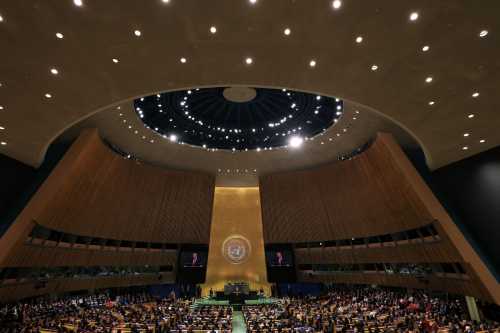
July 6-7, GenevaThe U.N. General Assembly established the global dialogue in resolution A/RES/79/325, following its commitment in the Global Digital Compact, adopted in 2024. Permanent representatives to the U.N. Egriselda López of El Salvador and Rein Tammsaar of Estonia served as co-chairs of the 2026 dialogue. The first session was held July 6-7 at Palexpo in Geneva, marking the first international AI forum in which all 193 member states sat at the same table alongside the private sector, civil society, academia, and the technical community. A second session will follow in New York in May 2027, coinciding with the high-level review of the Global Digital Compact.
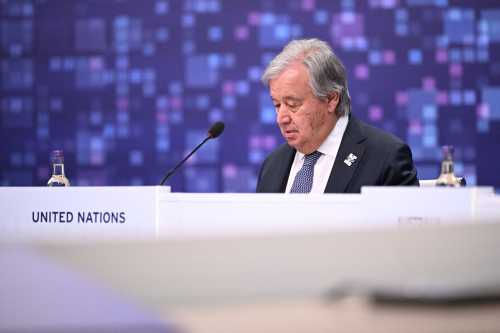
Opening the session, Secretary-General António Guterres called for a global governance system to shape AI for the good of humanity, warning against letting the world “vibe-code” humanity’s future and pairing the appeal with a renewed call for controls on autonomous weapons. He also proposed the AI Child Safety Pledge, called for locked-in access for developing countries, and urged that all AI data centers run on renewable energy by 2030. The agenda comprised plenaries on each of four thematic clusters: AI opportunities and implications; bridging the AI divide; safe, secure, and trustworthy AI; and respecting, protecting, and robust human oversight of AI systems. The thematic plenaries were followed by a multi-stakeholder plenary with a high-level governmental segment on “Dialogue of Dialogues.”
The session was preceded by six months of structured consultations that drew over 1,500 written submissions. Governments were the only stakeholder group to rank capacity-building first; most other groups ranked safety first, while transparency, accountability, and human oversight also scored highly.
The U.S. participated at the working level: White House Office of Science and Technology Policy Senior Adviser Katie Strickland delivered remarks emphasizing adoption, economic growth, and liberty-preserving deployment. The EU statement (delivered by the European Commission’s Director-General for Communications Networks, Content and Technology Roberto Viola) leaned on the need for a credible, independent scientific baseline and warned against a race to the bottom.
Independent International Scientific Panel’s preliminary report
The Independent International Scientific Panel on AI, co-chaired by Yoshua Bengio and Maria Ressa, presented its first annual report in plenary. The panel includes 40 members drawn from all five U.N. regions and selected across 140 countries. The report argues that policymakers need scientific evidence to govern AI, but by the time evidence is clear, it may be too late to act on it. Findings are organized across seven domains (AI science and trajectories; societal applications; economic implications; security, systems, and the environment; human rights, information, and democracy; cultural and individual flourishing and child safety; and management, governance, and reliability).
The report highlighted the concentration of AI development, noting that the U.S. and China account for roughly 75% and 15% of computing power among the world’s largest 500 AI supercomputers, respectively; and agentic systems’ software task capacity is doubling roughly every four to seven months while reliable control methods lag. The report also formally documents links between chatbot sycophancy and severe mental health harms.
The report also states that the AI divide stems from capacity to influence development, not just access to the technology, including infrastructure, talent development, and AI governance and public service capacity. Yet the co-chairs deliberately declined to make policy recommendations, arguing that doing so would politicize the panel’s evidence function. The next annual report will inform the second dialogue; thematic briefs (AI and the environment, AI and child safety, and governance instrument effectiveness) will come in the interim.
ITU AI for Good Global Summit
July 7–10, GenevaThe AI for Good Global Summit is the seventh summit organized by the ITU in partnership with 50 U.N. sister agencies and co-convened with the Government of Switzerland. The 2026 program covered agentic AI security, AI testing and benchmarking, misinformation and deepfakes, quantum applications, and AI infrastructure and energy demand.
On testing, a July 8 workshop built on the ITU-T Study Group 21’s benchmarking work. Additionally, the China Academy of Information and Communications Technology launched the International Initiative on Co-building Foundation Model Evaluation Ecosystems, calling on organizations worldwide to pool evaluation capabilities and benchmarking resources.
On July 2, Rwandan President Paul Kagame, Salesforce CEO Marc Benioff, and ITU Secretary-General Doreen Bogdan-Martin launched the AI for Good Global Commission, a roughly 44-member body pairing heads of state and government (Rwanda, Estonia, Iceland, Kazakhstan, Namibia, Nigeria, Singapore, and Togo, among others) with U.N. agency heads and industry executives, including Jensen Huang (Nvidia), Andy Jassy (Amazon), Brad Smith (Microsoft), Jack Clark (Anthropic), Aidan Gomez (Cohere), James Manyika (Google), and Cristiano Amon (Qualcomm). It builds on the ITU/UNESCO Broadband Commission model.
The commission held its first meeting on July 8, during the summit, and framed its priority as bridging the divide facing the 2.2 billion people still offline.
WSIS Forum 2026
July 6-10, GenevaThe WSIS Forum ran July 6 to July 10, co-organized by the ITU, UNESCO, U.N. Development Programme, and U.N. Trade and Development (UNCTAD). This was the first forum since the WSIS+20 review: The General Assembly adopted the WSIS+20 outcome document by consensus on Dec. 17, 2025, and resolution A/RES/80/173 reaffirmed the forum as the principal multistakeholder mechanism for advancing the WSIS Action Lines.
The 2026 forum focused on Action Line roadmaps aligned with the sustainable development goals and the Global Digital Compact, revised indicators, and a new biennial reporting cycle.
WAIC, the High-Level Meeting on Global AI Governance, and APEC Digital Weeks
Mid-to-late July, ShanghaiChina hosted the 2026 World Artificial Intelligence Conference and the High-Level Meeting on Global AI Governance in Shanghai from July 17 to July 20, held during the APEC digital weeks (China holds the 2026 APEC host year). The conference was jointly organized by the Ministry of Foreign Affairs (MOFA), the National Development and Reform Commission (NDRC), the Ministry of Industry and Information Technology (MIIT), the Ministry of Education, and the Ministry of Science and Technology, alongside the Shanghai government. The stated theme was “AI Partnership for a Brighter Future” per China Daily; Global Times translates it as “Intelligent partners, co-creating the future.” The conference included policy discussions, industry exhibitions, and the WAIC academic conference on research papers and international cooperation.
In the July 7 countdown briefing, officials announced the conference would include more than 1,400 guests, over 140 forums, and more than 300 product debuts. The NDRC released two outcomes at the conference: a collection of AI application success cases covering more than 20 countries and an action plan for AI cooperation and development spanning eight areas including intelligent computing, open ecosystems, and security governance. Twenty-nine countries signed the agreement to establish the World AI Cooperation Organization.
At WAIC 2025, Premier Li Qiang proposed a World AI Cooperation Organization (WAICO), and at the 2025 APEC summit—during which the U.S. skipped the leaders’ portion—President Xi Jinping advanced the proposal, positioning China as a champion of multilateral AI cooperation. Chinese officials say establishment of the organization, tentatively headquartered in Shanghai, is accelerating, framed as a platform for countries to deepen innovation cooperation.
APEC 2026 Digital Weeks
- Digital and AI Ministerial Meeting (DMM) on July 23, hosted by MIIT; expected to produce a ministerial joint statement.
- High-level dialogue on leveraging digital and AI technologies to power the APEC community, July 24.
- High-level forum on AI, July 24, hosted by the Cyberspace Administration of China; expected to produce an action initiative on AI development.
- Workshop on new concepts and approaches to AI literacy enhancement actions for the public, July 25.
- Data for Growth high-level roundtable, July 25, hosted by the National Data Administration (NDA); expected to produce an initiative on data for growth.
- Workshop on the role of data and AI in enabling industrial transformation, July 25. The APEC Telecommunications and Information Working Group (TELWG) and Digital Economy Steering Group (DESG) were scheduled around these high-level events.
US AI initiatives
Pax Silica Summit (June 25-26, Washington, D.C.)
Pax Silica is a U.S.-led initiative focused on securing supply chains for semiconductors, AI, and rare earths. It is coordinated by the State Department and launched in December 2025 alongside the signing of the nonbinding Pax Silica declaration. The declaration encouraged partnership on the “strategic stacks” of the technology supply chain.
The State Department held its second Pax Silica summit, following its initial summit in December 2025. The summit produced a Joint Statement on AI Opportunity Partnership signed by the United States and 34 other nations, aligning on a pro-growth approach to AI.
As a result of the summit, 10 new partners joined the initiative—Argentina, Chile, Costa Rica, El Salvador, the EU, Germany, Greece, Kazakhstan, the Netherlands, and Panama—bringing the total to 24 signatories. Taiwan endorsed the principles via a separate joint statement, and more than 12 affiliate countries participated. The summit also offered opportunities for private sector cooperation on supply chains.
After the second summit, the Bureau of Economic and Business Affairs posted a Notice of Funding Opportunity on July 1. It draws on the Pax Fund, which is repurposed funds from the CHIPS Act’s International Technology Security and Innovation Fund, anticipating three cooperative agreements ranging from $1 million to $50 million. The design was previewed at the summit: a credentialing and provenance platform expediting shipment of semiconductors, AI infrastructure, and critical minerals, integrating with existing customs, port operator, and shipper tracking platforms. It begins as a pilot with Panama’s ports and customs authorities; if successful, a second phase expands to other Pax Silica economies.
Federal policy
U.S. Executive Order 14409, titled “Promoting Advanced Artificial Intelligence Innovation and Security,” was signed on June 2, 2026, and establishes a classified process for designating “covered frontier models” and a voluntary framework under which developers grant the federal government up to 30 days of prerelease access, while expressly disclaiming any mandatory licensing, preclearance, or permitting regime. It also directs the Treasury to stand up an AI cybersecurity clearinghouse, including voluntary coordination of vulnerability scanning and patching with industry and critical infrastructure operators.
The order does not directly mention testing; the voluntary framework does not articulate any evaluative purpose for the up-to-30-day prerelease window beyond identification as a covered model and assigns the lead to the Treasury, the National Security Agency, and the Cybersecurity and Infrastructure Security Agency (CISA), with the National Institute of Standards and Technology (NIST) relegated to a consultative role. NIST’s Center for AI Standards and Innovation (CAISI) announced predeployment evaluation agreements with Google DeepMind, Microsoft, and xAI in May and had earlier agreements with Anthropic and OpenAI in 2024. It is not clear whether the executive order’s access framework will connect to CAISI’s evaluation function or run parallel to it.
U.S. President Donald Trump also signed a National Security Presidential Memorandum on AI in the National Security Enterprise on June 5, which rescinded and replaced the Biden-era NSPM-25. The memorandum is organized around four pillars (adoption, adaptation, assurance, and accountability), directs an update to DOD Directive 3000.09 on autonomous weapons within 90 days, proposes an AI National Security Strategic Reserve staffed by private-sector talent, and orders termination of contracts with AI companies that repeatedly limit how the government uses their products.
Discussion questions
- How do the summits this summer fit into the AI governance anchors and hooks model discussed at the last FCAI Dialogue? Can this organization structure make delineation of the initiatives and foster better coordination?
- The U.N. dialogue’s own consultations demonstrated a split: Governments ranked capacity-building first; nearly every other stakeholder group ranked safety first. How should global governance groups prioritize these objectives?
- The U.N. dialogue co-chairs said Geneva’s success will require embedding human rights into AI governance will require practical implementation rather than new declarations alone. What actions would make the initiative a success?
- How does Pax Silica differ structurally and philosophically from China’s Belt and Road Initiative or older trade frameworks?
- What role should private-sector tech giants play in shaping government-led economic security frameworks?
Recommended reading
G7 Summit
“G7 Évian 2026.” Élysée. https://www.elysee.fr/en/G7evian.
Montreal Institute for Global Security. “MIGS releases new report on Beijing’s interference operations across the G7.” MIGS, May 27, 2026. https://migsinstitute.org/migs-releases-new-report-on-beijings-interference-operations-across-the-g7/.
“The outcomes of the Évian G7 summit.” Élysée, June 17, 2026. https://www.elysee.fr/en/G7evian/2026/06/17/the-outcomes-of-the-evian-g7-summit.
Wheeler, Tom. “G7 should accept AI standards offer, but make it enforceable.” Brookings, July 1, 2026. https://www.brookings.edu/articles/g7-should-accept-ai-standards-offer-but-make-it-enforceable/.
UN Global Dialogue
Johnson, Daniel. “From AI to ‘killer robots’: UN chief issues urgent governance call.” UN News, July 6, 2026. https://news.un.org/en/story/2026/07/1167873.
“Global dialogue on AI governance.” United Nations. https://www.un.org/global-dialogue-ai-governance/en.
Kawamori, Hisae. “Global push for AI governance amid warnings of ‘catastrophic harm.’” UN News, July 5, 2026. https://news.un.org/en/story/2026/07/1167862.
Independent International Scientific Panel on AI. “Preliminary report.” United Nations. https://www.un.org/independent-international-scientific-panel-ai/en/preliminary-report.
“‘The science is here’: UN chief welcomes first global AI assessment.” UN News, July 1, 2026. https://news.un.org/en/story/2026/07/1167853.
Tucker, Jason, Virginia Dignum, Rachele Carli, Petter Ericson, and Tatjana Titareva. “The UN scientific panel on AI’s preliminary report does not establish its independence.” Tech Policy Press, July 8, 2026. https://www.techpolicy.press/the-un-scientific-panel-on-ais-preliminary-report-does-not-establish-its-independence/.
ITU AI For Good
“AI for Good Programme.” ITU. https://aiforgood.itu.int/summit26/programme/.
“Global leaders launch AI for Good Global Commission to expand access, strengthen trust and accelerate impact.” ITU, July 2, 2026. https://www.itu.int/en/mediacentre/pages/pr-2026-07-02-ai-for-good-global-commission.aspx.
Gold, Ashley. “UN launched ‘AI for Good’ commission.” Axios, July 1, 2026. https://www.axios.com/2026/07/01/un-ai-commission-ceos-world-leaders.
World AI Conference
Chen, Laurie, Casey Hall, and Eduardo Baptista. “Xi pitches China as leader of new global AI order, challenging US dominance.” Reuters, July 16, 2026. https://www.reuters.com/world/asia-pacific/chinas-xi-promotes-chinas-commitment-ai-access-speech-shanghai-conference-2026-07-17/.
“China to host 2026 World AI Conference in Shanghai in July.” China Daily, June 17, 2026. https://global.chinadaily.com.cn/a/202606/17/WS6a325452a310986e2b46085f.html.
US AI Policy
Kerry, Cameron F. “The Trump administration’s embargo on Anthropic’s latest models scorches its hopes to export American AI.” Brookings, July 1, 2026. https://www.brookings.edu/articles/the-trump-administrations-embargo-on-anthropics-latest-models-scorches-its-hopes-to-export-american-ai/.
“National Security Presidential Memorandum/NSPM-11.” The White House, June 5, 2026. https://www.whitehouse.gov/presidential-actions/2026/06/national-security-presidential-memorandum-nspm-11/.
Nguyen, Vinh and Michael C. Horowitz. “What Trump’s national security AI memo gets right—and leaves unresolved.” Council on Foreign Relations, June 9, 2026. https://www.cfr.org/articles/what-trumps-national-security-ai-memo-gets-right-and-leaves-unresolved.
“Promoting advanced artificial intelligence innovation and security.” The White House, June 2, 2026. https://www.whitehouse.gov/presidential-actions/2026/06/promoting-advanced-artificial-intelligence-innovation-and-security/.
Meeting summary
During the first panel, participants offered a mixed but broadly constructive view of the U.N. Global Dialogue in Geneva. Several described a glass-half-full outcome. The U.N. scientific panel’s report provided a narrative and diagnostic for the U.N. that extended beyond capacity-building into safety and security, and more than one participant saw the meeting as the first genuine opportunity for Global South governments to shape the direction of global AI governance. Others cautioned that the discussion remained abstract and high-level and that the path forward is unclear given leadership transitions at the United Nations and the geopolitics constraining global governance. Participants noted asymmetry in the mandates from the General Assembly: The scientific panel has a three-year remit, while the global dialogue itself is currently mandated to convene only once more.
On AI risks, participants perceived convergence across fora, in part due to the major reports, including the international AI safety report and the U.N. scientific panel report’s shared issue set including labor market disruptions, biosecurity risks, and impacts on individual autonomy, as well as real-world harms including deepfake harassment and cyberattacks. Both reports identify gaps in risk measurement and mitigation systems before systems are released.
Participants also flagged the limited visibility into internal risk mitigation practices at frontier labs beyond model cards and published safety frameworks and suggested distinguishing what should be disclosed publicly from what should go to institutions and evaluators. One participant argued that these risks were more alarming given the recent breach of Hugging Face’s internal datasets and credentials by OpenAI researchers testing prerelease models.
On incident reporting, discussions covered California’s SB 53 public reporting provisions, which cover four risk categories and draw on the state’s frontier AI report and the international AI safety report. Since diverging methodologies for incident reporting regimes could undermine meaningful assessment across jurisdictions, states such as New York and California have coordinated on defining AI incidents.
Participants generally agreed on a need for an independent evaluation ecosystem beyond AI safety institutes and for more real-world deployment data, while acknowledging structural and timing obstacles to collection. Future FCAI dialogues could examine evaluation capacity as well as whether evaluations should be continuous, pre-market, ex post, or ad hoc. Several agreed there should be continuous assessment given model creep, recursive learning, and unknown unknowns.
Some participants pointed to “wins” from this summer that include the approval of the first CEN-CENELEC JTC 21 standard and other European standards work supporting AI Act implementation, a G7 open-source initiative, and shared principles on generative AI risks to minors.
In the second panel, speakers discussed the updated HAIP reporting framework, which incorporates additional data sources alongside efforts to encourage adoption of the existing OECD incident taxonomy.
On China, participants perceived a distinction between state policy and industry behavior. On the one hand, the government’s pitch at this year’s World AI Cooperation rollout positioned China as a partner helping countries build domestic capability and narrow the “intelligence gap,” in contrast to an exclusive club. Yet, speakers noted that WAICO had few high-level signatories concentrated among large emerging economies, with no Western and few African participants, describing it as more of an optics exercise than offering any clear commitments. It was suggested that Chinese capacity-building has been delivered through open-source model releases more than diplomatic commitments. Industry rhetoric tracks closely that of U.S. firms, including points on artificial general intelligence (AGI) and superintelligence.
Policy, by contrast, was described as following the playbook from earlier information technologies: domestic diffusion, integration, and adoption, as well as external posture as an open partner. Nevertheless, participants noted a shift toward a more hybrid openness posture under commercial pressure with staged releases. Participants noted that the misuse, malfunction, and systemic risk categories from the international safety reports appear in Chinese AI law and are driving downstream tracking work. Views differed on whether Chinese policymakers will treat catastrophic risk seriously only with evidence of AGI or whether recent U.S. actions and frontier releases have already begun to shift their posture.
On the U.S. convening of Pax Silica, several participants questioned what the initiative has to offer given the lack of a public framework or roadmap. The current funding level was critiqued relative to the level of ambition but will likely receive more funds from the CHIPS Act. Many signatories are seeking reassurances on continued access to U.S. frontier models in light of the government’s hold on the Fable 5 release. Several participants also flagged the risk that Pax Silica and WAICO together deepen bipolar framing of the governance conversation.
Participants pointed out negative attitudes toward AI across Western publics with a widespread perception of inevitability, with job loss identified as a primary concern. Some observed that little sustained work is being done to make the case that AI will improve people’s lives.
Speakers also raised access and sovereignty pressures, as several firms are turning to Chinese models where U.S. offerings may be less accessible or affordable, or to mixing and matching the two. U.S.-China distrust constrains governance cooperation, and the countries may split on agentic standard setting.
Looking ahead to September, participants were skeptical that the U.N. General Assembly will produce substantive outcomes absent issue-specific U.S.-China cooperation on matters such as open-weight model incident responses or systemic risk reporting in the financial sector. One speaker described the UN’s most plausible role as conductor of an orchestra, coordinating a polycentric governance landscape through existing institutional relationships rather than generating new frameworks. Participants agreed that U.S. engagement in any multilateral forum would improve the odds of the forum’s progress.
Related Content
Authors




-
Acknowledgements and disclosures
Amazon, Google, Meta, and Microsoft are general, unrestricted donors to the Brookings Institution. The findings, interpretations, and conclusions posted in this piece are solely those of the authors and are not influenced by any donation.
The Brookings Institution is committed to quality, independence, and impact.
We are supported by a diverse array of funders. In line with our values and policies, each Brookings publication represents the sole views of its author(s).


Commentary
A summer of AI summits reveals a widening US-China divide
August 11, 2026