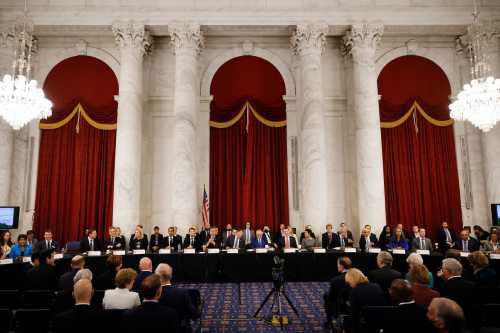
The recent G7 meeting featured the sovereigns of artificial intelligence (AI) assembled around a table with the heads of government of the world’s leading democratic economies. Dario Amodei of Anthropic, Sam Altman of OpenAI, Arthur Mensch of Mistral, Demis Hassabis of Google DeepMind, Alexandr Wang of Meta, and other AI luminaries joined the leaders of Canada, France, Germany, Italy, Japan, the United Kingdom, and the United States.
It was a new world order: The sovereigns of geography sitting alongside the sovereigns of intelligence. A handful of companies and their leaders now control the cognitive capabilities upon which governments, businesses, and citizens depend.
The executives did not position themselves as petitioners before the world’s governments but as indispensable partners. Sounding like someone prepared to govern if the nations do not, OpenAI CEO Sam Altman warned, “Do not cede your responsibilities to AI labs like mine.”
The companies’ goal was to solve the problem of divergent oversight of AI among countries. From a business point of view, this is a legitimate concern. It is the same as the ongoing debate in the U.S. about conflicting state AI laws. If the nations of the world adopt dissimilar AI governing policies, the economic power generated by a homogeneous market dissipates. Amodei was quite specific in this regard, calling on the nations to “resist the temptation to splinter” as they dealt with AI.
Beyond advocating for their corporate interests, the real opportunity coming from the sovereigns’ summit is how the AI executives, unintentionally perhaps, suggested a mechanism through which democratic societies can govern AI.
Building on standards
Acting from a position analogous to a sovereign power, the AI companies put forth their own proposal for AI governance. That proposal called on the assembled nations to share certain oversight responsibilities with the companies through a common standards-setting framework.
“I think we need, and everyone’s been talking about, a standards body, a U.S.-led standards body, that ideally works with close cooperation with the international democratic community,” Hassabis proposed. While the proposal was obviously self-serving, it was wise positioning that acknowledged the need for “close cooperation” between the companies and governments to achieve the companies’ goal.
Yet, the proposal for the establishment of a standards-based order need not be entirely one-sided. Properly implemented, such standards could reach beyond corporate interests to address these same companies’ broader behavioral issues and their effect on the public interest.
The need for governmental oversight of AI extends far beyond the industry’s desire for regulatory homogeneity. The effects of AI are local and national; the power to cause those effects is global.
Communities and nations confront data centers, job displacement, bias, discrimination, and other AI-generated consequences. The companies that drive those effects through control of AI infrastructure operate beyond any single jurisdiction.
The challenge for democratic governments is how the sovereigns of geography govern the sovereigns of intelligence. The platform for structuring such policies can be the same kind of standards process the AI leaders proposed at the G7 but designed to address more than corporate interests.
Multistakeholder standards
Commonly developed standards have long accompanied technological progress. Every day we experience the fruits of a standards process, from electric and building codes to the TCP/IP standard at the heart of the internet.
Standards are a collective way to identify and mitigate problematic issues. This is done through a multistakeholder process of interested parties. The AI companies, for instance, are currently working to standardize how AI models interact with external tools and applications (Model Context Protocol, or MCP) and how AI agents communicate with one another (Agent-to-Agent Protocol, or A2A).
Such industry standards typically address technical concerns about how things work. They seldom extend to dealing with the effects of those technologies on the people and enterprises who depend on them. But it doesn’t have to be that way.
The opportunity presented by the AI executives’ G7 proposal opens the door for international standards to address the homogeneity concerns of the companies while also establishing behavioral standards addressing competition and innovation in the marketplace. This could include, for instance, how the companies use their control of the infrastructure of AI—models, compute power, and the middleware allowing access to both—to promote pro-competition and pro-innovation activities such as interconnection for application developers, openness to necessary computing power, and accountability audits to review company conduct against the behavioral standards.
The AI sovereigns have put a standards proposal on the table. The national sovereigns now have the opportunity to accept it with material modification. The models for such action already exist in G7 history.
In 1989, for instance, the G7 established the Financial Action Task Force (FATF) to develop standards governing money laundering and terrorist financing. After the 2008 financial crisis, leaders of the G7 created the Basel Committee on Banking Supervision that established standards to reduce future financial crises (Basel III). In practice, the standards produced by FATF and the Basel Committee were not voluntary. To be noncompliant with FATF meant blacklisting in the financial markets. Basel III capital requirements were enforced by national banking regulators. Any AI standard must also include comparable enforcement.
A way forward
Adapting the tech world’s standards process from developing technical solutions to addressing behavioral policy challenges opens a window of opportunity that should not be missed.
The challenge for international leaders—including our own—is how to harmonize policies that promote the promise of AI while simultaneously protecting the interests of the enterprises, developers, and users who rely on access to its capabilities and infrastructure.
Limiting the standards process to technical issues solves the companies’ problems while giving governments cover to appear to be doing something. The companies would no doubt prefer this arrangement, which offers the appearance of accountability but without substance.
What is needed are behavioral standards that establish expectations for how AI companies will act when implementing their technical standard-aided services. While the technical standards process is typically industry controlled, the new international standards for marketplace behavioral expectations should involve industry as well as civil society, with the governments involved overseeing the whole process.
The leaders of the major democratic economies, starting with the United States, have an opportunity to adopt the idea of multistakeholder standards in a manner that is broad enough to address not just the technical issues, but also the issues that control of that technology creates to impact competition and innovation. The G7 leaders should accept the AI executives’ standards proposal and modify it in two ways. First, participation in the standards process must extend beyond the companies to include government and civil society. Second, and separately, the framework that results must be enforceable; voluntary compliance means the outcome is only a suggestion, not a standard.
Related Content

Author

-
Acknowledgements and disclosures
Google and Meta are general, unrestricted donors to the Brookings Institution. The findings, interpretations, and conclusions posted in this piece are solely those of the authors and are not influenced by any donation.
The Brookings Institution is committed to quality, independence, and impact.
We are supported by a diverse array of funders. In line with our values and policies, each Brookings publication represents the sole views of its author(s).


Commentary
G7 should accept AI standards offer, but make it enforceable
July 1, 2026