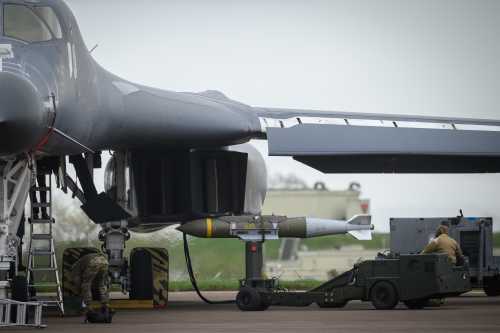
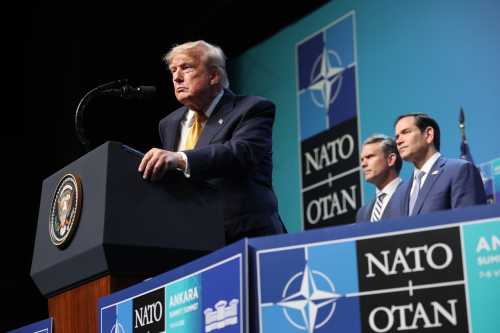
As President Donald Trump’s standard defense budget proposal for next fiscal year makes its way through Congress, another big request already awaits Capitol Hill’s attention. That first request is already for a lot of money—$1.15 trillion for 2027. Adjusted for inflation, it would surpass what President George W. Bush and President Barack Obama spent on the military at peak levels of the war on terror, easily exceed any defense budget from the Cold War, and approach peak levels of World War II. Yet Trump also wants an additional $350 billion pot of gold, in so-called “mandatory funding,” in next year’s budget as well. It would be available to the Department of Defense to be used as officials see fit, for 2027 and beyond, lacking normal congressional oversight or checks and balances.
This is bad budgeting and bad democracy. Congress needs to tell Trump that any supplemental for FY 2027 due to the Iran war should be made through normal channels—and be smaller in size. The rest of the $350 billion should be evaluated in public debate that lets taxpayers see, and affect, how our money is being spent. Overall, most of it is worthy—but it should be spread over defense budgets for the rest of the decade in a way that can be more closely supervised, and reevaluated year by year, by Congress as well as the executive branch.
For perspective, it’s worth beginning with the observation that while a trillion-plus budget for the American armed forces is a lot of money, it’s not a reckless amount relative to the challenges of today’s world—even for those of us unhappy about how Trump has been handling the Iran conflict. With Russia spending at least $200 billion a year now, and China spending at least $300 billion to $400 billion in equivalent resources, and each benefiting from geographic proximity to potential conflict zones, the challenges are serious. It is far better to bolster the U.S. military and work with America’s increasingly capable allies to deter conflict than to fight a war against a nuclear-armed foe without a clear margin of military superiority across all plausible scenarios, especially in a conflict with China.
A trillion-plus dollars a year is a huge sum of money, to be sure. But relative to a $7 trillion federal budget and a $30 trillion U.S. GDP, it is not inherently unaffordable. (In fact, during the Cold War, we spent 5% to 10% of GDP on the military each year, relative to a much smaller economy; today’s figure approaches 3.5% and would exceed 4% of GDP if Trump gets his way with the new budget request.)
Even more to the point, the kinds of funds being requested within the $350 billion mandatory pot are reasonable. They enjoy substantial support from both sides of the aisle as well as defense analysts of many different stripes. Consider the breakdown, as provided on the Department of Defense’s website:
- Defense Industrial Base, $113.1 billion
- Homeland Defense and “Golden Dome,” $17.5 billion
- Maritime Superiority, “Golden Battleship,” $7.7 billion
- Munitions and Missiles, $47.0 billion
- Air Superiority, Fighter Jets, $14.4 billion
- Space Superiority, $11.7 billion
- Next Generation Technology, Autonomy, Drones, $102.5 billion
- “Warrior Ethos,” $36.0 billion
Most of these categories of military activity and investment make sense as top priorities for the nation—but over the next few years, with careful decisionmaking, not with a single burst of funding.
The Golden Battleship class of new ships that Trump wants named after him probably does not make sense. Yet it is the smallest ticket item on the list. Funds for “warrior ethos” raise eyebrows about the further waging of culture wars, but again do not represent the biggest sums on the list. With proper congressional oversight, they can be redirected as necessary to emphasize the well-being of military families.
The proposed funding for the defense industrial base may sound like a slush fund at first blush. But if properly spent—again, Congress can help with proper oversight—it can reverse three decades of underinvestment in the American defense industry. Indeed, it follows in the tradition of the AUKUS arrangement with Australia and Great Britain that was negotiated by the Biden administration to strengthen America’s submarine shipbuilding foundations, including with cash transfers for specified purposes to key contractors. It is intended to reverse a generation of Pentagon acquisition practices that sought to imitate the private sector’s just-in-time and hyper-efficient ethos of modern American corporate thinking, but left the country with inadequate surge capacity for a crisis. Moreover, its execution will be overseen by the very capable if almost invisible Stephen Feinberg, a private-equity genius who is now the nation’s deputy secretary of defense.
So, the basic composition of the proposed $350 billion “second course” for the Pentagon’s 2027 budget is not so bad. And if it passes through the so-called reconciliation process, whereby Republicans muscle it through the Senate without needing the usual 60 votes to close off debate, it probably won’t be the worst thing to happen in Washington this summer.
But as a number of Republican senators themselves have been sounding of late, this kind of practice is still bad budgeting, pure and simple. There is a good reason that the Constitution gives Congress power of the purse, including over military matters. Congressional oversight is a good thing. For example, it ferreted out $600 toilet seats and illicit payouts to contractors during the Reagan years, redirected the 1980s “Star Wars” program into more credible and feasible forms of missile defense in the 1990s and 2000s, helped force President George W. Bush to change U.S. strategy in Iraq with the surge of 2007, and made sure our military troops and families were adequately cared for, especially in the most difficult periods of the so-called war on terror. Congress is a crucial partner of any president on matters of national security more broadly, having, for example, passed the Goldwater-Nichols reforms of 1986 (in the face of Reagan administration opposition). Those reforms strengthened and simplified the chains of command in the modern American military after the debacles of Vietnam and the failed 1980 Iran hostage rescue attempt and the 1983 Marine barracks bombing in Beirut.
That $350 billion is probably not a bad overall number—if spent out gradually over the rest of the decade with proper congressional supervision, bipartisan debate, and cooperation between the executive branch and Capitol Hill. It is a bad idea, however, if it’s just handed to the Pentagon on a silver—or make that gold—platter with no strings attached.
Author

Related Content


The Brookings Institution is committed to quality, independence, and impact.
We are supported by a diverse array of funders. In line with our values and policies, each Brookings publication represents the sole views of its author(s).


Commentary
A better way to spend $350 billion at the Pentagon
June 24, 2026