Intellectual humility is a rich subject of academic research and discussion. It engages psychologists, philosophers, and education researchers, filling pages of scholarly journals and animating debates at academic seminars.
But discussions of intellectual humility should not be confined to these arenas. Intellectual humility is not an esoteric or inaccessible idea. It’s about the universal experience of being wrong and how we respond to our fallibility. It’s a virtue that gives us a capacity to engage constructively with people and ideas we disagree with—and, in fact, to seek out those engagements because we find them enriching. It helps us appreciate and grow from the diversity that surrounds us.
Intellectual humility is a virtue that we should want people to know, think, and talk about. This certainly includes those who work and learn in schools. Schools are the primary institutions we have for equipping people to become contributing members of our society and democracy. If we believe our collective well-being depends on our capacity to learn and disagree productively, then we should want intellectual humility to be part of the everyday vocabulary of our education systems. And we should invite those who inhabit schools into conversation about how to build that vocabulary.
That is the starting point for this chapter. Rather than treating the question of whether and how schools should cultivate intellectual humility as one for scholars alone to debate, we sought the perspectives of adolescents, parents, and teachers.
We did this by administering three nationally representative surveys. The surveys help us understand how these groups think about intellectual humility and whether they are open to a more deliberate effort to cultivate it in students. The surveys also allow us to examine similarities and differences across subgroups of adolescents, parents, and teachers (e.g., by gender and race), as well as test whether the way intellectual humility is described affects how people respond to it.
We draw five main conclusions based on the survey results. These conclusions, which we describe in detail below, are:
- Both youth and parents—across demographic groups—believe that developing intellectual humility in adolescence is highly important.
- Both youth and parents say that schools should try to develop intellectual humility in students, despite being a little less confident that schools can do so effectively.
- Teachers also believe that developing intellectual humility is extremely important. In general, they would rather have all teachers trained in how to cultivate intellectual humility than have specific classes or clubs emphasize it.
- When the term “intellectual humility” is replaced with “open-mindedness,” young people rate it as more important and as a higher priority for schools to develop. Parents and teachers, however, do not respond differently to the two terms.
- Youth are more likely than parents or teachers to see a conflict between developing intellectual humility and confidence, but even most youth do not see an inherent tension.
If there is one key takeaway from these survey results, it’s that adolescents, parents, and teachers—across demographic groups—see value in cultivating intellectual humility. And they want schools to do something about it.
Methods
Survey sampling and design
For this study, we asked questions of youth, parents, and teachers as part of three separate RAND omnibus surveys. The items were similar across surveys to facilitate comparisons in the responses of these stakeholder groups. This was particularly true for the youth and parent surveys, for which the items were nearly identical. We asked slightly different questions of teachers, as we sought additional perspectives from teachers (e.g., how, if at all, they would like schools to cultivate intellectual humility).1 For all groups, we asked for respondents’ views of the importance of developing intellectual humility, whether schools can and should develop it, and whether they see a conflict between developing intellectual humility and developing confidence.
We administered items to youth through RAND’s American Life Panel (ALP). The ALP was fielded in spring 2026 and yielded 1,000 responses from participants between the ages of 12 and 21. As seen in Appendix Table A1, 24% of respondents were in 6th to 8th grade, 20% in 9th or 10th grade, 20% in 11th or 12th grade, and 21% were enrolled in college or graduate school. Another 10% were not enrolled in school at the time they completed the survey (and 4% had a missing value for their school level).
We also administered items to parents through the ALP and obtained 1,000 responses for this group as well. The ALP targeted parents of youth between the ages of 12 and 17. Demographic characteristics of the weighted sample are available in Appendix Table A2.
We administered items to teachers via RAND’s American Teacher Panel (ATP). The ATP was fielded in fall 2025 and yielded 1,007 responses. This panel consists of teachers across a range of grade levels, subjects, and types of communities (Appendix Table A3).
RAND designs these surveys to be nationally representative of the populations they represent. It does so through a probability-based recruitment approach and a weighting strategy that improves the alignment between the sample and the broader population. All the results that we report come from these weighted samples. For some analyses, we disaggregate the results by subgroup, which allows us to compare responses within the same survey (e.g., for middle school versus high school students).
Survey experiments
Intellectual humility is not a widely used term, and we suspect that many respondents had not encountered it before. This led us to wonder if the term itself (“intellectual humility”) or the way it is typically defined (about personal limitations) might affect how young people, parents, and teachers respond to it. Perhaps the language is jargony or negative in ways that undermine its resonance.
To explore these possibilities, we embedded two randomized experiments into the surveys:
First, we randomly assigned each respondent to either an “intellectual humility” or “open-mindedness” condition. This determined which term respondents saw throughout the survey. About half the respondents in each survey saw items that explicitly mentioned intellectual humility. The other half saw otherwise identical items that substituted “open-mindedness” for intellectual humility. This allows us to test if using a more familiar, accessible term affects how people think about intellectual humility. (We should note that researchers generally regard intellectual humility and open-mindedness as distinct but related concepts.)
Second, we randomly assigned each respondent to either a “personal limitations” or “learn from others” condition. This determined whether the framing of the definition emphasized people’s limits (a negative framing) or their opportunities to learn and grow (a positive framing). Here, for example, are the definitions provided to youth respondents:
- Personal limitations framing: “Being intellectually humble is knowing that we don’t know everything and our beliefs might be wrong. We can learn more and talk with people who disagree with us when we admit we might be wrong. When we’re intellectually humble, we accept that everyone is wrong sometimes.”
- Learn from others framing: “Being intellectually humble is knowing that we can learn from ideas and evidence that are different from what we believe. When we look for other points of view, we can understand issues better and talk with people who see things differently. When we’re intellectually humble, we see that different opinions can help us learn and grow.”
Because we ran two experiments at once, each respondent ended up in one of four groups. For example, about one-quarter of respondents saw the open-mindedness term paired with the personal-limitations framing. To keep the reporting simple, we describe the results of the two experiments separately.2 Also, when reporting descriptive results for the full sample, we combine respondents across all four groups.3
The full survey item text is available here.
Findings
If one theme emerges across our findings, it is that young people, parents, and teachers all believe that cultivating intellectual humility in adolescence should be a priority.
Here, in greater detail, are the main findings of these surveys:
Both youth and parents—across demographic groups—believe that developing intellectual humility in adolescence is highly important.
Our first item asked about the importance of developing intellectual humility (or open-mindedness) in adolescence. We used a 7-point Likert scale for their responses, ranging from “Not important at all” (1) to “Extremely important” (7).
Across all youth respondents, we found a mean response of 5.73 on this scale. The most common response was a 7 (selected by 43%). These results appear in Figure 1 and Appendix Tables B1 and C1.
Perhaps the most meaningful subgroup finding—across these surveys—is that all subgroups value the cultivation of intellectual humility. However, we do see a few notable subgroup differences among our youth respondents. For one, females (mean=5.97) place slightly more importance on developing intellectual humility than males (mean=5.49). Also, we see a stepwise pattern by student age. The level of importance increases as respondents move from middle school (mean=5.50) to lower high school (mean=5.68) to upper high school (5.79) and then college or graduate school(mean=6.00).
We asked this same “importance” question of parents. Here, too, the most common response was the highest possible rating of 7 (selected by 50%). Parents’ response (mean=6.01) to the item was very high, as shown in Figure 2 and Appendix Tables B2 and C2.
We see some differences between parent subgroups, though we are struck here, too, by how highly all these groups value the cultivation of intellectual humility. Regarding the differences, parents who identify as Democrats and parents with a bachelor’s degree or higher rated the importance especially highly.
Full results by subgroup appear in Appendix Tables B1-B3.
Both youth and parents say that schools should try to develop intellectual humility in students, despite being a little less confident that schools can do so effectively.
Our next items asked, separately, whether schools can develop intellectual humility in students and whether they should try. We again offered a 7-point Likert scale, ranging from “Not at all” (1) to “A great deal” (7).
These items speak to a question people have long asked about schools: Can they cultivate virtues in students, and is it appropriate to try? To frame the question for respondents, we noted that some people think schools can help students learn to be intellectually humble, while others believe schools can’t really teach it.
Figure 3 shows youth and parent responses to questions about whether schools can and should help students develop intellectual humility.
Both youth and parents feel more strongly that schools should try to develop intellectual humility (youth=5.52, parents=5.38) than that schools can effectively do so (youth=4.70, parents=4.86). For both groups, the most common response to the “can” item was a 5 and the most common response to the “should” item was a 7. The full distribution of responses is available in Appendix Tables C1-C3.
In other words, young people and parents not only see the cultivation of intellectual humility in adolescence as important—they want schools to help make it happen.
Teachers also believe that developing intellectual humility is extremely important. In general, they would rather have all teachers trained in how to cultivate intellectual humility than have specific classes or clubs emphasize it.
We asked teachers a similar set of questions about cultivating intellectual humility in middle and high school students, along with how, if at all, they would like schools to approach that work.
Teachers, like young people and parents, feel strongly that developing intellectual humility in adolescence is important (Figure 4). Most teachers (59%) chose a 7, “Extremely important,” on the 7-point scale (see Appendix Table C3). The mean response was 6.25. This enthusiasm was evident across teachers of different grade levels, subjects, and locale types.
On the questions of whether schools can and should develop intellectual humility in students, teachers responded similarly to youth and parents. These results appear in Figure 5. Teachers believe that cultivating intellectual humility is a worthwhile endeavor (mean=5.57 on the “should” item) but expressed slightly more reservation when asked about schools’ ability to do so effectively (mean=5.04 on the “can” item).
Teachers are especially well positioned to weigh in on schools’ potential to undertake this work—and on how, if at all, to do it. We therefore asked teachers what approach, or approaches, a middle or high school should take if it wants to help its students develop intellectual humility. We offered these options:
- Train all teachers in how to develop intellectual humility
- Teach intellectual humility in social studies class (how people have different perspectives on political issues)
- Teach intellectual humility in science class (how the scientific method involves knowing our hypotheses could be wrong)
- Develop intellectual humility in an optional debate club
- Develop intellectual humility by requiring all students to participate in debate
- Other, please specify
Their responses appear in Figure 6, below.
Teachers express a strong preference for staff-wide training in how to develop intellectual humility (73%) over a narrower focus on certain subjects or clubs. The responses to this item were similar for teachers of different grade levels (as shown in Figure 6), as well as across subjects and locale types (Appendix Table B3).
When the term “intellectual humility” is replaced with “open-mindedness,” young people rate it as more important and as a higher priority for schools to develop. Parents and teachers, however, do not respond differently to the two terms.
As described in the Methods section, we embedded two survey experiments. One involved the term used throughout the survey: intellectual humility or open-mindedness. The other involved the framing of the definition: personal limitations (a negative framing) or an opportunity to learn from others (a positive framing).
We suspected that the language we used could affect how young people, parents, and teachers responded to the idea of intellectual humility. However, we were surprised by how limited these effects were—with one exception. Youth respondents rated intellectual humility as more important to develop, and as a higher priority for schools, when the term “intellectual humility” was replaced with “open-mindedness.”
Figure 7 compares responses to the first three survey items for respondents who saw the term “intellectual humility” and those who saw “open-mindedness.” Among youth, using the term “open-mindedness” led to slightly higher ratings of both: how important it is to cultivate intellectual humility (5.86 versus 5.58) and whether schools should try to do so (5.62 versus 5.40). We did not find statistically significant differences on the “can” question for youth respondents.
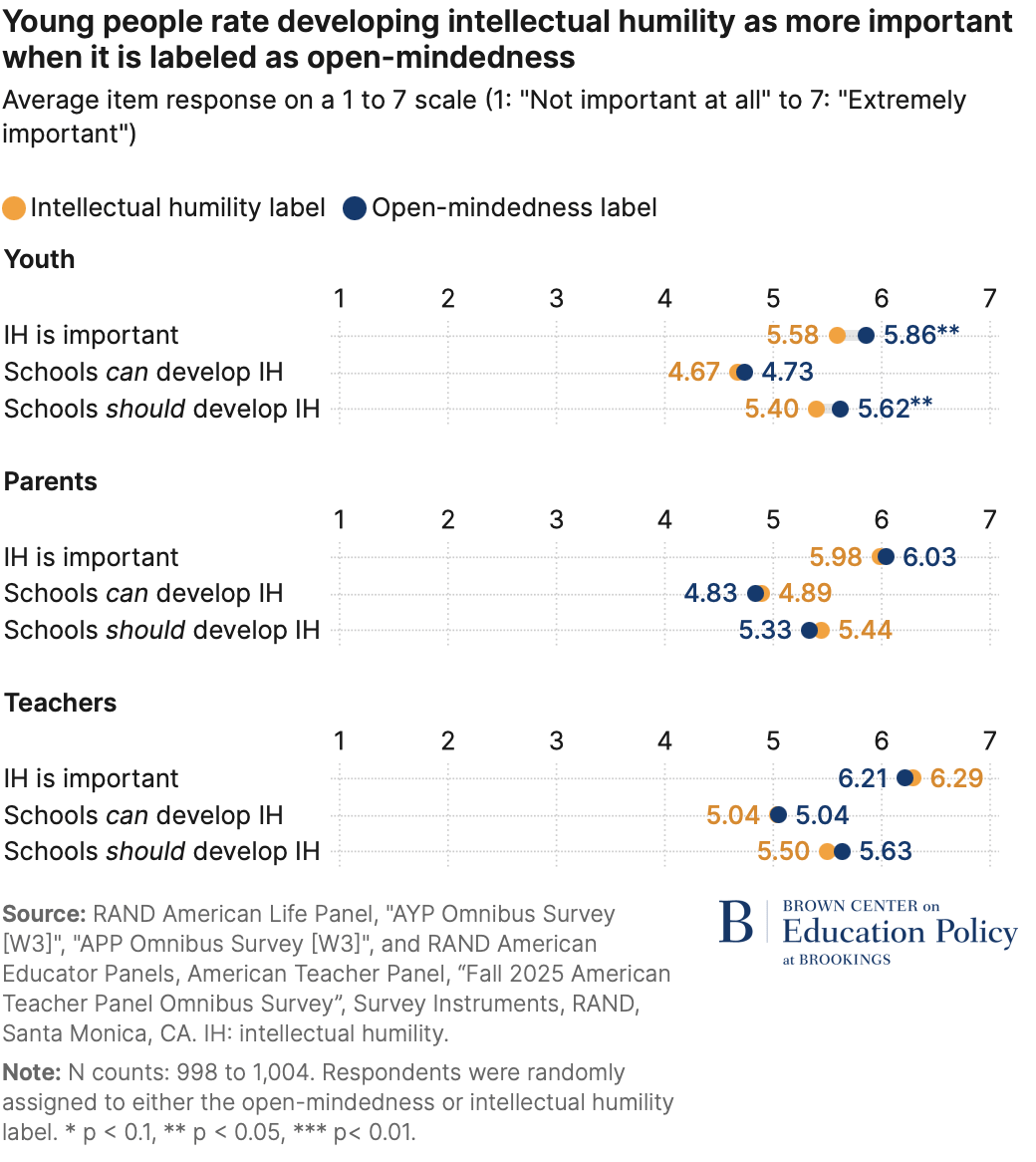
In contrast to the youth respondents, we found no statistically significant differences for parents or teachers. They reported very similar (and high) levels of importance regardless of which term they saw.
We found very few differences associated with the positive or negative framing. Youth, parents, and teachers all responded similarly regardless of whether we defined intellectual humility in terms of the opportunity to learn from others or personal limitations.4
Full experimental results appear in Appendix Tables C1-C3 and D1-D3.
Youth are more likely than parents or teachers to see a conflict between developing intellectual humility and confidence, but even most youth do not see an inherent tension.
As we discussed in Chapter 1 of this report, adolescence presents a particular set of challenges (and opportunities) for developing intellectual humility. It is a period of change and identity formation, and a time when many people are especially attuned to how their peers perceive them. It is also a time when many young people are still developing confidence. Researchers who study intellectual humility describe a complex relationship between developing intellectual humility and confidence, especially during one’s adolescent years.
With these surveys, we sought to understand how adolescents, parents, and teachers think about the relationship between intellectual humility and confidence. In particular, we asked if they see a conflict between developing intellectual humility and confidence in adolescence—and, if they do, what balance they believe is optimal.
Figure 8 shows responses to an item that asked respondents if they think that “confidence and intellectual humility are in conflict with each other.” It shows that large majorities of all three groups do not see a conflict. A larger share of youth respondents (32%) perceived a conflict compared to parents or teachers (15% each), but even among young people, most do not see an inherent tension.
In a follow-up item, we asked all respondents who saw a conflict what they think is the ideal balance of confidence and intellectual humility. Here, too, we offered a Likert scale, ranging from 1 (“More confidence/Less intellectual humility”) to 7 (“Less confidence/More intellectual humility”), with a midpoint of 4.
Among the subset of youth, parents, and teachers who said they see a conflict, a majority of each group chose the equal-balance midpoint. These results appear in Appendix Tables C1-C3.
Discussion
We opened this chapter with an argument that conversations about intellectual humility—and, in particular, developing intellectual humility in students—cannot be confined to academic circles. The results we present suggest that researchers who study intellectual humility will find a receptive audience among adolescents, parents, and teachers.
The core question we set out to answer in this chapter is whether young people and the adults in their lives believe that schools should work to cultivate intellectual humility. The answer is a decisive yes, and it holds for people from many backgrounds and contexts. We designed this survey to be able to identify differences across many types of subgroups. Perhaps the most striking takeaway from these subgroup comparisons, however, is that youth, parents, and teachers of very different backgrounds all feel that developing intellectual humility in adolescence is a highly important, worthwhile endeavor.
Beneath this headline finding lie more nuanced, but still important, insights. One is that respondents’ belief that schools should try to develop intellectual humility consistently (though slightly) outpaced their confidence that schools can do so effectively. We see this skepticism as healthy, though a growing body of research shows how schools can do this work. Of note, when we asked teachers how schools should approach this, they opted for training all teachers in how to cultivate intellectual humility. Teachers, it seems, would like to see this woven into the core work of schools, not relegated to a particular club or class.
The experimental results add some nuance of their own. Youth respondents rated the pursuit of intellectual humility as slightly more important, and schools’ responsibility for pursuing it as higher, when it was labeled as “open-mindedness.” Perhaps open-mindedness is a more familiar or accessible term, which makes it more resonant. Perhaps young people already see open-mindedness as a trait worth developing and don’t need to be convinced. Regardless, this may be important for educators to keep in mind if they look to introduce the concept of intellectual humility to their students.
Cultivating intellectual humility in today’s world may seem like an uphill battle, especially in the teenage years. However, the core message of this report is that we can and should cultivate intellectual humility in students—and that adolescents, as well as the adults closest to them, hope that we will.
BACK TO HOME
Intellectual humility homepage →
Read Chapter 1: “Developing intellectual humility in middle and high school students” →
Authors


-
Acknowledgements and disclosures
This project was made possible through the support of Grant 62974 from the John Templeton Foundation. The opinions expressed in this publication are those of the authors and do not necessarily reflect the views of the John Templeton Foundation.
-
Footnotes
- Additionally, even for similar items, the wording on the teacher survey differed slightly from the wording on the student and parent surveys. This is because we simplified the language for the student survey (which ran after the teacher survey) and opted to align the wording of the parent survey with that of the student survey.
- In appendix tables, we show the interactions between the “term” and “framing” treatments (in how they affect responses to our survey items). They are generally not significant, practically or statistically.
- This means that when we report on respondents’ views of intellectual humility, we are including responses from those who saw the term “open-mindedness” to accompany a definition of intellectual humility. Since the experiments had only modest effects, pooling the responses across experimental groups does not substantively change the results. Tables showing results broken down by condition, along with a check of randomization balance, are available in the appendix.
- For items that appeared later in the survey, the lack of experimental effects could be due to the time that had passed between reading the definition and responding to that item. However, even for the item that immediately followed the definition—about the importance of developing intellectual humility—we found no consistent, meaningful differences between those who saw the “learn from others” and “personal limitations” framings.
The Brookings Institution is committed to quality, independence, and impact.
We are supported by a diverse array of funders. In line with our values and policies, each Brookings publication represents the sole views of its author(s).