No one knows everything, and everyone is wrong sometimes. This is a reality of being human. However, appreciating that reality and the opportunities for learning and growth that it affords does not come easily. Admitting the limits of what we know, staying open to being wrong, and taking seriously the possibility that someone else has a better answer are not, for all of us, natural instincts. Intellectual humility, as researchers call it, is a virtue that requires cultivation.
Schools are the primary institutions we have for cultivating the knowledge, skills, and virtues that we value in our citizens. We ask a lot of schools in this regard, since the cohesiveness of our society, strength of our economy, and stability of our democracy all rely so heavily on how children are prepared for adulthood. We need students to develop literacy and numeracy, along with creativity and problem-solving skills. We need them to learn to engage constructively with other people, including those whose backgrounds or perspectives differ from their own. We need them to acquire skills that will serve them in the workforce.
Intellectual humility can get lost in this mix. Yet, by internalizing an understanding that we don’t know everything and always have much to learn from others, students can position themselves for lifelong learning and healthy interactions with others.
This chapter discusses what researchers are learning about intellectual humility in the adolescent years. It defines intellectual humility, examines why adolescence is a particularly important and opportune period for cultivating it, reviews the case for schools playing a central role in that effort, and shares recommendations for educators, policymakers, and researchers. An accompanying chapter provides results from nationally representative surveys that examine young people’s, parents’, and teachers’ views of intellectual humility.
What is intellectual humility?
Intellectual humility has become the subject of a fast-growing body of psychological and philosophical research and debate over the past decade. The literature now contains at least 18 distinct definitions, though most scholars agree that intellectual humility centers on recognizing the limits of one’s own knowledge and the possibility that one’s beliefs are wrong.
Synthesizing this literature, Porter and colleagues (2021) proposed a framework that organizes the definitions of intellectual humility along two dimensions. The first is whether it emphasizes our own limitations (self) or what we can learn from other people (other). The second is whether it is introspective (internal) or expressed outwardly through behavior (external). That framework is shown in Figure 1, along with samples of the views that correspond to each quadrant.
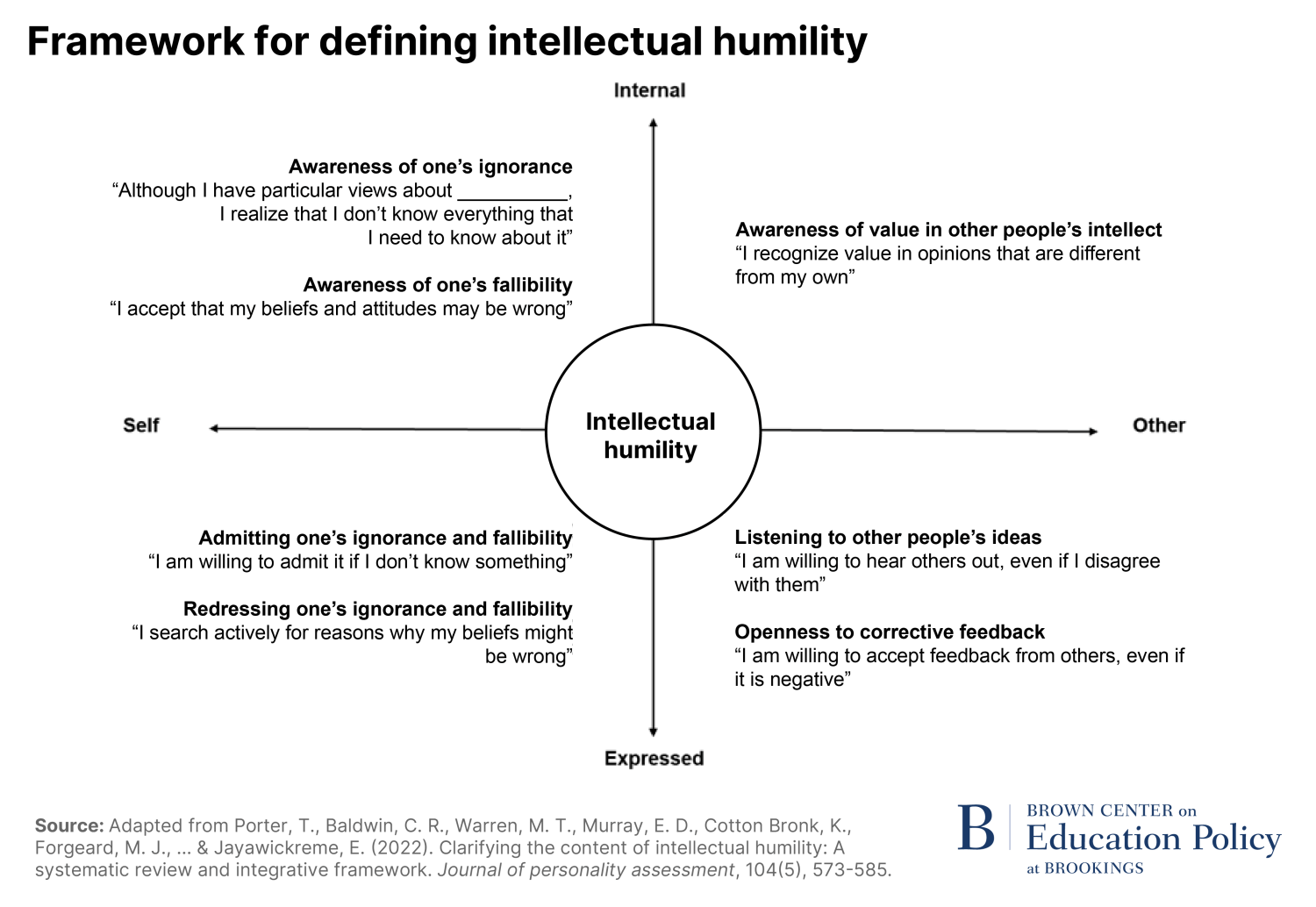
The unifying idea across this framework is an awareness that our beliefs are partial and may need revising. It is a recognition of the limits of being human and the opportunities those limits provide. Importantly, though, intellectual humility is not a fixed trait that people simply have or do not have. A person can be more intellectually humble in certain situations and can become more (or less) intellectually humble over time.
Cultivating intellectual humility offers benefits to the individual and to those with whom they interact. Intellectually humble people are better at spotting misinformation, less likely to endorse conspiracy theories, and less hostile toward people who disagree with them. They are more willing to question the conventional wisdom of their ingroup—a notable trait in an era of heightened partisanship and information silos.
It’s worth considering, too, what intellectual humility is not. It isn’t just another name for open-mindedness or curiosity. Open-mindedness emphasizes weighing different views, while curiosity emphasizes a desire to learn. While these virtues are related to intellectual humility, neither of them explicitly requires acknowledging the limits of one’s own knowledge, which is the hallmark of intellectual humility. Additionally, being intellectually humble does not require us to abandon our knowledge or convictions, capitulate to others, or doubt everything constantly. In fact, research does not show that intellectually humble people are more likely to doubt every belief they hold.
Intellectual humility in adolescence
Adolescence is a complex, socially charged stage of development. It marks a transition from childhood to young adulthood that reshapes young people’s emerging identity, self-concept, and posture toward their own knowledge and its limits. A growing body of research suggests this may be a prime period of life for developing intellectual humility.
Intellectual humility requires higher-level cognition, including metacognition (the ability to reflect on one’s own thinking) and social cognition (the ability to understand and interact constructively with others). Even young children show meaningful capacities in these areas, and these abilities become more sophisticated in the teenage years, as adolescents become better able to evaluate their own and others’ knowledge, weigh competing information, and calibrate their confidence appropriately. Self-understanding follows a similar arc. Children’s self-views tend to be simple and uniformly positive, while self-assessments grow more nuanced and accurate from late childhood through adolescence. An awareness of one’s limitations is a critical ingredient for developing intellectual humility.
This time of life also brings complexities and challenges. Adolescence is a period of asserting independence, so efforts to nurture intellectual humility must avoid undercutting adolescents’ self-confidence and autonomy. Moreover, adolescents may find that their environments send mixed signals. Some contexts, like classrooms, may reward intellectual humility, while other settings, like peer groups, may reward the appearance of self-assurance instead. As we discuss below, educators (and parents) have roles to play in shaping these contexts.
In other words, cultivating intellectual humility in adolescence is not easy. Yet, adolescents’ sophisticated cognitive abilities and capacity for nuanced self-understanding provide a window for the cultivation of intellectual humility.
Why developing intellectual humility in adolescence matters
Having established that developing intellectual humility in the middle and high school years is feasible, we turn now to the ways it is also beneficial. This includes supporting adolescents’ intellectual, social, and civic development.
Intellectual development. Adolescence is a period of significant intellectual growth, as young people’s growing independence and search for identity drive them to question assumptions and explore ideas for themselves. That same push toward independence, however, carries risk. It can fuel resistance to legitimate authority and greater susceptibility to misinformation, as adolescents test new sources of information and start forming views of their own. Intellectual humility offers a check against that risk. By prompting people to examine their own biases and blind spots, it can help adolescents tell credible information from false information, without dismissing legitimate expertise along the way.
Social development. Adolescents face complex social challenges. This can include conflicts with parents, new romantic relationships, and growing reliance on peers. Intellectual humility appears to facilitate healthier handling of interpersonal conflict and help young people become more empathetic and more satisfied with their relationships. Cultivating intellectual humility in adolescence, then, may improve the quality of young people’s relationships at a stage when social connections are strongly associated with well-being.
Civic development. Adolescence is a time when many people show a deeper interest in understanding the world they live in and how they can contribute to that world. Research indicates that intellectual humility is positively correlated with interest in politics and political discussions, while being negatively correlated with affective polarization (i.e., the tendency to view one’s own group favorably while feeling distrust or hostility toward opposing groups). This suggests that intellectual humility may contribute to healthier forms of civic engagement, especially in a period of deep political divisions.
Schools' role in developing intellectual humility
Research indicates that adolescents are developmentally capable of intellectual humility and benefit from its cultivation. How, then, can schools help in this pursuit? An emerging literature suggests that the keys may be to value, model, and practice intellectual humility in the classroom.
One promising approach is for educators to build “learning cultures” rather than “brilliance cultures.” These are classrooms that reward curiosity and exploration over “looking smart.” A related way of putting this comes from Jenny Anderson and Rebecca Winthrop in “The Disengaged Teen,” where the authors argue for moving students from “passenger,” “achiever,” or “resister” mode to “explorer” mode.
A study of sixth and seventh graders showed that classroom cultures oriented around learning led students to become more intellectually humble. On the other hand, brilliance cultures, where success is seen as requiring exceptional innate ability, leave students worried that showing intellectual humility (or admitting confusion) will cost them socially or academically. That concern compounds a broader problem, as many students learn early on that school rewards knowing answers more than asking questions. In fact, research indicates that teachers can increase students’ curiosity by directly teaching students how to ask good questions and encouraging them to do so.
Teachers can also help students develop intellectual humility by modeling it themselves. Porter, Leary, and Cimpian (2026) reported on several experiments and analyses that examined the relationships between teachers’ intellectual humility and students’ interest, engagement, and learning. They found that students were more engaged in class, felt more accepted by the teacher, and were more comfortable expressing intellectual humility when teachers modeled it in the classroom. They note that teachers’ words and actions provide cues to students about how to handle their mistakes and confusion. This can be as subtle as being thoughtful about how teachers respond to their own mistakes in the classroom.
Educating for intellectual humility can happen across subjects, as any teacher can model it. Yet, social studies and science present particular opportunities to cultivate intellectual humility. Social studies classes are where many students learn about societal issues and the conflicting perspectives that people have on them. Meanwhile, science classes are places to learn the scientific method, which is rooted in the same principles as intellectual humility. These subjects also present challenges alongside those opportunities. Social studies classes may require the steady, trained hand of a teacher to navigate potentially fraught discussions of sensitive subjects. In science classes, one such challenge is modeling intellectual humility without undermining credible expertise. Much “post-truth” rhetoric and science denial can superficially resemble intellectual humility in its appeal to uncertainty. However, intellectual humility does not entail doubting everything, and it opposes dismissing expertise to cling to preferred beliefs. Educators can help students navigate that tension by teaching how experts collaborate to build credible knowledge despite their own limitations.
New research on how high schools can measure and develop intellectual humility
We are interested in making intellectual humility more accessible to educators who might wish to incorporate it into their classroom instruction. This includes developing school-friendly ways of introducing the topic to students. We approached this work by seeking to create a measure of intellectual humility that is both rigorously developed and engaging in a classroom setting. By assessing how intellectually humble students are at a given time, educators can start a discussion about why intellectual humility matters and how to develop it.
We conducted a study in partnership with three high schools. For the study, students completed a survey-based task. We presented students (N=961) with a “controversial” issue—such as school cellphone bans, or the use of SAT or ACT scores in college admissions—and observed how students engaged with opinions and research that contradicted their views. Based on their responses, we created measures of their intellectual humility. We also administered existing (though less engaging) questionnaires for measuring intellectual humility, curiosity, and creativity. This allowed us to check if our new measure assessed intellectual humility specifically rather than more general ways of thinking.
The task began by describing an issue and noting that views on that issue vary. Students immediately stated which side of the debate they were on, indicated the strength of their conviction, and wrote a few sentences describing their initial position on the issue.
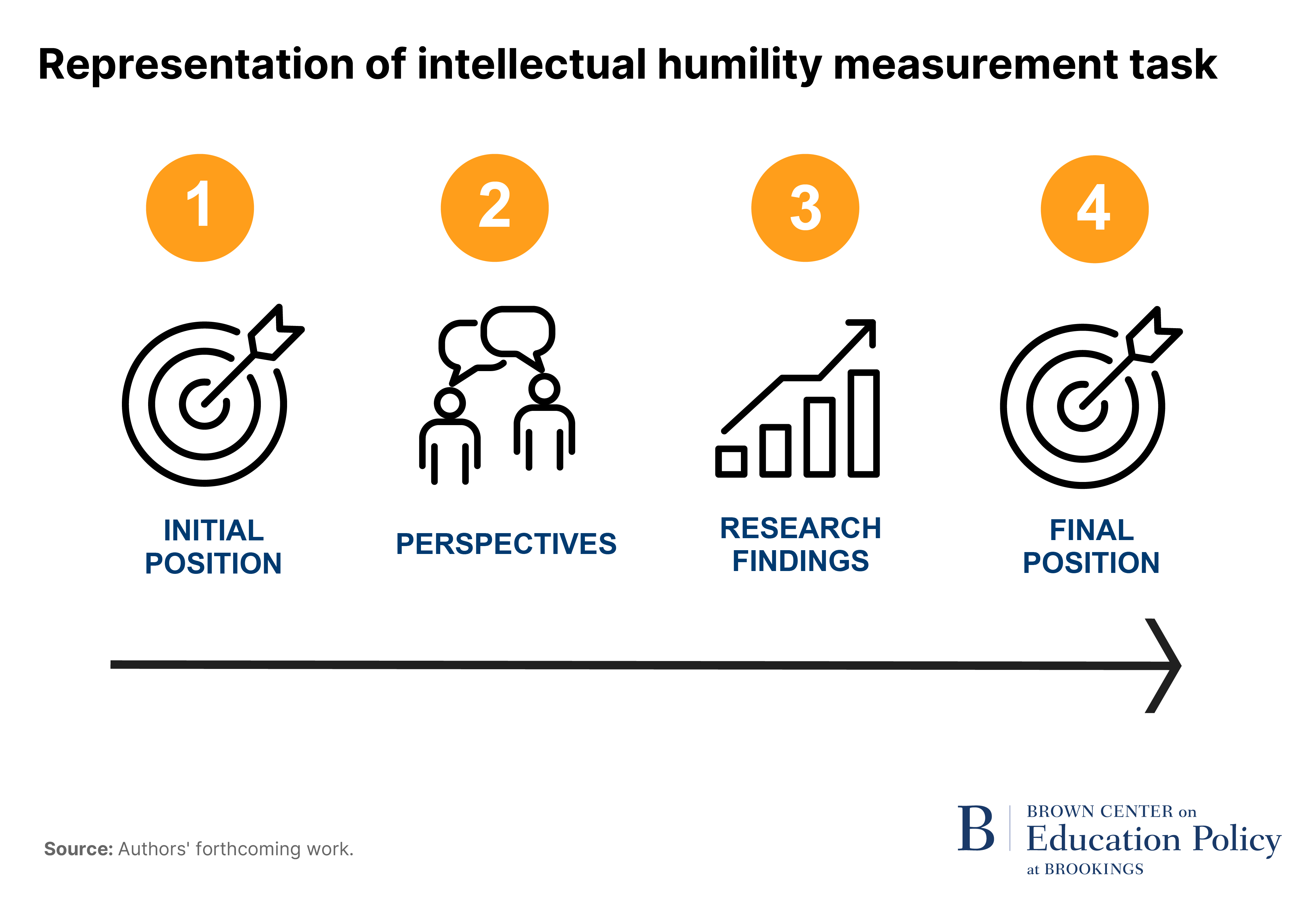
Next, we presented a series of perspectives—comments attributed to other students or teachers. Some of these comments agreed with the student’s position; some disagreed. Comments appeared one at a time, but they did not appear automatically. Students had to request each one, knowing only which side of the debate it represented (e.g., “Would you like to read a comment from another student who thinks …?”). If they chose to read it, we asked for their reaction (as an emoji). We recorded how many of these comments they chose to read—for and against their own position—and how they reacted to them.
We then presented a parallel set of research findings, some supporting the student’s position and some opposing it. For example, these findings could mention a study showing that students who get high SAT or ACT scores tend to earn good grades in college (an argument for using the exams in college admissions)—or that test anxiety can negatively affect students’ test scores (an argument against). Again, students decided each time whether to open a finding (e.g., “Would you like to read another research finding cited by people who think …?”) and reacted with an emoji if they did.
After students had engaged with as much or as little of this material as they chose, we asked for their final position on the issue. We posed the same set of questions that we had posed at the beginning of the survey. We also showed them their initial written response and gave them a chance to revise it before submitting their final answer to us.
The task was designed to be engaging, appropriate for classroom use, and effective at generating valid measures of intellectual humility. In fact, it generated numerous indicators of intellectual humility. For example, we could count the number of opposing perspectives and research findings that students opted to see. We could measure whether they responded positively or negatively to that information. We could assess whether seeing new information led them to change their opinions, the strength of their convictions, or their written arguments. We could also see what type of person they said they would most like to have a conversation with about the issue: a student or teacher who agrees with them, or one who disagrees.
We created a composite measure of intellectual humility from these indicators. We then compared this behavioral measure to how students responded to the questionnaires. We found that our measure was strongly correlated with the established intellectual humility questionnaire but not with the separate curiosity or creativity questionnaires. This gives us confidence that the task measured what it was designed to measure (intellectual humility). Moreover, many students reported that they enjoyed the task, suggesting that this could serve as an effective way to open a classroom conversation about what intellectual humility is, how intellectually humble students are, and how they can work to develop it.
This survey-based task is available to see here and available to download and use here.
Implications
No one knows everything, and everyone is wrong sometimes. This chapter has argued that we should want young people to internalize and appreciate that reality rather than resist it, and that schools are well positioned to help them do so.
Intellectual humility—the disposition to recognize the limits of one’s knowledge and to take seriously the possibility that one is mistaken—is a virtue worth cultivating, and schools are the primary institutions responsible for cultivating virtues, along with knowledge and skills. A growing body of research suggests that adolescence is a prime window for learning to be intellectually humble.
This literature review has implications for educators, policymakers, and researchers.
For educators, we see opportunities. Educators already have a lot on their plates. Most are likely not looking for expansive new obligations or curricula. We do not believe that either is necessary to cultivate intellectual humility. Rather, by working to build “learning cultures” in the classroom that reward curiosity over certainty, teachers can create an environment in which intellectual humility develops naturally. Teachers can further this development by modeling intellectual humility themselves and, in many settings, encouraging constructive dialogue among students who disagree.
For policymakers, we hope for attention, creativity, and restraint. Local and state policymakers can examine whether policies and content standards—especially, but not exclusively, in social studies—provide educators with enough latitude to help students challenge their own ideas. For example, policymakers could revisit state policies restricting discussions of controversial issues, which may undermine these efforts. Notably, the results from our educator survey show that many teachers would like to receive training in how to cultivate intellectual humility in their classrooms.
For researchers, we see opportunities to enrich our understanding of how, specifically, middle and high schools can cultivate intellectual humility. This research literature has grown considerably over the last decade, but neither schools nor adolescents have received the attention they deserve. By designing tools and approaches for classroom use—and rigorously evaluating those tools and approaches—researchers can simultaneously advance the research literature and help equip the institutions charged with developing virtue to do so more effectively.
Finally, this effort should remain responsive to the students, parents, and educators it is meant to serve. How much do they value intellectual humility, and how, if at all, would they like to see schools pursue its development? These questions are the focus of the chapter that follows.
CONTINUE READING
Read Chapter 2: “Youth, parent, and teacher perspectives on intellectual humility” →
Authors


-
Acknowledgements and disclosures
This project was made possible through the support of Grant 62974 from the John Templeton Foundation. The opinions expressed in this publication are those of the authors and do not necessarily reflect the views of the John Templeton Foundation.
Brookings is committed to quality, independence, and impact in all of its work. Activities supported by its donors reflect this commitment and the analysis and recommendations are solely determined by the scholars.
The Brookings Institution is committed to quality, independence, and impact.
We are supported by a diverse array of funders. In line with our values and policies, each Brookings publication represents the sole views of its author(s).