Jul 3

Past Event

Rendezvous with Destiny: How Franklin Roosevelt Took the United States into World War II

Event Materials

Audio

Brookings Multimedia content requires JavaScript. Your browser either doesn't have JavaScript or doesn't have it enabled.

Instructions to enable JavaScript.

Summary

On July 3, 2013, Foreign Policy at Brookings hosted Michael Fullilove, the executive director of the Lowy Institute in Sydney, Australia and discussant Kurt Campbell to examine Fullilove’s new book, Rendezvous with Destiny: How Franklin D. Roosevelt and Five Extraordinary Men Took America into the War and into the World (Penguin Press, 2013).

Fullilove opened his remarks by discussing his motivation for writing the book, beginning with his belief that President Roosevelt was the greatest statesman of the 20th century.

“He saved American democracy from the Great Depression, he led the allies to victory over the dictators, he won four consecutive presidential elections and he did all this with a broken body,” Fullilove said.

In addition, Fullilove said he thinks the period that he chose to write about—the two years between the outbreak of World War II in 1939 and American entry into the war with the attack on Pearl Harbor in 1941—was the turning point of the 20th century. During these two years, America transformed itself from a “nervous, isolationist, middle power” into a global leader, emerging from the war as the most powerful country in the world. “In a real sense, this two year period is the start of the American century in which we’re still living."

When war broke out in Europe in 1939, Americans were anxious to isolate themselves from the conflict. Though President Roosevelt wanted to support the democracies in Europe, he was held back by Congressional and public constraints.

“Roosevelt’s extraordinary achievement was to navigate these constraints and move a divided and hesitant America to ever-greater involvement in the war,” Fullilove said, setting America’s course for global leadership with Roosevelt’s direction.

He discussed Roosevelt’s distrust of the State Department, and his resulting choice to seek guidance from five associates that he sent on special missions to Europe. Fullilove went on to describe each of these five “special envoys”—paying particular attention to Harry Hopkins and his role in building the Anglo-American relationship—and their crucial role in navigating this tumultuous wartime with Roosevelt.

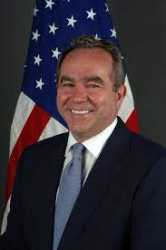
Kurt Campbell, former U.S. assistant secretary of state for East Asia and current CEO of The Asia Group, expressed his praise for Fullilove’s book, noting that it both aptly depicts the moment when the war began in Europe and painted Roosevelt in a compelling light, as a man with a “heavily forested interior.” Campbell reinforced Fullilove’s interpretation of Roosevelt and this time period as he discussed Roosevelt’s distrust of the traditional bureaucracy and consequent development of policies independent of government agencies through his five special envoys. He said Mr. Fullilove made some observations he had not previously considered.

“If you consider every locus of diplomacy that Roosevelt undertook, it was Atlanticist… All of the meetings with the senior players were in Europe,” Campbell noted.

During the question and answer session, Campbell and Fullilove discussed how Americans can compare Roosevelt’s approach to approaching war with examples from more recent foreign policy choices. Fullilove said that in the build-up to the Iraq War, President George W. Bush employed an opposite approach to Roosevelt, in that he proceeded swiftly and did not nurture a bipartisan consensus.

“Roosevelt used an incredible… subtle effort over the course of two years to build up bipartisan, domestic consensus in favor of internationalism and ultimately intervention,” Fullilove noted.

Campbell added that Roosevelt wanted the U.S. to be united, rather than divided, at the end of the war. He said typically at the conclusion of wars in the U.S., there is a strong desire among Americans for the need to “come home.” He said now, in 2013, Americans are also on the cusp of debating the necessity of bringing American troops home; even the age-old interventionist consensus among Republicans is falling apart. Campbell added that President Obama should be redirecting the focus of American foreign policy toward Asia and away from the Middle East, because that is where America’s opportunities lie.

Event Agenda

Details

July 3, 2013

10:00 AM - 11:30 AM EDT

Brookings Institution

Falk Auditorium

1775 Massachusetts Avenue, N.W.

Map

For More Information

Brookings Office of Communications

202.797.6105

Hosted By

Foreign Policy