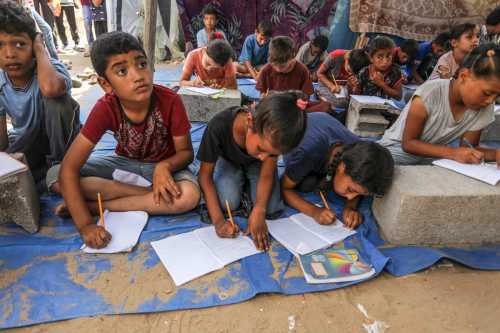
When I met Anwora Begum in Cox’s Bazar, Bangladesh, she was preparing for another day with her preschool class of Rohingya children. Like many working in humanitarian settings, she helps young children learn, play, and heal despite limited resources and few opportunities for ongoing professional support. She doesn’t have official teaching credentials from Myanmar, but with initial training and deep commitment, she creates real learning opportunities for her students.
Anwora’s experience is far from unique. Across many crisis-affected contexts, education depends on dedicated community and refugee teachers who step into classrooms despite limited preparation and support. Strengthening this workforce is becoming increasingly urgent. UNESCO estimates that 44 million additional teachers will be needed globally by 2030 to achieve universal education. In fragile and crisis-affected contexts, scarce training and few pathways for professional growth deepen existing teacher shortages.
As AI-embedded technologies begin to enter humanitarian contexts, the question is no longer whether humanitarian actors should engage with AI, but how these tools can be designed and deployed to strengthen teaching and learning in crisis settings. Engaging now, while the technology is still emerging, offers an opportunity to shape how AI is governed, designed, and used. For teachers—and by extension the children they teach—it could be transformative.
An education emergency
Today, approximately 234 million children are affected by various types of crises, and about 85 million (37%) of them are out of school or experiencing disrupted learning. The decrease in humanitarian aid is creating additional strain on children’s ability to learn. A Global Education Cluster analysis found that funding constraints forced humanitarian agencies to reduce their 2025 education funding ask by 33%, which resulted in a 43% cut in the number of people targeted for education assistance. As education budgets shrink, the gap between children’s learning needs and the capacity of systems to respond continues to widen—and behind these numbers are teachers stretched far beyond the support available to them.
Where AI may offer opportunities in emergencies
Against this backdrop, AI-embedded tools are beginning to enter humanitarian education—mostly as small pilots aimed at supporting teachers. In conflict-affected contexts of Nigeria, Bangladesh, and the Democratic Republic of Congo, for example, AprendIA uses generative AI in a closed system through WhatsApp to provide educators with teaching support, classroom resources, and professional learning opportunities. Meanwhile, AI-powered translation is tackling a different barrier: language. One application offers teachers a practical way to communicate in over 1,000 languages, crossing divides that so often fragment classrooms in displacement settings.
Lessons from COVID-19 offer a useful lens for where AI may add value—and where caution is warranted. During the pandemic, adult-facing technologies, including teacher professional development tools and phone-based tutoring—showed promise, while child-facing digital tools, particularly for younger children, produced weaker and more variable outcomes. Blended approaches that preserved human interaction—such as live online tutoring—outperformed asynchronous child-facing content delivery.
Although COVID-era technologies were not AI-enabled, these experiences suggest that technology is most effective when it supplements the human relationships that support learning. They also suggest that adult-facing tools may hold greater promise than child-facing ones. Direct evidence from humanitarian AI applications remains limited, however, and findings from COVID contexts do not transfer automatically to settings affected by displacement and conflict.
Decades of developmental research from early childhood through adolescence show that children learn and thrive through relationships—with parents and caregivers at home and with teachers and peers in schools and communities. Teachers are central to what happens in schools, especially for younger children. Investing in their capacity could reshape the landscape for children.
Innovation requires careful design
Who designs these technologies—and with whom—will largely determine whether they help. Currently, both for-profit and non-profit organizations are building AI tools with little input from the crisis-affected teachers and communities expected to use them. Solutions built without their participation risk being ineffective, irrelevant, or even harmful.
Emerging evidence and longstanding humanitarian practice point to a few principles that should anchor design from the outset.
- First, AI tools should strengthen—not substitute—the human relationships at the heart of children’s learning. The most promising applications support the adults around children: helping teachers plan, communicate, and grow professionally, so that more of their time and energy goes toward the children in front of them.
- Second, affected teachers, caregivers, and communities must be co-designers, not end users consulted after the fact—a core commitment of the Humanitarian Grand Bargain.
- Third, tools must work within the realities of crisis settings: low connectivity, shared devices, multiple languages, and teachers who, like Anwora Begum, may have limited formal training.
Designing well also means taking risks seriously from the start, rather than after systems are already in place.
For refugee and displaced children, information about identity, location, health, and family circumstances can carry significant protection risks. Humanitarian agencies have long recognized the importance of safeguarding sensitive information, but AI-enabled tools introduce new pathways for data collection and exposure that may require stronger safeguards and clearer guidance.
Commercial incentives pose a second risk. When profit becomes the primary objective, tools risk being designed around engagement metrics or revenue rather than the needs of teachers and children—and a commercial focus could put these tools out of reach for the crisis-affected teachers who most need them. Without intentional efforts to promote equity and local ownership, AI risks reinforcing existing inequalities rather than reducing them. Access, accountability, and local responsiveness will not happen by default; they require deliberate effort.
What must happen next
The potential benefits of AI will not be realized automatically. Deliberate choices will be needed to ensure that innovation serves children’s interests.
First, governments, donors, and humanitarian organizations should invest in evidence. Despite growing enthusiasm, evidence on AI-enabled tools in crisis settings remains limited.
Second, local educators and communities must remain central not only to design but also to deployment, monitoring, and adaptation over time.
Third, child protection and data privacy must be prioritized. Children affected by displacement and conflict are often among the most vulnerable populations, making strong safeguards essential.
Fourth, humanitarian actors should explore models that treat AI-enabled educational tools as public goods rather than purely commercial products, ensuring that access is not limited to those who can pay.
This World Refugee Day, as attention turns briefly to the nearly 118 million people displaced worldwide, it is worth remembering who holds learning together in those settings. Anwora Begum takes pride in her work, and her students deserve a teacher with the support, resources, and time to focus on them. AI will not solve the challenges she faces every day. But if designed with teachers like her in mind, it could ease some of those burdens—and improve learning for the children who depend on her.

Related Content

The Brookings Institution is committed to quality, independence, and impact.
We are supported by a diverse array of funders. In line with our values and policies, each Brookings publication represents the sole views of its author(s).
Commentary
AI in education emergencies should start with supporting teachers
June 22, 2026