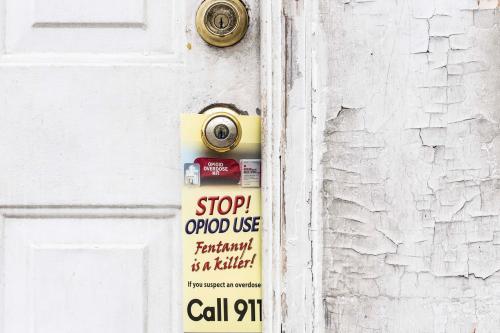
On December 15, the Trump administration designated illicit fentanyl and its “core precursor chemicals … such as Piperidone or other Piperidone-based substances,” as a weapon of mass destruction (WMD). Some families of fentanyl victims may consider the designation a welcome Christmas gift; others may see it as merely tough posturing. The designation does, in fact, significantly intensify the criminalization of fentanyl trafficking, dealing, and even, potentially, use. It reinforces the Trump administration’s overall conceptualization of drug policy as centering on maximum-strength militarized supply-side measures while reducing access to treatment. The implications range from domestic law enforcement to foreign policy. There is little clarity so far as to how the Trump administration intends to use the WMD designation. But it sets up a basis for more military counternarcotics actions abroad and intensified criminalization of drug dealing and use at home.
Why now?
The first Trump administration initially had the idea to designate fentanyl as a WMD, but internal pushback halted that move. At the time, key agencies, such as the Drug Enforcement Administration, said they had adequate tools to deal with fentanyl. But activists, including a segment of families of victims of fentanyl overdose, became staunch proponents of the idea. Soon, they were lobbying the Trump and then the Biden administration to make the designation. The second Trump administration resurrected the idea, and in the spring of 2025, it almost announced the designation. Once again, internal discussions delayed the move—until now.
Fentanyl’s WMD designation fits into the Trump administration’s overall conceptualization of drug policy. The policy heavily centers on maximum-strength and unprecedented supply-side measures, such as lethal military strikes against alleged drug boats in the Caribbean and the Pacific and the designation of now 15 criminal groups in Latin America as “foreign terrorist organizations.” These moves have coincided with decisions by the administration to gut funding for treatment and harm reduction and resurrect obstacles to access to treatment.
The legal code and international treaties
The primary U.S. legal statute pertaining to the use of weapons of mass destruction is 18 U.S. Code § 2332a, which criminalizes the use, attempt to use, and conspiracy to use or threaten a WMD against people within the United States, U.S. nationals outside the United States, U.S. property abroad, and in circumstances that affect interstate or foreign commerce. Penalties range from life imprisonment to the death penalty.
The mere possession of a WMD—in this case, fentanyl—does not immediately trigger domestic terrorism charges. Under 18 U.S. Code § 2331, the possession and use of a WMD can be classified as domestic terrorism if the intent is:
- To intimidate or coerce a civilian population.
- To influence the policy of a government by intimidation or coercion.
- To affect the conduct of a government by mass destruction, assassination, or kidnapping.
The lack of detailed specification in the Trump administration’s executive order as to what fentanyl precursors are designated as WMDs is perhaps meant to avoid the perennial problem of drug trafficking networks altering the chemical formulas to circumvent scheduling. However, this will create legal and control challenges. Businesses and foreign countries will not know when they are vulnerable to accusations by the Trump administration of enabling WMD terrorism through inadequate controls.
Domestic implications
The designation of fentanyl as a WMD not only allows federal law enforcement agencies to have jurisdiction, but it also significantly prioritizes their efforts to counter fentanyl. The Trump administration’s executive order specifically tasks the Department of Homeland Security (DHS) and the Department of Defense to take anti-fentanyl actions under the new WMD designation, though it doesn’t specify which actions.
However, it remains to be seen whether agencies such as the DHS and the Federal Bureau of Investigation will treat fentanyl trafficking in the same way as, say, a potential plot to detonate a radiological weapon. For one thing, WMD terrorism conspiracies are very rare, whereas fentanyl trafficking and dealing are ubiquitous, given the vast amount of consumption and users in the United States. The volume and frequency of dealing on U.S. streets overwhelm law enforcement resources.
Moreover, even for the DHS, it is unclear how the law enforcement prioritization that normally follows such a designation will mesh with the Trump administration’s focus on arresting and deporting undocumented migrants. Already, that focus has diverted Homeland Security Investigation resources and attention away from efforts to counter terrorism, transnational criminal organizations, and child abuse and trafficking, as well as other missions, with thousands of investigators reassigned to arrests and deportations of unauthorized migrants.
The WMD designation could lead to increased penalties for drug dealers, including the death penalty for dealers whose doses lead to deadly overdoses. Already, various U.S. states have laws that allow the distribution of a lethal dose be charged as a homicide. President Donald Trump has called for the death penalty for street drug dealers, even as he has pardoned some of the most notorious and top-level drug traffickers, including a crucial enabler of the Sinaloa Cartel. The Sinaloa Cartel and the Cartel de Jalisco Nueva Generación (CJNG) are the principal traffickers of fentanyl to the United States.
Yet many dealers are, in fact, drug users themselves, such as high school and college kids, who give some of their own contaminated drug supply to their friends, who then overdose. Subjecting them to the death penalty under WMD charges would serve little purpose and may discourage them from calling 911 during an overdose. Users may become afraid to purchase overdose-reversing naloxone.
Sentencing aside, WMD offenses fall under federal jurisdiction. If the WMD designation is interpreted to mean that all fentanyl-dealing cases in the United States are henceforth tried in federal courts, sentences for dealing could become longer. Diversion away from imprisonment could decrease since drug courts that offer such diversion operate primarily at the state and local levels. The overall outcome could be that many more people in the United States are imprisoned for fentanyl charges for much longer.
Will the WMD designation trigger further connections to alleged terrorism conspiracies? So far, the Trump administration has not attempted to use the designation of entities such as the Sinaloa Cartel to charge U.S. dealers or U.S. users with providing material support to terrorists—charges that are certainly possible under the material support statutes. But the WMD designation increases the legal risks of such prosecution efforts.
International implications
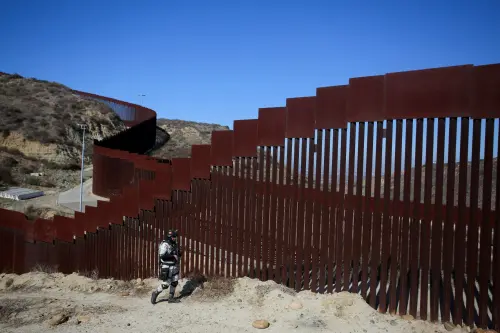
The WMD designation now allows the Trump administration to charge members and sponsors of the Sinaloa Cartel and CJNG under WMD terrorism charges. Those who advocate that the U.S. military strike the two cartels in Mexico, which Trump has said he is open to, will also feel emboldened by the designation.
There is also a possibility that the WMD designation could encourage the Trump administration to expand its range of possible military targets beyond the cartels and their labs in Mexico. Such an expansion could include countries like Guatemala, which serves as a transit point for the smuggling of fentanyl precursors (now also designated as a WMD). An extreme measure would be for the Trump administration to militarily target container ships, where fentanyl precursors are often hidden among legal cargo. Such actions would disrupt international commerce and violate international treaties.
Another dramatic foreign policy measure would be for the Trump administration to charge fentanyl precursor networks in India and China as assisting in WMD proliferation and terrorism, and potentially treat them or their assets as military targets, including in international waters. Such an approach would massively escalate tensions with China and further undermine the Trump administration’s difficult relations with India, weakening efforts to court India for countering China’s expansion in the Asia-Pacific region. But so far, China has been very adroit in its fentanyl diplomacy with the Trump administration, delivering little in exchange for tariff reductions and deploying effective counterpressures, such as its own tariffs, restrictions on rare earth exports, and boycotts of U.S. products like soybeans.
Far more productively, the Trump administration could seek to use mechanisms such as the Proliferation Security Initiative, a global effort to counter the smuggling of nuclear materials and components by screening and sealing containers. The Trump administration could promote the screening of a larger portion of global cargo for other contraband, such as the WMD-designated fentanyl precursors.
There is also the possibility that the Trump administration could pressure other countries into adopting a WMD designation for fentanyl and a range of its precursors. And why stop at fentanyl? Other synthetic opioids, such as nitazenes (spreading in Europe) or cychlorphine (emerging in the United Kingdom), are even more lethal than the fentanyl-class drugs.
If designating potent synthetic drugs as WMDs became a trend, we may end up not with more effective counternarcotics supply measures, but with diluted controls on nuclear, radiological, chemical, and biological weapons. Such an outcome would neither address America’s fentanyl crisis nor serve the Trump administration’s interests.
Author

Related Content
The Brookings Institution is committed to quality, independence, and impact.
We are supported by a diverse array of funders. In line with our values and policies, each Brookings publication represents the sole views of its author(s).

Commentary
Will designating fentanyl as a WMD misfire?
December 19, 2025