In recent decades, there’s been a sea change in how governments plan for and invest in roadway infrastructure. During the 20th century highway build-out, transportation practitioners would practically celebrate when people drove more total miles, because they linked that metric (known in transportation circles as “vehicle miles traveled,” or VMT) with economic growth. However, as the connection between higher VMT and economic growth began to fracture, a new generation of practitioners started to recognize that more driving doesn’t necessarily mean more prosperity.
Instead, we now know higher VMT often comes bundled with a host of negative side effects. More driving increases costs of living, as households spend more on gas, car maintenance, and insurance. Governments often pay to increase roadway capacity to accommodate more VMT, but such construction only induces more driving and fails to reduce congestion—all while leaving a bigger long-term maintenance bill. More VMT also leads to higher greenhouse gas (GHG) emissions and worse localized air pollution from particulate matter.
Many state officials, who control the bulk of transportation planning and investment, are looking for new ways to make getting to work, school, or the store easier, while keeping VMT under control. In many cases, they’ve started to consider new policy approaches. Chief among them: VMT mitigation strategies.
Though some VMT-reducing tools emerged during the 1970s oil crisis, when travel demand management gained traction, interest among state lawmakers gained steam in the last decade-plus. In 2013, California passed the first-of-its-kind SB 743, which asked transportation officials to mitigate the VMT their projects would generate. In the years since, other states have iterated on that policy. Each time, lawmakers acted with different motivations, but reflected the same general purpose: increase prosperity without driving up VMT and paving more roadway miles.
All of which makes the coming year a pivotal moment for VMT policy development. The midterm elections will bring in a new tranche of governors and their appointees, as well as state and local lawmakers—many of whom will take a fresh look at how much their transportation systems cost and how to achieve the greatest return on investment.
To understand the current baseline for state-level VMT mitigation policy, this report breaks down which states have these laws on the books, why some efforts have failed, and where VMT mitigation policies could become law in the current legislative session.
Which states have VMT mitigation laws?
Lawmakers in only four states have adopted VMT mitigation policies, with each state using a different approach. California and Minnesota approach mitigation at the project level, assessing potential VMT mitigation needs for individual projects. Colorado and Oregon mandate that the list of projects in their transportation plans generates total VMT below target levels.
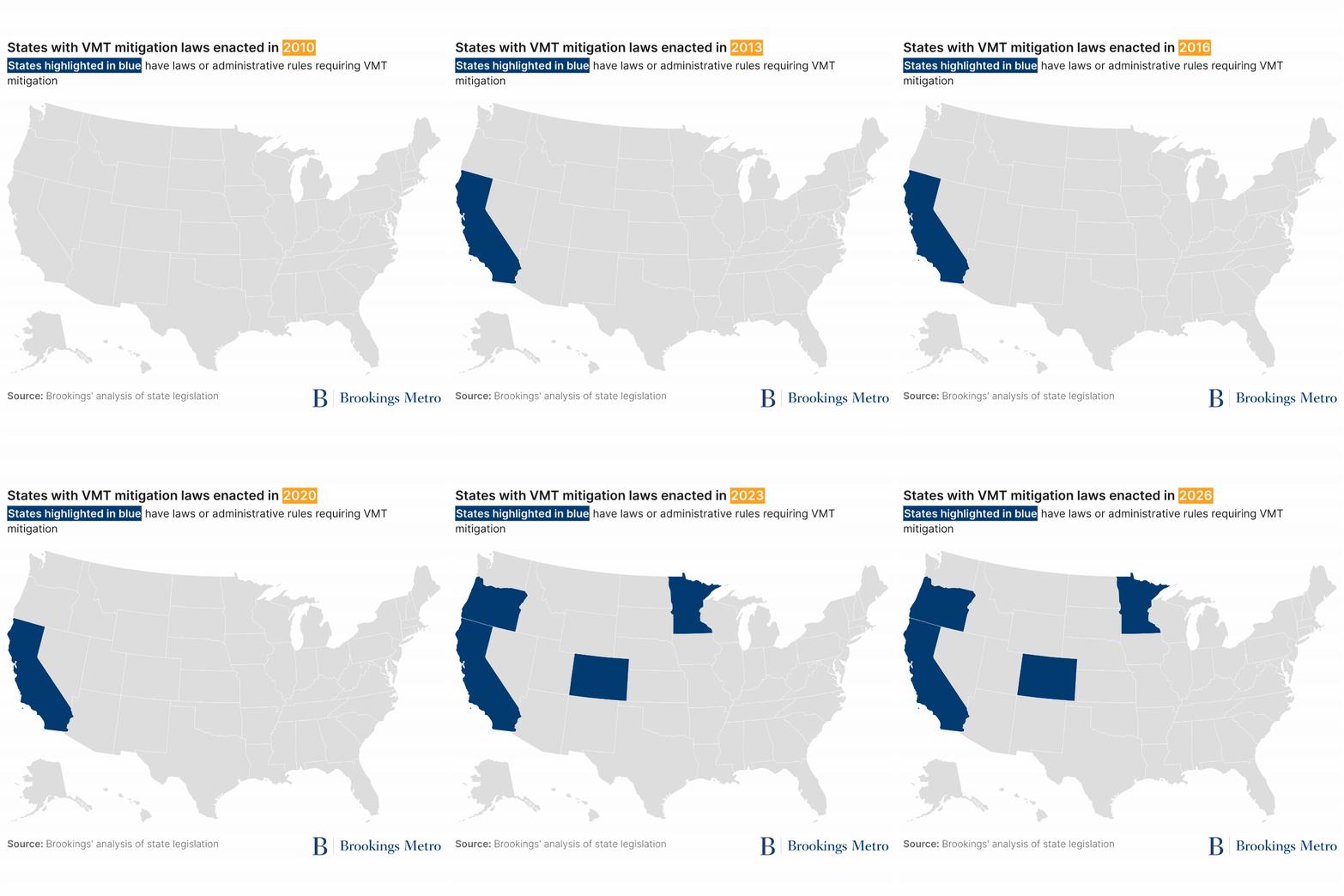
- California: California became the first state to require VMT mitigation when lawmakers passed SB 743 in 2013. That law changed what a project’s sponsor had to analyze and mitigate under the California Environmental Quality Act (CEQA). Developers and public agencies no longer had to assess a project’s impact on level-of-service (basically traffic flow), and instead analyze whether it would generate VMT. If environmental review finds a project will generate significant VMT, the project sponsor must mitigate that VMT with measures such as traffic performance management or new bicycle and pedestrian infrastructure. In 2025, AB 130 expanded this framework by creating a statewide VMT mitigation bank. Now, developers can avoid onsite mitigation by paying into a fund that finances transit, bicycle, pedestrian infrastructure, and other VMT-reducing projects.
- Minnesota: In 2023, Minnesota implemented a VMT mitigation requirement for projects on state-owned roads. HF 2887 requires the state department of transportation (DOT) to evaluate the impact of major highway expansion projects on GHG emissions and VMT before they can be included in the State Transportation Improvement Program (STIP). If the department finds a project would generate so much VMT that the list of projects in the STIP would fail to meet Minnesota’s targeted 20% reduction in per capita VMT by 2050, then its VMT has to be mitigated. Unlike California, Minnesota’s law requires VMT to be analyzed and mitigated even when environmental review is waived for a project.
- Colorado: Colorado addresses VMT mitigation at the planning level rather than by project. In 2021, state law SB 21-260 directed the state’s DOT and its metropolitan planning organizations (MPOs) to ensure the state’s transportation program aligns with the VMT reduction targets. If modeling results indicate that the suite of projects would exceed the state’s VMT reduction target, the Colorado DOT must modify that list or add investments in mitigation measures. The law does not wholesale prohibit highway expansion, instead constraining the statewide program on which those expansions are listed.
- Oregon: Oregon takes a similar tack to Colorado, with OAR 660-012-0160 requiring cities and counties to forecast their per capita VMT in a Transportation System Plan, including VMT generated by anticipated roadway expansions. That plan may not be adopted if projected VMT per capita for the horizon year is higher than the plan’s baseline year.
Because VMT mitigation laws are relatively new and states are still experimenting, no single approach has emerged as an outright best practice. Yet different policies have yielded different results. In Colorado, the Denver Regional Council of Governments (the region’s MPO) and the state DOT opted not to expand Interstate 25 and another highway, instead redirecting $900 million toward bus rapid transit corridors and other improvements. And though California’s SB 743 has led to a few project-level successes, there’s plenty of research suggesting it may be too weak to actually reduce VMT. That may be why academics and other experts have argued that the Colorado and Minnesota approaches are the most promising.
Why have VMT mitigation laws failed?
Only four states have VMT mitigation laws on the books—but that’s not for lack of trying. For every successful bill, others have failed. The legislative history of these unsuccessful attempts reveals which interests coalesce to support and oppose VMT mitigation, and which arguments tend to get traction with lawmakers.
- Maryland: Maryland is a particularly instructive example of how VMT mitigation legislation can fail. In the last legislative session, lawmakers introduced HB0084 and companion bill SB0395, which would have required the Maryland DOT to evaluate whether major highway expansions would induce demand and align with climate targets the legislature set. Supporters of the law argued it was necessary to implement the state’s commitment to addressing climate change and would improve safety, congestion, and air quality. However, the bill faced stiff opposition from highway builders, who labeled it unworkable because of the cost and the practical difficulty of modeling a project’s induced demand. In previous legislative cycles, earlier versions of the bill were opposed by the Maryland Chamber of Commerce and the Maryland Motor Truck Association over concerns about project delays and constraints on highway expansion.
- Maine: Similar opposition stalled Maine’s 2025 VMT mitigation legislation. Legislators were considering LD 1138, a bill that would have forced state transportation agencies to mitigate GHG emissions and VMT induced by capacity-expanding projects. Much like the Maryland bill, the Maine Motor Transport Association, which represents truckers, opposed the bill. Unlike in Maryland, three state entities testified against the bill: the Department of Transportation, the Turnpike Authority, and the Department of Environmental Protection. An issue that surfaced across all the opposition was the bill’s perceived redundancy; these organizations argued the bill duplicated past statewide climate planning and mitigation efforts as well as existing state and federal environmental review laws. These groups also predicted issues related to cost and project inefficiencies.
The legislative record in both cases suggests that business and industry support can be make-or-break for a VMT mitigation bill. Case in point: Business leaders went on the record supporting Colorado’s SB 21-260, which also dramatically increased transportation funding, when it was unveiled. The law eventually succeeded in part because major business groups backed the bill—a fact State Sen. Steve Fenberg highlighted when the bill passed his chamber. Colorado’s law may have also been buoyed by its increase in transportation funding—something that could have alleviated concerns in both Maine and Maryland.
More states may legislate VMT mitigation this year
At time of publication, four states are actively considering legislation meant to mitigate or set targets for reducing VMT. Each of these new bills represents a different approach by state policymakers to managing the negative externalities of driving. Crucially, each is also a test of which VMT mitigation measures are viable in the current political climate.
- Maryland: Maryland legislators refiled last session’s failed bill, now titled the Transportation and Climate Alignment Act of 2026, or SB0059/HB0437. This law would require the state DOT to conduct an impact assessment for any highway capacity expansion exceeding $100 million and develop a corresponding multimodal transportation program funded concurrently with highway construction. The net GHG emissions of the multimodal program and capacity expansion would have to be zero or less, and a project cannot proceed if it can’t mitigate its own emissions. Starting in Fiscal Year 2028, the state DOT must evaluate the impact on GHG and VMT of all major capital projects in its Consolidated Transportation Program. Additionally, the 2026 refile comes with several notable changes. One of those is that project leads can now mitigate GHG emissions instead of VMT, which means that a highway expansion generating more VMT in an area of high electric vehicle adoption may be permissible. And though the previous bill would have required mitigation for projects costing $5 million or more, this refiled version sets the threshold at $100 million. Important to watch will be whether these changes motivate the Senate Budget and Taxation Committee to bring the bill to a committee vote, which it did not for the bill’s previous version.
- New York: In New York, S4044/A4230 (dubbed the “Get Around NY Act”) would create a statewide goal of reducing overall VMT by 20% by 2050. Earlier versions of this bill stalled in committee, so its current implementation is straightforward: Before any highway capacity expansion can be approved, the relevant authority must conduct a VMT impact assessment. If the project does not align with the state’s goal, it must be redesigned or offset through mitigation measures such as transit expansion, bicycle and pedestrian infrastructure, or land use changes. This bill operates at the project level, requiring mitigation as a direct condition of project approval, making it most similar to Minnesota’s approach. But where Minnesota ties project mitigation to a combination of GHG emissions and VMT trajectory, New York proposes a VMT-only standard. This contrasts with other states, as it excludes some mitigation measures; electric vehicle adoption, for example, can reduce GHG emissions per mile driven, but not VMT.
- New Jersey: New Jersey’s S4873 takes a more foundational approach to VMT mitigation. The bill sets statewide VMT reduction targets and establishes a “Vehicle Miles Traveled Advisory Commission,” but it does not require mitigation for individual projects. If the bill passes, New Jersey will aim to reduce per capita VMT by 20% and statewide VMT by 8.5% from 2019 levels by 2050. This bill could tee up New Jersey to follow in California’s footsteps: The latter had created a regulatory framework around and goals for VMT reduction before SB 743 passed. Setting VMT reduction targets now may let New Jersey lawmakers pursue mitigation requirements in the future.
- Massachusetts: Massachusetts’ S2246 bars both long-range Regional Transportation Plans and Transportation Improvement Programs from approval unless they articulate a strategy to comply with the state’s GHG and VMT reduction goals. Much like Colorado’s planning-level regime, this bill would require the state DOT to modify its investments if modeling shows VMT generated by its program would exceed state targets. This bill would still represent a major shift from the state’s current framework, in which transportation planning and GHG reduction targets operate independently. More stringent measures previously failed in Massachusetts, so this bill is set up to answer whether lawmakers in a state with relatively ambitious GHG reduction targets are willing to legislate on VMT.
The next wave of state office holders can reorient their transportation systems to reduce VMT
At least 21 new governors and scores more new legislators will hold elected office in 2027, all with political winds at their back. However, these newly elected leaders will inherit transportation systems, budgets, and project backlogs developed under an old model. They have the chance to change things by orienting their state to be competitive for a future in which VMT mitigation is crucial.
They can start by learning about the politics and policy mechanics of VMT mitigation, relying on over a decade of legislative experience and policy experiments on the issue. Translating those lessons to their state brings a real opportunity to make local budgets stronger, constituents safer, and travel more affordable in the future.
Authors



The Brookings Institution is committed to quality, independence, and impact.
We are supported by a diverse array of funders. In line with our values and policies, each Brookings publication represents the sole views of its author(s).