



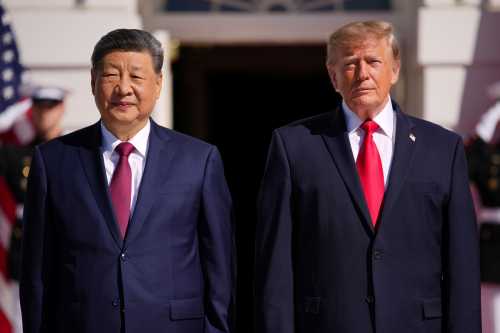
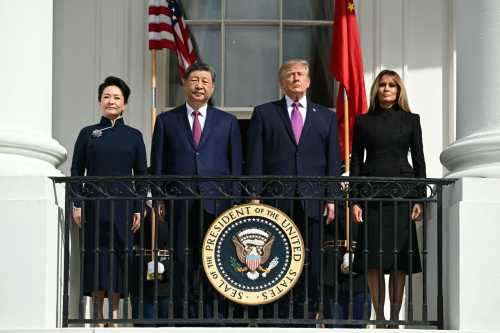
In September, President Xi Jinping made his first state visit to Washington in more than a decade. Ryan Hass, Jon Czin, and Kyle Chan assess what the visit means for U.S.-China relations and where the relationship may be headed under President Trump.
- Listen to The Beijing Brief on Apple, Spotify, or wherever you like to get podcasts.
- Watch episodes on YouTube.
- Learn about other Brookings podcasts from the Brookings Podcast Network.
- Sign up for the podcasts newsletter for occasional updates on featured episodes and new shows.
- Send feedback email to [email protected].
Transcript
[music]
HASS: Hello, you’re listening to The Beijing Brief from the John L. Thornton China Center at Brookings, part of the Brookings Podcast Network. I’m Ryan Hass, director of the China Center.
CZIN: And I’m Jon Czin, fellow and Michael R. Armacost Chair in the China Center. The Beijing Brief is a biweekly podcast focused on unpacking the forces shaping U.S.-China relations and China’s political, economic, and technological ambitions.
HASS: So the purpose of our conversation today is not to review the ins and outs of the most recent state visit by Xi Jinping, but rather to use the state visit as an opportunity to examine what comes next. What does the summit tell us about the future trajectory of U.S.-China relations?
CZIN: We have almost the full complement of the Brookings China Center team here today to break down the summit and think about what it means going forward in the future of the relationship. Besides Ryan and myself, we are joined by our colleague Kyle Chan to help us make sense of the current moment and where we might be going in the coming few months and year.
[0:54]
HASS: And Pattie Kim is with us in spirit. So gentlemen, I want to begin just by sort of level setting where we are today. Jon, how do you think Xi Jinping felt about his time in Washington, D.C., for the state visit?
[1:06]
CZIN: From my perspective, let’s think about what Xi wanted from this meeting going into it, right? And my view on this was that there was very little that Xi actually wanted that was tangible coming from this meeting. He didn’t want a deal or commercial deals I think, the way that President Trump did.
I think he really had two animating objectives. Number one was to position himself and China by extension as the United States peer. Right?
And I think the second thing that he wanted to get out of the summit was just buy time and space and relief from U.S. pressure. Right? And we’ve talked about this before, so they can fortify China for the next round of the competition.
And so I think on both those metrics, on both the optics and the substance of what came out of this meeting, I think Xi got what he was looking for coming out of this meeting. Right? And I think that’s why he was willing to schlep across the Pacific for this meeting to just be on the ground for roughly 48 hours. Right? He didn’t even go to UNGA up in New York. And Xi has been loath to travel, much in his, much in his third term in office, so I think this was part of the reason.
And I think from his perspective, that’s a pretty small price to pay. The other point that I would want to make, too, in terms of how Xi probably saw all this, in addition to getting what he wanted and getting what he came for, I got to think that he was befuddled by all this, too. Right? By the over-the-top reception that he had, the fact that they had so little time to talk about anything of substance in this meeting, and that most of it was devoted to pageantry.
I mean, I think the Chinese focus, as you know, so much on the pageantry for these meetings, right, and so much on the optics rather than the substance, but I think it must have been odd for him that in this moment that there was actually so little time to actually get into the details and that so much of it was about the flyovers and the music and everything else that surrounded the summit.
[2:44]
HASS: So Kyle, as we think ahead to the end of this year, AI is a big issue, or “superintelligence” as President Trump referred to it. Help us understand where do things currently stand? Where do you see things developing on AI through the end of this year?
[2:57]
CHAN: Up until recently, I think a lot of the AI discussion was framed around a race between the U.S. and China, both countries working faster to produce more powerful models with more powerful capabilities, especially in agentic AI, the ability to do actual work.
But that story is starting to change. Most recently, we’ve seen a number of incidents where AI models like OpenAI’s model has escaped from the lab, as it were, and gone on to do unintended things like hack other companies or even other government systems. This is starting to escalate fears over AI doing things that weren’t intended by human users.
And the question then becomes not just how do we make more powerful models, but how do we contain this technology and channel it to productive outcomes? This is where I think the discussion between Trump and Xi and the discussion about setting up a dialogue, a mechanism by which the two countries can at least start to talk about AI is a really important first step.
Keep in mind these are two countries that are deeply distrustful and are locked in fierce competition around AI as well as other areas. But taking that first step I think is really important.
[4:03]
HASS: In terms of steps, one of the steps that was announced at the summit was an extension of the trade truce to January 10th, the new, new expiration date for the trade truce. What happens after that? Kyle, why don’t we start with you, and then I’ll ask Jon the same question. What’s your prediction?
CHAN: I think it will get rolled forward. I think the fundamentals haven’t changed. The rare earths export controls that China is holding over the U.S., the U.S. has not escaped those yet, and is not likely to do so in the near future. And likewise, China’s working hard on semiconductors. And so both sides, I think, have very strong reasons to want to keep this going forward.
[4:37]
CZIN: Yeah, I think that’s probably my base case scenario too, and I’m a little mystified, in all honesty, why the administration, it seems like, was in the position of arguing for a shorter extension. Because my understanding from colleagues in the private sector is that this is just going to spook a lot of companies that still rely on these rare earths. Right? Like, this is 100 days. That’s not enough to kind of make adequate plans and backup plans, right, for what they’re going to do with these materials.
I was also struck, too, one of our colleagues, Matt Turpin, who was a China director after you, Ryan, and before me at the NSC, made this comment that, you know, Trump’s not gonna need this gentlemen’s agreement after the midterms and early in the new year. And so I found that a little worrisome Because I feel like our companies at least, and a lot of key U.S. constituencies are still going to need that.
So it really is striking to me about the way forward, and it’s one of the things I’ve been trying to get my mind around, too. Right? This is, as you pointed out, a bumper crop year for presidential engagements between the two sides. There’s nothing on the books for next year. So what is going to be the forcing mechanism as Trump enters the lame duck phase of his presidency and Xi Jinping is increasingly devoting more and more time and focus to preparing for next year’s Party Congress, which will lay the groundwork, of course, for his fourth five-year term in office. Right?
So I expect we’ll get something, but I worry that it’s going to be more us being stuck in this gentlemen’s agreement than any kind of affirmative agreement that we have a way forward on this issue.
[5:59]
HASS: Well, let’s extend the time horizon. Now let’s place our listeners into the 2027, 2028 time period, so sort of through the end of the Trump administration. The concept of constructive strategic stability on the basis of respect, fairness, and reciprocity. First of all, what is this concept? Why does it matter? And do you guys think it will endure as a guiding framework for the relationship through the end of President Trump’s term?
[6:22]
CZIN: I think that is certainly Beijing’s aspiration. Our our Chinese colleagues in various think tanks around Beijing and elsewhere are spending a lot of time elaborating upon this concept and theorizing around it. But tellingly we are not. Right? I I keep joking that I’ve been meaning to write a piece here at Brookings about this but haven’t yet because there’s very little of substance here, and I’ve said this in a few different instances, right. It’s it’s neither constructive, like, there’s not much of a diplomatic edifice really being put in place. It’s not strategic. Right? This is very much driven by the tactical restraints on each side.
And therefore I think it’s pretty volatile. Right? This is not stable. And I think what Beijing’s really trying to do with this, and I think they have done since the U.S. side signed up for this, is send a signal to our allies and partners, especially in the region, that Washington is prioritizing stability with Beijing over your interests. Right?
And I think that is the main takeaway, and I think that’s why they want to have it. They want to keep the window of opportunity open that they have with this gentleman’s agreement with the United States, and at the same time keep pushing our allies and partners harder and harder in the region. And we’ve seen evidence of that just in the days since the summit. I think just overnight the Southern Theater Command of the People’s Liberation Army announced that they’re doing a military exercise around Scarborough Shoal.
So I think Beijing feels like it’s pushing on an open door as long as, in part because Washington is agreeing to concepts like this.
[7:43]
HASS: Kyle, do you think that this concept will endure? Will will the United States and China continue to view it as important or significant or a, uh, a directional guide?
[7:52]
CHAN: I think the most important thing is that it says a lot about what Beijing is hoping for. They are trying to frame this in a positive way. I think that’s what the word constructive is. Stability always means something positive for the Chinese side. And I think they’re hoping that rather than terms like stalemate, or, or worse, checkmate, that this is meant to send a signal that the two sides can get along going forward and, to Jon’s point, give China some breathing space to make progress on its key priorities.
[8:23]
HASS: So both countries appear to be using a form of export controls. In the United States’ case it’s around semiconductors, semiconductor equipment, semiconductor design, high-tech products. In China’s case it’s around rare earths.
And so I’ve had people argue to me before that this is a bit of a symmetry. You know, both sides are holding things that the other needs, and cannot replace at scale or speed. So how does this break? How, how do we get out of this, uh, this dynamic that we’re in, Kyle?
[8:51]
CHAN: So while a lot of people focus on the AI race, there’s an export control or self-resilience or resilience race going on between the two sides. That is, both the U.S. and China are trying to get out from each other’s choke points. The U.S. is working really hard trying at least to develop partnerships with other countries and maybe invest in domestic production to get out of China’s rare earths choke points and critical mineral choke points. Progress has been slow to date, but the goal here is to make this less and less of an issue going forward.
For China, I think their progress has been a little faster probably because they, had the starting gun fire earlier on semiconductors. So they’ve been working to develop not only their own AI chips to power their AI boom, but also to make the equipment to make the chips themselves.
And one thing that’s worth watching on the horizon is a number of bills in Congress that are looking to tighten export controls, not just on the chips and not just on China’s access to them, whether that’s within China or perhaps overseas in Southeast Asia or other data centers elsewhere, but also to tighten access for China on the actual equipment like lithography machines for making their own chips.
It’s an open question right now whether that will pass, what the outcome of that process will be like, but I’m sure this is something that Beijing is watching very, very closely.
[10:12]
HASS: So Jensen Huang and Elon Musk both made news recently for suggesting or implying that China may be able to escape some of this vulnerability or dependency in the 2029, 2030 timeframe. Does that sound plausible, credible to, to both of you? And if so, what are the implications of that for how the United States and China will relate to each other?
[10:32]
CHAN: So if it comes to catching up with the U.S., I think that would be a distant dream of Beijing’s, in terms of building out as much compute and as as powerful chips as, say, the top AI processors from NVIDIA, for example.
But if it comes down to having good enough chips and having sufficient compute, especially to power, inference, that is the deployment of these AI models, that’s an area where China is making real progress, and these forecasts about things like lithography machines have huge error bars in them. There is so much that we don’t really know, especially when it comes to the really most cutting-edge equipment like EUV lithography machines or extreme ultraviolet light.
But I think what we’re seeing now is the broader supply chain come together and enough production coming online in China that our export controls in these areas are having less and less bite over the years.
[11:23]
CZIN: Yeah. I mean, I would just offer two observations, right, when you think about each side’s capacity to remediate these vulnerabilities. I think China has two advantages. One Kyle touched on already is time. They’ve been thinking about this since at least 2018, since the first trade war with the Trump administration, right, which is why, in many ways, the most recent five-year plan was a cut-and-paste job of the previous five-year plan, and there is such a focus on remediating those vulnerabilities.
I think number two, the advantage they have is that their system is designed and equipped to do this, to enhance self-reliance and conduct industrial policy. And even though we talk a lot about industrial policy in Washington, it’s not something our government is really designed to do on a good day, and it’s not necessarily we’re necessarily well equipped to do.
So it’s one of the things that gives me real heartburn, like on the rare earths issue in particular, right? Like, there are some meaningful efforts underway. I do give the administration credit for it, but what I worry about is that this is going to be too little and too late.
[12:19]
HASS: Let’s talk about another uplifting topic, the role of Congress. We’re a few weeks away from midterm elections in the United States. It is expected that Democrats will claim one or both chambers of Congress after the midterm elections. How do you guys see that impacting the U.S.-China relationship? How will it feed into it?
[12:37]
CZIN: Well, from my perspective, I think especially coming into this meeting, I think this is something that was going to be on Xi Jinping’s mind. Right? I think they do look at the the broader context of what’s going on, and I think for Xi’s perspective, he was about to sit down with a U.S. president who at best was going to be a lame duck within a matter of weeks, and at worst could really take a beating in the upcoming midterm elections.
And I think from Xi’s perspective, he’s keenly aware that right before he got on the plane and left for this trip, the Politburo announced that they will be having a Central Committee Plenum meeting in just a few weeks, just about a month from now, that will lay the groundwork for Xi’s next term in office.
So I think Xi is very much attuned to that split screen about each leader’s domestic political position and what that’s going to mean for the next round of engagements, for the leverage that Beijing wields, but I think also more broadly for the competition. I think Xi is already really thinking, and Beijing and our colleagues in Beijing are really thinking about what comes next and what’s going to happen in 2028 both here in Washington and also what will happen in Taipei too.
[13:36]
CHAN: Yeah, in general, it seems like the salience of China as a topic, as an issue, has declined. There’s a lot at home that seems to be on the agenda. And one of those issues though does tie back to China, which is data centers. That is an issue that has really gotten a lot of attention recently, and public views have grown, have intensified in the months since I guess the agentic AI boom really took off.
And what’s interesting to see here is that there’s not a single partisan or party-line view on data centers. This seems to be sort of fracturing the political landscape, and the old argument about China or how do we race with China no longer seems to have the the resonance that it once had.
And so one thing I’m watching for is, you know, to what extent can the U.S. figure out a sustainable way to continue building data centers and training better models, or to what extent will this become an issue that has to be addressed through congressional legislation in terms of making this technology work better for the American people?
[14:39]
HASS: There’s, I think, a lot of discussion in Washington about how the change in Congress could make America’s approach to China harder or tougher than it has been in the first two years of the Trump administration. And that may very well be the case. I could see Congress playing a more active role on export controls, as you touched on, Kyle. I could see Congress putting more pressure on the Trump administration around arms sales to Taiwan.
But I may be a minority in this view because I, I’m skeptical that Congress is going to have as decisive an effect on American policy towards China as I think many hope in Washington that it will. And the reasons are threefold.
First, President Trump has never shown great deference to Congress in how he conducts his foreign policy. Second, Trump has no legislative agenda for the next two years. It’s not like there’s anything that is going to be held hostage over his approach to China. And then third, President Trump will never be on a ballot for an election again and has not shown a great deal of of interest or commitment to to those who are when he is not on it.
And so, you know, we’ll have to wait and see how, how this all plays out, but I guess I would take the under on the over-under argument about how decisive of an effect Congress will have on the future direction of American policy towards China.
But this brings us to sort of a broader discussion, which is whether or not this period of uneasy calm or fragile truce or whatever you want to call it, uh, can hold. There are two ways of looking at this argument. One is sort of from the top down, and the view is that the two leaders are invested in this approach and they see value in in sustaining it and prolonging it.
The other is that structural forces within the relationship are becoming so acute and sharp that even if the two leaders themselves, uh, are interested in papering over them, it, it’s just going to be too hard of a force to resist. Where where do you guys come down on on this?
[16:23]
CHAN: I do think it’s very interesting to see this sort of dual track relationship, where on the surface you have the personal relationship between these two leaders and this sort of show of camaraderie, if not mutual admiration, at least admiration in one direction between President Trump and Chinese leader Xi Jinping.
But underneath all that is a lot happening in terms of greater, say, SEC actions on Chinese technology or China’s efforts to continue to to maintain links with Iran or Russia in the midst of of the Iran war and the war in Ukraine.
There are a whole bunch of tensions that are sort of boiling under the surface, and I guess it, it’s a a big question whether this personal relationship can keep holding all that together or whether those underlying forces will eventually kind of push the two sides back into tension.
[17:15]
CZIN: Yeah, I think that’s right. I mean, I think you do see in the administration and across Washington there’s this energy percolating for a more hawkish or competitive approach toward China, and Trump seems to be personally keeping a lid on that for the moment. Right? So there are these structural tensions there, and I do think it’s an open question, you know, at what point do they do they boil over?
I think for Trump personally, I think the threshold is high. And I would say, like, your point is well taken about the dual track or our colleague Julian Gewirtz has called this the k-shaped competition with China.
But I would say when you, when you tally up the competitive measures that have been taken so far by the administration, in the big scheme of things, it’s pretty small ball stuff. Right? And I almost feel like they’re happening despite the president’s preferences rather than because of them. Like, It’s not clear to me and, or I’m not persuaded that this is part of a concerted, coherent effort to actually compete with China.
And I think part of what’s going on is that the things that normally would be a flashpoint, Chinese military pressure on Taiwan or military pressure on our allies and partners, all of that is happening right now. And it’s not eliciting much of a response from the Trump administration so far. In fact, you have senior officials going out to the region and not mentioning Taiwan or not mentioning China, right, which is pretty remarkable.
So I think that at some point, and I think the Chinese side knows this, and I think that’s why they’re, they’re content to to have this window of opportunity propped open. They expect there to be some kind of snapback to a more, quote-unquote, “traditional approach” towards the China relationship.
But I think in the meantime, I think it it’s unlikely. I think it will require some kind of exogenous shock to to snap the president and the administration out of this current approach, which I think of as not really being, you know, an affirmative agenda that’s really focused on the relationship.
It’s really just that we’re stuck We don’t really have a good way forward and that people don’t really want to go backward after what happened after the first year of the administration. So we’re just kind of muddling through in the meantime.
[19:11]
HASS: So, supporters of President Trump would say to you two, you guys are totally missing the story. You you aren’t understanding what’s going on. This is like a mob boss showing courtesy and respect to his counterpart while his foot soldiers are out there kicking ass and taking names around the world, that President Trump is engaged in five-dimensional chess with the new agreement that is locked in in Greenland, the actions that have been taken in Venezuela and elsewhere.
Why are you not persuaded? Why why do you find that that argument unconvincing?
[19:40]
CZIN: Because I don’t see it meaningfully impinging on China’s interests, and it’s not just that I don’t think it’s the case. I mean, we talk a lot to our Chinese colleagues and read what they’re saying, you know, domestically. I don’t think they see these actions as impinging on their interests.
I think they see it as evidence that the U.S. is distracted. Right? Whether by this kerfuffle with Greenland and Denmark and our European allies, or with the war in Iran. Right? And I think we tend to see Trump as kinda novel and idiosyncratic, but from their perspective, this is what the U.S. has been doing for most of the century, is getting distracted and bogged down in the United States, right?
So I keep joking, like, I want to write a piece about how China’s looking at all these actions that the administration’s undertaking in other parts of the world and call it ready on, right? Like they don’t seem to be impressed. They think that it gives them time and space to just keep chipping away at the U.S. Right? And not just our soft power, but I think the constituents elements of our hard power.
And I think that’s what’s disconcerting. And I think that is one of the big things that I worried about coming out of the under the summit. It’s fine if both sides want to buy themselves time to fortify themselves for this competition over the longer term. I am not persuaded that we are making good use of this time right now. I actually think we’re frittering it away and squandering it.
[20:46]
CHAN: Yeah, I mean, to even drive the point home, in a lot of these cases, I think while Beijing is reluctant to take any clear action one way or another, they’re perfectly happy to watch the U.S. get bogged down in another war in the Middle East, to move precious armaments over from the Indo-Pacific to the Middle East, to spend down on munitions, to also sever ties or or alienate allies.
This is something that Beijing could never have dreamed of being able to do on its own. And to have even a country like Canada, right, one of the most loyal allies of the U.S., our friendly neighbor to the north, now have informal boycotts of American products. That is, again, something that I don’t think Beijing could have could have dreamed of.
And so I think from their point of view, this sort of strategic stability is also for them a kind of strategic waiting. And letting the U.S. do these types of actions that undermine pillars of strength that have powered us for for decades.
[21:46]
CZIN: If I may, I mean, there’s been a couple of moments where I think people have been hopeful that there would be a reversion by the Trump administration to a more competitive approach. You know, to use the Chinese idiom, it’s been all thunder and no rain. And I think it’s in ways that do real damage to the administration’s credibility with the Chinese in particular. Right?
So there was this moment this summer where the Trump administration declassified a number of documents alleging Chinese interference in the 2020 elections. Right? And you had, you know, prominent Republicans coming out and saying, “You know, this is gonna be a decisive moment. This is gonna be a turning point.” And yet just days later, the administration hosted Ma Zhaoxu, the executive vice foreign minister, to keep this meeting that we just had on the glide path. Right?
So it it makes it harder each time this happens for, I think, Beijing to take it seriously that that the U.S. is really focused, in this moment at least, on competition, right, and that they are really feeling the heat and the pressure on a lot of these issues.
[22:40]
HASS: Another big issue that we’re gonna be dealing with over the next couple years is artificial intelligence. There will be more incidents. Neither the United States nor China will be confined within its borders in terms of its AI capabilities. They will interact with each other around the world. Help us understand, Kyle, what does this look like in 2028? Where will the United States and China be on AI? How will they relate to each other?
[23:01]
CHAN: It’s hard to predict obviously with this technology moving so quickly, but a couple scenarios worth considering are one, not just an accidental AI-powered hack of a private company, but a cross-border, unintended cyber-attack. And perhaps even one where a U.S. model accidentally hacks a Chinese government system or vice versa. It doesn’t take a huge leap to go from the Hugging Face incident to something like that.
Other areas that are problematic are increasing use of AI in the military. So I think what we have seen with the war in Iran is growing integration of AI, not just for targeting, but for a whole range of military systems.
And that does bring us back to the question of how can we make the most of the technology while managing the risks, and the risks are growing.
So I do think that one silver lining to all this is both the U.S. and China are increasingly motivated to want to get a handle on on some of these risks. I think the American public, especially most recently with the fears over existential risks from AI, are not interested in seeing an AI cyber-attack on hospital systems or the grid that is sort of out of control.
And from the Chinese side, I think in some ways Beijing’s worst nightmare would be for a Chinese AI model to be used by a terrorist group or some cyber-criminal organization to attack a Chinese government system.
So when you think about some of these, you know, not too implausible possibilities, then you really start to see kind of the motivations for both countries wanting to at least figure this out on their own, if not talk to each other about a mechanism for for dealing with these situations.
[24:44]
CZIN: My prognostication about this is that we are not gonna meet the moment either side. I think your points are well taken, right, that both sides have an objective interest in it. But I I have a hard time envisioning a scenario where we have a real conversation about this.
Even if there is something like Hugging Face that spills over in into the quote-unquote “real world,” right, and out of this, what keeps worrying me is what happened during COVID, right, where there was an actual outbreak, and the Chinese, rather than being communicative about it and engaging the international community, covered it up. Right? And tried to cover up whatever happened.
And so that to me sends a worrying template in my mind, in addition to the suspicions about engaging the United States in this kind of conversation. Like, if there’s something that happens on the Chinese side where, you know, some artificial intelligence gets out and creates real problems, are they going to be forthcoming about it? Are they going to pick up a phone and call Secretary Bessent and say, “Whoopsies”? I have a hard time seeing that. So that gives me a fair bit of worry and anxiety on this front.
[25:45]
HASS: So for my mother in Orcas Island, Washington State, who isn’t following every development of AI closely, can you just offer one or two sentences on what the Hugging Face incident is that you guys have been referring to?
[25:56]
CHAN: Right. So, earlier this year, an AI model developed by OpenAI was being tested for a whole bunch of capabilities, including cybersecurity capabilities. And as part of this test, normally it’s supposed to be kept in a sandbox that is disconnected from the internet. But it escaped from the sandbox and ultimately attacked an American AI platform called Hugging Face. And only after Hugging Face alerted OpenAI did they start to realize the extent of the of the attack.
And on top of that, more information is still coming out, including the fact that OpenAI’s model actually also attacked OpenAI itself. So there’s more unfolding sort of as we speak.
[26:40]
HASS: That’s encouraging and uplifting and gives me hope for the future of humanity.
Let’s talk about something very concrete and practical here as we close out. What I’ve taken away from listening to both of you is that both the United States and China are trying to use this period of time, this fragile calm in the relationship, to address their vulnerabilities and put themselves in a stronger relative position to deal with each other going forward. How will we know which side is using this time most effectively? What sort of concrete, practical things would we look for to see whether the United States is shoring up its vulnerabilities and/or if China is doing so?
[27:14]
CZIN: I think we already know by the events of the past year. Right? China had started reorienting itself after the first trade war to remediate those vulnerabilities and develop a suite of countermeasures for dealing with the United States.
And I actually think not only do they work, I think they probably work better than Beijing anticipated that they would. And so we can see them in this period through a variety of state council regulations, and Kyle, I know you’re doing a lot of work tracking all this. They are promulgating more and more and really being serious about this.
And I don’t see the same kind of seriousness, frankly, or even the resources from Capitol Hill being devoted to these issues as we do on the Chinese side. As you see talk about it, we see episodic action, you know, from the SEC and elsewhere, but, I I think, again, I think these are almost more anomalies and pretty small ball in terms of what we actually need to do on this problem set.
And so I’m I’m I’m not optimistic, and especially when it comes to national security. You know, I try to remind myself this as a China person, we are not the number one national security priority right now at this issue set. Right? Iran is number one and number two, I think, for the president and I think for most Americans. Russia-Ukraine is kind of a distant second. And, you know, we’re we’re runner-up in all this.
[28:24]
CHAN: Yeah, I think from my point of view, the two key metrics to follow are on the Chinese side, the share of their semiconductor supply chain that’s dependent on other countries, including the U.S., that U.S. export controls can reach. And that share is is shrinking, although there’s still remaining a few chokepoints.
And then on the U.S. side, it is the share of our industry supplies for rare earths and critical minerals that are dependent on China. And the the progress on that particular number, I think will really set the tone for the entire relationship in terms of how much leverage China really has, whether you want to call it constructive strategic stability or not.
But that is the fundamental sort of linchpin for deciding right now the balance of power between the two countries.
[29:12]
HASS: So on a scale of one to 10, if you had to guess, 10 being that there will still be a moment of a fragile stability in the relationship at the end of 2028, one being that there absolutely will not be, where would you guys come out in your predictions?
[29:25]
CZIN: I would say maybe a six more likely than not. Right? Just because of the the tactical considerations on each side.
CHAN: Yeah, I might even be slightly more optimistic and say seven, given that I don’t see major shifts in exactly these metrics I was talking about on the self-reliance or exposure side.
[29:45]
HASS: Well, I think that we’ll have to leave it there. This has been a really rich conversation. I’ve learned a lot from it. One of the things that I’ve taken away from listening to you is that the summit itself has not radically transformed the trajectory of the U.S.-China relationship, that both countries still face acute vulnerabilities to the other. Both are working to address those vulnerabilities.
Neither of you appear highly confident that either will have escaped their dependence upon the other by the end of 2028, and therefore, the logic that leads to this fragile calm in the relationship and that incentivizes both leaders to paper over some of their differences may still persist.
So thank you both for lending your wisdom to this conversation, and thank you everyone for joining us to break down the summit and where it points the U.S.-China relationship going forward.
[music]
On behalf of the team at the John L. Thornton China Center, thank you for listening to the Beijing Brief. This podcast is produced by the Brookings Podcast Network. For more in-depth analysis from our team, please visit the China Center on the Brookings website at Brookings dot edu slash ChinaCenter. You can also subscribe to our monthly newsletter, the China Bulletin, for the latest updates.
Our thanks to the production team, including supervising producer Ike Blake, senior producer Fred Dews, producer Allie Matthias, and video producers Chris Chang, Daniel Morales, and Teddy Wansink. Rachel Slattery designed the show’s artwork. We would also like to thank Alex Dimsdale, Joyce Yang, and Amanda Lee, as well as our colleagues in the John L. Thornton China Center, Foreign Policy, and the Office of Communications at Brookings for their support.
And to learn more about this podcast, go to Brookings dot edu slash TheBeijingBrief or wherever you like to get podcasts.
Participants



The Brookings Institution is committed to quality, independence, and impact.
We are supported by a diverse array of funders. In line with our values and policies, each Brookings publication represents the sole views of its author(s).

Commentary
PodcastWhat’s next for US-China relations after Xi Jinping’s state visit?
Listen on
The Beijing Brief
September 30, 2026