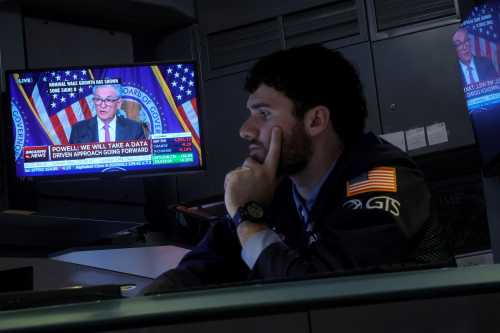
Federal Reserve Chair Kevin Warsh does not like forward guidance—the practice of a central bank telling markets and the public what it expects to do with interest rates in the future. “I don’t believe that I should be previewing for you what a future decision might be,” Warsh said at his confirmation hearing. And at his first Federal Open Market Committee (FOMC) meeting as chair in June 2026, the committee stripped the forward-looking language from its policy statement, and Warsh declined to put his own interest-rate projection in the Fed’s “dot plot”—the quarterly chart of Fed officials’ individual projections for interest rates.
Warsh’s stance raises a question: Can the Fed stop telling markets what it expects to do next while still explaining how it will decide what to do? In other words, can it abandon forward guidance but still provide what economists call the central bank’s “reaction function”?
What is a reaction function?
A reaction function describes how a central bank adjusts monetary policy in response to changes in the economy. By explaining its reaction function, a central bank says what it is watching, how it interprets the economy, how it weighs competing risks, and what developments would change its judgment.
The concept is not new. As early as 1963, economists William Dewald and Harry Johnson tried to estimate the Fed’s reaction function by inferring the central bank’s priorities from how it had responded to unemployment, prices, and other conditions. Stanford economist John Taylor’s 1993 rule—the famous Taylor rule—gave the concept one well-known form by prescribing an interest rate based on inflation and the economy’s distance from full employment.
The word “function” makes the process sound more mechanical than it is. The Fed does not simply plug numbers into an equation and accept what comes out. Economic data are revised. Important concepts such as maximum employment and the neutral interest rate cannot be observed directly. Shocks differ, and policymakers sometimes place more weight on the risk of one outcome than another. A reaction function is not a fixed formula. It is a way of describing the Fed’s policy logic with the judgment that policymakers apply.
The public’s understanding of the Fed’s reaction function is built from the Fed’s answers to questions like these: What’s behind the recent behavior of inflation and employment, and how does the Fed expect them to evolve over time? How is that related to the stance of monetary policy? Which measures of inflation matter most to the Fed? Would policymakers look through an oil-price shock or worry that it was spreading to wages and other prices? If inflation remained too high while unemployment rose, which risk would concern them more? What evidence would persuade Fed policymakers that interest rates were restraining the economy enough, or not? Taken together, the answers show the public how the Fed is likely to reason across different economic circumstances.
Why should a central bank describe its reaction function?
First, monetary policy works largely through expectations. The Fed effectively sets the federal funds rate, the overnight rate at which banks lend reserves to one another. But longer-term rates—the rates that matter to households and businesses on mortgages, corporate bonds, car loans, and other borrowing—depend partly on what markets expect the Fed to do in the future. If the market understands how the Fed is likely to respond as the economy changes, or understands the Fed’s reaction function, the Fed can more effectively influence longer-term rates and thus pursue its mandates. As former Federal Reserve Chair Ben Bernanke said in his Senate confirmation hearing for that position, “Monetary policy is most effective when it is as coherent, consistent, and predictable as possible, while … leaving full scope for flexibility and the use of judgment as conditions may require.”
Second, reaction function transparency helps the public and Congress hold the Fed accountable. As Bernanke put it, “For its policy independence to be democratically legitimate, the central bank must be accountable to the public for its actions.” The Fed makes decisions under uncertainty and cannot promise to forecast the economy correctly, but it can explain why it made a decision, what evidence it considered, and what could cause it to reconsider. That explanation strengthens the legitimacy on which the Fed’s independence depends, particularly when the institution is under political pressure.
In a December 2014 review of the Bank of England’s transparency practices, commissioned by then-BoE Governor Mark Carney, Warsh offered this standard for central bank communications: “A well-communicated policy is one which helps economic agents—households, businesses, financial markets—to understand the likely reaction function of policymakers to incoming information.”
How is a reaction function different from forward guidance?
Forward guidance communicates the likely future course of monetary policy. In some unusual circumstances—during and after the Global Finance Crisis, for instance—it is close to a commitment. (In December 2012, for instance, the Fed said it anticipated keeping rates near zero as long as the unemployment rate was above 6.5% and projected inflation was no more than 2.5%.) At other times, it is an indication of how the central bank will react if the economy performs as expected. Forward guidance influences market expectations about future short-term interest rates and, through them, the longer-term rates and financial conditions that affect the economy. Forward guidance tells the public what policymakers currently expect to do if economic conditions evolve as anticipated. The reaction function helps the public understand how and why the decision would change if the economy evolved differently. (For more on forward guidance, see this Hutchins Center explainer.)
Several other central bankers have expressed the same skepticism as Warsh about the wisdom of using forward guidance today. “What we decided to do is … give up on forward guidance,” Christine Lagarde, president of the European Central Bank, said at the ECB’s Sintra conference in July 2026. “And personally, and I’ve said that publicly, if I have one regret, it’s to have felt bound and compelled by forward guidance.”
What is Warsh objecting to?
Warsh objects to explicit rate-path signaling because he believes it can box in the Fed—slow its reactions to unexpected developments. He has said repeatedly that he wants to have a “family fight” at each FOMC meeting as opposed to telegraphing the outcome of each FOMC meeting in advance.
He also believes that it damps market reactions to economic surprises, which could send valuable signals to the central bank. When asked at a press conference whether the lack of forward guidance could lead to more volatility in markets, Warsh said, “I think the financial markets work less efficiently when they ask a question: How will the Federal Reserve react to that incoming information? The more that markets are paying attention to what’s happening in the real economy, deciding what’s good data and what’s less-good data, the more financial markets can price what they believe is the most likely and what are the tail risks. Financial market prices are probably the most important source of information to guide central bankers. But when all the financial markets are doing is reflecting back what we’ve said, then we’re taking the most important source of information and we’re being blind to it. I’d like us to create a system where those blinders come off, where markets are following data that they efficiently think is reliable, and they’ll be watching data., we’ll be watching data, they’ll come with better information through market prices to us. We can make more informed decisions.”
Some economists argue that forward guidance issued in the aftermath of the COVID-19 pandemic led the Fed to delay raising interest rates when inflation proved more persistent than it had anticipated. Christina Romer, a professor emerita at the University of California, Berkeley, said at a June 2026 Brookings retrospective on Jerome Powell’s term as Fed chair: “Why did policymakers stick with aggressive expansion for so long after the inflation started to rise strongly? Well, one reason was that they had issued extremely aggressive forward guidance that the funds rate would stay at the effective lower bound until average inflation was firmly back at 2% and employment was at its maximum level.” David Romer, also a professor emeritum at Berkeley, said guidance should be “carefully crafted” and that “the bar for using it should be high.” (You can read the Romers’ paper here: “An Early Retrospective on Monetary Policy in the Powell Years.”)
Fed Governor Christopher Waller echoed the Romers’ arguments in a July 2026 speech. “Forward guidance can help speed up policy transmission,” he said, “but if it is not flexible enough, it can hinder policy transmission. And, in some cases, it’s best not to use it at all.”
Can the Fed drop forward guidance and still be transparent?
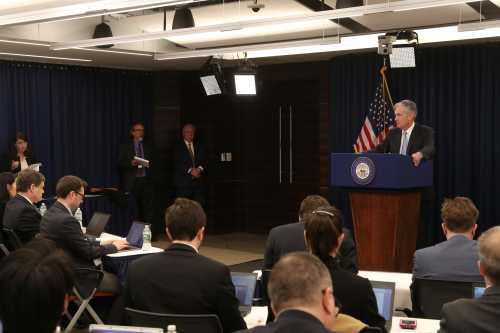
Some Fed watchers have questioned Warsh’s reluctance to explain, beyond a few words, how the Fed sees the economy and how it will make decisions on interest rates. At the June FOMC press conference, reporters repeatedly asked Warsh about the rationale behind its decision not to move rates. Why did the Fed hold rates steady despite above-target inflation? How restrictive did he think the policy was? What conditions would warrant a rate increase? Rather than explaining how those considerations fit together, Warsh repeatedly circled back to the Fed’s terse statement, his pledge to deliver price stability, or referred to one of his new task forces.
Some Fed watchers emphasize that in the absence of explicit forward guidance, it’s even more important for the Fed to clearly describe its reaction function. In a note to clients, for instance, Michael Feroli, chief U.S. economist at JPMorgan, complained: “Chair Warsh gave no forward guidance, but neither did he give present guidance,” meaning that that Warsh offered little context for the latest decision. Nick Timiraos of The Wall Street Journal put it this way: “There’s a difference between not telling markets your next move and not telling them how you make decisions at all.”
Transparency does not require signaling a likely path for interest rates, but it bolsters the case for explaining the Fed’s economic forecast, the evidence and analysis behind it, the principal risks to the outlook, and how policy might respond if that outlook changed. Lagarde calls it “framework guidance,” which she described as “informing market participants, informing financial experts from all walks of life about how we come to our monetary policy stance … that those interested in how we come up to a particular decision appreciate what we take into account, what intellectual process we go through, what indicators we are particularly attentive to, so that… Of course, they have to do a little bit more work themselves.”
In the final question at Warsh’s first press conference, Bloomberg’s Enda Curran asked him to describe “some of the principles that guide your own reaction function,” and the conditions under which the Fed should respond. Warsh acknowledged that his answer would be unsatisfactory, then said that the Fed would earn credibility by delivering price stability. He did not describe the logic that would get it there. At the ECB’s Sintra conference, CNBC’s Sara Eisen pressed Warsh: “Isn’t it important, Chairman Warsh, to give the market a sense of how you’re thinking about policy? You don’t have to give them a pre-commitment, but the whole reaction function, how you think of how you’re going to make policy?”
Warsh’s reply: “I think the most important thing we can do is to get policy right … It is said in recent weeks, ‘Well, we need to know more about your reaction function.’ If I look at trigger pullers, people that are making decisions in the bond market, in a range of markets, volatility is not up, it’s down. Yields aren’t up, they’re down. Inflation expectations are down. So I hear this as if people don’t understand. I think they actually understand quite well. “
One of the task forces Warsh is creating will review the ways the Fed communicates. He has indicated that he expects to make changes, but hasn’t offered details.
Authors


Related Content


The Brookings Institution is committed to quality, independence, and impact.
We are supported by a diverse array of funders. In line with our values and policies, each Brookings publication represents the sole views of its author(s).
Commentary
What is a ‘reaction function’ in central banking? How does it differ from ‘forward guidance’?
July 9, 2026