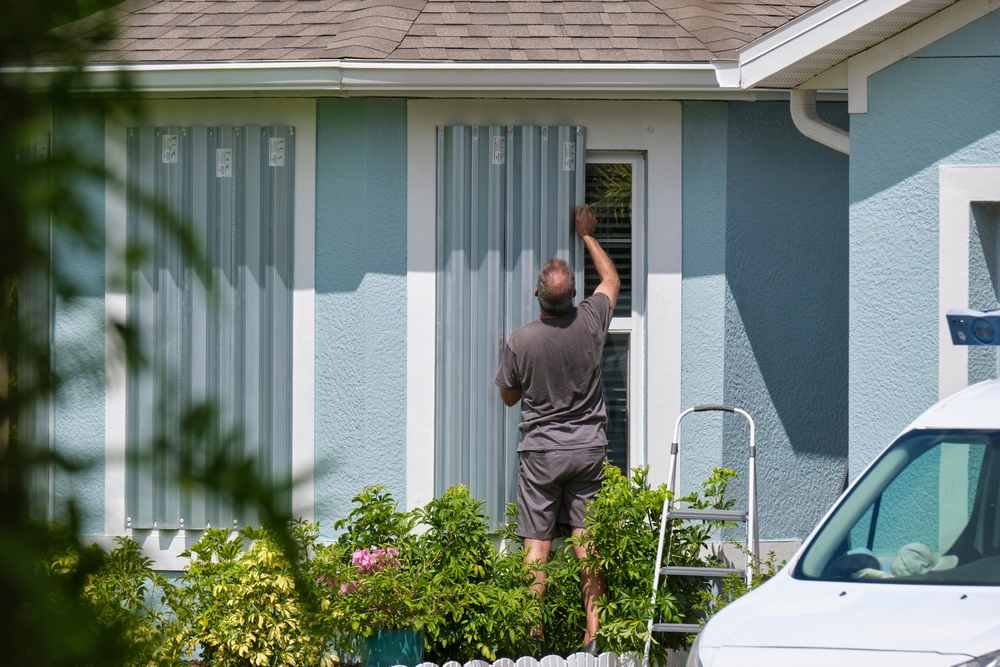
In “Uneven adaptation: Insurance pricing and household climate resilience,” Shan Ge of New York University’s Stern School of Business, Ankit Kalda and Varun Sharma of Indiana University’s Kelley School of Business, and Vikas Soni of the University of South Florida’s Muma College of Business provide the causal evidence of how insurance pricing shapes households’ decisions to invest in making their homes more resilient to damage from extreme weather. Drawing on more than 18 million policy observations from Citizens Property Insurance Corporation, Florida’s state-sponsored insurer of last resort, from 2002 through 2023, they track five categories of wind and water resilience upgrades: roof-to-wall attachments, roof covering materials, roof deck attachments, secondary water resistance, and opening protection such as hurricane shutters or impact windows.
Florida offers a rich setting for this research. State law requires all insurers to offer premium discounts for mitigation investments, and those discounts are calculated as a percentage of the total premium. As premiums rise, the potential savings from adaptation grow proportionally. In principle, this creates a powerful market signal: The more expensive a homeowner’s insurance, the more the homeowner stands to save by making the home more storm-resistant. Discounts can reach as high as 47%, translating to hundreds or even thousands of dollars in annual savings.
But while the dollar value of adaptation discounts increases the incentives to invest in resilience upgrades, higher premiums can strain household budgets, making it harder for some homeowners to afford the upfront costs of those upgrades. Which force wins depends critically on a household’s financial position. To distinguish between these effects, the authors exploit the fact that Citizens implements rate changes at the ZIP code level at different points in time. This allows them to isolate premium changes driven by insurer pricing decisions rather than by deteriorating conditions at individual properties—a methodological innovation that separates cause from correlation.
When looking at the average household, the authors find no statistically significant effect of premium increases on adaptation, but the average masks a sharp divergence across the wealth distribution.
Wealthier households—proxied by Zillow home price indices at the ZIP code level—respond to rising premiums by increasing their adaptation investments. For these households, the larger discount available at higher premium levels is enough to tip the cost-benefit calculation in favor of action, and their financial cushion means the higher premium itself does not crowd out the spending needed to claim it. Households in ZIP codes with home values one standard deviation above the mean see their probability of making wind-resistant upgrades increase meaningfully in response to premium hikes.
Lower-income households display the opposite dynamic. For them, rising premiums tighten an already binding budget constraint, pushing resilience investments further out of reach even as the potential discount grows. This effect dominates, and adaptation declines.
The wealth divide is reinforced by adaptation costs. Households in smaller homes, where the upfront investment required is lower, are more responsive to the financial incentive embedded in higher premiums. Larger homes require more expensive upgrades, making the budget constraint more likely to bind.
Policy implications
These findings carry direct implications for climate and insurance policy. As insurers continue repricing climate risk and withdrawing from high-exposure markets, the resulting premium increases will not push all homeowners toward greater resilience. For a substantial share of homeowners—those with the least financial flexibility and, often, the most exposure to climate hazards—higher premiums may actively discourage the protective investments that would reduce their risk.
The authors point to several policy levers that could address this gap: targeted subsidies for resilience upgrades, low-interest financing for home retrofits, and means-tested premium assistance programs that preserve the incentive to adapt while relieving financial strain. Programs modeled on Florida’s My Safe Florida Home matching grant initiative offer one template. Without such interventions, the authors warn, market-based insurance pricing alone risks producing a two-tiered system of climate resilience—one in which those least able to absorb climate losses are also least able to protect against them.
Authors




Related Content
The Brookings Institution is committed to quality, independence, and impact.
We are supported by a diverse array of funders. In line with our values and policies, each Brookings publication represents the sole views of its author(s).