Executive summary
Without giving many details, the Trump administration has proposed a robust, multitiered “Golden Dome” system to defend the United States against possible missile or aerial attack. The Congressional Budget Office (CBO) has estimated that such a system might cost $1.2 trillion to develop, deploy, and operate over 20 years. But such a massive system would not only verge on unaffordable; it could cause an arms race without providing the actual protection it promises.
President Donald Trump is right that the nation has many technologies it did not possess when Ronald Reagan announced his Strategic Defense Initiative 43 years ago. But the laws of physics still dramatically challenge and constrain what a missile defense system might realistically achieve.
Instead of such a huge system emphasizing space-based interceptors, the United States might therefore consider a more modest system designed to deal with limited, unauthorized, accidental, or coercive attack scenarios. We might forgo space-based interceptors, at least for now, and build something like a scaled-back version of the ground-based missile defense systems that the CBO postulated, designed to handle up to several dozen incoming warheads. Adding the associated sensors, many of them based in space, the cost might be $200 billion to $300 billion over 20 years.
A Golden Dome for America?
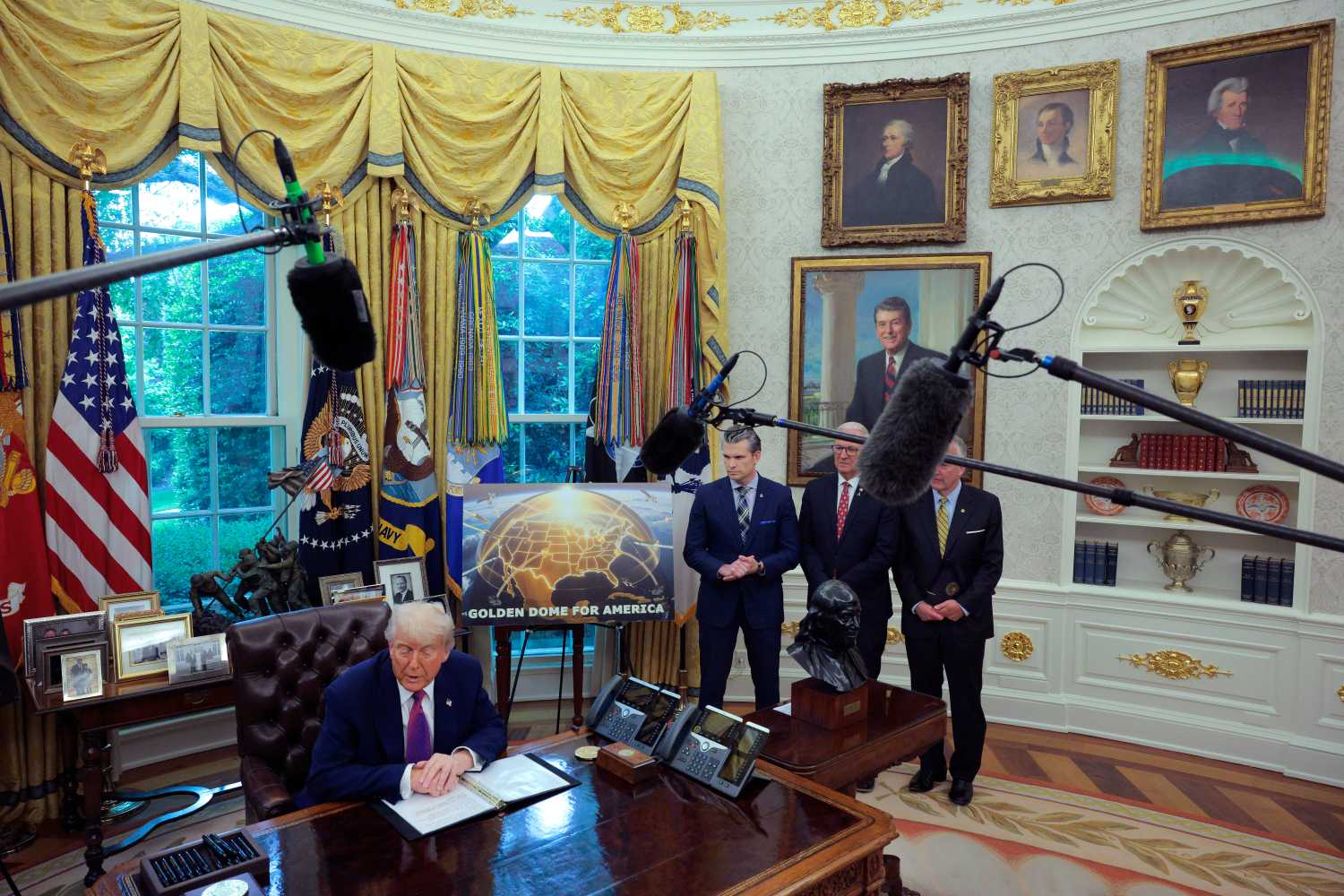
Not since the Manhattan Project has a military program of such scale, with such potential implications for international security, been shrouded in such secrecy. In January 2025, President Donald Trump issued an executive order calling for a multilayered nationwide protective shield against any and all airborne threats. He initially called the system “Iron Dome for America,” invoking the Israeli air and missile defense system that has proved so effective over the last three years. Today, it is known as the Golden Dome, after the president’s favorite color. Trump told the nation that the system would realize Ronald Reagan’s “Star Wars” vision of rendering nuclear weapons “impotent and obsolete” through modern technologies. Yet Trump then forbade the Pentagon from discussing specifics and has provided few details about the system. That remains the case today.
The Congressional Budget Office, interpreting what Trump’s directive might imply, recently developed a plausible architecture and estimated its cost at a whopping $1.2 trillion over 20 years. Even more remarkably, the CBO’s notional system, and particularly its space-based interceptor boost-phase layer, was sized to only defend against 10 long-range missiles launched simultaneously from a single location. The hypothetical defensive architecture consisted of four tiers: one in space and three on land, each designed to address incoming missiles or warheads at a different phase of flight. The highest-altitude land-based layer would build on the existing Alaska-centered system, adding more capable interceptors and two additional sites in the United States. A second, lower-altitude but still wide-area layer would also be based in the United States and would be designed to intercept hypersonic maneuvering missiles that the higher-altitude system could not address. Four sites would be established across the continental 48 states for this purpose. The lowest-altitude layer would consist of roughly 35 regional sites designed to defend against threats such as cruise missiles. These sites would also provide a final chance to intercept hypersonic missiles that penetrated the previous layers, as well as warheads that, perhaps aided by accompanying decoys, had evaded them.
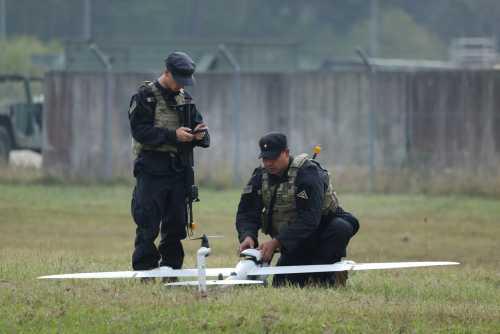
Each of these more than 40 ground-based sites would have dedicated sensors and anywhere from several dozen to roughly 100 interceptor missiles, with the types of interceptors varying according to their chief purpose and expected target. Short-range drones launched from within the United States or just over its borders would be handled separately through site defenses rather than national-level, wide-area systems. Such defenses would be deployed especially around critical infrastructure or sites requiring dedicated protection, including those locations associated with national leadership.
Russia and China have hundreds of missiles, and China’s arsenal is growing fast. With similar assumptions, a full-bore defense designed to address an all-out nuclear attack could quite plausibly reach multiple trillions of dollars over that time period. The Republican-controlled Congress has so far funded Golden Dome without subjecting it to serious oversight or demanding information about the system, with the administration seeking an average of about $15 billion a year over the next five years. The Pentagon claims the whole thing can be deployed for $185 billion, but no one outside the Trump administration knows what that would entail. The American public deserves, and Congress should demand, a much fuller and more public debate.
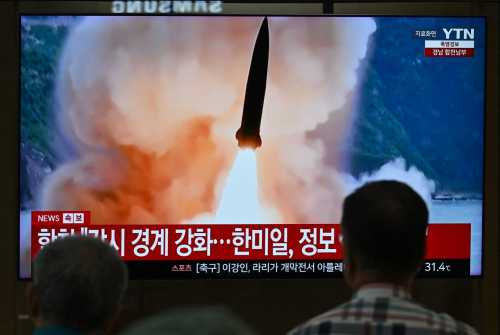
In fact, there is a good case for expanding air and missile defenses beyond the current limited capability, which is designed primarily to counter a North Korean threat and based largely in Alaska, with some 44 long-range interceptors of uncertain capability. North Korea’s own growing capabilities, China’s major nuclear expansion, Russia’s and China’s development of hypersonic missiles and other more complex threats, and the proliferation of drone technology all argue for doing so. And led by General Michael Guetlein at the Pentagon’s Office of Golden Dome for America, along with the Missile Defense Agency, the Space Force, the other military services, government-owned weapons labs, and the American defense industry, lots of smart people are pursuing lots of promising ideas. But Trump’s original directive to build a robust national defense against even an all-out nuclear attack is literally pie in the sky—simply not doable. We need a much more credible and transparent determination of what can be achieved, how, over what period, and at what cost.
The revenge of the Gipper?
The idea of building defenses against long-range missiles has been around for decades, almost as long as the long-range missiles themselves. But the 1972 Anti-Ballistic Missile (ABM) Treaty between Moscow and Washington was built on the assessment that the large-scale deployment of missile defenses would likely fuel an offense-defense arms race. The defenses of the day were seen as unlikely to work well enough to afford meaningful protection, yet credible enough that each side would fear the other’s defenses and undertake even larger offensive arms buildups to ensure a viable deterrent. A vicious action-reaction cycle would ensue, leaving no one safer and everyone poorer. As such, the treaty wound up limiting each side to one major defense site, which the Soviet Union elected to deploy around its capital. The United States, seeing little point in trying to shield itself against approximately 10,000 long-range Soviet warheads with the day’s available technologies, soon lost interest in deploying even that single site.
Reagan’s Strategic Defense Initiative (SDI) did not change the situation very much in the end—but the end of the Cold War did. As a result, President George W. Bush withdrew from the ABM Treaty in 2002. The United States proceeded to deploy a limited system on the West Coast, with interceptors in Alaska and California and detection and tracking radars at various locations on land and sea. Space-Based Infrared System (“SBIRS”) satellites would cue the system by detecting the hot plumes of the boosting missiles. The system was sized and located to intercept North Korean missiles after they finished their burn or boost phases, when they would embark on roughly 20 minutes of ballistic, unpowered flight outside the atmosphere toward North America. The interceptors are large, staged rockets that would carry a maneuvering exoatmospheric kill vehicle weighing some 140 pounds toward an incoming warhead, destroying it through the sheer force of the direct collision, without any explosive whatsoever.
Alas, while hit-to-kill interceptors are now proving their worth with the shorter-range Terminal High Altitude Area Defense, known as THAAD, Aegis/Standard Missile, and Patriot PAC-3 systems, it remains difficult to make the defense work at longer range and higher speed. The Alaska-based system has succeeded in a bit more than half of its realistic tests against intercontinental ballistic missile-range targets, although its performance has been improving. The tests did not, however, include the types of countermeasures one might expect a real adversary to employ—notably, large numbers of decoys mimicking real warheads within a given “threat cloud.”
Reagan’s 1983 “Star Wars” speech envisioned space-based defenses that would add remarkable new capabilities, far beyond even what the United States deploys today, to defeat the Soviet nuclear threat. Although the SDI program was later largely discredited as a plausible system, it did persuade Soviet leaders they could not win an offense-defense arms race with America, thus contributing to the end of the Cold War. It also produced some of the technologies that have helped protect Ukraine, Israel, and America’s Persian Gulf allies in recent years. Trump now claims that, four decades later, the United States has the technologies to pursue Reagan’s previously elusive dream.
The revenge of physics
Trump is not all wrong about the progress. There are very impressive new technologies, beyond the hit-to-kill technology developed over the last 30 years. For example, the so-called Hypersonic and Ballistic Tracking Space Sensor satellites will offer much more precise coordinates for any threatening object headed toward the United States. It may also be possible to put interceptors in space that could remain in orbit for years until needed—although lasers are a different kettle of fish. The advent of cheaper space launch has made a big difference too: it is now possible to imagine putting big numbers of large interceptor rockets into orbit relatively affordably.
But as Steve Fetter and David Wright have convincingly argued, it is much harder to protect a huge country like the United States from concerted enemy action than a small country like Israel. Even more to the point, it is much harder to effectively protect a large country against nuclear attack than conventional explosives: while a few defensive failures against conventional attack, however tragic, would not generally bring a country to its knees, even a single nuclear warhead getting through could amount to the single deadliest attack in a country’s history.
There are two other enduring realities, based on the immutable laws of physics more than the current and changing technologies of the day, that severely complicate any pursuit of a robust large-scale air and missile defense system. First is the problem of decoys. Because space is a (near) vacuum, objects accelerated there to a given speed will continue to move at the same speed regardless of their size, shape, or weight. Hence, a light decoy, say a Mylar balloon designed to reflect radar waves, with a small heating device inside to mimic the heat signature of a real warhead, will be difficult to distinguish from a real threat. In theory, one can shine a particle beam at the different objects to try to identify them—but that requires proximity and lots of power.
Second is a stark reality about objects in low-Earth orbit, which is where space-based interceptors would need to operate: the so-called “absentee ratio.” At any given moment, most space-based interceptors would be out of position to destroy a particular intercontinental ballistic missile (ICBM). Since they are constantly moving relative to the Earth’s surface, they cannot hover over a possible launch point. And because an attacker could launch an ICBM at any moment, an effective defense would require flooding low-Earth orbit with interceptors to create a lattice that would always have some interceptors in the right place at the right time.
This absentee ratio is often very high. The CBO calculates that, if the goal of interceptors is to destroy an ICBM in the boost phase before any decoys could be deployed, the absentee ratio for interceptors using current technology would be about 390:1. Assuming two shots per incoming missile, the CBO calculates that 7,800 space-based interceptors would be required to have a good chance of destroying 10 ICBMs. At more than $20 million per interceptor, that would cost more than $700 billion over 20 years, since the satellites would likely last only about five years each. Slight atmospheric drag at the altitudes in question would gradually degrade their orbits. Over two decades, therefore, the United States would need to build and launch some 30,000 satellites—that is, replenishing the original constellation three times.
The absentee ratio would be much lower if the space-based interceptors were designed to shoot down threats during their midcourse flight rather than their much shorter boost phase—20 minutes versus three to five. Depending on interceptor speed, the ratio might be 10:1 or less. But that brings us back to the decoy problem: during midcourse, warheads are difficult to distinguish from objects designed to mimic them. In theory, a nuclear warhead on the interceptor could destroy an entire threat cloud, but the resulting radiation would fry a lot of the satellite electronics needed to track and target subsequent threats. Other approaches, including electronic warfare or conventional explosives that disperse shrapnel, might take out much or most of a threat cloud, but the distances involved make such approaches highly challenging. Historically, the consensus has usually been that countermeasures are relatively simple to deploy and difficult to defeat. Major nuclear powers have already perfected technologies to disperse multiple objects—including multiple independently targetable reentry vehicles—from a single missile “bus,” and similar decoys could considerably complicate missile defense.
A more credible approach: From Golden to Bronze Dome?
Nuclear weapons are not going to become impotent and obsolete anytime soon, if ever. But more modest homeland missile defenses could play several useful roles. (I am assuming, as did the CBO, that defenses against short-range drones launched from within or next to American territory will remain a separate proposition, best handled locally and perhaps not by the Department of Defense.) Think of it less as a golden dome than a bronze one, perhaps.
One worthy goal would be to defend against a small attack by North Korea or, someday perhaps, Iran with higher confidence than is the case today. Combining defensive capabilities with the capacity to conduct preemptive strikes prior to an ICBM launch, or cyberattacks against the electronics used by such offensive weapons, may be enough to thwart these threats even as they improve and expand.
A limited national missile defense system could also provide some protection against a possible accidental or unauthorized launch, perhaps one initiated by a rogue commander of a given missile silo or submarine. Such a capability might also prove useful, heaven forbid, if a rogue AI system launches a nuclear attack—even though the United States and China have already agreed that AI should never be given the authority to launch a nuclear war.
A limited missile defense could also help in certain great-power war scenarios and, one hopes, help deter them in the first place. For example, if China were losing a fight over Taiwan, it might be tempted to roll the dice by detonating a nuclear warhead high above a single U.S. military base. The goal could be partly to shut down American military capabilities there while causing only modest loss of civilian life, if the location were chosen correctly. Such an attack would also seek to put the fear of God into an American president in the hope that he or she would seek to end the war before it escalated further.
It would be a very high-risk gamble, to be sure. But a desperate Chinese leader might not rule out the idea, rather than lose Taiwan and quite likely their own hold on power. Certainly, the history of American nuclear brinkmanship—from Korea to Taiwan to Berlin to Cuba to the Middle East—implies that such threats cannot simply be dismissed. Vladimir Putin’s behavior and threats early in the Ukraine war suggest the same. Missile defenses could complicate or deny such an option to a future adversary decisionmaker. They could also help fend off attacks by long-range, conventionally armed ICBMs if a future China or Russia attempted to use them to destroy several key military bases. In that case, even imperfect defenses could work to the defender’s advantage by denying a would-be attacker any confidence that such a limited strike would achieve its objectives.
There is another reason defenses might appeal at a broader strategic level. Historically, as noted before, they have been viewed as a potential catalyst to an arms race. In the future, however, they could help discourage one by providing an alternative to an offense-only nuclear arms race. U.S. intelligence now projects that China will deploy 1,000 to 1,500 nuclear warheads in the 2030s, up from just 200 a few years ago and about 600 today. Once that happens, traditional bilateral arms control, already on life support at best, will likely be dead.
China and Russia are not really allies, and so they will refuse to have their aggregate arsenals limited to the same ceiling as America’s, leaving the United States as nuclear superpower No. 1. But the United States will not accept a world in which China and Russia are each allowed arsenals the same size as its own, creating three nuclear superpowers with two aligned against it. (The arsenals of Britain and France are much smaller.) Rather than try to match the combined Chinese and Russian arsenals and risk an arms race, the United States might better sustain parity through a blend of offensive and defensive capabilities. It would likely have a certain advantage in defenses, while Moscow and Beijing together would have the combined edge in offensive nuclear weapons. Everyone, however, would still have enough weapons to wreak unimaginable havoc. With the kind of transparency measures that Amy Nelson and I have previously advocated, a stable three-way equilibrium might be reached.
A partial model for what might make sense was presented by the first Bush administration in the early 1990s. Named GPALS, for the Global Protection Against Limited Strikes system, it was designed to shoot down up to about 200 incoming warheads—though that was probably a very optimistic estimate of how many warheads it could actually have handled. In theory, it would have used land-based interceptors at some six sites around the country, along with 1,000 space-based interceptors. A second phase could have added more of everything. With only 1,000 space-based interceptors instead of 30,000, the system became affordable even with the technological constraints of the day: about $150 billion in 2026 dollars, or roughly one-eighth of what the CBO’s interpretation of Golden Dome might amount to, despite being sized against a larger enemy threat.
Rather than attempt to build something like GPALS that included a large space-based system, we might build something like a scaled-back version of the three-tiered, ground-based missile defense systems that CBO postulated, designed to handle up to several dozen incoming warheads. If a major U.S. adversary concentrated a large attack on one part of the country, it could, in theory, saturate the defenses, thereby maintaining a viable deterrent without engaging in an all-out arms race. Indeed, it could likely do so without keeping its nuclear forces on hair-trigger alert.
By contrast, if the United States deployed very large defenses, an adversary might fear an American preemptive attack against its nuclear forces that would eliminate much of its deterrent, with U.S. defenses mopping up the rest. It might then feel compelled either to enlarge its offensive forces, maintain a launch-on-warning posture, or both.
On balance, there is a promising chance that a limited, three-tiered, ground-based defense architecture assisted by sensors on Earth and in space could offer defenses against various forms of accidental, unauthorized, or rogue-state attack without compromising strategic stability.
Any space-based interceptors that the United States chose to deploy might focus just on warheads in midcourse flight, since the absentee ratio would be much less than for boost-phase defense. But again, I am skeptical of even that approach, since decoys would likely be able to overwhelm such a space-based midcourse system. Ground-based interceptors coupled with ground-based and space-based sensors seem to be the sounder approach.
Adding the associated sensors, many of them based in space, the price tag would remain below $500 billion over 20 years, according to the CBO’s estimates. Indeed, if the system were designed to shoot down perhaps several dozen warheads and thus scaled back considerably from what the CBO assumes, the cost might wind up closer to $200 billion to $300 billion—roughly 2% of the likely average annual defense budget over the next two decades.
If boost-phase defense is desired against North Korea, there are other options, given the Korean Peninsula’s geography. Specifically, aircraft based in Japan, manned or unmanned, could field interceptor missiles using relatively straightforward technology to shoot down North Korean ICBMs during their roughly five minutes of boosted flight—when the missiles would present large, unitary targets because decoys could not yet have been deployed. Jaganath Sankaran and Steve Fetter estimate that such a system could be built and operated for no more than several hundred million dollars a year in development, procurement, and operating costs, assuming a system made up of perhaps several dozen interceptors.
These are systems worth researching and analyzing, discussing with allies and eventually the Russians and Chinese, and perhaps deploying. But it cannot happen just within the halls of the Pentagon. It is time for the Trump administration to explain itself, lay out its concepts and initial plans for a national air and missile defense system, and bring the rest of us into the debate. After all, Article I of the Constitution gives the Congress—the people’s branch of government—power of the purse over the nation’s armed forces.
Author

Related Content
The Brookings Institution is committed to quality, independence, and impact.
We are supported by a diverse array of funders. In line with our values and policies, each Brookings publication represents the sole views of its author(s).