




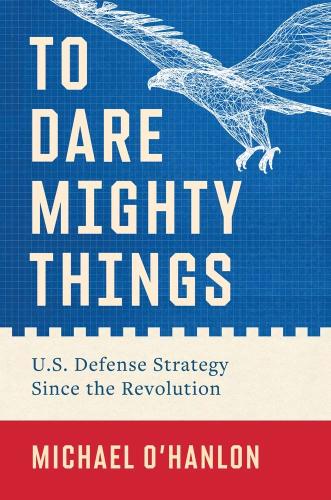
Brookings senior fellows Michael O’Hanlon and Robert Kagan discuss O’Hanlon’s latest book, To Dare Mighty Things: U.S. Defense Strategy Since the Revolution, an examination of 250 years of U.S. defense policy around the world. “Isolationism,” O’Hanlon says, “strikes me as the least accurate term” to describe that history.
Related Content
2026
Transcript
O’HANLON: The whole first half of our history was not about isolationism. It was about expansionism. And the idea that we’re taught that it was about isolationism just misconstrues any possible proper definition of that term.
[music]
KAGAN: Hello, this is The Current, and I’m Bob Kagan, senior fellow at the Brookings Institution. I’m delighted to be here with Mike O’Hanlon, who is the Phil Knight Chair in Defense and Strategy at the Brookings Institution and the author of a new book called To Dare Mighty Things: U.S. Defense Strategy since the Revolution.
Mike, welcome.
O’HANLON: Thank you, Bob. Great to be with you.
[0:42]
KAGAN: Let me just say, as someone who’s read this book, it’s fascinating. It’s an easy read. As as you say, it’s 250 years in 250 pages, which I must say as a historian is quite an accomplishment. Let me just start by asking about the title. Why did you call it To Dare Mighty Things? It’s not what most Americans think about when they think of things like defense strategy.
[1:03]
O’HANLON: Well, Bob, thanks. I I mostly wanted to be accurate. And as you know, I’m a fan and student of your book, Dangerous Nation, which goes up to about the same period where Theodore Roosevelt made that speech, he made it the year after the Spanish American War, in 1899. And of course he had been assistant secretary of the Navy, was becoming soon vice president, then president. And so he captured that era. And in many ways if you had to sort of find an average American president, not in ability, but an averaging out America’s role in the world, he’s maybe not a bad person to look to.
But mostly that comes from the famous speech where he talks about how it’s important to get out there in the public arena and not shrink back into the shadows. And it’s better to have, you know, a resume checkered with a few defeats as long as you’re striving for something big. So it’s a famous speech.
But those words, “to dare mighty things,” to me capture the essence of who we’ve been as Americans with our military for now 250 years. Because we’ve tended to be very assertive. We’ve tried to do big things. We have not been shrinking violets. We’ve been a “dangerous nation.”
And we’ve not always been successful. We’ve not always been noble. We’ve generally been a force for good. But we almost always have tried to do mighty, big things. So that’s why I thought it was an accurate title. And anytime you can borrow from Theodore Roosevelt, presumably you’re off to a good start.
[2:21]
KAGAN: I think that some people would say, well, Theodore Roosevelt was one of our more ebullient presidents and and he had a particularly large vision, even for his time, of what America might do on the world stage.
You know, I think most people learn in their history books that America is basically an isolationist nation. And even today, I think people think that our sort of knee jerk approach to the world is isolationism. But you seem to be contradicting that in terms of what the sort of mean American approach to the world is.
What what do you think about the the argument that we’re fundamentally an isolationist nation?
[2:58]
O’HANLON: Yeah, thanks, Bob. And you know, you and I have been through a lot in our careers by now, and so I think part of my answer is going to be personal and then I’ll give a more proper academic answer. But you and I both went through the Iraq war debate. And that was a fascinating time in our country’s history, and we just talked about it in our event with Dave Petraeus. And what we saw in that period, it was a response to 9/11 where we did not want to be seen as a retreating power. Osama bin Laden had called us basically a pacifist nation or a a paper tiger.
And maybe this is the best way to understand Vice President Cheney, who in many people’s minds changed from when he was secretary of defense to vice president. And I think he did change in some ways, but it wasn’t because of his heart or his health. I’ve talked to a number of his aides. They say what changed for him was 9/11 and the sense of fear that the next time could even be a lot worse.
And so instead of trying to have a nice, targeted special operations raid to find bin Laden, wherever he might be, and of course by that point he was in Afghanistan fleeing towards Pakistan, so it would’ve been hard to find him. But instead of confining ourselves to a counter-al Qaida strike, we tried to change the Middle East. And that’s quintessentially American. To think big.
And you know, I’m not trying to rehash that debate. And, you know, there were a lot of good arguments on all sides, and there was some bad information on the side of the administration where they sometimes misconstrued the intelligence. But nonetheless, the idea of thinking big is quintessentially American.
I also observed in the book, at one point I started a paragraph, which is personal observation, I said, I knew both Robert McNamara and Donald Rumsfeld. And to me they were sort of both charismatic guys, I actually liked them both. But they both are tragic figures in our history. And I said by understanding those two, we can understand a tendency we sometimes have to maybe think a little too big or to think, you know, too ambitiously with the wrong set of tools or the wrong kind of resources.
So my own career has taught me that Americans tend to think that if it’s worth doing, it’s worth overdoing, or, you know, it’s worth reaching out and trying to change the world more than simply addressing immediate defense and security needs.
And when I go back and look through our history, and this is where your excellent book, Dangerous Nation, really influenced me a lot, the whole first half of our history was not about isolationism, it was about expansionism. And the idea that we’re taught it was about isolationism just misconstrues any possible proper definition of that term.
And in fact, let me also shout out your recent short book about antiliberalism and rebellion that talks about our history up through Donald Trump, because I love your treatment of the American Revolution in that book where you talk about the big ideas drove us to, again, think very big. The British weren’t really treating us all that badly, but we decided with this idea of democracy and individual rights that we had with this big landmass that stretched before us, even though only a part of it was settled at that time by by colonists, that we should make this our own country. And then once we had it, keep expanding it.
So isolationism strikes me as the least accurate term. I know our good friend Charles Kupchan wrote a whole book about isolationism, and I’m glad he did because he certainly identifies an intellectual current that’s been there in our history. I just don’t think it’s manifested itself in our policy very much.
[6:17]
KAGAN: Which I think is a good opportunity to bring us to the present right now. And you recently wrote an article about our current president, Donald Trump, saying that it’s no surprise to you that he’s not an isolationist. How do you square the way the National Security Strategy that I think was released in December characterizes what America’s objectives should be? It’s very much focused on the Western hemisphere. It is very much about being the primary power in the Western hemisphere. And I think hints at the idea of a kind of global spheres of influence.
And yet, you wrote that Donald Trump is not really an isolationist. He ran on this principle of America First. The National Security Strategy looks like it reflects the idea of America First. Some of the most influential people in the Pentagon, I’m thinking about someone like Elbridge Colby, his whole doctrine was we really should only be focused on China and not be distracted by even defending Europe anymore.
How would you put this whole picture together in light of the fact that, as you point out, that Donald Trump is not exactly limiting himself to activities in the Western hemisphere?
[7:22]
O’HANLON: It’s a great question. There are a couple of things I’d say that are not going to be perfect or complete answers. But one of them is, okay, let’s talk about Golden Dome. The big idea of sort of Star Wars reincarnate, the idea of a big national missile and drone defense for the whole United States. Is that a homeland defense, Western Hemisphere concept? Or is that also a way of dealing with China? Because if you’ve become vulnerable to Chinese missiles in a future Taiwan contingency, the answer could be both. And also potentially of relevance to dealing with North Korea or even Russia. And so even something like that, I don’t see narrowly as a Western Hemisphere-oriented concept or motivation.
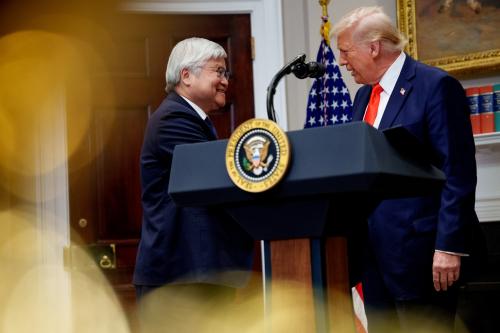
And of course, we’ve seen Trump in his first year of the second term strike Iran, we’ve seen him strike Nigeria, snatch a president out of power in Venezuela, which is the Western Hemisphere, admittedly. But we’ve also seen him, thankfully so far, at least, stay in all of our alliances.
And so I haven’t seen him disengage from Europe or East Asia. He tries to disengage from the Middle East, but that’s true of most American presidents, and they get pulled back like Trump did in June. You know, he wants to have credit for solving eight conflicts, including at the Thai-Cambodian border, and my old Peace Corps country of Congo with Rwanda. So these don’t strike me as isolationist or Western Hemisphere First strategies.
But all this comes with two cautionary notes and I’ll invite you to add on if you wish. One of them is even if isolationism doesn’t describe Trump, and we’ve never really been isolationists as Americans, the fact that there are these precedents doesn’t mean that it’s okay to behave the way Trump’s behaving, because some of the ways we behaved in the past, in the 19th century in particular, don’t really work for the 21st century. And some of them didn’t even work at the time.
And so those are my two cautionary notes. Just because there’s a precedent doesn’t mean you should automatically take a breath of relief or let out a sigh of relief because it didn’t always work then, and it sure as heck may not work now.
But yet in in many specific ways, I can see Trump’s behavior sort of with antecedents in Presidents Madison, Monroe, Polk, McKinley, Roosevelt, and others.
[9:29]
KAGAN: Well, it’s interesting because, you know, one of the things that when you talk about grand strategy, people almost invariably want to talk about whether there is a gap between ends and means. And, I wonder whether when you promulgate the National Security Strategy, which I take it you know better than I do, but it’s supposed to sort of drive defense strategy. It’s supposed to drive procurement strategy. And it’s what kind of force are you going to have. So you have a a National Security Strategy which is more in line with an America First approach, but you have a president who clearly is very globally active, in fact in some ways more globally active than any of his recent predecessors.
Is there the potential of a mismatch? I mean, I would say even before Trump, a lot of people would say that our military capabilities were not sufficient to meet the stated missions of our strategy, including the simultaneous defense of Europe and East Asia security. We used to talk about being able to fight and win two wars. Then we started talking about being able to fight and hold. Now I’m not sure we even have a strategy to win one major conflict. What is your sense of our capabilities versus what whatever the strategy says is manifestly a very globally active foreign policy?
[10:46]
O’HANLON: Yeah, it’s great question. You know, I have a chapter of course on the Cold War. And in the Cold War we first realized we had a big problem on our hands in the late 1940s, and you would’ve thought the country deserved a chance to recover. But we didn’t have that for long.
And then we wound up going through different phases of thinking under Eisenhower we should have this primarily nuclear-based deterrent against Soviet control of Europe. But Truman, of course, decided we first shouldn’t and then should fight in Korea. And we were searching for where the perimeters should be established and defended.
And we went through a period of trying to be able to fight two-and-a-half wars– China, the Soviet Union, and then a smaller one. Vietnam didn’t really quite fit the half war thing with a half million troops deployed. Nixon, I think in a good strategic move, reduced our ambitions to a one-and-a-half war capability.
And then as you say, in the post-Cold War world, we said two regional conflicts as our sort of pacing requirement. Wasn’t really a strategy, it was more a force-sizing paradigm. And then it turned out we couldn’t quite even do that. Once we actually did have two wars, Iraq and Afghanistan, they were different types than we expected. And longer. Smaller but longer. And as you say, we’ve now shifted into hoping that we have a one war capability.
Interestingly– and this is where I try to match grand strategy with defense strategy and look at the interconnections– through all these permutations on different grand strategies and and rhetorical or aspirational objectives, the force structure has changed very little. It declined by about a third after the Cold War ended, but as we’ve gone through two major regional wars as our notional, you know, requirement, to one-and-a-half, to now a one big peer superpower rival, we’ve changed the force structure by about 5% in terms of shifting from one area to another, and the overall size has continued to modestly decline to about 1.3 million active duty.
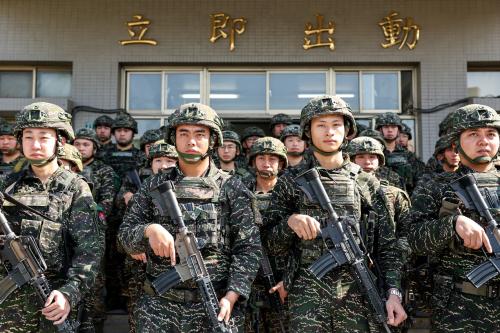
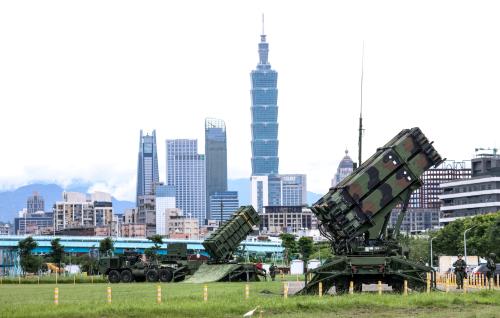
So do we have a capability that’s adequate? I think we have a very good chance to stop a Chinese invasion of Taiwan, a very uncertain prognosis if we have to try to break a Chinese blockade of Taiwan. And what I’m hoping is that Xi Jinping is less reckless than Vladimir Putin, and he sees the risks of not being able to succeed with either of those scenarios as adequate to therefore not try as long as things don’t get too out of hand with Taiwan’s pursuit of greater autonomy or independence as he sees it.
But I think we don’t know if we would win that war. And that’s without even raising the possibility of whoever’s losing escalating to nuclear conflict or just taking a five-year time out and building up a new force like the Europeans used to do in between their wars and then trying again.
So I think we better be pretty agnostic on that, and I’m not even sure another a $100 or $200 billion in the annual defense budget would solve the problem.
[13:33]
KAGAN: Well, you you alluded to this earlier in the conversation, and I think one of the things that I think has been a force multiplier has in fact been our alliances. And so that even if we didn’t always have the capability necessarily on paper to address every problem we might have, we’ve also had allies who were, you know, participants in that.
You say that Trump hasn’t shown any sign of pulling away from the allies. I could point to a couple of signs that he is. Defense officials have told the Europeans that they need to be capable of defending themselves entirely on their own by 2027. It has never been American policy that Europeans should have to defend themselves on their own. We wanted them to do more in the common collective defense. But we never were going to say, “you’re on your own.” That does seem to be strategy right now.
And in addition to that Trump has, I think, much to many people’s surprise, continued to be very firm on the question of taking Greenland, and is even threatening military action to accomplish that. What would some action like that do to the alliance that is such a key part and has been such a key part of our strategic posture?
[14:39]
O’HANLON: It would be horrible, I think. And if we took Greenland, I take some European officials at their word that in their estimation it would amount to the end of the alliance. If we pull forces out of Europe, don’t just give European allies these goals, but actually make a plan to pull out of Europe by 2027, that’s terrible.
You know, maybe in the old days if we had kept NATO at 16 countries like it was after the Cold War ended, maybe the Europeans could defend themselves, because then Germany’s the frontline state. But with the Baltics the frontline states, and each of the Northern Baltics, Latvia and Estonia, having 25% Russian speaking population and being right next to Russia with some very nice tank country dividing the three from Russia, I I would be petrified. And I would think that Vladimir Putin would be sorely tempted to try to nibble away and see what he can get away with. So I think that’s a really bad idea.
You know, the National Security Strategy that just came out in some ways didn’t bother me that much. You had to sort of filter it through the usual rhetoric that we get from this administration. But what really did bother me was the discussion of Europe. It was not only wrong in my mind, it was weird. It was hearkening back to a period when Europeans knew themselves, had their culture, had their greatness, had their manhood.
And their wars all the time! Paul Kennedy’s book, The Rise and Fall of the Great Powers, is all about basically European wars, because that’s who did most of the world’s fighting for about 500 years. Maybe not literally most, but a lot of it, and certainly most of the expeditionary warfare. So I don’t want to go back to that Europe. I’d much prefer the post-1945 Europe.
[16:09]
KAGAN: And yet there are all kinds of people, as you know, writing in Foreign Affairs and elsewhere that it would be great to move to a spheres of influence world. I guess the Russians get their sphere. The Russian sphere has historically always included the Baltic states and part of Poland by the way, if not, if not all of Poland. And I don’t know what anybody would say about what China’s natural sphere of interest is. I’m sure the Chinese believe it includes pretty much every country on its border. That is their historical memory when they were the hegemon of of East Asia.
What’s your view of moving to a spheres of influence world that is as different from the kind of world we’ve been living in since 1945?
[16:48]
O’HANLON: Well, it’s a terrible prospect and I think our colleague and good friend Tom Wright captured it well in his book. But he talked about one of the problems with spheres of influence apart from, you know, relegating small countries to dominance by large countries is that no one tends to agree on where the spheres should be drawn, where the line should be drawn dividing them. And so you just pointed out, okay, China. Does China get to control Korea? I mean, it’s one thing if China wants to pursue Taiwan, that’s a big enough problem for us. And, you know, I I hope we can figure out a way through our careers and our children’s careers to prevent World War III over that issue.
But, if you really go to spheres of influence, you’re inviting Russia to decide which ancient map they want to use to decide where the real Russia should be. And Putin’s going to be maximalist. I think he’s going to start with small to modest steps and then keep going if he gets away with it. I think you’ve made this kind of point yourself very eloquently in your writings.
So I’m terrified by that prospect of spheres of influence. No one knows where they start, where they stop, and where the dividing line should be drawn.
I will give Trump credit for one pragmatic thing. I do think he’s correct that trying to force a ceasefire in Ukraine more or less along the front line of combat is the only practical way to end this war in the near to medium term. But, we should be nervous about having to do that, because it does in some sense partially reward Putin for aggression. And it does in some sense encourage him to think he can get away with another round. And I’d be willing to hold my nose and live with that peace deal as long as other things to shore up Ukrainian sovereignty happen as well.
But yes, spheres of influence thinking is dangerous because where does the line get drawn?
[18:30]
KAGAN: Well, that that is, I think, the most interesting question. Let’s bring this to a conclusion. Let me just ask you, if you had to leave our listeners with one thought coming out of your book, what what would it be?
[18:42]
O’HANLON: We Americans are very assertive, and that’s usually a good thing. Especially for the last 80 to 90 years of world history, we’ve, I think, on balance, despite all of our mistakes, we’ve still maintained a system of alliances, a commitment to an a global order that has prevented World War III in a way that we never succeeded in preventing World War I or World War II.
So engagement is good. And let’s not give that up. When I say, “America the assertive,” I don’t mean that as an insult. But I do mean it as a reminder that when we trust our instincts, they’re often a lot more assertive than we think and most other countries understand that about we Americans. We don’t always understand it about ourselves.
[music]
KAGAN: Well, thank, thanks so much, Mike, and and your book is really terrific. And if listeners want to learn more about this book and also about Mike’s research, they can visit our website at Brookings dot edu.
Participants


More information:
- Listen to The Current on Apple, Spotify, YouTube, or wherever you like to get podcasts.
- Learn about other Brookings podcasts from the Brookings Podcast Network.
- Sign up for the podcasts newsletter for occasional updates on featured episodes and new shows.
- Send feedback email to [email protected].
The Brookings Institution is committed to quality, independence, and impact.
We are supported by a diverse array of funders. In line with our values and policies, each Brookings publication represents the sole views of its author(s).
Commentary
PodcastThe myth of American isolationism
Listen on
The Current Podcast
January 16, 2026