
The challenge
Since the early 1980s, the White House has required federal agencies to conduct a formal cost-benefit analysis for most economically significant regulations. For rules where its conventions make sense (for example, many environmental regulations), cost-benefit analysis can inform policymakers and the public about the likely effects of a regulation and help guide policymakers to better decisions.
But for some major categories of regulations, the conventions of formal cost-benefit analysis do not make sense. One such category is tax rules and rules addressing transfer programs such as Social Security or the Supplemental Nutrition Assistance Program (SNAP). Mandating formal cost-benefit analysis for these “transfer rules” undermines effective regulatory policymaking.
First, the analysis biases the regulatory process against revenue-raising and redistributive policies that move resources from those with more to those with less. Second, it often provides critics with easy but misleading means of attacking the rules and has the potential to create vulnerabilities in court. Finally, requiring that agencies do cost-benefit analysis—and requiring that the Office of Information and Regulatory Affairs (OIRA) review the analysis—delays the rulemaking process and wastes agency and OIRA resources, without producing useful policy guidance.
Formal cost-benefit analysis is not useful when applied to transfer rules because it ignores the distributional and fiscal goals that motivate them—mainly, redistributing resources among individuals and increasing or decreasing deficits. Instead, formal cost-benefit analysis views transfers—including transfers between individuals and the government, such as tax payments or Social Security benefits—as a wash: The offsetting gain and loss to different groups or entities cancel each other out.
Economic analysis of transfer rules can be useful precisely because it can help policymakers judge whether the costs imposed by such rules are worth it, but it makes no sense to do regulatory analysis in a framework that sets aside the transfers that are the reason for the rule in the first place.
Because the primary effects of the rules are zeroed out, compliance and administrative costs will usually mean that formal cost-benefit analysis finds regulations that expand transfers or increase revenues have costs exceeding their benefits. For example, in 2024, the U.S. Treasury announced a series of actions to combat a tax avoidance strategy used by certain large partnerships, with estimated revenue gains of over $100 billion over a decade. When the Trump administration subsequently moved to reverse one part of that initiative, the cost-benefit analysis for its proposed rule concluded that its only economic effect would be to reduce compliance costs for businesses by $163 million. In their words, “The Treasury Department and the IRS do not anticipate any other material economic effects of the [regulation] beyond the filing burden reduction.” In a traditional cost-benefit framework, the $163 million is a cost, but tax revenues are a disregarded transfer.
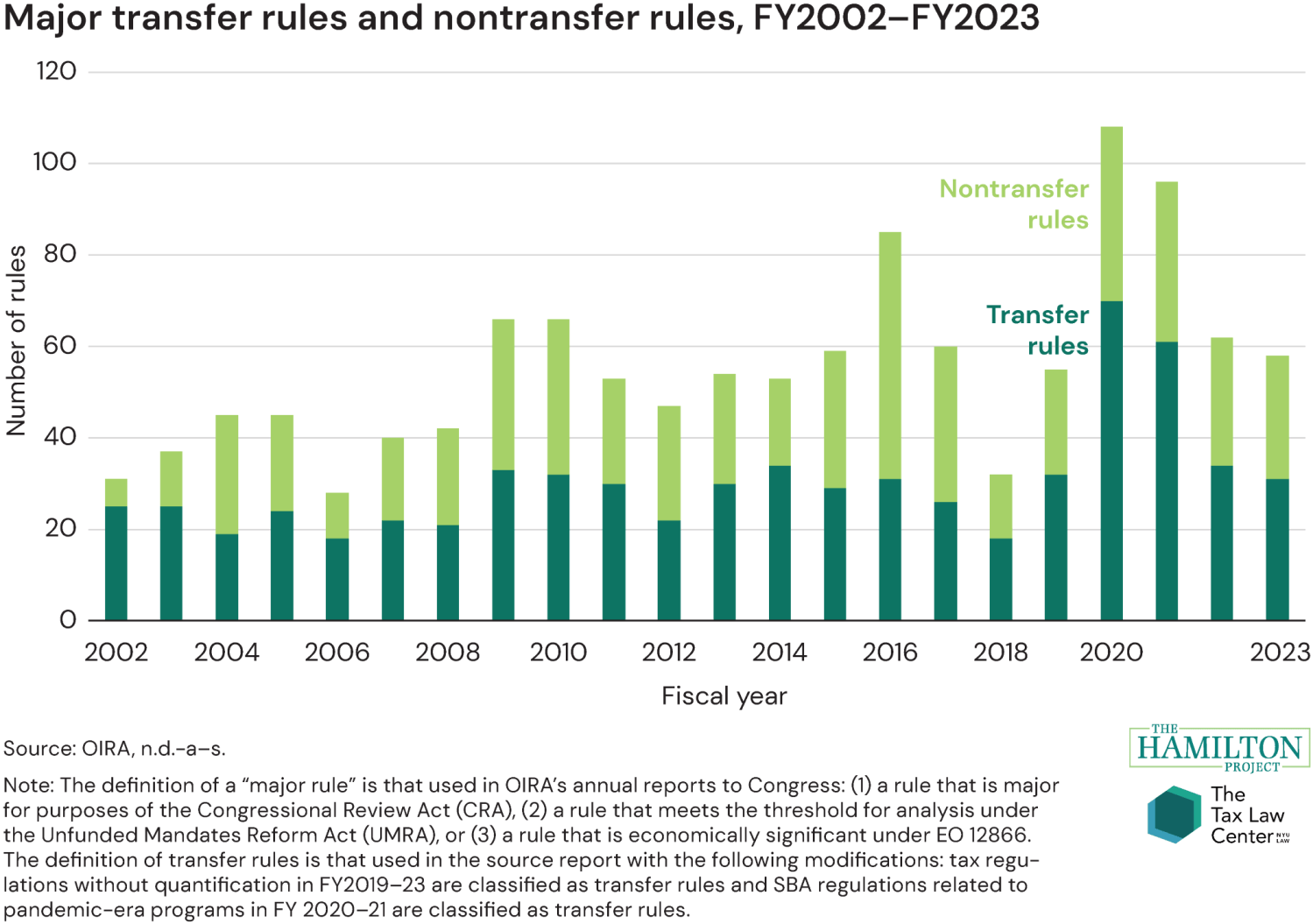
Transfer rules account for a large share of rules subject to OIRA review—roughly half for the period from 2002 to 2023—and thus for a large share of the OIRA and agency resources dedicated to producing cost-benefit analyses. Tax regulations were exempted from OIRA review for most of the past 40-plus years, but that exemption was revoked during both the first and second terms of the Trump administration. During the period from 2018 to 2023, when most tax rules were subject to a requirement for cost-benefit analysis, tax rules accounted for 11 percent of transfer rules and 6 percent of all rules.
The proposal
Greg Leiserson (Tax Law Center at NYU Law) proposes to eliminate both the requirement for cost-benefit analysis of transfer rules and substantive review of transfer rules by OIRA. Specifically, he recommends restoring the longstanding exemption for tax rules; creating parallel exemptions for regulations related to Social Security, Medicare, Medicaid, the Affordable Care Act (ACA) marketplaces, and SNAP; and allowing agencies to identify other transfer rules to exempt on a rule-by-rule basis.
Under the proposal, agencies would continue to conduct and publish analysis as part of the rulemaking process but would use their judgment about what analysis is most appropriate to inform (and document) reasoned decisionmaking. OIRA would continue to fulfill its statutory responsibilities with respect to transfer rules and could coordinate appropriate review by the White House and other relevant agencies, but it would have no formal clearance role and would not be responsible for approving rules for publication. No legislation is required to implement the proposal; it could be adopted administratively.
An alternative approach would be to revise OIRA’s guidance for agencies to require a more useful alternative analysis for transfer rules. Indeed, the Biden administration committed substantial intellectual and staff resources to revising that guidance. However, while the updated guidance was a significant improvement, it did not resolve the fundamental challenges of valuing the distributional and fiscal impacts of transfer rules.
Leiserson argues that his proposal would both streamline and accelerate rulemaking and improve the quality of the rulemaking process by eliminating a type of analysis that is at best useless and often prejudicial for transfer rules.
Author

The Brookings Institution is committed to quality, independence, and impact.
We are supported by a diverse array of funders. In line with our values and policies, each Brookings publication represents the sole views of its author(s).

Commentary
Reforming regulation: A proposal to end unsound cost-benefit analysis requirements for tax and transfer rules
October 14, 2026
Key takeaways: