


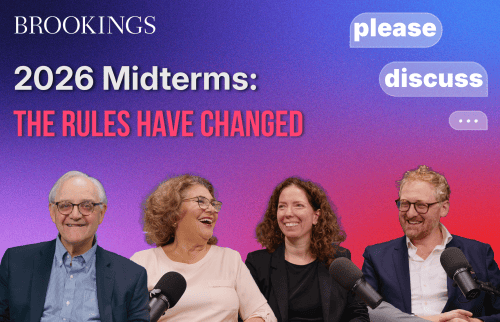
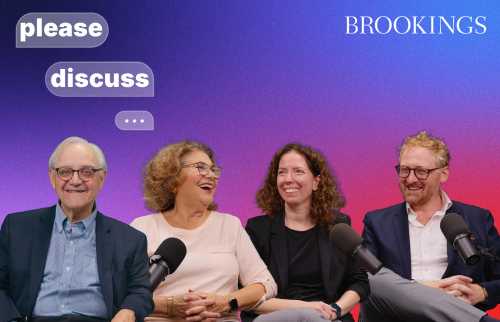
In the second episode of Please Discuss, Brookings scholar E.J. Dionne moderates a conversation about how foreign policy crises and kitchen table pressures are shaping the 2026 midterm elections. Brookings vice presidents Suzanne Maloney, Ben Harris, and Marcela Escobari examine rising gas prices stemming from the conflict in Iran, strained household finances, and the economic fallout of aggressive immigration enforcement.
Related Episode
- Listen to Please Discuss … on Apple, Spotify, or wherever you like to get podcasts.
- Watch on YouTube.
- Learn about other Brookings podcasts from the Brookings Podcast Network.
- Sign up for the podcasts newsletter for occasional updates on featured episodes and new shows.
- Send feedback email to [email protected].
TRANSCRIPT
[music]
HARRIS: Voters were promised lower prices. They haven’t received that in the form of retail gas. That’s up quite a bit since the war in Iran. They were promised cheaper prices in food. They didn’t get that. They were promised cheaper prices on housing. They didn’t get that. And I think voters are looking to politicians to fulfill the promises that they didn’t make.
DIONNE: I sense a kind of slowly developing cross-partisan hunger that people are tired of this politics we’ve had now for quite a while. My favorite line is old civil rights leader Fannie Lou Hamer, “People are sick and tired of being sick and tired.”
Welcome to Please Discuss, a new podcast bringing together many of the sharpest minds at Brookings to unpack the defining issues of our time. I’m E.J. Dionne, a senior fellow here at the Brookings Institution. This is part two of a three-part miniseries on what’s really shaping the 2026 midterms, the shifting rules over where and how we vote, the issues motivating voters, and after the election, what the outcome will mean for the balance of power and the shape of public policy.
On this episode, we’re drilling down into foreign policy crises, domestic kitchen table pressures, and major demographic shifts driving voters to the ballot box.
Joining me today to unpack these dynamics are three Brookings vice presidents and program directors. Suzanne Maloney, vice president and director of Foreign Policy at Brookings. Welcome to you, Suzanne.
MALONEY: Great to be here.
DIONNE: And Ben Harris, vice president and director of Economic Studies. Welcome, Ben.
HARRIS: Thanks, E.J.
DIONNE: And Marcela Escobari, vice president and director of Global Economy and Development. Welcome, Marcela.
ESCOBARI: Thank you. Great to be here.
[1:48]
DIONNE: I’d like to start by saying that contrary to skeptics, issues really do matter to voters. And so let’s have just a lightning round. I suspect there might be consensus here. What are the major issues, moving voters headed into the midterms? Please discuss. Suzanne?
[2:08]
MALONEY: Great. Well, I will start because I just stopped at the gas station on my way into the office today, and I think that we all have felt higher prices at the pump, and that is part of a larger escalation of prices in the consumer economy. I think that that is a major issue for many individual Americans who are feeling it.
[2:25]
DIONNE: Ben?
[2:26]
HARRIS: Yeah, I mean, I agree with Suzanne. This is about household finances. Voters were promised lower prices. They haven’t received that in the form of retail gas. That’s up quite a bit since the war in Iran. They were promised cheaper prices in food. They didn’t get that. They were promised cheaper prices on housing. They didn’t get that. And think voters are looking to politicians to fulfill the promises that they didn’t make.
[2:46]
DIONNE: Thank you. And Marcela?
[2:48]
ESCOBARI: I agree that that’s at the top of voters’ minds. I think the issue of immigration is important. It’s not at the top, not because they’re happy with the current policies, they’re just more unhappy with everything else.
[3:00]
DIONNE: Suzanne, it’s a fascinating election in part because foreign policy doesn’t usually move voters in elections unless either there’s a major problem with the policy or it has an impact on domestic policy. In the case of Iran, it passes, as it were, on both points. Talk about the Iran policy, how it sort of, if you will, unraveled or at least gotten to the point that it’s at, and how you think voters are looking at it.
[3:31]
MALONEY: Thanks, E.J. I think that’s a really good place to start because in a sense the president came to office the first time around on the basis of a campaign that really leaned heavily into his opposition to the forever wars. He talked a lot over the course of 2016 and in subsequent campaigns about the economic cost of the war in Afghanistan and in Iraq, and about the human cost of those wars.
And I think in many senses he was prescient, ahead of the game in terms of the debate here in Washington of having a pulse of where Americans were on those issues.
And yet what has happened over the course of his second term in office is that he launched not one, but two wars against Iran, the first one relatively brief and arguably quite successful in setting back Iran’s nuclear program.
The second one, I think, with a similar intent in terms of duration, but instead it has spiraled into something of a stalemate with major implications for the price that Americans pay for their gasoline, which is of course a major factor for most Americans given the reliance on automobile and other transportation here in the United States.
And it has had fallout on wider prices that one pays for food and other consumer goods that are really relevant to people’s pocketbooks. And so I think there is both the sense that the policy itself led to a war that has dragged on much longer than was anticipated, that has put the United States at odds with many of its traditional partners, both in the region and around the world, that it has created a, you know, something of a humiliation that a a small, relatively inferior, technologically and economically, power like Iran has been able to hold off the United States, to close the Strait of Hormuz, and even as the president and the Department of War has been able to resume higher flows and near pre-war levels of oil coming out of the Strait of Hormuz, it has come at a very high price, a premium of about thirty dollars a barrel. It has required about a third of the deployed U.S. naval assets stationed in the Middle East to ensure that this oil can come out.
And that is something that Americans both feel in their pocketbooks and can see is not a successful foreign policy. And so you’re you’re absolutely right that we’re in a sort of unique situation, especially for a midterm election, in which what the president is doing overseas is having a real impact on his ability to get his agenda done at home and to prevail in midterm elections.
[5:53]
DIONNE: Yeah, I’ve been traveling the last couple weeks in Kansas and Mississippi, where there’s a lot of agriculture, and what’s really striking is the Strait of Hormuz matters to farmers. You’ve got fertilizer prices, you’ve got diesel prices, and then of course, the tariffs are causing all kinds of problems for the farmers.
But looking at Iran, did anybody in the administration anticipate this Strait of Hormuz problem, and how did we end up here?
[6:20]
MALONEY: Over the course of the past forty-seven years, we have thought a lot about the threat posed by Iran. We’ve thought a lot about what Iran might do if it were attacked either by the United States or by another power. And we have gamed out what might happen in those sets of circumstances thousands of times at the Department of Defense and in other contexts. And we know that Iran has threatened consistently when it is under pressure that if Iranians can’t export oil, they will ensure that no one can export oil.
And so the target of the Strait of Hormuz was entirely predictable. The challenge, I think, was the set of assumptions that went into planning this war, the presumption that it would mimic what happened in the June 2025 war, which was very clearly delimited in terms of time and scope of ambitions.
This time around, the president struck alongside Israel with a series of attacks that took out the senior echelon of military and political leaders, including Iran’s head of state, its supreme leader, Ayatollah Ali Khamenei. The Iranians understood that this was not a short-term war. They clearly saw it, and the president signaled that it was a regime change war.
And the presumption was that the regime would simply collapse once that senior echelon of leaders was removed. It was a very, very flawed presumption.
[7:35]
DIONNE: And and just briefly before we move to other topics. This war has kind of refracted back into Ukraine policy over the last couple of weeks with President Trump announcing this deal with Vladimir Putin in Russia to try to get some diesel from Russia, and this has caused real havoc among American allies. Just briefly, if you could talk about that problem.
[7:58]
MALONEY: Yeah. I think what we’ve seen is the president looking for a scapegoat, and the scapegoat that he’s decided to identify is that of Volodymyr Zelenskyy. And he has been critical of Zelenskyy and the Ukrainians’ targeting of Russian refineries through their newer long-range strike capabilities. That has created differential pressures on different parts of the oil market around the world.
We saw early in the war there were some pressures around airline fuel, and now we’re seeing real pressures around diesel, and that plays out in the heartland of the United States because it is a a key product for farmers, for truckers, for those who are involved with agriculture and shipping.
And it is then having that wider ripple effect on the rest of the American economy. The president has opted to try to address this crisis, the escalating price of diesel fuel at the pump, by making a deal with Vladimir Putin to import Russian diesel fuel. That is in contravention to sanctions that he only just signed in the name of former Senator Lindsey Graham, and it is in contravention of all of the policies that we have been implementing on our allies and partners as well as other countries around the world to try to cut off Russia’s oil revenues as a means of putting pressure on the regime there.
So we are essentially taking a step that we would not permit from any other country in the world simply to get a little bit of traction at the ballot box.
[9:18]
DIONNE: Of course, we could get some diesel from Canada, but that’s another story which we might want to go into.
Marcela, I want to turn to immigration. Immigration was one of the issues that helped elect Donald Trump in 2024, and had he pursued a policy of closing the border without all of these other things he has done, he might still be ahead on the immigration issue. What’s really shocking about this election is he’s lost that issue, that there’s a small advantage now to Democrats on the immigration issue, and this has had an extraordinary effect on the Latino vote.
Why don’t you take all of that and put it together because it’s a real political punch to a lot of Republican candidates out there this year?
[10:01]
ESCOBARI: I mean, it’s no surprise that the Latino vote is an important voting bloc, and they had an important shift, around 20 points, during the last election that was instrumental in giving him the presidency. In the last year and a half, all of that advantage has been lost.
But that shift in the Latino vote probably mirrors the concerns of other voters with the economy at the top. Of course, immigration also hits closer to home for the Hispanic community, and two-thirds of Hispanics find the current enforcement policies to have gone too far.
And, you know, it’s a policy that hits them directly, that targets their communities directly. That same Telemundo poll shows that around 30% of Hispanics say that they or somebody they know has started carrying IDs in the fear that they will be detained by ICE. And their fear is real. Five-hundred U.S. citizens have been detained by ICE.
So, I do think it’s affecting the Latino vote, but I do think it’s affecting everybody.
[11:06]
DIONNE: And I’ll use a very polite word here, the ferocity of enforcement has had and the killings have had a real impact on people’s views of this.
[11:15]
ESCOBARI: I think most voters have found the current policy excessive in who it’s targeting. Seven out of 10 of the people detained have no criminal record. And excessive in these tactics, the shock and awe tactics, that have led to violent encounters and to deaths. And I think they are meant to elicit fear way beyond the people who are targeted. And excessive in its cruelty. Our colleague Tara Watson has published that 145,000 US children have lost a parent because of these policies.
[11:46]
DIONNE: You have done, you and your colleagues have done a really interesting study. It’s important to put facts behind public policy, and the expectation that Trump was talking about is that if you deport people here illegally, it will create jobs for Americans. Your study found something else that I think would be quite surprising to people.
[12:07]
ESCOBARI: Yeah, we wanted to test that explicit economic promise, that if we take, you know, one person out and we arrest or deport one person, that that will open up a job for Americans. And this was the first empirical evidence of this ICE enforcement surges on local cities.
And we found quite the opposite, that actually one arrest equals four lost jobs in these cities where enforcement surged. We basically looked at 370 cities, looked at the top quartile where enforcement had significantly surged. These cities, these set of cities, were actually growing slightly faster than everybody else, and there’s a clean trend break on the month that there’s a surge in enforcement. It sounds like a big number, but it’s actually quite intuitive.
You know, people are afraid to go to work, and sometimes people with legal status stop going to work. It disrupts economic supply chains. Right? If half of a framing crew gets deported and they can’t finish their job, projects stall and businesses close.
And the last mechanism is suppression of demand. People don’t go out when they’re afraid.
These mechanisms are not new. It’s just the tactics of this administration have made these effects a lot more aggravated.
[13:21]
DIONNE: There is more of a consensus in the country on how to solve some of these problems than is usually talked about. Talk a bit about this potential consensus because at some point we gotta solve this problem.
[13:35]
ESCOBARI: Yeah, there is consensus of what good immigration policy looks like, and most Americans believe that immigration is good for the country. Actually, Gallup has been tracking it for the last 26 years, and the number of Americans that believe that immigration’s good for the country has never dipped below 50%. It actually was at the lowest after September 11, and the highest was last year at 79% of Americans believing that immigration is good for the country.
They want immigration that provides a secure border and that humanely deports people who don’t come through legal ways. They want legal pathways that meet the economic needs of of our country, and that means quotas that were not set 40 years ago when our economy was a fifth of its size. And I also think that it involves working with the rest of the hemisphere and working with other countries so that we support countries that can stabilize migrants closer to home.
So these set of policies make sense, and of course, also legalizing people who have been here for a long time and don’t pose a public threat. Seventy-five percent of Americans believe in that. So that set of policies are what Americans want, but it’s not what they’re seeing today.
[14:50]
DIONNE: Ben, you could solve all our economic problems right here, right now, but I won’t ask you to do that. But it is so striking that the very same issues that helped elect Donald Trump are the issues that are hurting Republicans in this election around the economy. How did that happen?
[15:10]
HARRIS: Well, it happened through ill-advised policies that pushed up the cost of goods and made the pocketbooks of millions of American households significantly tighter. And so I think the way to look at it is, A, you can look at polling, and people are really unhappy with the current economy. There’s a couple different surveys we look at to find how people are feeling about the U.S. economy. One is the University of Michigan Consumer Sentiment Index. That is at a historic low. We’ve never seen it this low. We didn’t see it this low during COVID. We didn’t see it this low during the great financial crisis, during the Obama administration. People are really unhappy.
If you look at the Conference Board Consumer Sentiment Index, it’s a little bit less negative, but it’s still the lowest we’ve seen in 15 years. So people really do not like this current economy, and that’s showing up in approval ratings for the administration.
So how did we get here? First, we got here through a trade war, which pushed up prices for imported goods and domestic goods that were manufactured with imported inputs. It came with a war in Iran, which pushed up the price of gas by about $1.20, as Suzanne said. The average U.S. household buys about 60 gallons of gas a month, so if you’re paying $1.20 extra for a gallon of gas, you’re talking about $75 extra per month.
And wage gains that not only President Trump but also members of his cabinet promised have been sluggish and slow. The bottom 40% of the income distribution has almost no discretionary income. That is, after you’ve paid your taxes and after you’ve paid all of your household bills, you have almost nothing left over. If you’re in the bottom 20%, you have nothing on average, and if you’re in the next quintile, you have about $2,000.
The trade war has pushed up the average household spending by about $1,000. So if you’re in that bottom 20%, you went from having nothing left over after paying your bills to being in the hole by $1,000. The average household, as we just talked about, spends about $75 extra per month on gas. That’s about $1,000 per year.
Now, the Trump administration did pass this One Big Beautiful Bill Act, which provided households a rebate relative to prior year’s taxes that gave them an extra $1,000. But when you add all these three things up, you’re still in the hole by about $1,000 over the course of the year.
Now, there’s not going to be another tax cut most likely, but households are still paying the price of higher tariffs, and they’re still paying the price of higher retail gas. So as this goes on farther and farther, you’re seeing households get pinched more and more, and that’s showing up even in, like, New York Fed delinquency data, where we’re looking at transitions into delinquency for credit cards. That’s going up. It’s starting to look again like the great financial crisis.
So I would say for the bottom 90% of households, those that don’t own a lot of stock, things are feeling incredibly tight right now.
Now, who’s doing well? Those that have a lot of money in the stock market. And we saw unprecedented gains over the last quarter. Thirteen trillion dollars in household wealth added through rises in equity prices.
But the problem is, as we all know, that the top 10% own virtually all the stocks in the U.S. economy. So the one group that is not showing steep declines in consumer confidence are those that have a lot of money in the stock market.
[18:26]
DIONNE: This is, as you’ve written about, the K-shaped economy, and I think one of the things that you and others have focused on is we talk about the cost of living and inflation, but there’s a real problem now with real wages in the economy. And I have noticed again on the campaign trail that people are actually starting to talk about wages as well as prices.
[18:48]
HARRIS: Yeah, real wages going back to the middle part of 2024 until the war with Iran were actually rising. Nominal wages were going up by about 4% on average. Prices were going up by about 3%, so that meant you had about a one percentage point delta where you’re doing a little bit better. That has more than been eaten up by higher gas prices. And so you’re seeing year over year, energy prices are up by about 14%, and that has put real wages in the negative.
And so this extra $75 a month that households are paying for retail gas is is really painful and is more than compensating for any any wage increases they’re experiencing.
[19:27]
DIONNE: Just last thing on the economy. One of the things that clearly hurt the Democrats in 2024 were interest rates that had really had to go way up to curb the inflation that immediately followed the COVID recovery. And that had President Trump pursue policies to bring those rates down, I think the politics would look a little different.
He appointed a new head of the Federal Reserve, and what happened? Interest rates have ticked up. Talk about your view on interest rates, both their political impact and the policy involved.
[19:59]
HARRIS: Yeah, well, interest rates are the one big policy tool we have for dealing with higher prices. They are at the forefront on our war against inflation. And to Kevin Warsh, the new chair of the Fed, he was appointed by a president who demanded that not only does the Fed not raise rates, but the Fed cuts rates. President Trump has said he thought the right level for interest rates was around 1%, which is just insane.
But Kevin Warsh, to his credit, rose rates in the face of pressure from the White House. That’s the right decision to make given that inflation has been persistent.
The problem from a political standpoint is that Americans don’t like high interest rates. I mean, high interest rates are designed to slow down the economy. And from a household standpoint, you know, you like lower prices, but you don’t like a slower economy, and they can be really unpopular.
And this means that mortgage rates are over 7% now. If you want to buy a home, not only do you have the pain of having to pay more in interest costs, but there’s also this lock-in effect where most people who own a home and have a mortgage today have locked in lower interest rates than the market rate.
And so not only if you’re a home buyer, not only do you have to pay higher rates should you be able to find a home that you can purchase, but there are a lot fewer homes on the market. So, it’s doubly painful.
If you have credit card debt, which more Americans are having for the reasons we discussed earlier, you’re paying more on that credit card balance.
So, it is it’s painful for American households. But it’s designed to be. It’s designed to slow down the economy. But if you’re paying more each month, you know, maybe you don’t care so much about that.
[21:30]
DIONNE: Yeah, I’d like to bring everybody together here because these economic issues hit at both ends and are caused by many of the factors you talked about. Marcela, Latino voters historically have been among the most economically sensitive voters. They really care about the economy, and you’ve seen over the years some significant fluctuations in Latino vote.
[21:52]
ESCOBARI: I think what you said is is absolutely right, and this is why I think that big shift in the Latino vote, this over 20% shift support away from Trump, is mirroring the rest of the electorate, which puts the economy number one. It’s just that migration has, you know, also this double whammy of affecting communities personally and also having an economic effect.
[22:14]
DIONNE: And I’d like to ask Suzanne that the tariff policy has had a kind of double effect. Obviously, it’s increased prices here and created a lot of discontent. I I was glad you raised the farm country because it could be one of the biggest surprises of this election is what’s happening in the plains.
But it also has a powerful effect on our alliances. There’s been a real deterioration of U.S. relations with people who had been our friends for a long time. How do we come back from all of that?
[22:46]
MALONEY: I think that’s a a really important question, and it’s one that we’re going to struggle with for some time to come because I think the rest of the world will have concluded from both the first two years of President Trump’s second term, as well as some of the lessons we learned during his first term, that these political trends are here to stay.
The distrust of allies, the willingness to go it alone, the reliance on military power to try to affect our interests overseas that set us at odds with some of our most important partners and allies around the world are probably going to stick around no matter who is elected in the next presidential election.
And so, we are going to see some distance. We are going to see a lot of hedging already by partners and allies looking for different arrangements. They’re not going to walk away from the United States, but they do see us as less reliable in the long term, less predictable.
And they’re going to build other arrangements, whether it’s in the Gulf where we see this new Mecca alliance that involves Turkey, Pakistan, and Saudi Arabia, or whether it’s in the Indo-Pacific where we are seeing a lot more efforts to try to promote self-reliance, to try to build networks within the region that can supplement, not substitute for, American power, influence, and trade, which has been such an important factor in fueling economic growth around the world historically.
[24:02]
DIONNE: And Ben, I’d like to ask you this. Everything we’ve said really in this conversation is very gloomy for Republicans in this election, and that’s because the reality of the polling and the flow of the campaign seems to be negative to them. We still don’t know what the outcome will be. There’s some time left in this campaign.
But a lot of these issues behind the scenes when various kinds of economists, Republican and Democratic economists, talk to each other, there’s some consensus and some differences of opinion. Could you talk about that, Ben? Because you talk to every kind of economist.
[24:36]
HARRIS: Well, I do have a lot of conversations with Republican economists. Republican economists are Republicans, but they’re also economists. And economists like free trade, and I know almost no economists that are fans of this trade war.
Economists like immigration. I mean, just kind of building on what Marcela said, in a typical year in the U.S., we have about a million net immigrants coming. Over the course of the Trump administration, we’ve had about zero. And so that has real implications for the labor market. That has implications for domestic consumption. That means over the course of two years, we have two million fewer consumers within the United States.
So, I think that Republican economists are hoping that we’ve learned our lessons from the trade and immigration policies. But at the same time, I think they’re very big fans of the tax cuts, not just the one that was put in place in 2025, but also the one that happened in 2017, which reduced the cost of investment and reduced the corporate tax rate fairly substantially.
So, you know, I think for Republican economists, it’s not all bad news. I think they’re they’re quite big fans of the administration’s fiscal policy, but I think they hope that there are lessons learned.
[25:43]
ESCOBARI: And to add what Ben said on on what we’ve been talking about on immigration policy, we are also handicapping our future growth by some of these reductions of legal migration. We have reduced in the last year-and-a-half over 30% of the students that come here, that study STEM, that are the engine of innovation.
At a time that AI is going to create that technological disruption, we are going to need that kind of labor to produce the next companies and the next jobs in the next 10 years. So, decisions today are going to have lasting effects.
[26:19]
DIONNE: I’d like to have a quick round, again, for all three of you, and maybe we’ll go reverse this time, starting with Marcela. Do you have any idea in your head of the day after the election, what issue decided it? Is there a wildcard issue that people are not really thinking about as much now? How do you think we will look back? And this will be on tape, and we’ll all get together again and pass around awards for the right answer.
[26:48]
ESCOBARI: I think AI is on people’s minds. Eighty-four percent of Americans have a negative perception of what AI is doing to jobs, and I think it’s actually the one place where they are looking for bigger government and AI regulation because they’re not seeing how this is translating for better government for them, better health care for them.
And I think the current choice of President Trump of getting closer to the tech executives and have hands-off position, I think it’s not going to bode well with voters.
[27:19]
DIONNE: You know, I’m so glad you said that because I think that is a real issue that’s grown in the last several months. Data centers obviously are a big issue, but I do think the data centers issue is also part of a larger “what does this mean?” And I think there are more questions in voters’ heads. Ben?
[27:35]
HARRIS: AI is the best possible answer. A Pew poll found that only one in six Americans were optimistic about the impact of AI on society over the next 20 years. Forty percent were negative. I think data centers are kind of the focal point for anxiety around AI because I think a lot of Americans don’t necessarily understand how it’ll impact them, and data centers are something that are tangible that you can push back on. So I think data centers for me would be the best answer.
The other thing is our fiscal outlook for the United States. We’ve passed 100% debt-to-GDP ratio. That has made many people uneasy. The rise in interest rates on the long end of the curve, so 10, 20, 30-year bonds, is not so much driven by the higher interest rates we talked about, but also by increased debt hitting the market. And I think that people can intuitively understand that we’re in a precarious fiscal outlook, and they’re uncomfortable with it.
[28:26]
DIONNE: I think that is the big debate also going into the 2028 election. And no one wants to talk about it because we either need cuts or new revenue, and I think we’re going to have a lot of debates about revenue going forward and where to find it. But thank you for that.
Suzanne?
[28:42]
MALONEY: I will stick to the theme and and also point to tech, but build on what both Marcela and Ben have said in a small way, which is that I think this issue of catastrophic risk, which has been part of the the new conversation about what the models might be capable of doing, and we’re hearing new reports every day, feeds into this larger sense of anxiety that Americans have about the world and our place in it.
And some of that is is fueled by the fact that we have been experiencing these conflicts, especially right now in the Middle East, that could have some additional implications at home.
And so, we’ve just seen over the course of recent weeks, reports of terrorist activity in the UK, for example, targeting U.S. military presence there that appears to be linked to Iran. There is a real possibility of additional escalation in the days that still lie between the publication of this podcast and the election itself. And if we see that escalation in the Middle East, and if we see further effects around the world of the conflicts that we’re in, I think it just feeds this deep-seated fear that Americans are beginning to have about technology, about our place in the world, and about the possibility of that impacting their own personal safety.
[29:50]
DIONNE: That is a great point, and I don’t want us to end on a completely scary note. So, I want to say one of the things I think all of you had in common in what you said is, I sense a kind of slowly developing cross-partisan hunger to get to the next stage, that people are tired of this politics we’ve had now for quite a while.
My favorite line is old civil rights leader Fannie Lou Hamer, “People are sick and tired of being sick and tired.” And I don’t think that’s a partisan thing. I think you’re starting to sense that across the board, but we will find out soon.
And I want to thank you all for a really sharp and candid policy-rich and data-rich discussion. Suzanne Maloney, Marcela Escobari, Ben Harris, thank you for being here.
[music]
To dig deeper into our research on the midterms and the issues we discussed and the broader political landscape, please visit Brookings dot edu.
In our next episode, arriving after the midterm elections in November, I’ll be joined by another panel of terrific scholars to break down the results and discuss what’s next in our politics and in our government.
Make sure to follow us on YouTube or your favorite podcast app or explore all our shows at Brookings dot edu slash podcasts. I’m E.J. Dionne. Thanks for listening to Please Discuss.
The Brookings Institution is committed to quality, independence, and impact.
We are supported by a diverse array of funders. In line with our values and policies, each Brookings publication represents the sole views of its author(s).
Commentary
PodcastPlease Discuss … the pressures shaping the 2026 midterms
Listen on
Please Discuss …
October 20, 2026