The Red Sea basin is in profound crisis, beset by conflicts: Sudan’s brutal civil war, escalating fighting in South Sudan ahead of December elections, Houthi attacks on Saudi Arabia and shipping, and a worsening struggle with al-Shabab in Somalia. Now, the prospect of renewed war between Ethiopia and Eritrea threatens to make matters considerably worse. The two neighbors were longtime adversaries until a rapprochement in 2018, but that peace has ended, and the risk of a third conflict is real. Such a war could bring devastating humanitarian consequences and merge the region’s overlapping conflicts into a massive conflagration on both sides of the Red Sea.
A troubled history
Starting in 1961, Eritrean separatists fought three successive Ethiopian regimes—Haile Selassie’s empire, Mengistu Haile Mariam’s Marxist military junta, and Meles Zenawi’s Tigray-dominated transitional government, which became the Federal Democratic Government of Ethiopia in 1995. Eritrea achieved de facto independence in 1991 and de jure independence in 1993, at a cost of tens of thousands of fighter and civilian casualties on both sides.
Eritrea’s first and only president, Isaias Afwerki, has never permitted elections or political parties and has maintained crushingly tight control over the country ever since. In contrast, Ethiopia in 2018 shifted from the heavy-handed domination of the Tigray People’s Liberation Front (TPLF) to a near monopoly over official institutions by Abiy Ahmed’s Prosperity Party. (Neither Zenawi’s approach of managing Ethiopia’s complex diversity via “ethnic federalism” nor Abiy’s attempt to centralize control has managed to eradicate various insurgencies.) The two countries fought a border war in 1998-2000, again at the cost of tens of thousands of civilian casualties.
In 2018, Abiy wanted to demonstrate a sharp rupture with the previous Ethiopian policies. He reached out to Isaias, with the help of the United Arab Emirates (UAE) and Saudi Arabia. The two leaders visited each other’s capitals, restored diplomatic relations, and reopened air travel and cross-border civilian movement for the first time in two decades. But the apparent reconciliation, it turns out, was not for peace. It culminated in Isaias’ decision to join Abiy in fighting a common rival for power: the TPLF, which had retreated to Ethiopia’s Tigray region, bordering Eritrea, after losing control of the central government to Abiy and subsequently held provincial elections in contravention of Addis Ababa’s electoral calendar. What triggered the explosion of violence in November 2020 remains hotly debated, but the ensuing war involved atrocities, war crimes, and accusations of attempted genocide, killing at least 600,000 people through fighting, starvation, and disease.
Isaias wanted to crush the TPLF entirely. The November 2022 Pretoria agreement, brokered by the African Union with the help of the United States and others, ended that war between Addis Ababa and the Tigrayans but led to the unraveling of the Abiy-Isaias bromance.
Back to the brink
Ever since, Horn of Africa analysts have fretted that any provocation could provoke Abiy and Isaias into direct conflict, with international consequences. Regional powers filled with ambitions and grievances would likely exploit the situation by rushing in weaponry, money, and possibly fighters, escalating the violence—just like in Sudan.
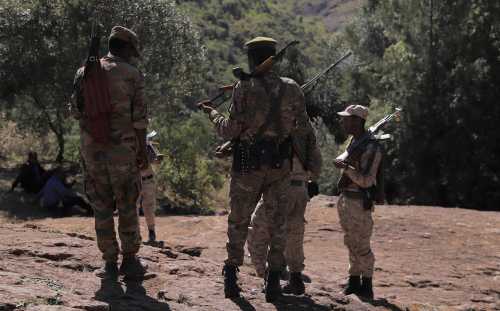
This nightmarish scenario became more likely in October. After decades of hostility and wars, Isaias and the TPLF had improbably joined forces against a common enemy: Abiy. In September, Eritrean forces reportedly crossed into Ethiopia in support of the TPLF, which—as in November 2020—seized key cities and installations. But unlike the last Tigray war, this time, the Ethiopian National Defense Force (ENDF) quickly regained control of much of Tigray and moved troops to the border with Eritrea.
In an October 9 letter to the United Nations Security Council, Ethiopia’s foreign minister warned that Ethiopia would be “taking measures in the exercise of its inherent right of self-defense” in response to Eritrean support of Ethiopian insurgent groups and violations of Ethiopian sovereignty. The following day, the Eritrean foreign minister responded with his own letter to the U.N., describing the Ethiopian allegations as “an insult to the intelligence of the international community” and calling on the Security Council to take action against what he warned was Ethiopia’s threat to invade Eritrea.
To their credit, countries and institutions immediately intervened to prevent another war in the Red Sea basin. U.S. Secretary of State Marco Rubio called Abiy to urge de-escalation, while U.S. Ambassador to the U.N. Mike Waltz met with his Eritrean counterpart. (Having let Biden-era sanctions on Eritrea expire, the Trump administration seems to be thawing relations with Asmara.) The African Union called for “maximum restraint” after the two sides severed diplomatic relations. U.N. Secretary-General António Guterres also urged de-escalation and offered his good offices. U.N. Assistant Secretary-General Martin Kimani has briefed the Security Council twice, while U.N. Special Envoy for the Horn of Africa Guang Cong has met officials to pledge U.N. support for peace and security efforts.
Mutual suspicions, mounting tensions
But the question is whether this third war between Ethiopia and Eritrea was averted or simply delayed. None of the underlying issues that could spark belligerency have been meaningfully addressed.
Isaias certainly has not forgotten Abiy’s claim that Ethiopia, currently the world’s most populated landlocked country, had made a “mistake” in ceding Assab port to Eritrea upon the latter’s secession from Ethiopia. Asmara perceives Ethiopian troop movements near the Eritrean border as part of Abiy’s ambition to reclaim a Red Sea commercial and naval port. Renewed questions in Addis Ababa about the legitimacy of Eritrea’s independence, plus Ethiopia’s hosting of Eritrean opposition figures, stoke Asmara’s paranoia about regime change.
Abiy, for his part, accuses Eritrea of destabilizing Ethiopia through cross-border incursions and by arming, funding, and training opposition and insurgent groups, including the TPLF and the Amhara FANO. The two groups joined several others in forming the “Alliance for Survival” in September, aiming to overthrow Abiy. While Eritrea’s military is dwarfed by the ENDF, Abiy also views Isaias’ ties to the Sudanese Armed Forces (SAF) and to Egypt with suspicion. Both countries have a long history of acrimony with Ethiopia, exacerbated more recently by disputes over the Nile River waters and Addis Ababa’s role in facilitating support to the Rapid Support Forces in Sudan. The SAF’s hosting of an anti-Abiy Tigrayan force, known as Army 70, estimated at several thousand armed fighters, further heightens tensions.
A former diplomat who frequently visits Addis Ababa told me that Abiy most likely hears well-intentioned calls for de-escalation as meaning, in practice, a green light for the TPLF and other opposition groups to regroup, with Eritrean support. The risk is that he may eventually find the situation with Asmara intolerable and the temptation to act irresistible. Alternatively, Eritrea could provoke an Ethiopian military response by deploying forces in sensitive or contested border areas, potentially prompting SAF or Egyptian support for Isaias. Cairo has surely noted that Ethiopia recently acquired Russian military aircraft capable of reaching Egypt. A war may start along the Eritrean-Ethiopian border, but it would not remain confined there. It could spill into other conflicts raging in the region, fueling a wider conflagration on both sides of the Red Sea.
Beyond de-escalation
Calls for de-escalation, then, are insufficient and must be paired with proposals to address the existential threats both Abiy and Isaias feel from the other. The United States was a witness to the December 2000 Algiers Agreement (which ended the 1998-2000 Eritrean-Ethiopian war) and supported the 2002 Eritrea-Ethiopia Boundary Commission decision. Perhaps the United States could monitor remotely and report publicly on troop movements along the border. The U.N. and African Union could work with the parties to establish an incident prevention and response mechanism, to prevent misunderstandings from escalating into conflict and to establish notifications for issues such as troop movements. Despite tensions between Saudi Arabia and the UAE over Yemen and Sudan, Riyadh, with channels to Isaias, and Abu Dhabi, allied with Abiy, could cooperate on confidence-building between Eritrea and Ethiopia, building on their 2018 cooperation to coax the two leaders to restore diplomatic relations.
Addressing Abiy’s insistence that Ethiopia needs its own Red Sea port—an ambition that he probably sees as uniting an otherwise fractious population—is complicated but necessary for long-term stability. While this idea needs more elaboration than this article allows, a regional initiative to improve and expand transport and shipping infrastructure could include the upgrading and expansion of Assab port, alongside predictable and guaranteed Ethiopian shipping facilities, and paired with third-party assurances of Eritrean sovereignty.
But what if, as seems likely, both leaders are determined to see the other overthrown? Those with influence over the two leaders and any outsiders encouraging them should emphasize that regime change rarely produces friendly results. A destabilized, fragmented Ethiopia, with the second-largest population in Africa, would have serious spillover effects in Eritrea and beyond. A sudden collapse of the regime in Asmara, with no strong institutions or civil society to fill the vacuum, would likely lead to chaos and sustained insurgency against an Ethiopian occupation of all or part of Eritrea. If either leader sees war as inevitable or even desirable, they need to understand the potentially devastating consequences of proceeding in that direction. Ethiopia’s neighbors—Somalia, Sudan, South Sudan—offer ample warning of what happens when outsiders, whether near or far, back insurgencies.
Preventing Ethiopia and Eritrea from war does not end the violence ripping through both sides of the Red Sea. But it takes one potential crisis off the table.
Author

Related Content
2025
The Brookings Institution is committed to quality, independence, and impact.
We are supported by a diverse array of funders. In line with our values and policies, each Brookings publication represents the sole views of its author(s).
Commentary
Pulling Eritrea and Ethiopia back from the brink of war
November 12, 2026