In 2025, the United States cut its foreign aid allocations by 57%, roughly evenly distributed between channels using its own bilateral and multilateral institutions.1 That year, aid to and through multilateral institutions amounted to some $9.2 billion out of total U.S. official development assistance (ODA) of about $29 billion (one-third). Core contributions to multilaterals fell 51%, from $6.6 billion to $3.3 billion, with especially heavy cuts (down 87%) to core funding of the U.N. system. The U.S. withdrew from the WHO, made no Gavi pledge, defunded UNFPA and UNRWA, and announced its withdrawal from UNESCO. On January 7, 2026, it announced exits from 66 further bodies, including UNFCCC, UN Women, UN-Habitat, UNCTAD, IRENA, and the IPCC (ASIL 2026). It ended budget support to Ukraine, appropriated through the 150 account and managed through the World Bank’s multi-donor PEACE program, which had been $10.8 billion in 2023 and $7.6 billion in 2024.2
At the same time, the U.S. kept some multilateral commitments. It pledged $4.6 billion to the Global Fund’s eighth replenishment in November 2025, down from $6 billion (NextBillion 2025). It pledged $3.2 billion to the 21st replenishment of the International Development Association (IDA21) over three years, down from a $4 billion pledge made earlier by the Biden administration, but still a sizable commitment.3 It contributed $2 billion to the United Nations Office for the Coordination of Humanitarian Affairs (OCHA) in December 2025 and an additional $1.8 billion in May 2026.
The aversion to supporting multilateral institutions with contributions to their core budgets stems from a perceived drift of multilateral institutions from their original stated purpose and a perceived misalignment with U.S. national interests.4 These are long-standing concerns. In 2017, Sens. Bob Corker and Chris Coons proposed a bipartisan Multilateral Aid Review Act to steer U.S. funding to institutions scoring highest on results, management, accountability and transparency, fit with foreign policy, and comparative advantage relative to bilateral and other multilateral organizations. This brief reviews how the United States could approach these questions.
1. Why use multilaterals at all?
The choice between bilateral and multilateral channels is about comparative advantage. For large donors such as the U.S., it is also about influence over the management and activities of big organizations, adding policy leverage to financial leverage. The literature (Gulrajani 2016; Birdsall and Kharas 2014) and decades of DAC practice point to five areas where multilateral agencies tend to outperform bilateral donor agencies.
- Scale and logistics in humanitarian crises. WFP, UNHCR, UNICEF, and IOM have pre-positioned supply chains, access negotiated with all parties to a conflict, and processes that offer better delivery results in difficult conditions, with cost-effectiveness and financial accountability acceptable to multiple donors.
- Pooling for global public goods. The Global Fund and Gavi use pooled procurement and, in Gavi’s case, advance market commitments to lower commodity prices and shape markets. Pandemic surveillance, climate mitigation, and environment facilities (among other cross-border challenges) create benefits for all countries and are best financed through collective structures to negotiate burden-sharing. The Famine Early Warning Systems Network (FEWS NET) and the Demographic and Health Surveys are examples of public goods that have been funded by the U.S. and could, in principle, be funded multilaterally.
- Leverage of donor money. Multilateral development banks borrow on capital markets against shareholder capital. IDA21 turned $23.7 billion of donor pledges into about $100 billion of financing capacity, roughly $4 per donor dollar (World Bank 2024).
- Managing risk in fragile settings. Multilateral fiduciary systems allow donors to provide finance to governments that do not have strong internal controls with less risk of corruption or diversion of funds, as with World Bank-administered budget support for Ukraine since 2022.
- Technical advice and norm-setting. Multilaterals can press for policy reform based on global experience, using neutral, evidence-based analysis. Bodies such as the United Nations Framework Convention on Climate Change, the IPCC, and UN Women, among many others, help set common standards, agendas, and development priorities.
Bilateral aid is preferred when there is distinctive donor experience (such as technical assistance for agricultural research from U.S. land-grant colleges, also substantially cut in 2025); when specific criteria are important (democracy and governance are foundational for the Millennium Challenge Corporation’s country selection process); for security assistance; and when accountability for results is important for communicating with taxpayers (such as Feed the Future or Power Africa).
The best practice put forward by the DAC is that channel choice should rest on an explicit, published strategy and evidence, not on default habits or political fit alone. Several large donors have published multilateral strategies or reviews, some better than others: the U.K., the Nordic countries, Germany, the Netherlands, and France. The United States is not alone in lacking one: Japan and Canada have no published multilateral review. The rest of this policy brief reviews where U.S. practice diverges from that of other countries, what the implications are, and what might be done in the future to make decisions more systematically.
2. How much does the U.S. channel to and through multilaterals?
In 2024, the U.S. routed $23.7 billion, or 36% of its $65.7 billion gross ODA, to or through multilateral agencies; the DAC average excluding EU institutions was 32%.5 As noted above, this figure was inflated by the mechanics of how U.S. aid to Ukraine was appropriated and channeled. With the change in approach, the U.S. now likely channels roughly the same share as other countries to and through multilateral institutions. The main difference between the U.S. and other countries’ use of multilateral institutions lies not in the proportion of funds but in the composition of the funds between core and earmarked resources. As Figure 1 shows, the U.S. is the smallest provider of core funding to multilaterals (11% of its total aid, compared with 27% for Sweden) and a relatively high user of earmarked contributions (30% compared with 15% for the U.K.).
Figure 1. The U.S. used multilaterals more than the DAC average but mostly through earmarked funding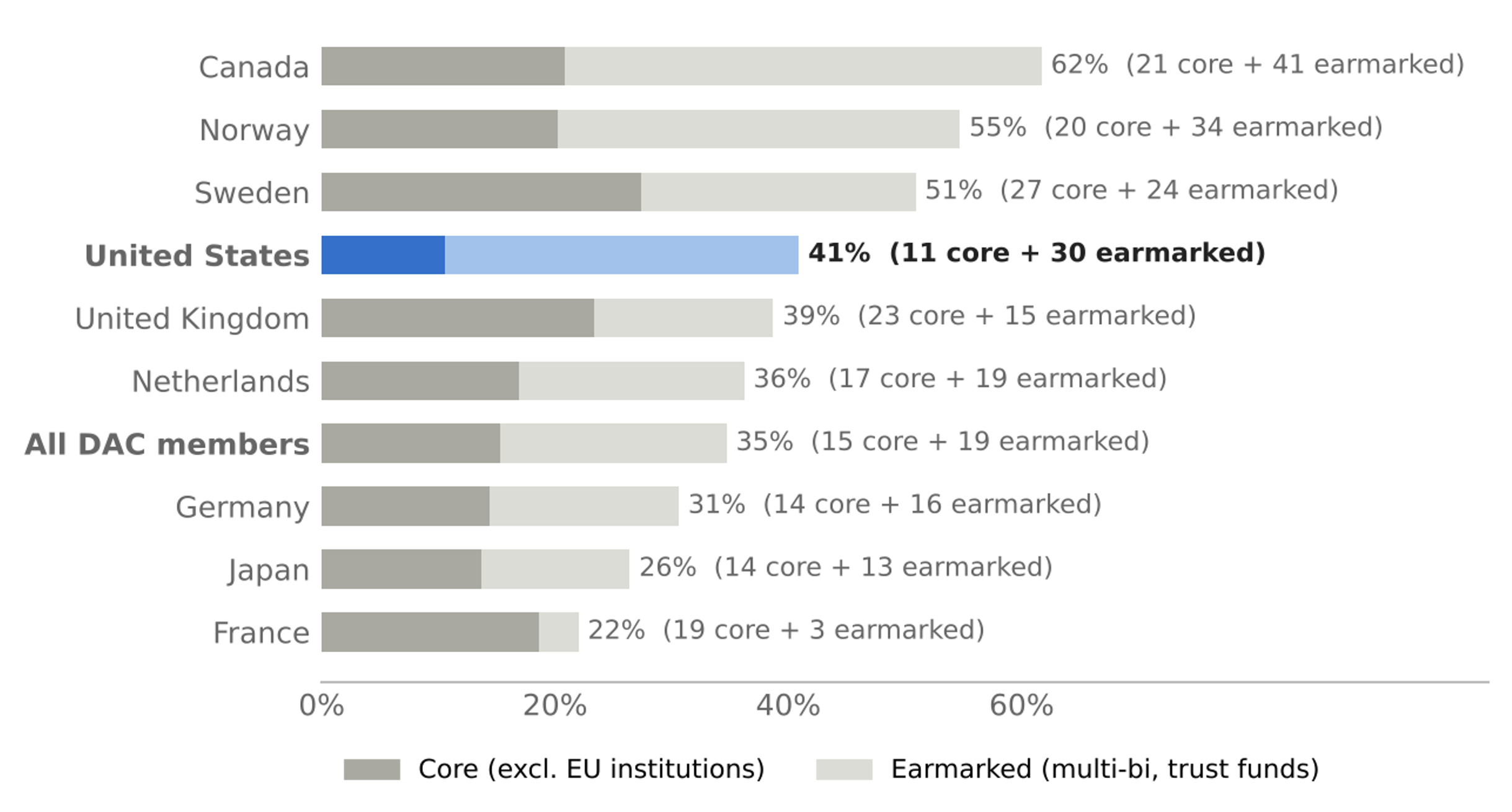 Note: Share of gross ODA to and through multilaterals, 2022-24 average. EU institutions are treated as bilateral. Gross ODA = bilateral ODA plus core multilateral contributions. U.S. contributions for these years are biased upward due to large earmarked contributions to a World Bank trust fund for Ukraine.
Source: OECD, Providers’ total use of the multilateral system (DF_MULTI) and CRS; gross disbursements, constant 2024 U.S. dollars.
The implication of these numbers is that U.S. core funding of multilateral institutions (excluding EU institutions) is seriously below its fair share, as usually measured in terms of GDP. It accounted for only 22% of the $31 billion in core funding provided to multilaterals by DAC members in 2024, yet the U.S. economy made up fully 45% of DAC members’ combined GDP. In 2025, the U.S. slashed its core funding still further, by $3.4 billion, accounting for almost all of the $3.5 billion overall reduction in core funding by DAC members.
On humanitarian operations, however, the U.S. has historically borne more than its fair share, providing about 58% of the roughly $42 billion that DAC members channeled through multilaterals for humanitarian response over 2022-24. The U.S. has funded more than its fair share in agencies it particularly favors such as the International Organization for Migration, the United Nations High Commissioner for Refugees, and the World Food Programme. Following the cuts in 2025, however, the U.S. share of humanitarian funding is likely to be commensurate with its economic weight in the DAC, but only because other countries also cut their aid substantially.
3. Earmarking and core funding of multilateral agencies
Core funding lets an agency allocate by its own mandate and formulas. Earmarked funding (multi-bi contributions, single- and multi-donor trust funds, thematic windows) lets the donor choose the country, sector, or project, and uses the agency mainly as an implementer. Historically, the U.S. has used earmarks extensively in its funding of U.N. agencies (83% earmarked) but much less for other institutions (15% for the World Bank Group, excluding Ukraine trust funds; 8% for global funds). U.S. earmarking is widely used both for country selection purposes and for specific projects, sometimes linked to the procurement of U.S. goods and services.
Earmarking is most prevalent in humanitarian assistance. A decade after the Grand Bargain, when humanitarian donors vowed to pursue localization, quality funding, cash, and pooled funds, the system is moving in the opposite direction. Most of the U.S. funding to OCHA in 2026 is “pooled” in name only (56% of U.S. contributions go to countries where the U.S. represents over 90% of the total funding).6 OCHA is essentially administering U.S.-financed country funds. The burden-sharing aspect of pooled funds is being lost, and the humanitarian motivation of responding to the greatest human needs, as identified by the global community, is equally at risk.
Earmarking is also slowing the shift toward cash and the localization agenda of the humanitarian community. Cash and vouchers are now used for about one-fifth of humanitarian assistance (ALNAP 2026). An International Food Policy Research Institute study for WFP in four countries (Margolies and Hoddinott 2015) found that using only cash or vouchers instead of food would have reached about 15% more people with the same budget. Other studies find higher returns: a CALP-commissioned study of $11.4 billion in humanitarian transfers over 2014-25 found multipurpose cash 37.5% more cost-efficient than in-kind food aid (Van Der Merwe and Sadik 2026). More of the aid goes to intended beneficiaries when cash is used. The overall savings to the system could be in the range of $1-3 billion annually.
For the U.S., two-thirds of its earmarked funds are coded as “project-type” interventions rather than thematic programs. The OECD warns that multilateral earmarking is shifting from substituting for bilateral aid to displacing core funding, “bilateralising” the multilateral system (OECD 2026a). It recommends, at minimum, moving from project-level restrictions to broader thematic earmarking. It also urges members to set out explicit multilateral engagement strategies and to share the burden of funding systemically important agencies (OECD 2026a).
The experience with food aid shows the cost of tying aid through earmarking. WFP is the largest recipient of U.S. earmarked funding, and U.S. food aid has historically come with two further restrictions: purchase of U.S. commodities (Food for Peace requires 50-100% U.S. commodities) and shipment of at least half on U.S.-flagged vessels.
The U.S. Government Accountability Office (GAO) found that WFP’s local procurement in sub-Saharan Africa cost about 34% less than comparable U.S. in-kind food aid, and 29% less in Asia (GAO 2009). Locally or regionally procured grains have saved more than half their cost on average (Lentz, Passarelli, and Barrett 2013). Cargo preference raised U.S. food aid shipping costs by an average of 23% (GAO 2015).
Tying also reduces speed. In-kind U.S. food aid took an average of 147 days to arrive in sub-Saharan Africa, against 35-41 days for local or regional purchase (GAO 2009). Local procurement or cash cut response times by about 14 weeks, a 62% gain (Lentz et al. 2013).
Tying rules are being tightened in the United States. Food for Peace moved from USAID to the U.S. Department of Agriculture in December 2025. Its first $452 million tranche, all to WFP, required 100% U.S.-origin commodities, and the second, $357 million, requires half of each grant to go to U.S. commodities and freight (CFR 2026). If tying raises costs by about a third, as the GAO estimates suggest, a $1.2 billion program delivers what about $0.9 billion would buy untied, a reduction in impact equivalent to roughly $300 million a year.
Although earmarking is less prevalent in economic development agencies than in humanitarian agencies, it is still significant and carries real costs. A 2025 review of the evidence for Sweden’s Expert Group for Aid Studies (EBA) and the German Institute for Development Evaluation (DEval) found that core funding generally outperforms earmarked funding (Ihl et al. 2025).
- Earmarked projects at the World Bank and regional banks cost about 1.5 times as much as core-funded projects, mainly because of supervision costs (Heinzel et al. 2023).
- Earmarking can lead to excessive fragmentation. In FY2019, 70% of the World Bank’s 529 trust funds held only 7% of trust-fund resources. A major overhaul (“Umbrella 2.0”) has consolidated most World Bank–administered trust funds into 75 thematic umbrella programs, alongside 26 financial intermediary funds (FIFs).7 These funds are now large in scale: FY2025 disbursements were $26.6 billion.
- U.N. agencies and the World Bank charge fees for administering earmarked trust funds (typically 8% at the U.N. and up to 12% for Bank-executed World Bank funds), but these probably do not cover the full cost of supervision, so core funds end up subsidizing earmarked work, aggravating the problem.
4. Toward a U.S. multilateral aid review
The U.S. has never conducted a comprehensive, evidence-based multilateral aid review (Pipa, Seidel, and Conroy 2018). The Multilateral Aid Review Act introduced by Corker and Coons in 2017 would have required one but was not enacted. The closest equivalent is the review ordered by Executive Order 14199 in February 2025. It asked the secretary of state to determine within 180 days which international organizations are “contrary to the interests of the United States” and whether they can be reformed. The review that followed looked at political fit but was apparently conducted without published evidence on effectiveness, value for money, or the cost of exit. A long tail of small agencies was zeroed out, but the amount of money saved was small: the 66 withdrawals announced in January 2026 would have saved at most a few hundred million dollars a year, less than 1% of U.S. aid. They cost the U.S. seats in standard-setting bodies such as UNFCCC, IPCC, and IRENA. The large savings came from cuts to the main international humanitarian agencies and the U.N. regular budget.
Any multilateral aid review should answer, for each organization:8
- Does U.S. funding attract and leverage other countries’ money?
- Does the U.S. bear a fair share of the burden, proportionate to what others contribute?
- Is the organization well run, efficient, and properly staffed and structured?
- Does it maximize impact and respond nimbly to changing circumstances?
- Do its mandate and operations fit U.S. national interest priorities?
To address these questions, most donors rely on information collected by MOPAN, a 20-member group, including the U.S., formed in 2002 and hosted by the OECD since 2013. For example, the U.K.’s 2011 Multilateral Aid Review, which drew on MOPAN data where available alongside its own assessments, rated 43 organizations on value for money and fit with U.K. objectives. It ended funding for four, demanded reforms at four, and increased funding to six. Others ran similar exercises.
MOPAN has completed 121 assessments of 36 organizations, including new reports on UNDP (2026) and on UNFPA, the Asian Development Bank, GEF, and UNESCO (2025). The U.S. chaired the design of the current MOPAN 3.0 methodology, which scores organizations on 12 key performance indicators on a 1-4 scale.
Figure 2 below plots the U.S. funding share of major organizations against the MOPAN ratings. U.S. money is concentrated where effectiveness scores are middling. IOM (62% of DAC funding from the U.S.; score 2.58 out of 4—see Figure 2), UNHCR (56%; 2.80) and WFP (52%; 2.82) are rated satisfactory but sit in the lower half of the range. These agencies, however, work in the hardest contexts where needs are greatest; MOPAN scores measure organizational systems, not development impact.
Figure 2. The agencies most dependent on U.S. funding score in the lower half of MOPAN’s satisfactory range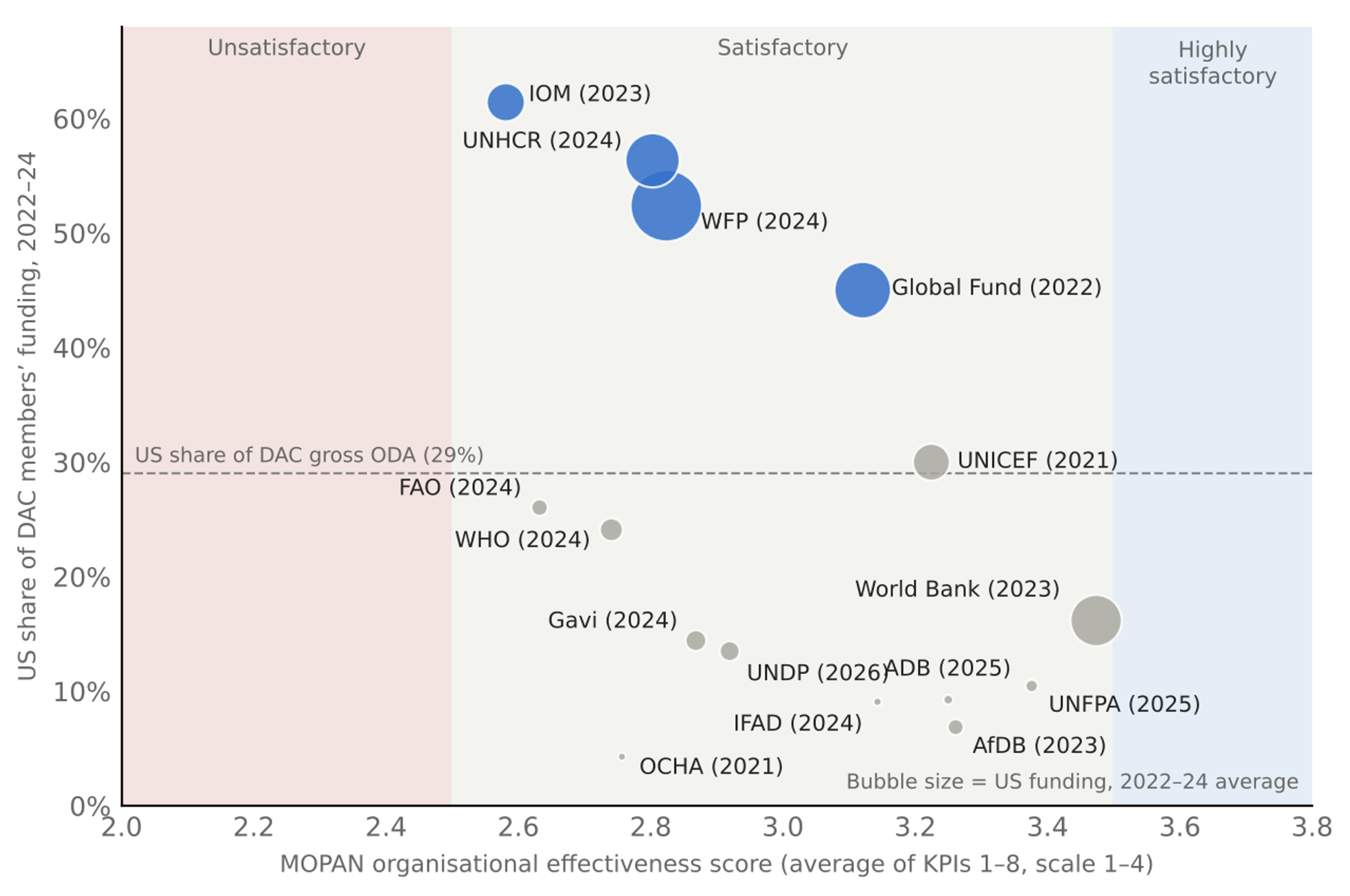 Vertical axis: U.S. share of DAC members’ contributions (core plus earmarked), 2022-24 average; excludes EU institutions and non-DAC donors, so overstates the U.S. share of total revenue. The World Bank figure covers IDA and IBRD only and excludes Ukraine trust funds. Horizontal axis: average of MOPAN key performance indicators 1-8 (organizational effectiveness) from the latest assessment (year in parentheses). Bubble size is proportional to the size of the U.S. contribution.
Sources: OECD DF_MULTI; MOPAN technical annexes; author’s calculations.
5. Policy implications
The U.S. should concentrate on channels where its dollars buy the most leverage and results, and it should attach fewer strings.
- Conduct a transparent multilateral aid review to provide an evidence base for deciding where to put more, where to push for reform, and where an exit would cost little. Use MOPAN evidence on organizational effectiveness, and add U.S.-specific tests of fit, development impact, leverage, and burden-sharing.
- Protect a short list of high-priority core contributions. IDA, the African and Asian Development Funds, and the Global Fund score well and offer scale, co-financing, and burden-sharing at low U.S. administrative cost.
- Shift from project-level earmarks to pooled thematic windows. Two-thirds of U.S. earmarked money buys single-donor projects. Moving even part of it into multi-donor funds, as the U.K., Canada, and Norway do, would cut costs for agencies and partner countries while keeping thematic control.
- Untie food aid. Reducing U.S. commodity and cargo preference requirements, or at least restoring flexibility for local and regional purchase and cash, would stretch each food aid dollar by roughly a quarter to a third and speed delivery by months. U.S. farmers can be compensated by other programs using the savings from untying.
- Coordinate exits and share the burden. Where the U.S. does withdraw, it should explore whether other DAC donors are willing to take on a greater burden, especially for agencies such as UNHCR, IOM, and WFP, which rely on the U.S. for more than half of DAC funding. Small normative bodies cost little and carry influence that others will otherwise take.
Data note
Unless otherwise noted, figures come from the OECD Data Explorer (accessed October 14, 2026): Providers’ total use of the multilateral system (DF_MULTI), which separates core contributions from contributions through multilaterals; the Creditor Reporting System (DF_CRS) for bilateral ODA by sector and modality; and DF_DAC1 for preliminary 2025 totals. Values are gross disbursements in constant 2024 U.S. dollars; 2025 comparisons use grant equivalents. EU institutions are treated as bilateral throughout: their core and earmarked contributions are removed from multilateral totals, and gross ODA is unchanged. “Gross ODA” is CRS bilateral ODA plus core multilateral contributions. MOPAN scores are simple averages of the KPI 1-8 scores in each organization’s latest technical annex (seven KPIs where one could not be extracted). The 2025 estimate of U.S. multilateral funding is illustrative pending detailed CRS data.
Sources
ALNAP (2026). State of the Humanitarian System 2026. London: ALNAP.
ASIL (2026). United States announces withdrawal from 66 international organizations.
Birdsall, N. and Kharas, H. (2014). The Quality of Official Development Assistance (QuODA): Third Edition. Brookings Institution, July 10, 2014.
CFR (2026). The revamped Food for Peace program bypasses countries closest to famine.
Executive Order 14199 (2025). Withdrawing the United States from and ending funding to certain United Nations organizations and reviewing United States support to all international organizations. Federal Register 90(26), February 10, 2025.
GAO (2009). International Food Assistance: Local and Regional Procurement Can Enhance the Efficiency of U.S. Food Aid, GAO-09-570.
GAO (2015). International Food Assistance: Cargo Preference Increases Food Aid Shipping Costs, and Benefits Are Unclear, GAO-15-666.
Gulrajani, N. (2016). Bilateral versus multilateral aid channels: strategic choices for donors. ODI.
Heinzel, M., Cormier, B. and Reinsberg, B. (2023). Earmarked funding and the control-performance trade-off in international development organizations. International Organization 77(2).
Ihl, J. et al. (2025). The Effectiveness of Core and Earmarked Funding in Multilateral Development Cooperation. DEval/EBA Discussion Paper 2/2025.
Lentz, E., Passarelli, S. and Barrett, C. (2013). The timeliness and cost-effectiveness of the local and regional procurement of food aid. World Development 49: 9–18.
Margolies, A. and Hoddinott, J. (2015). Costing alternative transfer modalities. Journal of Development Effectiveness 7(1): 1–16.
MOPAN (2021-2026). Assessment reports and technical annexes for ADB, AfDB, FAO, Gavi, Global Fund, IFAD, IOM, OCHA, UNDP, UNFPA, UNHCR, UNICEF, WFP, WHO, and the World Bank; and “About us” (mopan.org).
NextBillion (2025). Global Fund raises $11.4 billion, including $4.6 billion from the United States.
OCHA (2026). Country-Based Pooled Funds Data Hub (cbpf.data.unocha.org), accessed October 16, 2026.
OECD (2026a). Multilateral Development Finance 2026, Chapter 3: Funding to the multilateral development system.
OECD (2026b). Preliminary ODA levels in 2025, DCD(2026)8.
OECD Data Explorer: DF_MULTI, DF_CRS, and DF_DAC1 datasets.
Pipa, A., Seidel, B. and Conroy, C. (2018). A U.S. multilateral aid review: Assessing the value of U.S. investments in the multilateral development system. Brookings Global Economy and Development Working Paper 127.
Van Der Merwe, R. and Sadik, K. (2026). Show Me the Money: Efficiency and Effectiveness in Humanitarian Response. CALP Network.
World Bank (2024). Donors and World Bank Group boost IDA development (IDA21 press release, December 5, 2024).
World Bank (2025). Trust Fund Financial Information Summary, December 2025.
Author
-
Footnotes
- OECD (2026b); OECD DAC1 data.
- From December 2024, U.S. support to Ukraine shifted from grants appropriated through the 150 account to the U.S. share of the G7’s Extraordinary Revenue Acceleration (ERA) loans: a $20 billion loan from the Treasury’s Federal Financing Bank, paid through the World Bank-administered FORTIS fund and to be repaid from the proceeds of immobilized Russian sovereign assets. As a loan priced at the Treasury rate plus 1.3 percentage points, it appears not to be counted as U.S. ODA.
- The House FY2026 appropriations bill provided nothing for IDA, but the Consolidated Appropriations Act 2026, restored the full $1.066 billion requested by the administration.
- For example, Treasury Secretary Scott Bessent said that “mission creep has knocked these institutions off course” in an April 2025 speech to the Institute of International Finance during the IMF–World Bank Spring Meetings. In the case of OCHA contributions, country selection earmarking is used to align humanitarian activities with U.S. national interests.
- A note on EU institutions. OECD DAC statistics count EU institutions as multilateral. However, this brief treats them as a bilateral channel to facilitate the comparison with the United States. EU institutions are funded only by EU member states and act largely as a collective European donor. The adjustment lowers the multilateral shares of EU members, especially Germany, France, and Italy, and makes the comparison with the U.S. more meaningful; Annex 1 shows the organizations to which the U.S. makes the largest contributions.
- The U.S. provides over 95% of the funds for Bangladesh, Kenya, Uganda, Guatemala, Honduras, El Salvador, Colombia, Haiti, Chad, Nigeria and Mozambique, and 90-95% for the Democratic Republic of the Congo. It provides no funds for occupied Palestinian territory (OPT), Afghanistan, Somalia, Yemen or the Sahel. Source: OCHA CBPF Data Hub, accessed October 16, 2026.
- World Bank (2025).
- Pipa, Seidel and Conroy (2018).
The Brookings Institution is committed to quality, independence, and impact.
We are supported by a diverse array of funders. In line with our values and policies, each Brookings publication represents the sole views of its author(s).