As the Iran war reaches a critical juncture, the Trump administration and Iran appear to prefer extending a precarious truce rather than resolving the issues that divide them. One reason may be the war’s persistent unpopularity. Public opinion polls have consistently shown public opposition to the war the United States and Israel initiated against Iran, making it unique among modern American wars, which often benefit from initial public support or at least a rally-around-the-flag effect.
However, opposition alone does not explain public skepticism. Critics on both the left and right argue that the war has not advanced American interests, while others contend that the United States is losing the war. How do Americans actually assess the war so far and its consequences for American interests?
In the latest round of the University of Maryland Critical Issues Poll—fielded by Ipsos among 1,377 American adults, May 15-21, 2026—we found that a majority of Americans say the war has impacted American interests more negatively than positively, while a plurality of Americans say neither the United States nor Iran has won or is winning the war.

On matters related to American foreign policy in the Middle East, as on many other issues, polls have consistently shown not only significant differences of opinion along party lines, but also major differences by age, both among Democrats and Republicans. The results in this poll are no exception, but with some notable variation.
As usual, there are significant partisan differences. Eighty-four percent of Democrats and 63% of independents say the war’s effects have been more negative than positive. But even among Republicans, the assessment is more negative (33%) than positive (25%).
Notably, majorities of both under-35 Americans (55%) and those 35 years or older (57%) say that the impact of the Iran war has been more negative than positive.


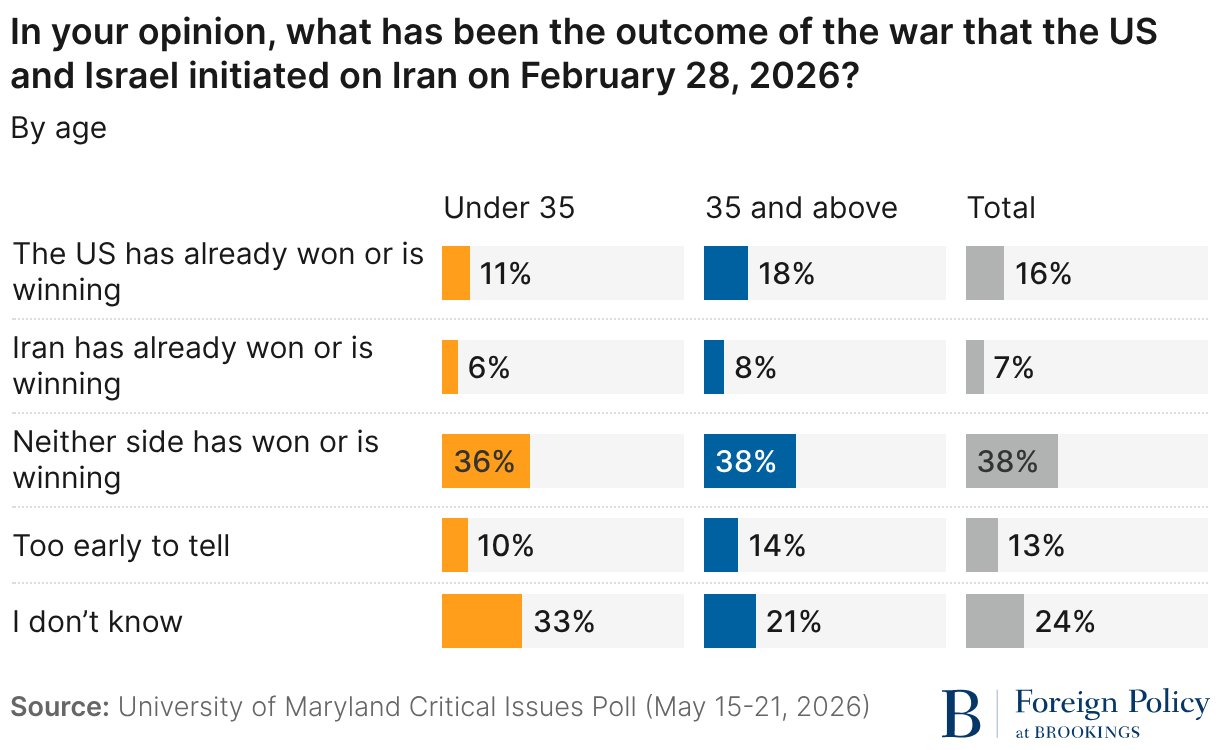
Overall, 38% of respondents said neither Iran nor the United States has won or is winning the war, including 56% of Democrats, 24% of Republicans, and 42% of independents. At the same time, a plurality of Republicans, 39%, say the United States has won or is winning, compared to only 1% of Democrats and 12% of independents. About a quarter said they didn’t know, while 13% said it’s too early to tell.
Fewer younger Americans (11%) tended to say that the United States has won the war or is winning compared to those 35 years old or over (18%), while a larger segment of younger Americans (33%) say they don’t know compared to those 35 years old and over (21%).
Context and implications
Before the war commenced on February 28, 2026, another poll we conducted from February 5-9 found that 21% of respondents, including a minority of Republicans (40%), backed a potential war with Iran. At the same time, only 30% of all respondents said such a war would serve American interests, including 34% of Republicans. Nonetheless, I concluded at the time that American attitudes were malleable, especially among Republicans, since President Donald Trump had yet to make a case for the war and nearly one-third of Americans said that they didn’t know whether they favored or opposed the United States initiating an attack.
Indeed, once the war started, there was some shift among Trump’s Republican base, with an early poll showing a majority of Republicans (77%) expressed support, compared to only 40% support before the war. Yet, there was no major national shift in the opposition to war as Democrats and independents, as well as a significant minority of Republicans, seemed to double down in their opposition despite a rally ‘round the flag expectation.
Indeed, polls have since been consistent in finding continuing American public opposition to the war and its consequences. In many ways, the outcome was predictable and predicted. As noted in the findings of the Middle East Scholar Barometer, which I codirect with Marc Lynch and surveyed academic experts before and just after the war began, only 5% of respondents supported launching a war, and just 1% thought that it would produce a pro-American democratic regime in Iran. Many international relations experts similarly warned that Iran would emerge stronger and that the war might end in a strategic defeat for the United States, with their views being echoed by influential critics of the war on the Republican right, including Tucker Carlson and Megyn Kelley, reaching parts of the president’s own political base.
Polls have not only shown robust public opposition to the war and lower approval of the president because of it, but also a rising assessment that the war has not gone well for the United States. An April Pew poll, for example, found that 51% of total respondents said American military action in Iran has gone “not too/not at all well.” This represented a six-percentage-point increase from responses to the same question in the previous poll in March.
Our latest poll brings home the rising public fear that, regardless of the war’s aims, the United States is not perceived to be winning. This view extends across all segments of the public, including Republicans over 35 years old, who have been generally more supportive of Trump. Moreover, Americans decidedly view the impact of the war to be detrimental to U.S. interests. It’s hard to imagine that extending the war further could reverse the tide of public attitudes.
Author

Related Content
The Brookings Institution is committed to quality, independence, and impact.
We are supported by a diverse array of funders. In line with our values and policies, each Brookings publication represents the sole views of its author(s).
Commentary
Most Americans say the Iran war is bad for America
Fewer than one in six Americans say the U.S. is winning the war
June 4, 2026