Small businesses form the backbone of our economy and job market. And over the past five years, they have been whipsawed by the pandemic, the rush of recovery funding that followed, sudden shifts in our industrial support and trade policies, and now a spike in fuel prices and huge economic uncertainties tied to global conflicts.
The resilience and success of our nation’s small businesses have never been more important, and that’s why it’s a big, missed opportunity that we don’t invest smarter in what works to support them: building local small business ecosystems to spark and accelerate entrepreneurial growth. Thankfully, this is a fixable problem, even as resources are constrained—and local leaders, especially at the county level, are showing the way.
Small business matters, in more and less visible ways
With more than 36 million firms employing over 59 million workers, small businesses account for 99.9% of all U.S. businesses and almost half of private sector employment.
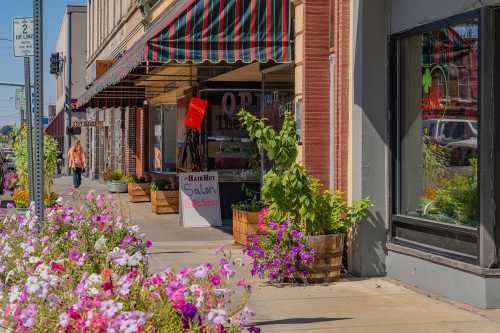
Nowhere is this more visible than in the communities that make up the real economy that most Americans experience day to day—on Main Street, not Wall Street. But small businesses, and the local “ecosystems” in which they succeed or fail, also play a unique role in economic transformation and growth. They are a primary source of net new job creation, which happens when firms grow, as well as a uniquely important pathway to wealth creation for their owners, a source of innovation in products and services, and a cornerstone of strong communities. Rigorous analyses consistently show that a dollar spent at a locally owned small business is much more likely to recirculate in a community than a dollar spent, say, at a chain store. Small businesses are the most likely to spend locally, employ local people, and model pride of place. They are the fabric and the weave.
We now have an opportunity to energize local places in ways that can restart the nation’s sluggish job market and expand the ownership economy, empowering millions of entrepreneurs and making them more resilient to shocks. But only if we’re clear-eyed about how inadequate our traditional approach to small business development really is.
The urgency of this moment
Over the past several years, trillions of dollars in public and private investment have been committed to expand and modernize energy, transportation, and other critical infrastructure, as well as manufacturing and other strategic sectors. If one includes massive capital investment in data centers to support AI deployment, that figure is even greater. Crucially, many of these investments are anchored in domestic supply chains and “Made in America” commitments, creating significant new demand for what small businesses (as well as larger incumbent firms) can offer.
Small businesses and local economies don’t entirely depend on those “strategic sectors” for growth, but making the most of them while also enabling as many promising Main Street businesses to survive and thrive is essential. And the success of those Main Street businesses depends in part on the success of the strategic, export-oriented enterprises that act as the engines of a regional economy.
The key lies in how that range of small businesses get the support they need and how communities build high-functioning small business ecosystems that collectively support the creation, survival, and growth of small businesses in a given place.
Developing an effective small business ecosystem is very different from America’s fragmented approach, wherein time-starved small business owners must navigate a maze of well-intended but disconnected (and sometimes irrelevant) “assistance” programs.
How ecosystems get built and who builds them
Building out the support systems that enable a wide range of small businesses to thrive and become more resilient to economic shocks might sound like a task for the local chamber or the nearly 1,000 federally funded SBDCs that provide entrepreneurs with counseling and training.
But when it comes to building systems of support, one unsung hero is county government. There’s a “Goldilocks” quality to county government: It’s not too big to navigate and not too small to matter when it comes to pulling disparate public and private capabilities and agendas together across a range of local marketplace players. And multiple counties coming together to drive inclusive economic development can be powerful too, as the business-led, cross-county partnership Greater St. Louis, Inc., illustrates.
America’s roughly 3,000 county governments are major providers of health care and other services, and during the pandemic recovery, counties collectively invested over $65 billion of federal funding in small business resilience and growth. Almost all counties sponsor economic development such as workforce development, large employer retention, and small business support, which can range from startup to expansion and from firms serving local retail customers to emerging providers of advanced products seeking out export markets.
Crucially, county governments are not just funders. They are also conveners of regional collaborations between the aforementioned players. They can play a “quarterback” role in ecosystem-building and foster coordination based on shared goals. Such teamwork is critical for building and sustaining effective small business ecosystems.
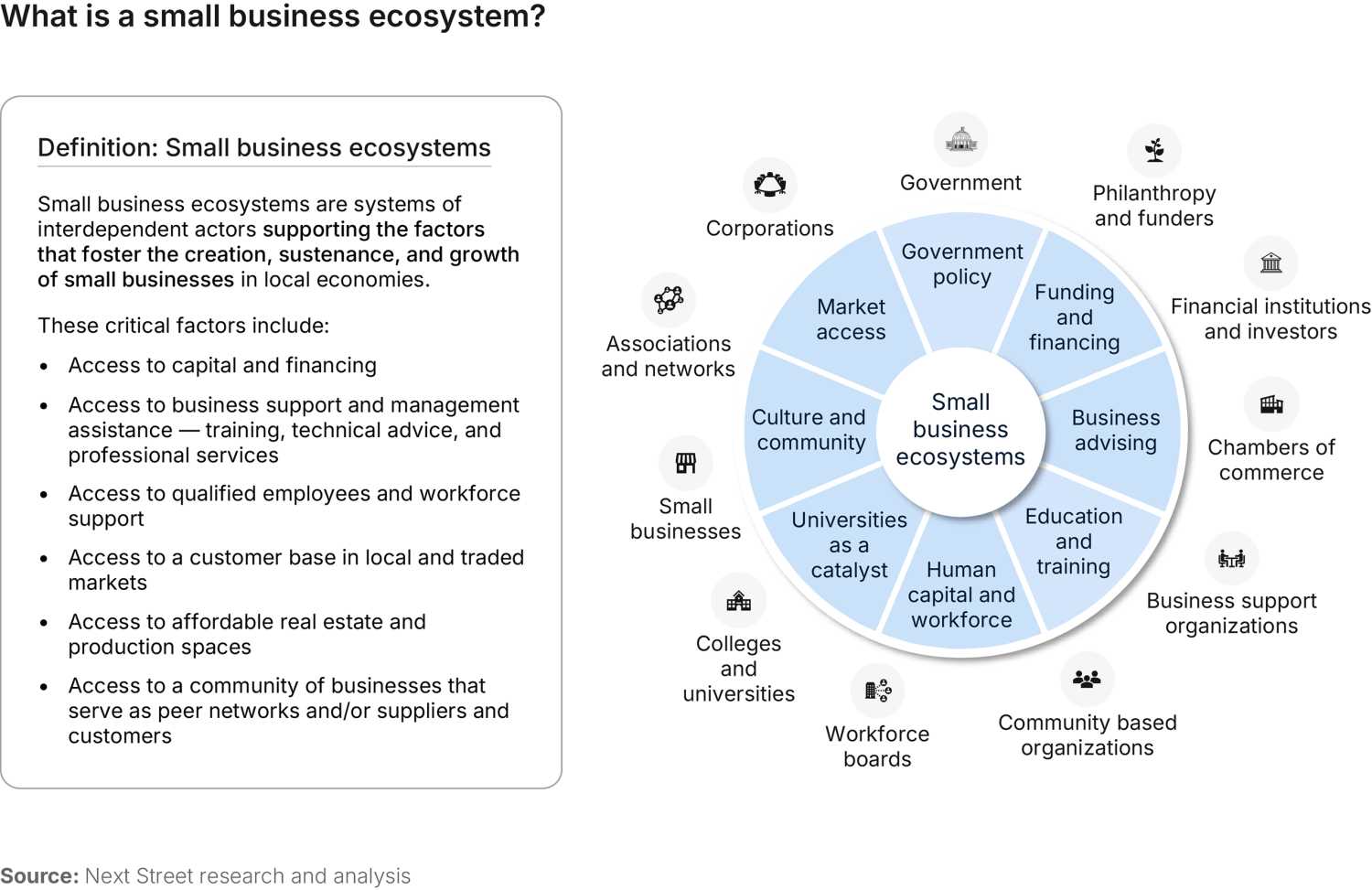
Regardless of who quarterbacks, functional ecosystems provide access to capital, access to a customer base (or several), business support and management assistance, workforce development strategies, affordable real estate, and peer networks of other entrepreneurs.
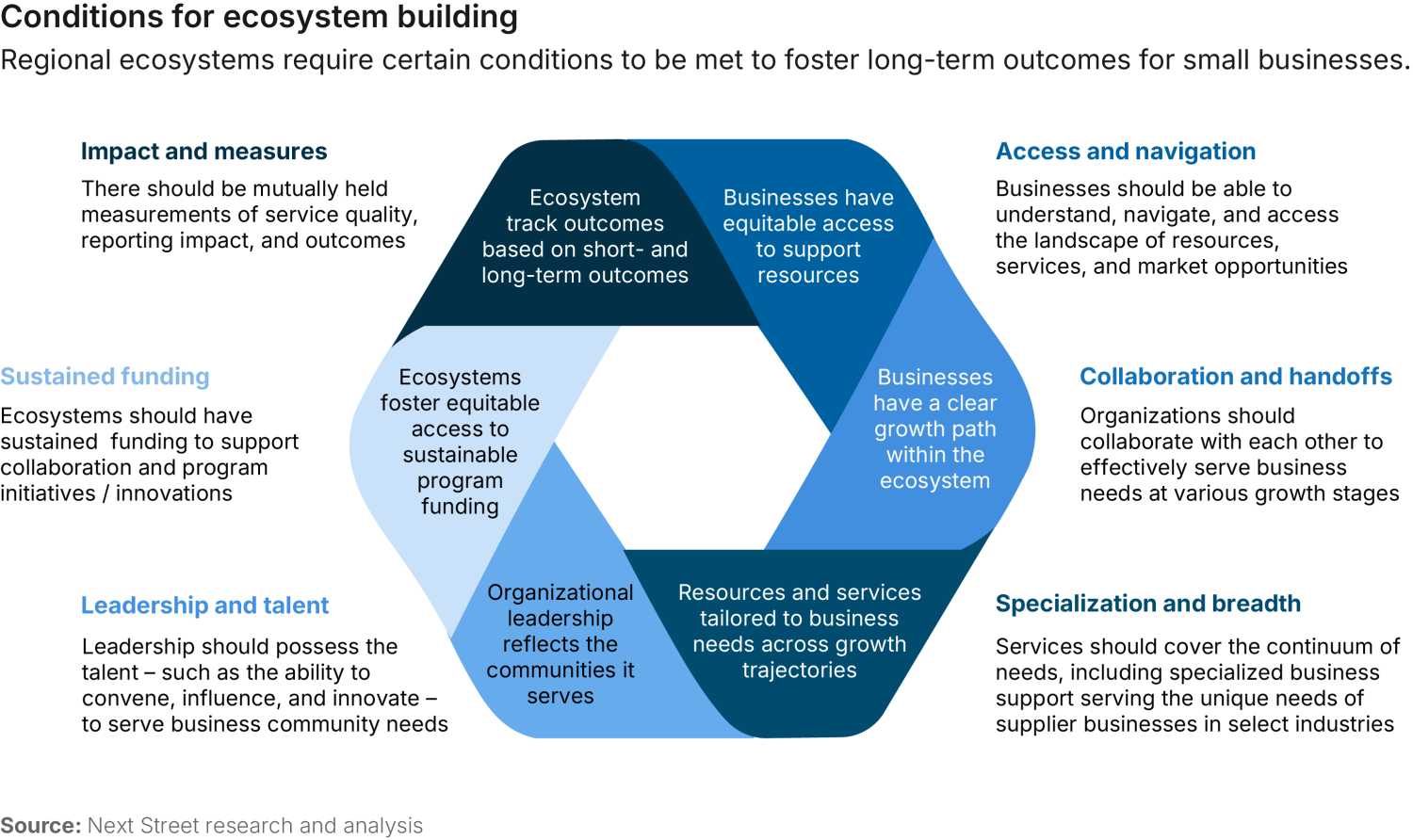
Ecosystems also need sustained and predictable funding to support collaboration, program initiatives, and innovation; leadership and support talent to convene, influence, and innovate in response to local needs; and shared measures of success to track progress and course-correct when needed (see Figure 2).
Traditional approaches have been both “one-size-fits all” and “come-one-come-all.” That inclusive mindset is laudable, but a deep evidence base confirms that without smart targeting, tailoring, and an orientation to outcomes, we cannot improve local economies or build family wealth on a broad basis.
Local innovation in action
We’re seeing focus, commitment, and advances across the country, sometimes with counties in support rather than driving roles, and resources coming from focused state governments, large companies, philanthropies, universities, or other stakeholders.
Greater St. Louis, Inc., is an integrated economic development organization that coordinated a regional jobs and business growth plan, with ecosystem-building as a pillar. A similar “Get in the Game” initiative is positioning entrepreneurs to win contracts as suppliers for the 2028 Olympics in Los Angeles. In Central New York and Greater Phoenix, Brookings researcher Joseph Parilla told us, “Purpose-built intermediary capacity is helping small businesses engage with large-scale industrial shifts.” Likewise, Mecklenburg County, N.C., centered on Charlotte, is organizing to support small businesses in response to major new public and private investments in manufacturing plants, electric vehicle adoption, infrastructure upgrades, and new logistics demands. And Cook County, Ill., home to Chicago, reinvented its approach to small business development and resilience—starting with the pandemic recovery—to focus on a targeted, ecosystem-driven strategy that has served over 40,000 businesses so far. (Disclosure: One of the authors, Conanan Johnson, supported the county’s effort.) As Cook County Board President Toni Preckwinkle emphasized, “The coordinated and data-driven approach to supporting small businesses represented a fundamentally new model.”
Not every region will get to host global sporting events or the massive new computer chip fab plants like those sprouting up in Central New York and Phoenix, of course. What’s replicable is creating effective ecosystems rather than continuing the status quo of disconnected assistance programs. The results are beginning to speak for themselves: more revenue, better small business survival rates, expanded pools of local suppliers, more vibrant and resilient Main Streets, and more.
Looking ahead
Building a strong small business ecosystem is foundational to transforming local economies for growth as well as for resilience to shocks. Doing that at scale will require prioritization, collaboration, patience, and innovation, as these examples show. But above all, it requires seeing small business not as peripheral to growth, but as one of its most important drivers—and at the same time recognizing how inadequate our traditional approach to small business support has been.
Authors


The Brookings Institution is committed to quality, independence, and impact.
We are supported by a diverse array of funders. In line with our values and policies, each Brookings publication represents the sole views of its author(s).