
The public health case for later high school start times is well established. Sleep cycle changes during puberty make adolescent learning difficult early in the morning, and too-early start times have been associated with a slew of issues from poor grades to increased anxiety and depression—and even car accidents among teens. The American Academy of Pediatrics recommends that high schools begin no earlier than 8:30 a.m. As of 2021, less than 30% of public high schools complied.
The gap between recommendation and practice is, at least partly, operational. Roughly half of public school students ride a school bus, and districts often manage fleet costs by staggering start times so that a single bus can serve two or three schools. Moving one high school schedule later can mean either moving an elementary or middle school schedule earlier (disruptive) or buying more buses (expensive). In 2014, Montgomery County Public Schools in Maryland estimated that a 50-minute delay in high school start times would cost roughly $21 million per year. The district ultimately moved start times just 20 minutes later instead. More recently, Florida repealed its later-start law over concerns about cost and implementation.
Districts therefore face what can appear to be major tradeoffs between adolescent health and transportation spending. Recently, we worked with San Francisco Unified School District (SFUSD) to see if we could help the district manage these tradeoffs.
Changing school start times is hard, in theory and in practice
Operations researchers have studied school bus scheduling for decades. Bus schedules create mathematically complex problems, because there are too many potential scenarios to evaluate (even with very fast computers). This problem grows even more complex if we treat start times as a variable that can be changed.
Part of that complexity comes from the implications of start-time changes for various stakeholders. How would a change affect parents, especially those with multiple children in school? How would it affect after-school programs? Teachers and staff? Athletics? Changing school start times is difficult because it layers a hard policy problem on top of an already-hard operations problem.
A well-documented example comes from Boston Public Schools (BPS). In 2017, BPS worked with a research team (including two of us) on bus routing and bell times. The routing work was implemented and took 50 buses off the road, saving $5 million. The bell-time proposal didn’t fare as well. Despite the proposed bell times coming from a carefully designed model—and being approved unanimously by the school committee—the proposal was ultimately withdrawn due to community opposition. Subsequent commentary emphasized that stakeholders didn’t have enough visibility into the tradeoffs considered by the optimization model.
Giving district leaders options empowers them to make better decisions
In December 2020, SFUSD was searching for ways to comply with a 2019 state law, Senate Bill 328 (SB 328), that required later middle and high school start times. They had to do this with an already-strained budget. They reached out to us, knowing that we had worked on related issues in Boston. Informed by our Boston experience, we emphasized that no mathematical model could identify a single-best schedule. Rather, carefully designed models could inform policymakers’ discussions with constituents, helping them work toward a schedule the community would accept.
Initially, SFUSD leaders stated three objectives: compliance with SB 328, low transportation costs, and minimal disruptions to the existing schedule. Rather than trying to create a single-best schedule, we created about a thousand potential schedules that differed in their specifications (e.g., allowable start times). The key insight was that costs could be comparable even if the start times of a couple dozen schools changed. Having several viable options empowered district leaders to work with the community to find the option that fits them best.
Of course, comparing a thousand schedules is easier said than done. But we displayed all these schedules in a spreadsheet that allowed users to trim and sort the options based on their preferred specifications (Figure 1). A key feature of the design was that it made the interdependence of school start times visible. When stakeholders advocate for a time change at one school, the tool shows which other schools must shift their times to keep costs constant. (We don’t mean to suggest this tool is the only or best way of doing this; it’s an illustration of what’s possible.)
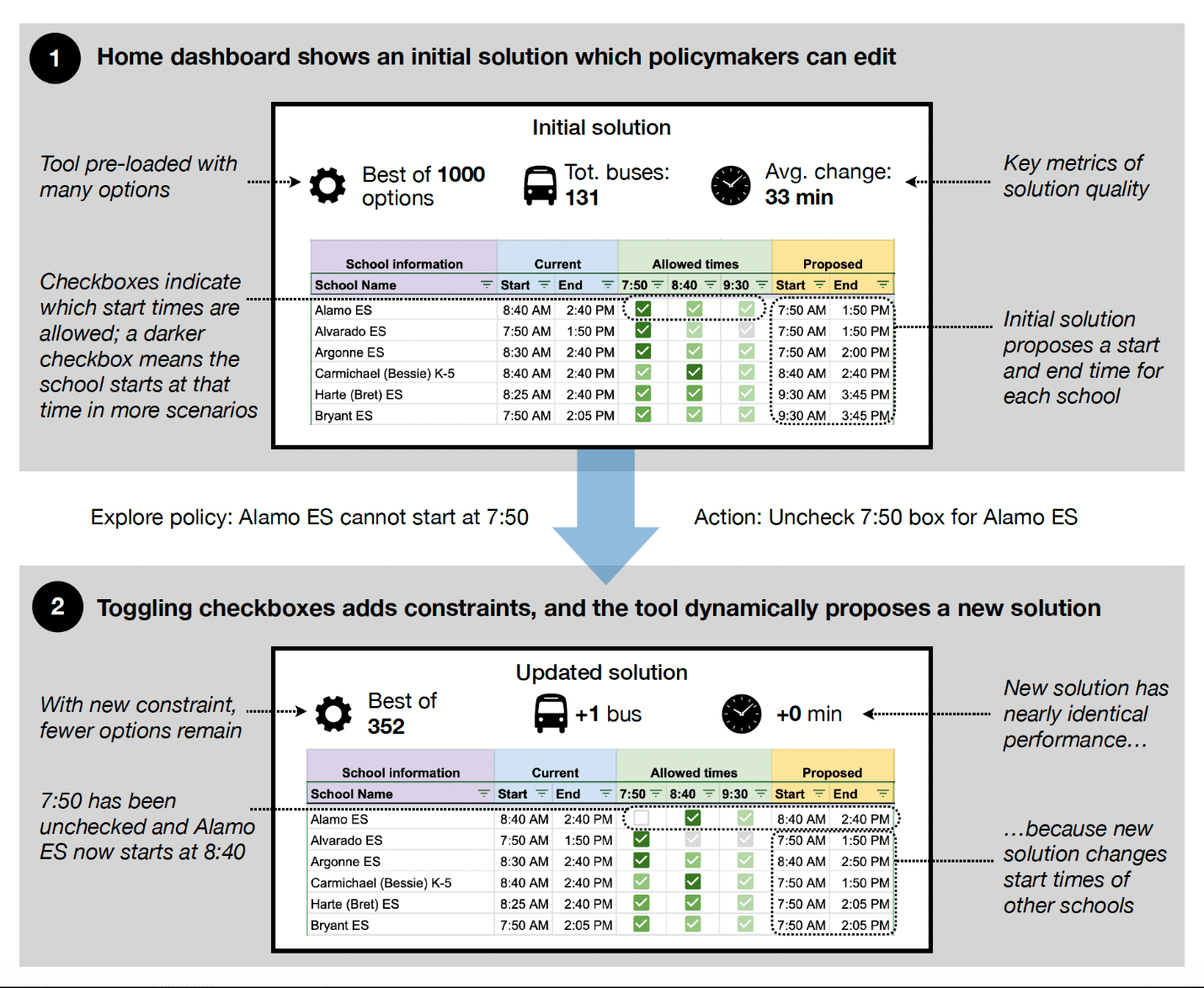
Source: Delarue, A., Lian, Z., & Martin, S. (2026). Algorithmic precision and human decision: A study of interactive optimization for school schedules. Management Science, 72(1), 148-166.
Ultimately, SFUSD chose an approach that aligned end times at neighboring elementary schools so that staff could share professional development time. They adjusted weekly instructional time to produce more consistent end-time patterns. And they sought to minimize the number of schools with start times that changed by more than 50 minutes. None of these objectives had even appeared in our model, because district leaders either didn’t know about them ex ante or didn’t think they could be accomplished. This is not to say that SFUSD leaders were unaware of their community’s needs. Rather, it showed us that it’s much easier to solicit community feedback when presenting real options rather than abstract questions.
Outcomes and survey evidence
When San Francisco schools reopened in fall 2021, we saw the operationalization of these decisions. All 133 schools had one of three start times: 7:50 a.m., 8:40 a.m., or 9:30 a.m. All middle and high schools began at 8:40 a.m. or later.1 Annual transportation costs fell by approximately $5.5 million.
At the same time, transition to the new schedule was not painless. The following spring, we surveyed about 24,000 families and 3,551 staff members at affected schools. Roughly 6,400 parents (26.7%) and 1,522 staff (43.7%) responded. A slight majority of parents reported being at least somewhat satisfied with their school’s new start time, and 37% were very satisfied. Even so, 23% were very unsatisfied. Most very unsatisfied respondents said they would have preferred another start time, a reminder that consensus can be hard to reach even within a single school. Others were very unsatisfied despite receiving their “first choice” start time, which suggests they might be more dissatisfied with the process than the outcome.
Implications for districts and states
Drawing conclusions from a single experience with a single district is challenging, and there were some idiosyncrasies involved here. For example, this work coincided with in-person school reopenings following COVID-19, and most of SFUSD’s transportation services target students with disabilities. Nevertheless, we think this experience offers lessons for districts that might consider schedule changes of their own, including later start times for older students.
First, district leaders should leave time for “objective discovery,” or finding out what stakeholders care about most. And they should understand that presenting real options—rather than hypothetical questions—helps to gather actionable feedback.
Second, they should strive to communicate about the ripple effects of changing a start time at just one school. Seeing a system’s interdependencies can help district leaders and community members work toward a solution that works broadly, not just in one place.
Third, district leaders should understand that the field of possibilities is likely broader than they realize. Moreover, being open to a schedule that is only slightly more expensive than the cheapest option can open up many intriguing alternatives.
Related Content



Authors


-
Footnotes
- SFUSD also had four K-8 schools. Their start-time change was delayed to fall 2022.
The Brookings Institution is committed to quality, independence, and impact.
We are supported by a diverse array of funders. In line with our values and policies, each Brookings publication represents the sole views of its author(s).