A growing immigration enforcement crisis faces the nation as communities across the country are being targeted by the aggressive implementation of deportation policy. Several cities facing challenges from Immigration and Customs Enforcement (ICE) actions are filing lawsuits to stop raids in their jurisdictions, limit federal enforcement power, and oversee ICE procedures, including requiring that ICE agents do not wear masks to cover their faces. High numbers of deportations are not new to the nation, but the direct conflict between federal agents and state governments, along with video footage of protesters being shot by ICE agents, marks this as a unique period in history.
The consequences of militarization on communities
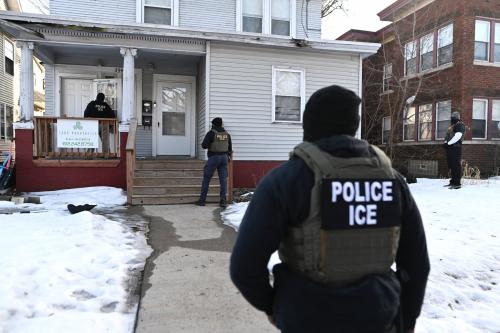
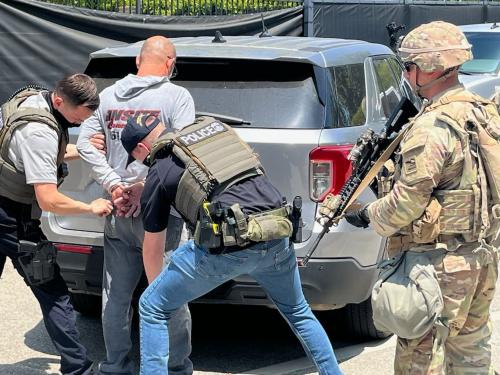
Millions of Americans are experiencing indirect harm from viewing images of violent incidents involving ICE agents. Social media is flooded with videos of masked federal agents in tactical gear breaking windows, pulling individuals from vehicles, and pointing weapons at protesters. NPR has covered this issue extensively, documenting social media evidence of ICE using excessive force against a growing number of residents. Exposure to these images across news and social media platforms amplifies the impact of police brutality to a national scale.
Public opinion does not support these actions. A CNN poll found that 56% of adults believe the ICE agent’s use of force in the shooting of Renée Nicole Good in Minneapolis was “inappropriate,” while only 26% felt it was “appropriate.” This is consistent with registered voter polls from Quinnipiac University and Yahoo News-YouGov, which found that a majority of voters believe this shooting was not justified. Furthermore, Americans are 20% more likely to believe that ICE enforcement actions make cities less safe than more safe. The shooting of Alex Pretti has also generated significant criticism following the release of eyewitness accounts and videos. This shift in public sentiment likely contributed to the recent dismissal of Kristi Noem as secretary of the Department of Homeland Security (DHS).
These incidents, driven by shifts in policy and enforcement activities, will likely have a marked impact on Americans’ views toward law enforcement and a lasting negative impact on communities long after the Trump administration leaves office. In research focused on the implications of Black Lives Matter (BLM) protests in St. Louis and Baltimore, contributors to this series found that exposure to excessive force from law enforcement leads to negative outcomes, including diminished trust in police and increased stress and other mental and physical health challenges. This triggers shifts in behavior, particularly in communities targeted by federal immigration activity, where residents are less likely to report crimes to the police due to a lack of trust.
Disrupting social norms
The actions of ICE agents and statements from the Trump administration have radically shifted several societal norms. These include eroding law enforcement transparency, diminishing accountability for due process violations, and undermining public trust by forcing residents to prove they belong in the United States.
A fundamental principle of law enforcement is the tradeoff between public accountability and the authority granted to officers to use their weapons when warranted. Unfortunately, residents have become accustomed to seeing aggressive force and the militarization of their cities. This may explain why even basic legislation requiring officers to show their faces has become necessary.
The use of face masks and unmarked vehicles by ICE officers challenges the public’s ability to verify the identities of these federal agents, directly undercutting accountability. This led 21 states in July 2025 to formally request that Congress pass legislation restricting federal agents from wearing face coverings and requiring them to display identification and agency designations on their vehicles. Since then, more than 30 states have introduced bills restricting law enforcement officers’ use of facial coverings.
More alarming than the actions themselves is the messaging from the White House, which reinforces an ideology of limited accountability for ICE actions. Following the fatal shooting of Renée Good in Minneapolis, Vice President JD Vance suggested that federal agents possess “absolute immunity.” This aligns with a broader push by the Trump administration to shield ICE from state-level prosecution and penalties, even in cases involving alleged violations of due process.
Throughout the country, residents now encounter checkpoints where they face potential detention based on skin color, language, or accent. This directly challenges the societal norm and legal requirement that law enforcement must have probable cause to execute a search, arrest, or detention. As discussed in a prior article, the Supreme Court’s decision to allow racial profiling for identifying noncitizens has led to a growing number of U.S. citizens being targeted by ICE, resulting in arrests, detentions, and documented violations of due process.
The Trump administration is reinforcing this shift in societal norms by placing the burden on citizens to provide documentation of their status. Former Secretary Noem stated that Americans should be prepared to prove their citizenship if approached by ICE agents. Fears regarding ICE detention regardless of citizenship status are supported by data suggesting that in the first nine months of the second Trump administration, as many as 170 U.S. citizens were detained. Because the government does not explicitly track the number of citizens detained by ICE, the total is likely higher following an escalation in raids and public unrest.
The administration is also exponentially expanding DHS capacity to execute immigration crackdowns in more cities nationwide. In July 2025, Congress passed the One Big Beautiful Bill, providing DHS with more than $170 billion to expand detention and deportation infrastructure, and the current DHS appropriations bill—itself the subject of a contentious political struggle causing an ongoing partial government shutdown—aims to allocate even more funding.
Beyond budget increases, the Trump administration has already begun repurposing personnel; amid the current government shutdown, ICE agents have been deployed to major airports to handle passenger ID verification and other TSA-related duties. This precedent of using immigration enforcement for domestic civil oversight raises a chilling possibility: the potential redirection of these agents to monitor other sensitive civic spaces, such as polling locations.
Policy action is required to address the long-term effects
Policy action is urgently needed to address the challenges in communities impacted by federal encroachment into immigration enforcement. Critical solutions include raising officer hiring standards by cross-checking federal recruit files with state-level misconduct records and establishing a duty to intervene, which mandates that agents stop colleagues from using excessive force. These recommendations align with established policy frameworks designed to address use-of-force issues across all law enforcement agencies.
States are increasingly taking action to limit federal reach. New Mexico, for example, recently enacted the Immigrant Safety Act, which prohibits state and local governments from entering into agreements to detain individuals for civil immigration violations. The law also bans 287(g) agreements, which deputize local law enforcement to perform federal immigration functions, and bars the use of public land for immigration detention. This serves as a model for other states seeking to place limitations on an immigration infrastructure that currently receives significantly more funding than other areas of law enforcement.
Many of these supportive policies were implemented across the country following the BLM movement and the push for police reform. Yet, 2025 remained one of the deadliest years on record for police killings. The disruption of these societal norms suggests that the democratic commitment to civil and human rights is fracturing.
As state and local governments navigate the intersection of federal immigration enforcement and municipal public safety, several policy frameworks have emerged to address these jurisdictional challenges. These measures aim to restore the administrative norms and community trust essential for effective law enforcement.
- Independent oversight mechanisms: Creating civilian review boards to include an audit function for federal operations within local jurisdictions. These boards provide a transparent venue for receiving and reviewing community complaints. This ensures that coordinated enforcement actions, including those involving ICE and Border Patrol, remain subject to public accountability.
- Strengthening congressional access: Codifying the right of members of Congress to conduct unannounced oversight visits to federal detention facilities, facilitating legislative monitoring of detention conditions and agency compliance with federal standards.
- Mitigating community-level impacts: Developing social-service interventions to address the secondary effects of enforcement. This includes allocating resources for educational recovery in impacted school districts and expanding access to trauma-informed mental health care to stabilize community well-being.
While trust between law enforcement and citizens has fallen to historic lows, concrete policy action can repair the bonds that hold communities and democratic institutions together.
Related Content
Authors


The Brookings Institution is committed to quality, independence, and impact.
We are supported by a diverse array of funders. In line with our values and policies, each Brookings publication represents the sole views of its author(s).
Commentary
ICE is disrupting societal norms and democratic ideals
March 30, 2026