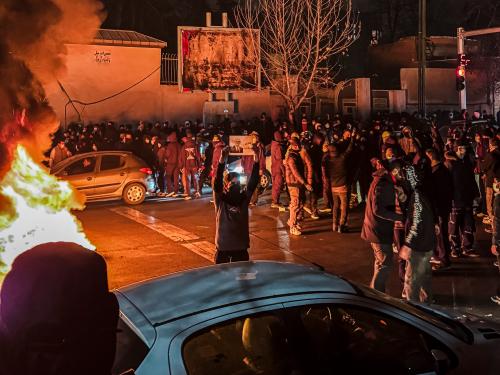
As Iranian authorities kill thousands of protesters and U.S. President Donald Trump considers military action, China’s Ministry of Foreign Affairs finds itself on the sidelines, calling for calm. To be sure, China has considerable interests in Iran, but those interests are not existential or even critical. This reflects an asymmetry in the Sino-Iranian relationship: China is much more important to Iran than vice versa. Beijing will be unsentimental about events inside Iran and about the fate of Iran’s current regime. For China, its interests in Iran will be focused on protecting stability, ensuring continuing access to Iranian oil exports, and seeking to prevent the emergence of a pro-American regime in Tehran.
If Iran’s regime eventually falls, China’s leaders could grow more concerned about the aftershocks inside China than outside of it. As the Arab Spring and other events have shown, China’s leaders are deeply sensitive to images of popular protests leading to regime collapse, even more so when the United States is perceived to play a role.
Iran as a mid-tier partner for China
Iran and China established diplomatic ties in 1971. In 2016, they elevated the relationship to a comprehensive strategic partnership during Xi Jinping’s visit to Saudi Arabia, Egypt, and Iran. That 2016 visit, during Xi’s first term and nearly a decade ago, was his last official visit to Iran. This time gap stands in contrast to the number of times Xi has visited other key countries and states along China’s periphery during that period.

The last Iranian head-of-state visit to China occurred in February 2023. During that visit, Xi and Iran’s then-President Ebrahim Raisi discussed advancing relations strategically and “opposing external forces interfering in Iran’s internal affairs.” This conversation occurred against the backdrop of the Biden administration’s sanctions on Iran and at a time when U.S.-China relations were reeling from the aftershocks of a Chinese spy balloon that had violated American airspace.
Beijing and Tehran’s comprehensive strategic partnership puts China’s relationship with Iran on par with its relationships with the European Union, Saudi Arabia, and the United Arab Emirates. However, China’s relationship with Iran falls below China’s “all-weather strategic partnerships” with Russia, Pakistan, and others.
For China, economics trump security in Iran
China values its relationship with Iran for three primary reasons: first, Iranian exports of oil and gas support China’s energy security; second, Iran’s adversarial relationship with the United States diverts American attention and resources that otherwise could be trained on countering China; and third, Iran serves as an entry point for China to assert greater influence in Southwest Asia. Iran has enabled China to diversify its supply of oil and gas and avoid becoming overdependent on Russia, Saudi Arabia, or others for imports.
Beijing and Tehran deepened their economic relationship in 2021 during Chinese Foreign Minister Wang Yi’s visit to Tehran. During that visit, the two countries signed a “25-year cooperation agreement.” This deal, almost entirely economic, committed China to invest $400 billion in Iran over 25 years in exchange for continued access to Iranian oil supply. This agreement is widely interpreted as an effort to keep Iran’s economy afloat in the face of American sanctions after Washington’s withdrawal from the Joint Comprehensive Plan of Action. China’s pledges of major investments in Iran have not materialized at the expected pace.
This has been a source of frustration for Iran’s leadership, especially since the structure of the Sino-Iranian bilateral trade relationship is markedly uneven. In 2025, Iran exported more than 80% of its oil to China, while China’s imports of Iranian crude oil represented 13.4% of its overall imports by sea. Moreover, the main Chinese consumers of Iranian oil are independent teapot refineries, which operate on razor-thin margins and depend on imports of discounted oil from sanctioned countries such as Iran, Venezuela, and Russia to stay afloat. These teapot refineries are mostly clustered in Shandong province and generally are not viewed as national priorities by Beijing.

Iran was a recipient of Chinese development financing to construct the recently launched Qom-Yiwu rail freight train, which will connect the central Iranian city of Qom to Yiwu, China. The train will increase trade between China, Iran, and Central Asia by standardizing the rail corridor through the region. Overall, however, Iran does not stand out as a major recipient of Chinese development financing. It falls within the middle tier of Beijing’s overseas lending recipients.
Beijing and Tehran also maintain a security partnership. Their elevation of relations to a comprehensive strategic partnership included agreements to jointly target terrorism, illegal immigration, and transnational and organized crime. The 25-year cooperation agreement also included a statement to strengthen military and security cooperation via military exercises and intelligence-sharing to combat terrorism. China and Iran also consistently participate in naval exercises with Russia, including most recently in a BRICS Plus naval operation near South Africa.
Beijing balances this security cooperation with its relationships with the Gulf states, Israel, and the United States. While China has not offered Iran any security guarantees, Beijing has sold air defense systems, anti-ship missiles, ballistic missile components, and dual-use items, including precursors to support Iran’s missile propulsion and guidance systems. Beijing also provides technical assistance and training to Iran. In return, Iran provides China with deeply discounted energy supplies, diplomatic alignment, access to infrastructure, and opportunities for expanded maritime coordination, including in the Persian Gulf.
The limits of China’s support for Iran’s security were apparent in June 2025. After the United States struck Iran’s nuclear sites, Beijing’s response was largely rhetorical. The Chinese ambassador to the United Nations, Vice Minister Fu Cong, denounced the attack as a serious violation of the U.N. Charter, and the Chinese Ministry of Foreign Affairs spokesperson later reiterated that China stands ready to support communication and peacemaking between Iran and “other relevant parties.” On a call with Iranian Foreign Minister Abbas Araghchi, Foreign Minister Wang Yi conveyed China’s interest in serving as “a builder of peace and a promoter of stability in the Middle East,” without offering any tangible support toward that objective.
Reflecting China’s relatively narrow interests and competing priorities, Chinese analysts have long described China’s relationship with Iran as “strategic opportunism.” The absence of productive U.S.-Iran relations affords China a low-cost opportunity to extract benefits from Iran.
Anticipating Beijing’s reaction to Iranian protests
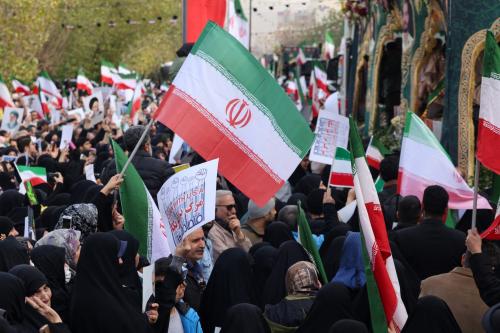
The current configuration of power in Iran serves China’s interests. As Wang expressed in a readout of his January 15 call with his Iranian counterpart, Beijing hopes that the Iranian government and people will “stand united, overcome difficulties, maintain national stability and safeguard their legitimate rights and interests.” Wang’s outreach signaled Beijing’s political support for the regime.
Similarly, Chinese national media reinforced this stance by amplifying narratives that emphasize domestic approval for Iran’s leadership and reframe the unrest as the result of U.S. “cognitive warfare.” Beijing has also provided surveillance technology to help Iranian authorities control information flows and modeled how to exercise full control over a country’s internet service. Beyond these steps, however, Beijing has limited policy tools to shield the Iranian regime from public protests.
If Iran’s current governing structure collapses, Beijing will pragmatically move to protect its people, companies, and investments. It will aim to secure uninterrupted oil flows, encourage rapid efforts to bolster domestic stability and limit external spillover, and cultivate influence with the successor government, particularly to prevent a realignment toward the United States.
Beijing would also attempt to mitigate the risk of Iran becoming a flashpoint in U.S.-China relations. Stable ties with Washington remain a priority, particularly as China wants to use Trump’s planned April visit to China to secure economic and strategic relief from American pressure. Beijing will be loath for events in Iran, Venezuela, or elsewhere to interfere with these higher objectives.
A regime collapse in Tehran would likely not significantly weaken China’s strategic position in the Middle East, as Yun Sun explored in 2024. Even a temporary disruption to Iranian oil exports to China would be manageable. China has ample strategic petroleum reserves and could replace Iranian supply with oil from alternative sources, including Russia, Saudi Arabia, Iraq, Brazil, the United Arab Emirates, and Oman. In such circumstances, Beijing may be forced to pay more for oil imports; teapot refineries could also face a financial squeeze. Losing a reliably anti-American partner in the Middle East would be uncomfortable, but it would not present a crisis for Beijing.
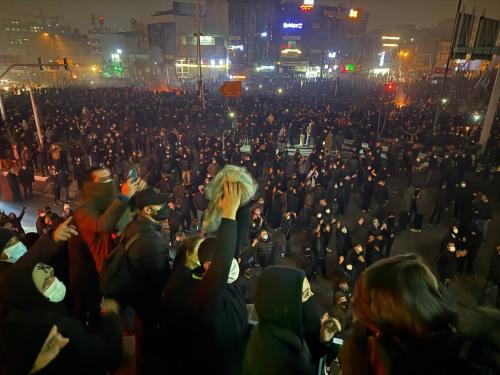
The greater concern for China’s leaders would be intangible: images of popular protests deposing an entrenched regime. Such scenes could reactivate the neuralgias that were evident in Beijing during the color revolutions in the former Soviet Union and the Arab Spring. A successful uprising would also expose the limits of repression for stamping out calls for political reform. China’s leaders could respond by tightening domestic surveillance, social media monitoring, and the visibility of the public security presence to quash any rumblings of organized dissent.
At present, there are no signs of elevated levels of public protest inside China against the Chinese Communist Party. We are not forecasting that events in Iran will inspire Chinese citizens to launch similar political protests inside China. Even so, Beijing’s leaders likely will leave nothing to chance when it comes to upholding domestic stability.
Even though China’s leaders would prefer to see Iran’s current political regime remain in place, they could manage a change in leadership in Tehran. What they would not tolerate is any attempts to use events inside Iran to encourage similar protests inside China. Iran is not existential for China’s leaders. Domestic stability is.
Authors


Related Content
The Brookings Institution is committed to quality, independence, and impact.
We are supported by a diverse array of funders. In line with our values and policies, each Brookings publication represents the sole views of its author(s).
Commentary
How is China positioning itself as Iran’s regime teeters?
China has considerable interests in Iran, but those interests are not existential or even critical.
January 27, 2026