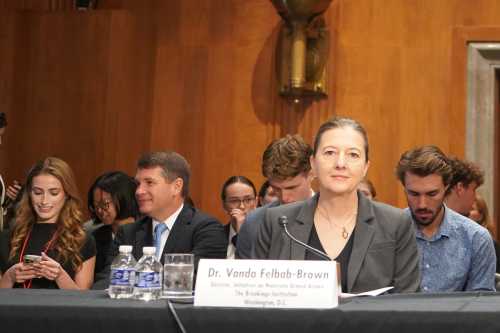
Vanda Felbab-Brown testifies before the U.S. Senate Caucus on International Narcotics Control on “Dirty Money: Chinese Organized Crime in Latin America.” Below is her delivered testimony in full, lightly edited for style.
Dear Chairman Cornyn, Co-Chair Whitehouse, and distinguished members of the caucus,
Thank you for holding this hearing entitled “Dirty Money: Chinese Organized Crime in Latin America.” This is a crucial issue that deserves the attention of the Senate Caucus on International Narcotics Control and its members. I am honored to have this opportunity to submit this testimony as a statement for the record.
I am a senior fellow at the Brookings Institution, where I direct the Initiative on Nonstate Armed Actors and the Brookings series, the Fentanyl Epidemic in North America and the Global Reach of Synthetic Opioids, and codirect the Africa Security Initiative. Illicit economies, such as the drug trade and wildlife trafficking, organized crime, and corruption, and their impacts on U.S. and local security issues around the world are the domain of my work and the subject of several of the books I have written. I have conducted fieldwork on these issues across Latin America as well as in Asia, Africa, and the Middle East. I have been studying Chinese criminal networks operating in drugs, wildlife trafficking, logging, and mining and money laundering since 2008 and extensively written about those issues in books, such as “The Extinction Market: Wildlife Trafficking and How to Counter It,” and reports such as “China and Synthetic Drugs Control: Fentanyl, Methamphetamines, and Precursors” and “China’s Role in Poaching and Wildlife Trafficking in Mexico.”1
The Brookings Institution is a U.S. nonprofit organization devoted to independent research and policy solutions. Its mission is to conduct high-quality, independent research and, based on that research, to provide innovative, practical recommendations for policymakers and the public. The testimony that I am submitting represents solely my personal views, and does not reflect the views of Brookings, its other scholars, employees, officers, and/or trustees.
Over the last two decades, Chinese actors have expanded their illicit activities in Latin America and the Caribbean, often taking advantage of the expansion of Chinese legal businesses and trade with the region. The presence of Chinese criminal groups has also grown, sometimes exploiting Chinese diaspora communities in the region. Their activities span a wide spectrum of crimes — from drug trafficking to money laundering, extortion, human smuggling, and illegal fishing, logging, mining, and wildlife trafficking. Chinese drug trafficking networks continue to be the principal suppliers of precursor chemicals for the production of methamphetamine and fentanyl to Mexican cartels that produce both drugs in Mexico. And Chinese money laundering networks have become the go-to money launderers for the Mexican cartels.
Like other criminal groups in Latin America, the illicit activities perpetrated by Chinese actors present multifaceted threats and harms to the rule of law, economic well-being and sustainability, biodiversity and environmental conservation, public health, and public security.
Unlike most other criminal actors in the Hemisphere, however, some Chinese criminal groups and activities also serve to advance the diplomatic influence and economic interests of the Chinese government. That limits the interest and willingness of the government of China to counter such corrupt practices and illegality.
That said, most criminal activities in the region are perpetrated by Latin American groups, and the violence perpetrated by Chinese criminal networks represents a very small fraction of the criminal violence that plagues the region. By and large, Chinese criminal networks operate through corruption and partnerships with local networks, rather than the extraordinary violence perpetrated by Mexican, Colombian, or Ecuadorian criminal groups.
Crucially, illicit activities by Chinese actors are perpetrated not solely by outright criminal groups, but also by Chinese legal companies that employ corruption and/or act in violation of laws and regulations and are indifferent to the harmful effects of their activities. Various non-Chinese businesses, of course, also operate in those nefarious ways in Latin America and the Caribbean. But the size of China’s trade with Latin America and the Caribbean, which has grown from $12 billion in 2000 to $489 billion in 2023 and is expected to reach at least $700 billion in 2035,2 and of China’s demand for Latin American natural resources make the impact of illicit behavior particularly pronounced. An extensive Chinese presence in Latin American ports that fails to implement transparency and accountability principles, diligent application of the rule of law, and unbiased law enforcement generates further risks.
At the same time, China has expanded its law enforcement assistance programs in Latin America and the Caribbean. Yet China’s law enforcement cooperation is often skewed, one-sided, and self-serving. Chinese anti-crime technology systems, which risk augmenting the violations of human rights and civil liberties, enhancing repression, and serving as a backdoor for espionage, have become popular across the region.
Yet there are many opportunities to counter Chinese criminal networks and corruption systems in Latin America and the Caribbean and productively engage the Chinese government in such efforts, as I lay out in the policy recommendations section of the testimony.
In its subsequent parts, I provide a very quick overview of the panoply of criminal groups in Latin America and the Caribbean and highlight and detail the role of Chinese networks in:
- Drug trafficking in the region.
- Money laundering.
- Illegal, unreported, and unregulated (IUU) fishing.
- Wildlife trafficking.
- Illegal logging and mining.
- Human smuggling.
In discussing these illicit economies, I lay out the threats and harms they pose.
In the section on the crime-state nexus, I also sketch the complex connections between some Chinese criminal groups and Chinese authorities and then outline the risks associated with the expansive role of Chinese businesses in Latin American and Caribbean ports.
Next, I describe the expansion of China’s law enforcement efforts in Latin America and the Caribbean. I also detail the circumstances under which Chinese law enforcement actors take actions against Chinese criminal activities.
I conclude with a detailed set of policy recommendations. They include:
- Helping state authorities in Latin America and the Caribbean to develop law enforcement tools against Chinese criminal networks.
- Encouraging the adoption of U.S. anti-crime and port monitoring and operations technology as alternatives to Chinese systems such as Safe Cities.
- Dismantling Chinese money laundering networks.
- Countering Chinese criminal groups’ operations beyond drugs.
- Building clean, transparent, and traceable supply chains.
- Reducing corruption and patronage systems and establishing apolitical, independent legal systems.
- Scrupulously adhering to human rights and civil liberties protections, avoiding any kind of vilification of Chinese communities, and holding law enforcement accountable.
- Adopting comprehensive, sustainable socioeconomic anti-crime policies.
- Strengthening U.S. domestic resources, institutions, and laws for such support systems in Latin America and the Caribbean.
- Helping Latin American and Caribbean governments and investigative systems, such as investigative journalists, to encourage China to take enforcement actions against criminal behavior by Chinese entities in the region.
- Expanding U.S.-China counternarcotics cooperation and reviving the Global Coalition to Address Synthetic Drug Threats.
A panoply of Chinese actors involved in criminality
Today, Chinese criminal groups are present in most, if not all, Latin American and Caribbean countries. Some of these groups are large and notorious, such as the 14K Triad, Sun Yee On Triad, and the Fujian Mafia; others are medium-sized operations, such as Guangzhou Enterprise, operating in Colombia. Others yet are small family-based networks that, despite sometimes grandiose names such as the Zhang Cartel (which has smuggled fentanyl precursors to Mexican drug trafficking organizations), may consist of only a handful of individuals. Other groups include Flying Dragons, Tai Chen, and Fuk Ching groups.3
The exact panoply of Chinese criminal groups in Latin America and the Caribbean is hardly known. Law enforcement agencies in the region often lack the investigative and linguistic resources to uncover and truly analyze Chinese criminal networks. Many nongovernmental actors in the region simply tend to label any Chinese criminal entity as “Chinese Mafia.” A good understanding of networks, identities, and relationships is woefully lacking across the region.
As is typical of Chinese criminal groups elsewhere in the world, they tend to engage only in very limited violence, mostly perpetrated against Chinese diaspora communities and rarely entailing murders. Chinese criminal groups’ modus operandi tends to involve developing networks of corruption and influence and forming partnerships with local criminal actors, corrupt government officials, and dirty businesses to perpetrate illegal activity. Among some of the rare violent episodes associated with Chinese criminal groups in Latin America and the Caribbean are a series of assassinations in Argentina between 2009 and 2014 when Chinese criminal groups hired Argentinian hitmen to eliminate their rivals, resulting in 31 murders over a five-year period.4 Yet such violent manifestations of Chinese criminal activities represent a tiny fraction of the violence inflicted by Latin American groups on Latin American and the Caribbean countries where homicides routinely number in the tens of thousands annually. Chinese criminal groups do, however, engage in extortion of diaspora communities, such as in Chile, Argentina, and Jamaica.
Many Chinese criminal groups in Latin America and the Caribbean also engage in legal trade activities and economies, from extractive industries to the retail of consumer goods imported from China. This foothold in both the legal and illegal realms gives them significant political power and the ability to elude law enforcement, as they can hide the illegal enterprises in their portfolio within a sometimes much larger legal one.
Similarly, many Chinese legal businesses in the region act illegally by engaging in corruption and violating the rules governing extractive industries and businesses. The negative effects of this illegal behavior by legal actors may be far greater than those of Chinese criminal groups.
Drug trafficking
Since 2019, Chinese smuggling networks have been the principal suppliers of precursor chemicals to Mexican cartels for the production of fentanyl. They also supply the cartels with precursors for methamphetamine, an increasingly potent drug that is also killing significant numbers of U.S. citizens. Prior to 2019, these Chinese drug networks, mostly consisting of small and middle-level chemical companies and even mom-and-pop brokers, supplied finished fentanyl directly to the United States. The switch to supplying precursors took place to avoid tougher regulations after China scheduled, i.e., placed under control, the entire class of fentanyl-type drugs in 2019, expecting that the Trump administration would end its economic tariffs on China, as I have detailed in many of my writings.5
U.S.-China counternarcotics cooperation has been halting and limited. China has subordinated the counternarcotics cooperation to its strategic objectives and the state of its overall relationship with Washington, and Beijing expects payoffs for counternarcotics cooperation. In 2020, when Washington failed to lift tariffs on China, China slow-walked its counternarcotics cooperation. It eviscerated it altogether between 2021 and 2023 after the Biden administration intensified strategic cooperation with China in all kinds of domains, including economic, strategic, military, and technology.
Nonetheless, in late 2023, the Biden administration’s adroit diplomacy and both countries’ mutual desire to stabilize the freefall in U.S.-China relations led to a resumption of counternarcotics cooperation in 2024.6 During that year, China mounted various anti-fentanyl measures. A resurrected U.S.-China counternarcotics working group began sharing information and intelligence while Chinese and U.S. law enforcement officers cooperated on cases.7 Beijing also scheduled—placed under controlled or altogether banned—dozens of precursors for fentanyl as well as the dangerous tranquilizer xylazine that is abused in recreational drug use.8 Beijing also began scheduling nitazines, a class of synthetic opioids even more potent than opioids and smuggled from China to the United States and Europe. Chinese law enforcement authorities engaged China’s pharmaceutical and chemical industries to discourage precursor smuggling, sending out notices that precursor sales would be more tightly monitored and compliance failures could result in U.S. sanctions and prosecutions.9 Chinese officials shut down hundreds to thousands of websites selling scheduled precursors.10
These measures were hardly perfect. Chinese companies selling precursor chemicals and illicit drug fillers sanctioned by the U.S. government would quickly reemerge online, sometimes with just slight alterations to their names.11 Various journalistic investigations showed fentanyl precursors still flowing from China.12 But other journalistic exposés suggested that by the end of 2024, at least some Mexican fentanyl cooks were struggling to source traditional precursors from China.13 Those findings reinforced assessments by U.S. policymakers and counternarcotics officials that considerably fewer precursors were being shipped from China in the second half of 2024 than before.14 Still, Chinese drug networks continually sought to evade restrictions by finding new formulas to produce fentanyl and methamphetamine from nonscheduled precursors and knowingly shipping them to Mexican cartels to produce fentanyl and meth.
The Trump administration’s fentanyl-linked tariffs in January 2025 disrupted the U.S.-China cooperation that had built up across 2024 and ultimately delivered little improvement to U.S.-China counternarcotics cooperation.
As a key deliverable to reduce U.S. fentanyl-linked tariffs, China announced the scheduling of 13 fentanyl precursors in November 2025 after a summit between President Donald Trump and President Xi Jinping.15 In July, China had announced the scheduling of nizatines.16 Scheduling chemicals is important, and China finds it to be a convenient policy tool. But with the scheduling of nitazines and some of the fentanyl precursors having already been underway in the second half of 2024, China essentially got to double-count the same deliverables as accommodation to both the Biden administration and the Trump administration.
Moreover, the effectiveness of the scheduling of synthetic drugs and their precursors is limited because drug chemists adapt by producing illicit substances from nonscheduled and increasingly very basic chemicals. The everyday use of such chemicals in industries and households means that many will not end up scheduled. Unlike in the United States, China’s laws lack material support clauses and racketeering and conspiracy statutes. Thus, as long as Chinese traders sell nonscheduled chemicals to Mexican cartels or other criminal entities, even if they knowingly provide them with recipes on how to produce fentanyl or methamphetamine from those nonscheduled chemicals, Chinese law enforcement does not prosecute them.
Chinese traders have been using this evasion mechanism since 2019. The loophole was obvious during the Biden administration. Trump’s tariffs and diplomacy have so far left it gaping. Yet it is the most important issue pertaining to the supply of precursors for illicit fentanyl and other synthetic drugs from China.
The arrest in Mexico and extradition to the United States via Cuba of Zhi Dong Zhang, known as Brother Wang, provides an important intelligence and prosecution opportunity. Zhang is accused of trafficking fentanyl and cocaine to the United States via Mexico, working closely with the Sinaloa Cartel and Cartel de Jalisco Nueva Generación.17 He is also believed to have extensive knowledge of the precursor smuggling networks and can provide valuable intelligence on their structures and operating systems in China. With more than 170 bank accounts and 150 companies already identified as linked to him, Zhang also stands accused of extensively laundering drug money.18 He can thus provide further important intelligence on Chinese money laundering networks and their methods, an issue of high concern detailed below.
Although the White House’s 2025 suspension of the tariff-exempt status for de minimis goods valued at $800 or less was justified in terms of counternarcotics controls and preventing fentanyl and fentanyl precursor shipments, it is unlikely to significantly reduce drug flows.19 Already, Chinese traders may find it harder to reach U.S. drug users directly, but they currently ship many precursors directly to Mexico, not through the United States. And for shipments anywhere, they are likely to hide drug contraband within large volumes of legal cargo.
Meanwhile, during its tangling with the United States in 2025, China showed a great skill in creating its own counter-leverage to the fentanyl-linked tariffs through its own tariffs; boycotts of U.S. exports to China with special political salience in the United States, such as soybeans; and restrictions on exports of sensitive commodities to the United States and the West, such as rare earth metals. To date, China has been able to negotiate no larger deliverables to the Trump administration than what it already had on the books with the Biden administration.
Increasingly, Chinese criminal networks in Latin America and the Caribbean are involved in other drug smuggling activities than just the trafficking of synthetic drugs and their precursors. From Chile to across the United States, Chinese criminal networks have invested in developing large-scale illicit plantations.20 Although these enterprises tend to be low-profit, especially when they compete with legal cannabis production in the United States, they allow Chinese criminal groups to establish footholds in new localities and develop knowledge of the local criminal landscape and law enforcement systems. Additionally, they are low-risk and low-priority targets for law enforcement actions. The illicit cannabis is sold locally as well as shipped to China, where profits are far higher. The plantations also serve as money laundering ventures.
In Latin America and the Caribbean, Chinese criminal networks also distribute other drugs, such as ketamine, through karaoke bars, particularly to Chinese diaspora communities. (Ketamine is one of the drugs frequently consumed recreationally in China.)
Finally, at least in one instance, a Chinese fishing vessel was identified as smuggling cocaine.21 Given the vast size of the Chinese fishing flotilla operating around Latin America and in the Caribbean, as detailed below, and the persistent and successful efforts of Latin American criminal groups to recruit fishing vessels for drug smuggling, there is a high possibility that many more Chinese fishing vessels will be lured into drug trafficking.
Money laundering
As I detail in “China and Synthetic Drugs Control,” Chinese actors have become crucial money launderers for Mexican cartels and criminal groups across Latin America and the Caribbean as well as in Europe, displacing traditional mechanisms such as the Black Peso Exchange Market.22 Chinese money laundering networks utilize a wide variety of tools, including casinos, real estate businesses, burner checking accounts, cashier check smurfing, and cryptocurrencies. Indeed, the deregulation of cryptocurrencies gravely enhances the enormous opportunities for criminal groups to perpetrate crimes and launder money. In casino-based laundering operations, bulk cash is brought to a Latin American casino, for example, where the cartel-linked individual loses his bet while his money laundering associate in Macau wins. A payment is then made to Chinese precursor smuggling networks, or the money is laundered for a cartel.23
Trade-based money laundering and Chinese underground banking are among the most powerful tools of Chinese money launderers. Since China conducts legal trade with just about every country in the world, Chinese money launderers have a unique advantage in being able to hide illicit money among the vast sums of legal business through over-invoicing and under-invoicing with any country in the world. In contrast, Bolivian money launderers, for example, would likely face scrutiny for conducting allegedly legal business with remote countries. The wide demand for luxury goods in China allows launderers to buy consumer goods abroad with dirty money, export the goods into China, and then resell the goods for a profit. No international bank wire transfer needs to take place. Another type of trade-based laundering includes Chinese launderers for the Jalisco New Generation Cartel buying shoes in China and reselling them in Mexico to give the cartel the necessary cash.24
Chinese underground banking systems similarly allow Chinese launderers to bypass the official banking systems and the anti-money laundering measures adopted by the banking sector. It allows Chinese launderers to utilize Chinese businesses and expatriates, such as students living abroad, including in Mexico, the United States, and Latin America.25
These informal systems emerged to subvert China’s capital flight controls and laws that allow Chinese citizens to move only the equivalent of $50,000 from China abroad per year. Today, they allow Chinese money launderers to impose the vast majority of laundering costs on Chinese citizens and businesses in China, whom they heavily tax for moving their money out of China. As a result, the money launderers can charge very low fees to Mexican cartels and criminal groups. Instead of being faced with money laundering fees as high as 15% or 20% of the volume laundered on the Black Peso Exchange Market, criminal groups dealing with Chinese launderers can pay under 5%.26
As described in detail in Drazen Jorgic’s Reuters special report, the money launderers’ interface with the formal banking system may take place only in China, where U.S. law enforcement agencies have limited visibility.27 U.S. investigations and court cases revealed that the Bank of China was among the Chinese financial firms utilized by Chinese operators for laundering Mexican cartels’ money.28
Using encrypted platforms, burner phones, and codes, cartel representatives hand over bulk cash to a Chinese contact. The contact brings the money to a U.S.-based Chinese business with a bank account in China and uses a phone app to transfer the yuan equivalent to another account in China, bypassing U.S. bank fees and scrutiny. Chinese money launderers would then perform similar “mirror transactions” to convert the money into pesos, utilizing Chinese businesses with Mexican bank accounts.29
Other money laundering and value transfers between Mexican and Chinese criminal networks include value transfer utilizing wildlife products, such as protected and unprotected marine products and timber.30 The wildlife commodities used for money laundering, tax evasion, and as barter payments between Mexican cartels and Chinese precursor networks encompass a wide variety of products desired in Traditional Chinese Medicine or as luxury goods for consumption or speculation, including totoaba bladders, abalone, jellyfish, and lobster.31 Instead of paying in cash, Chinese traffickers are paid in commodities. The amount of value generated by wildlife commodity payments, likely in the tens of millions of dollars, may not cover all of the precursor payment totals. But since the precursors needed for fentanyl production also likely cost Mexican drug traffickers only tens of millions of dollars, the wildlife barter payments could cover a substantial portion of the money owed.32
During 2024, after years of China’s refusal to cooperate with the United States against money laundering, the Biden administration succeeded in building up the United States’ anti-money laundering cooperation with China. As I detail in “The Fentanyl Crisis: From Naloxone to Tariffs,” Chinese banks, including the People’s Bank of China, participated in various U.S.-China fentanyl dialogues and engagements with a variety of U.S. agencies involved in countering money laundering.33 The early 2024 meetings grew into a formal exchange and cooperation platform between the U.S. Department of Treasury and the People’s Bank of China.34 China also cooperated in U.S. law enforcement efforts to target money launderers working for the Mexican cartels, including the arrests of Chinese money launderers.35 Though meaningful, the cooperation was not without challenges, such as those stemming from different U.S. and Chinese anti-money laundering laws. But U.S. law enforcement officials praised China’s creativity in making charges and indictments consistent with Chinese laws while being responsive to U.S. requests.36
This U.S.-China anti-money laundering cooperation was disrupted when the Trump administration imposed fentanyl-linked tariffs on China in January 2025. It is not clear that the restart of some China-U.S. counternarcotics cooperation following the October 2025 summit between President Donald Trump and President Xi Jinping will also resurrect anti-money laundering cooperation to its 2024 levels, let alone deepen it.
IUU fishing
Targeting a wide range of finfish, including crucial top predators such as sharks, and other marine species, such as octopus, shrimp, and squid, IUU fishing by Chinese vessels or linked to Chinese actors operating under flags-of-convenience has escalated dramatically around Latin America and the Caribbean over the past 25 years.37 Five years ago, the U.K.-based Overseas Development Institute estimated that the China’s distant water-fishing fleet came to number nearly 17,000 vessels.38 A substantial number of them operate off of Latin America. Although such IUU fishing is most notorious around Brazil, Argentina, Chile, Peru, and Ecuador, large Chinese fishing fleets in the Western Hemisphere operate as far north as Mexico.
The Chinese fishing flotillas sometimes consist of 300-500 ships operating in an area at once. Because the flotillas include an extended network of motherships capable of resupply, refueling, and seafood processing, the flotillas can operate at sea for months or even two years without docking in ports. Organized crime groups in Latin America and the Caribbean, such as Mexican cartels, also deliver stolen and siphoned off fuel to Chinese fishing vessels.39 That allows them to evade oversight and law enforcement, as well as raises concerns about the extent of labor violations and outright enslavement of fishing crews. At the same time, Chinese fishing fleets frequently take advantage of weak regulatory and port controls in Latin American countries, congregating in areas of weakest regulation and enforcement.
Like their Chinese counterparts, Russian, Japanese, and European vessels are also involved in IUU fishing around Latin America and the Caribbean. National fishing industries in Latin America and the Caribbean often seek to keep their regulations weak and enforcement limited and extensively violate even the meager regulations.40 Perhaps as much as 80% of annual seafood catch by national fishing fleets in various Latin American countries may be undocumented, unregulated, and outright illegal.41 But the size of the Chinese fishing flotillas and the immensity of demand for seafood products in China greatly surpass the destructive effects of other IUU fishing.
Chinese fishing vessels and those linked to Chinese actors have regularly been shown to intrude into Latin American, Caribbean, African, and Asian countries’ exclusive economic zones, turning off or spoofing the automated identification system with which they are supposed to operate. These vessels notoriously engage in destructive practices such as catch of protected species and extensive bycatch, fishing in protected marine reserves, and sea bottom trawling that smashes the entire ecosystem and jeopardizes its ability to regenerate. Such flotillas can devastate a marine ecosystem within 24 hours, such as by hunting out all present sharks. Indeed, Chinese actors are infamous for their focus on hunting sharks and the illegal practice of shark finning to feed a still-strong demand in China for shark fin soup, a luxury good.
These illegal and problematic fishing practices destroy biodiversity, thereby inflicting enormous economic costs on local fishing and coastal communities and national economies, potentially running into tens of billions of dollars annually. Individual countries in Latin America and the Caribbean may face annually losses of hundreds of millions and even billions of dollars.42 And because seafood continues to significantly increase in importance as a protein source for humanity, such practices also jeopardize local food security.43 Finally, there is also the risk that Chinese fishing vessels could carry Chinese spy equipment, potentially acquiring sustained access to gathering intelligence in vast areas.
Not all illegally caught marine species that end up in Chinese markets are harvested by Chinese actors. Chinese trafficking networks frequently link up with local organized crime groups, such as the Sinaloa Cartel and Cartel de Jalisco Nueva Generación, local fishing vessels, such as in Brazil, or artisanal fishers who illegally harvest marine products, such as sea cucumber species, abalone, and geoduck clams.44 Among the most notorious seafood products illegally harvested by local actors and smuggled by Chinese trafficking networks into demand markets in China is the bladder of the totoaba fish in Mexico. The poaching of the totoaba risks the survival of the marine porpoise vaquita marina.45 The expanding demand for bladders from large croaker fish species, consumed as a luxury item in China, has spread the poaching of croaker fish around the world, including to Brazil.46
Many Latin American and Caribbean countries have become gravely concerned with the destructiveness of Chinese fishing fleets in or near their waters. Some, such as Chile and Peru, have sought to tighten their own port and catch regulations. Various countries in the region have developed cooperative agreements with the U.S. Coast Guard to help them with the detection of IUU fishing in their waters and rapidly respond to illegal operations, a vital capacity most countries in the region lack.
China has responded to criticism from Latin America and around the world by maintaining that it implements “continuous 24-hour monitoring” of its vessels and mandates hourly position reports from vessels that “significantly surpass international benchmarks.” China also contends that it maintains a policy of “zero-tolerance” for violations and diligently inspects suspected illegal behavior.47 While far from fully accurate, such statements by the Chinese government provide further mechanisms to hold China accountable for IUU fishing.
Indeed, under increased diplomatic pressure, China has adopted concrete measures to crack down on illegality linked to Chinese vessels. Its 2019 Fisheries Law revisions finally included provisions against IUU fishing, though enforcement remained limited.48 In June 2023, China adopted the World Trade Organization’s Agreement on Fisheries Subsidies, a crucial framework that seeks to limit national subsidies to fishing fleets.49 Around the world, the artificial inflation of fishing fleets due to state subsidies drives much IUU fishing—by Chinese actors and others. China’s 2022 Five-Year Plan for fisheries seeks to promote aquaculture, limit wild catch, and reduce the size of its fishing fleet.50 In 2025, China also ratified the Port State Measures Agreement, a landmark international treaty that since 2016 seeks to combat IUU fishing by denying access to ports to vessels that engage in IUU fishing and by blocking fish caught illegally or without certification from entering markets and supply chains.51
IUU fishing does not affect only marine species. Illegally harvested sweet-water fish also head from Latin America to China. A wide variety of species, such as the zebra pleco (hypancistrus zebra), are poached across the Amazon and Orinoco basins and the Pantanal for the aquarium trade in China—as well as Europe and the United States.
Wildlife trafficking
Latin America has seen a vast expansion of poaching and wildlife trafficking in all kinds of animal and plant taxa in recent years, much of it linked to China. When I first started warning about the emerging risk of China-linked poaching and wildlife trafficking hitting Latin America in 2010 and 2012, many conservation and organized crime actors saw it as a remote possibility, focusing predominantly on China-linked poaching in Africa and Asia and deforestation in Latin America. Since then, unfortunately, my predictions have come true.
As we have seen in other parts of the world, once Chinese wildlife trafficking networks deplete countries’ taxa and ecosystems in particular regions, they prospect for new species in new localities. Riding on the tail of expanding Chinese legal trade and extractive industries and tapping into Chinese diaspora networks, Chinese wildlife trafficking networks often organize local populations to hunt wildlife species, sometimes directing them to illegally harvest particular taxa. In Latin America, like in Asia and Africa, they take advantage of preexisting hunting and wildlife trafficking networks and markets, rapidly and dramatically augmenting the scale of poaching in a locality. In places such as Peru, Bolivia, Guyana, and Mexico, connections to demand markets in China, along with the expanding purchasing power of local populations, have become significant drivers of expanded poaching.
The species poached in Latin America today for markets in China include jaguars, songbirds, parrots, crocodilians and other reptiles, such as turtles and tortoises, butterflies, and plant species such as orchids.52
As happened in Mexico, local organized crime groups learn from the Chinese networks that illegal markets in natural commodities, which they previously ignored, contain significant value. They then expand their illegal operations into environmental crime. Wildlife species and biodiversity are subjected to vastly augmented pressures of destruction amidst often weak law enforcement capacities. Local poaching networks become absorbed into global trafficking enterprises, sucking out large volumes of wildlife from ecosystems, while localized demand markets balloon in scale.
Moreover, as my investigative work has shown, Mexican criminal groups have discovered that they can pay for some of the precursor chemicals they buy from Chinese smuggling networks in wildlife products—from jellyfish to terrestrial species to timber.53
Wildlife trafficking in Latin America thus encompasses a wide variety of threats. In the first place, it poses a massive threat to biodiversity depletion and ecosystem collapse. It is now linked to drug trafficking as well. Most dangerously, poaching and wildlife trafficking continue to pose enormous risks of zoonotic disease emergence that could easily trigger catastrophic pandemics far surpassing the damage inflicted by COVID-19.54 Such pandemics, which could readily emerge out of poaching and wildlife trafficking in Latin America, could kill tens of millions of people, devastate domestic husbandry and economies, push hundreds of millions of people into poverty and into illegality, thereby strengthening the power of organized crime groups and even threatening national security. The highly pathogenic H5N1 influenza that has been devastating bird species and marine mammals in Latin America and has spread into poultry, cows, and pigs on U.S. farms is just one of the latest and most acute zoonotic threats.55
Illegal logging and mining
Even before Chinese criminal networks contributed to the expansion of wildlife trafficking in Latin America, they, as well as Chinese legal businesses, had already been implicated in illegal logging and deforestation in Latin America. With a voracious appetite for both hardwood species and softwood, China is the world’s largest importer, processor, and consumer of timber products. Within the vast volume of hardwoods, such as rosewoods, bastard rosewoods, and granadillos, heading to China from Bolivia, Brazil, Guatemala, and Mexico, is an extensive illegal supply.56 In fact, in the case of timber, Chinese legal companies engaged in illegal practices enjoy many advantages over outright criminal actors. And much of the illegal timber trade in Latin America is conducted by local actors supplying Chinese firms, which take advantage of poor regulatory and oversight systems and are satisfied with fake licenses. Chinese logging companies also engage in extensive bribery in Latin America, as became evident in Peru, for example.57 There, just like in Ecuador, Bolivia, and Brazil, China is a significant driver of illegal logging and deforestation. In 2021, more than 70% of timber leaving the Peruvian port of Callao for China, for example, was on the so-called red list, i.e., with the exporting company facing legal proceedings and sanctioned for crimes related to illicit timber.58
China is, however, hardly the only offender implicated in illicit timber imports. The United States, despite its potent Lacey Act, and Europe, despite its ambitious EU Deforestation Regulation, continue to struggle with the import of illicit timber, relying on local documentation of legality and sustainability documentation of timber imports.59 Yet as my research this past summer in Brazil confirmed, violations regularly take place in the licensing—with inappropriate and illegal licenses regularly issued, and license holders regularly logging in violation of permits and laundering illegally-harvested timber through their licenses. Sawmills also still extensively engage in timber laundering: Once the timber is chopped into pieces and mixed in with other wood, traceability dramatically declines.
Chinese imports of other commodities, such as agricultural products like soybeans from Brazil, are also extensively implicated in illegal deforestation. Agricultural production drives two-thirds of legal and illegal deforestation globally; almost 70% of land clearing for agriculture is illegal.60 In some countries, such as Brazil, the percentage of land illegally cleared for agriculture is as high as 95%!61
Illegal mining for gold, copper, and other precious and rare minerals and metals, as well as more ordinary stone kinds, too, has skyrocketed across Latin America. Organized crime groups’ extensive involvement in gold mining in Mexico, Ecuador, Peru, and Colombia has attracted wide attention, particularly because of the use of highly destructive and dangerous practices, such as the use of mercury. Yet many legal entities’ mining operations in the region extensively violate regulations. In some cases, Chinese nationals have been directly implicated in artisanal illegal mining in Latin America, such as in Suriname.62 More frequently, and more destructively, Chinese joint ventures and large importers tend to ignore mining regulations and the provenance of the metals, ores, and stones, especially if they can furbish their purchases and imports with a license, whether legitimate or not. Legal Chinese companies involved in mining in Latin America also extensively engage in bribery. Once again, because China is such a large importer of gold and minerals from Latin America, the odds are high that substantial volumes of ore and mineral exports heading into China come from illegal mining practices.
Illegal logging and mining generate a wide variety of threats beyond large economic losses. Both contribute to the destruction of local ecosystems that can last decades or forever. They also contribute to the collapse of a variety of crucial ecosystem services, such as forests with hydrological functions and savannahs that limit flooding and create beneficial microclimates. The fragmentation of forests and other habitats vastly exacerbates zoonotic disease emergence and spread, weakens ecosystems, and pushes wildlife and humans into dangerous proximity.
Nonetheless, China has started paying attention to its role in illegal logging. In 2019, China added Article 56 into its Forest Law, a provision that seeks to improve forest governance and better protect forests. China has struggled in the implementation of Article 56 and, oftentimes, has not sought to do so regarding imports of timber to China. Nonetheless, in 2023, China and Brazil signed a joint declaration highlighting a shared commitment to eliminate illegal deforestation and prevent the illicit timber trade, combat climate change, and build a green economy.63 At the 2023 climate Conference of Parties in Glasgow, China joined the United States in a pledge to end global illegal logging.64 My fieldwork in Brazil in 2025 showed that China still has a long way to go to deliver on such commitments and move them from greenwashing into reality, but they nonetheless provide an important basis of engaging China on illegal logging and mining.
Human smuggling
Various Chinese criminal groups have been involved in smuggling migrants to the United States through Latin America or into Latin America. They have included Chinese actors in Chiapas and the so-called Red Dragon group operating in Peru and Ecuador two decades ago,65 as well as other groups more recently bringing Chinese migrants from Mexico into the United States and then enslaving them on illegal cannabis farms.66 While large Chinese criminal groups such as the Fujian Mafia and the 14K Triad occasionally also dabble in human smuggling (and, in other parts of the region, also human trafficking), much of Chinese human smuggling around the world and in and through Latin America is perpetrated by mom-and-pop type networks relying on preexisting familial connections spanning continents.
However, unlike in the case of wildlife trafficking or illegal logging, the scale of Chinese migrant smuggling pales in comparison to the scale of undocumented migration into the United States from within Latin America. In 2023, the number of encounters with undocumented Chinese migrants totaled some 25,000, and in 2024, it was expected to reach as much as 60,000. Those are, no doubt, large numbers, especially from the very low baseline of merely 330 Chinese migrants in 2021.67 But during 2023 and 2024, the total number of U.S. law enforcement encounters with undocumented people reached between 2 million and 3 million.
The crime-state nexus
Beyond exacerbating specific illicit economies, Chinese criminal networks operating in Latin America and the Caribbean pose a broader risk of making foreign countries more susceptible to Chinese government influence. As I explain in “China and Synthetic Drugs Control” and in “Chinese Crime and Geopolitics in 2024,” Chinese criminal groups cultivate political capital with Chinese authorities and foreign government officials by promoting China’s political, strategic, and economic interests.68 Particularly large criminal networks that also operate in legal economies, such as the 14K Triad, provide a variety of services to the Chinese government, the Chinese Communist Party (CCP), and Chinese legal enterprises. Such services include establishing networks of corruption and influence among foreign politicians and businesses that can be parlayed into securing favorable business deals for Chinese companies or extending China’s diplomatic and political influence in specific countries.
As current and former law enforcement officials from the United States and Latin America (as well as in Africa and the Asia-Pacific region) conveyed to me, China-linked criminal groups also serve as the Chinese state’s eyes and ears on the Chinese diaspora. Well before Chinese overseas police stations sprang up in the United States, Europe, Latin America, and elsewhere, some Chinese criminal groups acted—and continue to do so today—as extralegal enforcers on behalf of Chinese authorities against those who speak and act against the Chinese government and the CCP. They also pressure Chinese expatriates and their families to return to China when they are sought by the Chinese government. Just like Chinese overseas police stations, certain Chinese criminal groups are seen as elements of China’s so-called United Front concept and system that sees all kinds of Chinese state agencies, nonstate entities, and citizens as a joint, if disparate, front to promote the CCP’s influence and definition of China’s interests.69
In turn, Chinese government officials often unofficially extend the umbrella of party protection and government authority to such Chinese criminal groups.
These arrangements, however, do not mean that all criminal activity by Chinese networks is directed by the Chinese government or the CCP. In the vast majority of cases, Chinese criminal actors participate in illegal enterprises on their own, and Chinese legal businesses make their own decisions about engaging in corruption or violating other regulations in their operations abroad.
Ports
China’s role in ports in Latin America and the Caribbean, which, like elsewhere in the world, has grown substantially over the past two decades, represents a further source of concern for countering illicit economies overall and China-linked illicit economies in particular. A project by the Center for International and Strategic Studies has identified 37 port projects by Chinese companies in Latin America and the Caribbean.70 These include very important transshipment hubs such as ports at the Panama Canal; Manzanillo, Lazáro Cardenas, and Veracruz in Mexico; Chancay in Peru; and Kingston in Jamaica. Many of these ports and others are major trafficking venues for drugs, timber, wildlife, and other contraband.71
Among the potential risks associated with China’s port investments and ownership are China’s preferential treatment for its own companies and trade at the expense of the United States and others, espionage embedded in Chinese equipment and databases, and even potentially outright sabotage or blockade of port access and shipping lanes if a U.S.-China conflict breaks out.72
There is also the more immediate risk of unequal application of law enforcement against contraband trafficking. Enforcement practices in ports with significant Chinese presence could, for example, be manipulated to ignore gold, timber, or wildlife smuggling to China. The lack of transparency that frequently comes with Chinese port ownership could facilitate a culture of corruption and bribery.73
As a result of pressure from the Trump administration, CK Hutchison Holdings Limited, a large Chinese port company, announced in March 2025 that it plans to sell its seven terminals in Latin America and the Caribbean to a consortium led by the U.S-based BlackRock.74 In August, Hutchison delayed the sale until 2026, stating its complexity, and even before that, China’s State Administration for Market Regulation had also announced a review that could influence the sale.75 If the sale goes through, concerns about any potential unequal application of law enforcement to contraband smuggling between China and Latin America and the Caribbean may be reduced.
However, the most challenging law enforcement issue simply comes from the volume of Latin America’s trade with China. Large volumes of legal cargo make it easy to hide contraband. That is equally a problem for the United States and Europe. As U.S. and European law enforcement officials have frequently conveyed to me, even in major Western ports, only some 2% or 3% of containers are examined. There is hope that new technologies will boost controls to a higher level, but it is currently easy to hide contraband in large amounts of legal cargo.
Moreover, it needs to be emphasized that some Latin American and Caribbean ports where Chinese companies do not have an operating role, such as Guayaquil in Ecuador, are also massive drug and contraband transshipment hubs.
China’s law enforcement assistance in Latin America and the Caribbean
China prides itself on its strong law enforcement systems and the very low levels of violent criminality in China. Beijing actively advertises abroad an image of China as a place of high public safety and of highly effective law enforcement. To that effect, as I detail in “China and Synthetic Drugs Control,” China plays a strong and active role in various multilateral law enforcement and counternarcotics fora and devotes significant resources toward shaping them and securing preferred outcomes, though far more so in Asia than in Latin America.76
Nonetheless, within China’s framework of the Global Security Initiative, China has intensified its law enforcement engagement with Latin American countries—particularly through the sale of law enforcement monitoring technologies and law enforcement training. For example, in May 2025, during a China-Community of Latin American and Caribbean States Forum, President Xi Jinping offered law enforcement training programs tailored to the needs of Latin American countries.77
As of now, at least 35 major cities across Latin America have purchased Huawei’s high-tech surveillance system known as Safe City, which features CCTV cameras and facial recognition among other components.78 Other Chinese technologies are being rapidly adopted in a variety of law enforcement functions across the region.
These technologies raise concerns about whether data privacy, human rights, and civil liberties will be undermined and whether the technologies will facilitate authoritarian repression by governments in Latin America and the Caribbean. There are also concerns about those technologies serving as backdoor espionage opportunities for China.
Law enforcement training and exchanges with Latin American countries are also expanding. They are geared toward elevating China’s prestige in the region and strengthening China’s influence in Latin America and the Caribbean. China now provides some form of bilateral or multilateral law enforcement training to the vast majority of countries in Latin America and the Caribbean, with its focus on the region growing since 2021.79 In some countries in the Asia-Pacific region, such as in Cambodia and the Solomon Islands, concerns have arisen that China’s presence in law enforcement systems in those countries now amounts to colonialization and dramatically skews law enforcement toward Chinese interests at the expense of local countries. China’s presence in law enforcement systems in Latin America is not as extensive currently.
Like elsewhere in the world, China has also set up overseas police stations in Latin America. In 2022, Safeguard Defenders identified 14 Chinese overseas police stations in eight countries in Latin America and the Caribbean.80 Highly controversial in the West, many of these police stations operate outside of the established perimeters of international law enforcement assistance and sometimes act outright illegally in their host countries. China denies such allegations, claiming the police stations merely serve to assist Chinese expatriates with issues such as passport renewals and other everyday legal matters in China. Yet just like in the case of “China Aid Centers,” which are also present in seven Latin American countries, the concerns are that the overseas stations act as repression tools against the Chinese diaspora and potentially espionage hubs.
Overall, China’s law enforcement cooperation with other countries is mediated through and mostly secondary to China’s geopolitical goals. China extends law enforcement cooperation to countries with which it seeks to court or with which it has good relations; China likewise denies it to countries with which its relations are not good. It uses law enforcement cooperation and assistance to extend and enhance China’s diplomatic clout and political influence in host countries.
Moreover, China’s counternarcotics and law enforcement posture is complex and selective. Far from equitable peer-to-peer law enforcement relations, China’s bilateral police and counternarcotics cooperation tends to be selective, uneven, and geared toward a limited set of its own priorities: minimizing drug consumption in China; minimizing capital flight from China; monitoring Chinese expatriates; suppressing Chinese dissidents; and repatriating Chinese fugitives, such as through operations Sky Net and Fox Hunt. Beijing rarely acts against the top echelons of Chinese criminal syndicates operating outside of China unless they specifically cross a narrow set of interests of the Chinese government—perpetrating visible violence within China or against Chinese citizens or opposing China’s Communist regime.
China’s law enforcement actions toward criminality and corruption perpetrated by Chinese companies are equally selective. Its actions against illegal practices by Chinese networks in logging and deforestation, mining, wildlife trafficking, and IUU fishing tend to be meager, sporadic, or incomplete. Only when a bad image of China as a source of criminality abroad becomes particularly notorious and undeniable and starts costing China diplomatic capital does Beijing intensify law enforcement actions.
Recommendations
Countering Chinese criminal networks and activities in the Western Hemisphere requires a comprehensive and multifaceted strategy that emphasizes the rule of law and clean supply chains. Core elements of the strategy include:
1. Helping state authorities in Latin America and the Caribbean to develop law enforcement tools against Chinese criminal networks.
Latin American law enforcement agencies often lack the linguistic skills and operational focus on Chinese criminal networks, as they grapple with a range of highly violent Latin American groups. Countering the role of Chinese networks may be low on their priority list. While recognizing that suppressing the most violent criminal groups must remain their law enforcement policy priority, U.S. law enforcement agencies can support partners in Latin America and the Caribbean in developing awareness of the risks Chinese criminal groups and activities pose and investigative capacities, including linguistic training, to counter them.
In addition to growing specialized capacities within agencies, such support could also encourage the development of joint task forces that pull in experts on Chinese criminal networks from across a wide set of local agencies.
The United States can also help its partners in Latin America and the Caribbean to develop positive relations with Chinese diaspora communities so that those communities feel empowered to report crimes and repression that target them. Such positive relations with Chinese local communities can become valuable springboards into broader investigations.
2. Encouraging the adoption of U.S. anti-crime and port monitoring and operations technology alternatives to Chinese systems, such as Safe Cities.
To be effective in persuading Latin American and Caribbean countries to eschew Chinese technologies, with their associated espionage and repression risks, the United States will need to provide them with technological alternatives to critical infrastructure and public safety systems. However, U.S. technologies must strictly adhere to human rights and civil liberties protections.
3. Dismantling Chinese money laundering networks.
With Chinese money laundering networks rapidly eclipsing the Black Peso Exchange Market, financial intelligence units and law enforcement agencies in Latin America and the Caribbean must expand their purview, with the United States helping them build up-to-date systems.
That includes building strong anti-money laundering measures and anti-illicit activities systems into cryptocurrencies, which are widely utilized by Chinese and other criminal networks.
4. Countering Chinese criminal groups’ operations beyond drugs.
Since Chinese criminal groups operate in many domains other than drugs, countering their money laundering schemes and illicit activities in logging, mining, IUU fishing, and wildlife trafficking is essential. More focus on all of these activities will help Latin American and Caribbean countries develop a multifaceted picture of the Chinese criminal networks and their local and international networks of influence, including political and government sponsors in China.
Since Latin American criminal groups have diversified their activities into a variety of illicit and licit economies, strengthening law enforcement efforts against crimes against nature and business corruption helps counter both Chinese and local criminal networks.
Law enforcement investigations into illicit economies in natural resources often provide unique venues for infiltrating criminal groups, generating intelligence, and uncovering their political and government-linked networks. Thus, fostering competent and well-resourced law enforcement forces specializing in efforts against poaching, wildlife trafficking, IUU fishing, and illicit logging, deforestation, and mining provides varied benefits to dismantling organized crime.
Such non-drug economies also need to feature prominently in intelligence gathering and efforts to gather financial intelligence and counter money laundering.
In the case of IUU fishing specifically, it would be particularly advantageous for the United States to expand and strengthen its cooperative agreements with Latin American and Caribbean countries to utilize the U.S. Coast Guard as a partner rapid-response capacity. In addition to protecting economic sustainability and biodiversity, the Coast Guard would help develop intelligence on the convergence of these crimes with drug trafficking and espionage.
5. Building clean, transparent, and traceable supply chains.
The IUU fishing domain, however, is a prime example of how local and foreign criminal networks intersect. The United States should use its collaboration with Latin American and Caribbean countries to encourage badly needed strengthening of regulations, monitoring, and enforcement against domestic fishing fleets’ and port authorities’ irregular and illegal practices. The persistence of bad local practices will continue to attract and enable criminality from the outside.
Overall, countering Chinese criminality and corruption in natural resources requires countering all criminality in such supply chains. In seafood, timber, ores and minerals, legal wildlife commodities, and agricultural products, the United States should be diligent and steadfast in encouraging countries in Latin America and the Caribbean to develop transparent, traceable, and clean supply chains and strengthen their monitoring and punishment of violations.
The United States and U.S. companies should lead by example in adopting high legality and sustainability standards and strictly enforcing them.
6. Reducing corruption and patronage systems and establishing apolitical, independent legal systems.
Systematically prosecuting criminal groups’ political and business sponsors, Chinese or local, and their political patrons at all levels of government, is fundamental to success. That in turn requires building up effective, apolitical prosecutorial and legal systems shielded from political interference as well as infiltration by criminal groups.
Countering generalized corruption and patronage systems that provide exceptions from the rule of law for one’s clique fosters both objectives. Criminality thrives amidst corruption.
Countering corruption is significantly enhanced by strong independent oversight bodies, such as offices of inspectors general and other systems of transparency and accountability, including thriving investigative journalism and civil society organizations that expose the malfeasance of politicians, police, and security forces and hold them to account.
7. Scrupulously adhering to human rights and civil liberties protections, avoiding any kind of vilification of Chinese communities, and holding law enforcement accountable.
Strongman law enforcement tactics ultimately backfire and, over time, cause profound damage to all aspects of the rule of law. They may be popular for a while, but they destroy the essential trust of populations in police forces and the law.
Vilifying minorities, such as Chinese diaspora groups, both undermines justice and deprives law enforcement agencies of valuable, accurate intelligence.
All law enforcement activities need to take place amidst scrupulous adherence to the rule of law, due process, and civil liberties and human rights. All too often, wars on crime have become a mechanism for broad political repression and for overthrowing democracy. Unaccountable law enforcement forces, incentivized to suspend the rule of law against alleged criminals—on the basis of however flimsy allegations—readily become tools of authoritarianism and turn on all citizens without restraint.
Brutal and unaccountable law enforcement forces also lose their anti-crime effectiveness. In many countries, such police forces have become the top criminals, redistributing drug markets and other crime turfs among themselves.
In contrast, reducing impunity for all, including law enforcement forces, and strengthening the rule of law improve anti-crime efforts.
8. Adopting comprehensive, sustainable socioeconomic anti-crime policies.
Chinese networks tap into preexisting systems of corruption and patronage among Latin American and Caribbean elites and institutions, but they also exploit marginalized local populations dependent on illicit economies or readily lured to them, such as in illegal mining, logging, and poaching.
Well-designed socioeconomic measures to counter illicit economies in Latin America and the Caribbean will help reduce the pool of those in the region willing to participate in illicit economies. They can help address the root causes of crime and strengthen bonds between local marginalized populations and the state. They can help weaken the bonds between local populations and criminal groups and increase both state capacity and legitimacy.
Yet all too often, such programs are not designed as a comprehensive, sustainable strategy that focuses on legal job creation, but rather limited short-term, discrete handouts and buy-offs. Such socioeconomic programs easily become mechanisms of political patronage with a limited impact on reducing crime. They also end up outright co-opted by organized crime.
9. Strengthening U.S. domestic resources, institutions, and laws for such support systems in Latin America and the Caribbean.
To be effective in countering Chinese criminality and fostering Latin American capacities to do so, the United States must strengthen its own resources for the task. They include developing adequate resources and maintaining strong laws.
If the majority of U.S. Coast Guard systems, such as cutters and other vessels, are tied up in counternarcotics efforts, few systems will be available to partner with countries in Latin America and the Caribbean to counter Chinese and other IUU fishing, for example.
The number of U.S. Fish and Wildlife inspectors and special agents has been generally flat since the 1970s, even though crimes in natural resources have ballooned. Their presence in Latin America is thin. Investigative capacities and personnel in other agencies, such as Homeland Security Investigations, have been reoriented to other U.S. domestic priorities, such as undocumented migrants.
Resurrecting and expanding Organized Crime and Drug Enforcement Task Forces dedicated to countering Chinese criminality is also essential. These task forces effectively bring together agents and experts from across many U.S. law enforcement agencies and across all domestic layers of the U.S. government, and have been part of the U.S. Justice Department’s toolbox since 1982. Before they were dismantled by the Trump administration, they were some of the world’s most effective law enforcement bodies. Their undoing leaves the United States vulnerable to organized crime efforts, including those by Chinese actors.
To effectively uncover Chinese criminal networks, the United States must lead by example and sustain its legislation and enforcement mechanisms, such as the Forest Act and the Lacey Act. The Lacey Act has been the basis of prosecuting all kinds of organized crime activities in natural resources around the world, and it remains a cornerstone law enforcement tool against Chinese criminal networks. It is essential, however, that the tool is not weakened by narrowly diluting the interpretation of harm to include only direct interference with the endangered species itself, while the destruction of the ecosystem on which it depends is excluded from the concept of harm.
The Foreign Corrupt Practices Act (FCPA) has similarly been a cornerstone U.S. legislation to combat political sponsors of organized crime around the world. The Trump administration’s efforts to minimize prosecutions under the FCPA and weaken other anti-corruption tools counterproductively foster the conditions under which all organized crime, including Chinese networks specifically, thrives.
10. Helping Latin American and Caribbean governments and investigative systems, such as investigative journalists, to encourage China to take enforcement actions against criminal behavior by Chinese entities in the region
Latin American and Caribbean countries can leverage China’s increasing interest in expanding law enforcement assistance in the region to demand that Beijing take diligent and robust efforts to counter corrupt and criminal Chinese networks in the region. They should take advantage of Chinese bilateral commitments and various pieces of domestic Chinese legislation that promise to strengthen accountability in fishing and logging and expand them into other domains, such as mining. Latin American and Caribbean countries should demand that law enforcement assistance with China is a fully two-way street and not one narrowly focused on limited Chinese interests.
China often starts taking law enforcement actions when nefarious behavior by its businesses and citizens faces widespread public exposure. Therefore, the United States should support civil society nongovernmental organizations and investigative journalists in Latin America that specialize in public interest protection and fearlessly expose local and external corruption and illegality.
11. Expanding U.S.-China counternarcotics cooperation and reviving the Global Coalition to Address Synthetic Drug Threats.
U.S.-China counternarcotics cooperation regarding fentanyl and other synthetic drugs is a complex bilateral issue that also spans Latin America and the Caribbean. I have written extensively about it and provided detailed policy recommendations.
Suffice to say, for this hearing, the Trump administration should build on the recent U.S.-China counternarcotics agreement. Washington should seek to collaborate with China to develop sustained mechanisms for China to prosecute the sales of non-scheduled precursors by Chinese actors to organized crime groups. Washington should also encourage the adoption of Know Your Customer practices and regulations. Washington should also support a robust reactivation of the U.S.-China narcotics working group and explore how to strengthen Chinese anti-money laundering efforts, given the limitations of Chinese laws.
Currently, there are strong opportunities for collaborative engagement. If they fail, Washington could again explore actions such as visa denials and sanctions against Chinese businesses and officials.
Finally, Washington should not let the Global Coalition to Address Synthetic Drug Threats die on the vine. The coalition provides important platforms for engaging Latin America and the Caribbean in efforts to mitigate and prevent the growth of Chinese criminality and synthetic drugs in the region, and the public safety and public health devastation they inflict.
Author

Related Content

-
Footnotes
- Vanda Felbab-Brown, The Extinction Market: Wildlife Trafficking and How to Counter It (London: Hurst and Oxford University Press, 2017); Vanda Felbab-Brown, “China and Synthetic Drugs Control: Fentanyl, Methamphetamines, and Precursors,” The Brookings Institution, March 2022, https://www.brookings.edu/research/china-and-synthetic-drugs-control-fentanyl-methamphetamines-and-precursors/; Vanda Felbab-Brown, “China’s Role in Poaching and Wildlife Trafficking in Mexico,” The Brookings Institution, March 29, 2022, https://www.brookings.edu/events/chinas-role-in-poaching-and-wildlife-trafficking-in-mexico/.
- Pepe Zhang and Tatiana Lacerda Prazeres, “China’s Trade with Latin America Is Bound to Keep Growing. Here’s Why That Matters,” The World Economic Forum, June 17, 2021, https://www.weforum.org/stories/2021/06/china-trade-latin-america-caribbean/; Fundación Andrés Bello, “Trade Between China and Latin America Reached US 489 Billion in 2023,” La Fundación Andrés Bello, February 12, 2024, https://fundacionandresbello.org/en/news/latin-america-%f0%9f%8c%8e/trade-between-china-and-latin-america-reached-us-489-billion-in-2023/.
- R. Evan Ellis, “Chinese Organized Crime in Latin America,” PRISM 4, no. 1, 2011: 65-77, https://apps.dtic.mil/sti/tr/pdf/AD1042765.pdf.
- David Gagne, “Rising Dragon? The Chinese Mafia Threat in Latin America,” InSight Crime, October 15, 2014, https://insightcrime.org/news/analysis/rising-dragon-the-chinese-mafia-threat-in-latin-america/.
- Vanda Felbab-Brown, “China and Synthetic Drugs Control;” Vanda Felbab-Brown, “China’s Role in the Fentanyl Crisis,” U.S. House of Representatives Subcommittee on National Security, Illicit Finance, and International Financial Institutions, hearing “Follow the Money: The CCP’s Business Model Fueling the Fentanyl Crisis,” March 30, 2023, https://www.brookings.edu/testimonies/chinas-role-in-the-fentanyl-crisis/; Vanda Felbab-Brown, “Fentanyl and Geopolitics: Controlling Opioid Supply from China,” (Washington, DC: The Brookings Institution, July 22, 2020), https://www.brookings.edu/research/fentanyl-and-geopolitics-controlling-opioid-supply-from-china/.
- Vanda Felbab-Brown, “US-China Relations and Fentanyl and Precursor Cooperation in 2024,” The Brookings Institution, February 29, 2024, https://www.brookings.edu/articles/us-china-relations-and-fentanyl-and-precursor-cooperation-in-2024/.
- Vanda Felbab-Brown’s interviews with U.S. law enforcement officials, fall 2024.
- See, for example, “White House Drug Policy Director Statement on PRC Fentanyl Precursor Scheduling Actions,” Office of National Drug Control Policy, August 6, 2024, https://bidenwhitehouse.archives.gov/ondcp/briefing-room/2024/08/06/white-house-drug-policy-director-statement-on-prc-fentanyl-precursor-scheduling-actions/; Brian Mann, “Critics wary as China promises tighter fentanyl controls,” NPR, August 30, 2024, https://www.npr.org/2024/08/29/nx-s1-5089978/fentanyl-china-precursors.
- Vanda Felbab-Brown’s interviews with U.S. government officials, spring 2024.
- Vanda Felbab-Brown’s interviews with Chinese officials, fall 2024.
- Steven Dudley et al., The Flow of Precursor Chemicals for Synthetic Drug Production in Mexico, InSight Crime, May 2023, https://insightcrime.org/wp-content/uploads/2023/05/The-Flow-of-Precursor-Chemicals-for-Synthetic-Drug-Production-in-Mexico-InSight-Crime-March-2023-3.pdf.
- See, for example, Maurice Tamman, Laura Gottesdiener, and Stephen Eisenhammer, “We Bought Everything Needed to Make $3 Million Worth of Fentanyl,” Reuters, July 25, 2024, https://www.reuters.com/investigates/special-report/drugs-fentanyl-supplychain/.
- Natalie Kitroeff and Paulina Villegas, “Mexican Cartels Lure Chemistry Students to Make Fentanyl,” The New York Times, December 1, 2024, https://www.nytimes.com/2024/12/01/world/americas/mexico-fentanyl-chemistry-students.html.
- Vanda Felbab-Brown’s interviews with U.S. government and law enforcement officials, summer and fall 2024.
- “FBI Chief: China Agreed on Plan to Stop Fentanyl-related Chemicals,” Reuters, December 1, 2025, https://www.reuters.com/business/healthcare-pharmaceuticals/fbi-chief-china-agreed-plan-stop-fentanyl-precursors-2025-11-12/.
- “China: Announcement of Class Scheduling of ‘Nitazene’ Analogues,” United Nations Office on Drugs and Crime, July 2025, https://www.unodc.org/LSS/Announcement/Details/7e29daf9-1d49-45e6-95e7-8ce932bc94e1.
- “Accused Fentanyl Kingpin Dubbed ‘Brother Wang’ Extradited from Cuba to the U.S., Mexico says,” CBS News, October 24, 2025, https://www.cbsnews.com/news/fentanyl-kingpin-brother-wang-extradited-cuba-to-us-mexico-says/.
- Paulina Villegas, “‘Brother Wang,’ Accused of Being Drug Cartel Fixer, Is Arrested in Cuba,” The New York Times, October 23, 2025, https://www.nytimes.com/2025/10/23/world/americas/cuba-chinese-man-mexico-drugs.html.
- Suspending Duty-Free De Minimis Treatment for All Countries,” The White House, July 30, 2025, https://www.whitehouse.gov/presidential-actions/2025/07/suspending-duty-free-de-minimis-treatment-for-all-countries/.
- Chris Dalby, “Why Chinese Mafias Are Moving Into Chile,” InSight Crime, September 14, 2023, https://insightcrime.org/news/why-chinese-mafias-are-moving-into-chile/; Terry Gross, “How the Chinese Mafia Came to Control Much of the Illicit Marijuana Trade in the U.S.,” NPR, March 21, 2024, https://www.npr.org/2024/03/21/1239854106/how-the-chinese-mafia-came-to-control-much-of-the-illicit-marijuana-trade-in-the; Lisa Cavazuti, “Marijuana and Mexican Cartels: Inside the Stunning Rise of Chinese Money Launderers,” August 3, 2024, https://www.nbcnews.com/investigations/marijuana-mexican-cartels-stunning-rise-chinese-money-launderers-rcna158030.
- “Chinese Nationals Convicted in Maritime Drug Smuggling Case,” U.S. Attorney’s Office Eastern District of Texas, August 3, 2018, https://www.justice.gov/usao-edtx/pr/chinese-nationals-convicted-maritime-drug-smuggling-case.
- Vanda Felbab-Brown, “China and synthetic drugs control”; Drazen Jorgic, “Special Report – Burner Phones and Banking Apps: Meet the Chinese ‘Brokers’ Laundering Mexican Drug Money,” Reuters, December 3, 2020, https://www.reuters.com/world/asia-pacific/special-report-burner-phones-banking-apps-meet-chinese-brokers-laundering-2020-12-03/.
- For further details, see various hearings of the Commission of Inquiry into Money Laundering in British Columbia,” https://www.cullencommission.ca; and Sam Cooper, “Exclusive: How B.C. Casinos Are Used to Launder Millions in Drug Cash,” Vancouver Sun, September 29, 2017, https://vancouversun.com/news/national/exclusive-how-b-c-casinos-are-used-to-launder-millions-in-drug-cash.
- Drazen Jorgic, “Special report: Burner phones and banking apps.”
- For background, see John Langdale, “Chinese money laundering in North America,” The European Review of Organised Crime 6, no. 1 (2021): 10-35, https://standinggroups.ecpr.eu/sgoc/wp-content/uploads/sites/51/2021/05/4-Researchnote.pdf.
- Ibid.
- Drazen Jorgic, “Special Report: Burner Phones and Banking Apps.”
- Ibid.
- Jorgic.
- Author interviews with current and former U.S. and Mexican officials and law enforcement officers, in Mexico City and by virtual platforms, October and November 2021.
- Author interviews with current and former U.S. and Mexican officials and law enforcement officers and Mexican fishery experts and high-level fishery operators, in Mexico City and by virtual platforms, October and November 2021; Operation FAKE GOLD: the Fight to Save the Vaquita and the Marine Life in Baja California,” Earth League International, https://earthleagueinternational.org/vaquita-operation-fake-gold/.
- Author interviews with U.S. law enforcement officials, in Mexico City and by virtual platforms, October 2021.
- Vanda Felbab-Brown, “The Fentanyl Crisis: From Naloxone to Tariffs,” (Washington, DC: The Brookings Institution, March 5, 2025), https://www.brookings.edu/articles/the-fentanyl-crisis-from-naloxone-to-tariffs/.
- “Supplemental Advisory on the Procurement of Precursor Chemicals and Manufacturing Equipment Used for the Synthesis of Illicit Fentanyl and Other Synthetic Opioids,” U.S. Department of Treasury, June 20, 2024, https://www.fincen.gov/sites/default/files/advisory/2024-06-20/FinCEN-Supplemental-Advisory-on-Fentanyl-508C.pdf.
- See, for example, “Federal Indictment Alleges Alliance Between Sinaloa Cartel and Money Launderers Linked to Chinese Underground Banking,” U.S. Department of Justice, June 18, 2024, https://www.justice.gov/archives/opa/pr/federal-indictment-alleges-alliance-between-sinaloa-cartel-and-money-launderers-linked.
- Vanda Felbab-Brown’s interviews with U.S. law enforcement and government officials, summer and fall 2024.
- See, for example, Sara Nix, “Keeping the Lights On,” (Washington, DC: C4ADS, June 3, 2025), https://c4ads.org/reports/keeping-the-lights-on/.
- Miren Gutiérrez et al., “China’s Distant-Water Fishing Fleet and the Export of Environmental Crimes,” (London: Overseas Development Institute, 2020), https://media.odi.org/documents/chinesedistantwaterfishing_web.pdf.
- Vanda Felbab-Brown, “China’s Role in Poaching and Wildlife Trafficking in Mexico,” The Brookings Institution, March 29, 2022, https://www.brookings.edu/events/chinas-role-in-poaching-and-wildlife-trafficking-in-mexico/.
- See, for example, “IUU Fishing Crimes in Latin America and the Caribbean,” Center for Latin American and Latino Studies, American University, August 2022, https://insightcrime.org/wp-content/uploads/2022/09/SSRN-IUU-Fishing-Crimes-in-Latin-America-and-the-Caribbean-American-university-InSight-Crime-2022.pdf.
- Vanda Felbab-Brown’s interviews with experts on fisheries in Mexico, Chile, Peru, and Argentina, fall 2021.
- “IUU Fishing Crimes”; “What Is China’s Connection to Illegal Fishing and Environmental Harm in Argentina’s South Atlantic,” Expediente Público, March 3, 2025, https://www.expedientepublico.org/what-is-chinas-connection-to-illegal-fishing-and-environmental-harm-in-argentinas-south-atlantic/.
- See, for example, Michael Sinclair, “The National Security Imperative to Tackle Illegal, Unreported, and Unregulated Fishing,” The Brookings Institution, January 25, 2021, https://www.brookings.edu/articles/the-national-security-imperative-to-tackle-illegal-unreported-and-unregulated-fishing/.
- Vanda Felbab-Brown, “China’s Role in Poaching.”
- See, for example, Vanda Felbab-Brown, “Fighting to Keep the Vaquita Alive: CITES Sanctions on Mexico and Botched Prosecution,” Mexico Today, April 16, 2023, https://mexicotoday.com/2023/04/16/opinion-fighting-to-keep-the-vaquita-alive-cites-sanctions-on-mexico-botched-prosecution/; Vanda Felbab-Brown, “The Vanishing Vaquita and the Challenges of Combating Wildlife Trafficking,” The Brookings Institution, June 5, 2017, https://www.brookings.edu/blog/order-from-chaos/2017/06/05/the-vanishing-vaquita-and-the-challenges-of-combating-wildlife-trafficking/; “Operation FAKE GOLD: the Fight to Save the Vaquita and the Marine Life in Baja California,” Earth League International, https://earthleagueinternational.org/vaquita-operation-fake-gold/.
- Lulu Ning Hui and Sarita Reed, “‘Gold in the Sea’: Brazil’s Booming Fish Bladder Trade,” Al Jazeera, January 20, 2022, https://www.aljazeera.com/economy/2022/1/20/gold-in-the-sea-brazils-booming-fish-bladder-trade.
- “Chinese Fishing Near Chilean Waters on the Rise?” MercoPress, October 23, 2025, https://en.mercopress.com/2025/10/24/chinese-fishing-near-chilean-waters-on-the-rise.
- Juan He and Xiong Zhang, “China Revamping Decades-old Fisheries Law to Combat Illegal, Unreported, and Unregulated Fishing: Stimulating the Intersection of Law, Technology, and Markets,” Frontiers in Ecological Evolution 10 (March 2022): https://doi.org/10.3389/fevo.2022.777497.
- “China Formally Accepts Agreement on Fisheries Subsidies,” The World Trade Organization, June 2023, https://www.wto.org/english/news_e/news23_e/fish_27jun23_e.htm.
- Zhang Chun, “China’s Five-Year Plan for Fishing Focuses on Aquaculture,” Dialogue Earth, March 24, 2022, https://dialogue.earth/en/ocean/chinas-five-year-plan-for-fishing-focuses-on-aquaculture/. See also James W. Ellsworth, “Will 2024 Be a Turning Point for IUU fishing?,” The Brookings Institution, January 24, 2024, https://www.brookings.edu/articles/will-2024-be-a-turning-point-for-iuu-fishing/.
- Xidi Cheng and Lei Wang, “China’s Ratification of the Agreement on Port State Measures to Prevent, Deter and Eliminate Illegal, Unreported and Unregulated Fishing: Driving Factors, Challenges, and Possible Pathways,” Frontiers in Marine Science 12 (2025), https://doi.org/10.3389/fmars.2025.1690824.
- See, for example, Vanda Felbab-Brown, “China’s Role in Poaching,” and Andrea Crosta et al., “Unveiling the Criminal Networks Behind Jaguar Poaching in Suriname,” (Amsterdam: IUCN National Committee of the Netherlands, 2023), https://earthleagueinternational.org/wp-content/uploads/2023/05/Unveiling-the-criminal-networks-behind-jaguar-trafficking-in-Suriname_ELI_IUCN-NL-final-1.pdf.
- Vanda Felbab-Brown, “China’s Role in Poaching.”
- See, for example, Vanda Felbab-Brown, “Reconciling Competing Policies for Combatting Wildlife Trafficking and Preventing Zoonotic Pandemics,” in Max Gallien and Florian Weigand, eds. The Routledge Handbook of Smuggling (London: Routledge, 2021): 228-246, https://www.taylorfrancis.com/chapters/oa-edit/10.4324/9781003043645-17/reconciling-competing-policies-combatting-wildlife-trafficking-preventing-zoonotic-pandemics-vanda-felbab-brown?context=ubx&refId=eec8d4d7-e92d-42c2-9451-85b5341231d1; Vanda Felbab-Brown “Preventing Pandemics Through Biodiversity Conservation and Smart Wildlife Trade Regulation,” The Bookings Institution, January 25, 2021, https://www.brookings.edu/research/preventing-pandemics-through-biodiversity-conservation-and-smart-wildlife-trade-regulation/.
- Mariana Leguia et al., “Highly Pathogenic Avian Influenza A (H5N1) in Marine Mammals and Seabirds in Peru, Nature Communications 14 (2023): 5489, https://pmc.ncbi.nlm.nih.gov/articles/PMC10484921/pdf/41467_2023_Article_41182.pdf; Emily Anthes and Apoorva Mandavilli, “The Bird Flu is Back,” The New York Times, October 23, 2025, https://www.nytimes.com/2025/10/22/health/h5n1-bird-flu.html.
- Ibid.; “Not So Rosy: Time to Halt Trafficking of Coveted Tropical Timber,” UN Environmental Programme, August 22, 2019, https://www.unep.org/news-and-stories/story/not-so-rosy-time-halt-trafficking-coveted-tropical-timber.
- Mark Wilson, “Peru Governor Accused in China Wood Trafficking Network,” Insight Crime, November 10, 2021, https://insightcrime.org/news/peru-governor-accused-china-wood-trafficking-network/.
- Ibid.
- For details, see “EU Deforestation Law: Council and Parliament Reach a Deal on Targeted Revision,” Council of the EU, December 4, 2025, https://www.consilium.europa.eu/en/press/press-releases/2025/12/04/eu-deforestation-law-council-and-parliament-reach-a-deal-on-targeted-revision/.
- “Corporate Implementation, Impacts, and Reporting on No-Deforestation & ‘Nature Positive’ Post 2020,” Forest Trends, September 12, 2022, https://www.forest-trends.org/publications/corporate-implementation-impacts-and-reporting/; Cassie Dummet et al., “Illicit Harvest, Complicit Goods: The State of Illegal Deforestation for Agriculture,” Forest Trends, May 18, 2021, https://www.forest-trends.org/publications/illicit-harvest-complicit-goods/.
- Kerstin Canby, Genevieve Bennett, and Verena Manolis, “China and Brazil Have a Joint Commitment to End Illegal Deforestation Driven by Trade. What Does This Mean for Major Importers Like the EU, UK, and US? Forest Trends, April 21, 2023, https://www.forest-trends.org/blog/china-and-brazil-have-a-joint-commitment-to-end-illegal-deforestation-driven-by-trade/.
- Simon Menet and Antoine Bondaz, “Gilded Shadows: Unveiling the Role of Chinese Trading Posts and Transnational Networks in Fueling Illegal Gold Mining in French Guiana,” (Paris: Fondation pour la Recherche Stratégique, September 25, 2023), frstrategie.org/sites/default/files/documents/publications/recherches-et-documents/2023/132023.pdf.
- Kerstin Canby, Genevieve Bennett, and Verena Manolis, “China and Brazil Have a Joint Commitment.”
- Wang Yi, Fernando Sampaio, and Cao Derong, “What’s Next for China and Brazil’s Cooperation on Green Value Chains? Experts Explain,” World Economic Forum, August 2, 2023, https://www.weforum.org/stories/2023/08/china-brazil-green-value-chain-cooperation-experts-explain/; Rodrigo Bellezoni, Peng Ren, and Zhao Zhong, “China’s Silent Greening,” The Stimson Center, May 18, 2023, https://www.newsecuritybeat.org/2023/05/chinas-silent-greening/.
- “China Complicida Por Lucha del Tráfico de Personas en Ecuador” [China Complicit in the Fight Against Human Trafficking in Ecuador], El Universo, November 14, 2008, https://www.eluniverso.com/2008/11/14/0001/626/77D77D68D2D646D091AF366AB0CD8B67.html/; “Red de 22 Empleados del Reniec Implicados en Tráfico de Chinos” [Network of 22 Reniec Employees Implicated in Chinese Human Trafficking], El Comercio, July 25, 2011.
- Andrea Crosta et al., “Environmental Crime Convergence: Launching an Environmental Crime Convergence Paradigm Through Investigation of Transnational Organized Crime Operations,” (Los Angeles: Earth League International and John Jay College of Criminal Justice, June 2023), https://earthleagueinternational.org/wp-content/uploads/2023/06/ELI-Environmental-Crime-Convergence-Report-June-2023.pdf; Brian Mann, “U.S. Cannabis Shoppers Face Market Flush with Illegal Weed,” NPR, February 5, 2023, https://www.npr.org/2025/02/05/nx-s1-5173866/cannabis-market-illegal-weed-consumers#:~:text=According%20to%20Felbab%2DBrown%2C%20Chinese,such%20as%20fentanyl%20and%20methamphetamines.
- Francine Kiefer, “Why Chinese Migrants Cross US Southern Border in Growing Numbers,” The Christian Science Monitor, May 2028, 2024, https://www.csmonitor.com/USA/2024/0521/chinese-migrants-why-border-crossing.
- Vanda Felbab-Brown, “China and Synthetic Drugs Control,” and Vanda Felbab-Brown, Diana Paz García, and Vibha Bajji, “Chinese Crime and Geopolitics in 2024,” The Brookings Institution, January 24, 2024, https://www.brookings.edu/articles/chinese-crime-and-geopolitics-in-2024/.
- For more on the United Front approach and China’s overseas police stations, see Emile Dirks and Diana Fu, “China’s Overseas Police Stations: An Imminent Security Threat?,” The Brookings Institution, February 2024, https://www.brookings.edu/articles/chinas-overseas-police-stations-an-imminent-security-threat/.
- See, Henry Ziemer, Jaehyun Han, and Aidan Powers-Riggs, “No Safer Harbor: Evaluating the Risk of China’s Port Projects in Latin America and the Caribbean,” (Washington, DC: Center for Strategic and International Studies, June 26, 2025), https://features.csis.org/no-safe-harbor-china-ports/.
- Vanda Felbab-Brown, “China’s Role”; Alejandro Mendoza et al., “China Inc.: Un Negocio Criminal de Adeuanas” [China Inc.: A Criminal Customs Business], https://vix.com/es-es/detail/video-4522386.
- Henry Ziemer, Joseph S. Bermudez Jr., and Jennifer Jun, “The Geopolitics of Port Security in the Americas,” CSIS, September 23, 2024, https://www.csis.org/analysis/geopolitics-port-security-americas.
- Felbab-Brown, “China’s Role”; Christopher Hernandez Roy, “Are Chinese Ports in Latin America Preferred by Organized Crime?” Center for Strategic and International Studies, September 23, 2024, https://www.csis.org/analysis/are-chinese-ports-latin-america-preferred-organized-crime.
- Sabrina Valle, Suzanne McGee, and Michael Martina, “BlackRock to Buy Hong Kong Firm’s Panama Canal Port Stake Amid Trump Pressure,” Reuters, March 3, 2025, https://www.reuters.com/markets/deals/ck-hutchison-sell-80-stake-hutchison-ports-group-1777-billion-deal-2025-03-04/.
- Enoch Yiu, “Li Ka-shing’s Hutchison to Delay Controversial US$23 Billion Global Ports Sale Until 2026,” South China Morning Post, August 14, 2025, https://www.scmp.com/business/article/3321872/ck-hutchison-first-half-profit-drops-92-one-costs-uk-vodafone-three-merger; Henry Ziemer, Jaehyun Han, and Aidan Powers-Riggs, “No Safer Harbor.”
- Vanda Felbab-Brown, “China and Synthetic Drugs Control: Fentanyl, methamphetamines, and Precursors,” (Washington, DC: The Brookings Institution, March 2022), https://www.brookings.edu/wp-content/uploads/2022/03/FP_20221107_drug_trafficking_felbab_brown.pdf.
- “Full Text: President Xi’s Keynote Speech at the Opening Ceremony of the Fourth Ministerial Meeting of the China-CELAC Forum,” Xinhua, May 13, 2025, https://english.www.gov.cn/news/202505/13/content_WS68234033c6d0868f4e8f2811.html.
- Conrad Egusa, “China is Fueling Surveillance Technology Adoption in Latin America—Who is in Charge of Data Privacy?” Security Boulevard, September 26, 2025, https://securityboulevard.com/2025/09/china-is-fueling-surveillance-technology-adoption-in-latin-america-who-is-in-charge-of-data-privacy/.
- Sheena Chestnut Greitens, Isaac Kardon, and Cameron Waltz, “China’s Foreign Police Training: A Global Footprint,” The Carnegie Endowment for International Peace, November 2025, https://carnegieendowment.org/research/2025/10/chinas-foreign-police-training-a-global-footprint?lang=en.
- “Patrol and Persuade: A Follow-up Investigation to 110 Overseas,” (Madrid, Safeguard Defenders, December 2022), https://safeguarddefenders.com/sites/default/files/pdf/Patrol%20and%20Persuade%20v2.pdf.
The Brookings Institution is committed to quality, independence, and impact.
We are supported by a diverse array of funders. In line with our values and policies, each Brookings publication represents the sole views of its author(s).

Commentary
TestimonyHow Chinese criminal networks fuel illicit markets across the Americas
December 9, 2025