
Executive summary
Well before the Trump administration took office in January 2025, there was an ongoing negotiation in world affairs over the balance of decisionmaking power within the multilateral order. The Western-led instruments that dominated the first part of the post-Cold War system—exemplified by the Group of Seven (G7)—were under pressure to cede ground to wider arrangements, sharing control with the “emerging” powers and reflecting the growing influence of the Global South. That debate continues, but since taking office, U.S. President Donald Trump has changed its terms. In both rhetoric and action, his administration has challenged two core precepts of the established multilateral order: a trade system based on reciprocity and negotiated rules, and a prohibition against the use of force to acquire territory. Oddly, though, the administration’s moves to withdraw from established international institutions have been far less sweeping than anticipated. And China, widely expected to take advantage of the Trump administration’s instincts against multilateralism, has not so far capitalized.
Still, the Trump administration’s policies have driven more nails in the coffin of the Western lead in multilateral affairs. At the same time, its stance on issues like the BRICS has made the prospects of a negotiated expansion of decisionmaking power less likely. Yet it also has not attracted much international adherence to its own version of a new multilateralism. The world is thus left without a coherent vision of the multilateral order ahead.
This paper proceeds as follows. First, we review the debate over the contours of multilateral order—especially its underlying power arrangements—that predate the Trump administration. Then, we examine two major strands of diplomacy that played out during Trump’s first year in office, each representing alternative poles within that debate: a year-long effort to more fully articulate the case for inclusive multilateralism, in the form of Brazilian leadership of an unusual trifecta of global summits (the G20, the BRICS, and the U.N.’s Conference of Parties); and a parallel effort to use the G7, under Canadian leadership, to keep the United States tethered to the multilateral order, and sustain Western leadership thereof. Having laid these out, we turn back to the Trump administration itself, and its stance on the U.N., multilateralism writ large, and its own putative Board of Peace. We note China’s relative silence on these themes—in sharp contrast to many expectations—and the early signs of other actors, notably India, moving into the space the United States may be leaving. We then conclude with four scenarios for how the multilateral order might evolve in the coming few years—an issue we will continue to track and assess.
A time of disruption
From the first weeks of 2025, the Trump administration actively undermined three cornerstones of a stable international system. First, it tore into the rules-based trade regime with sweeping, indiscriminate tariffs that affected allies and rivals alike.1 Second, it signaled its willingness to break from the U.S. administrations of past decades and flout the U.N. Charter’s prohibition against acquiring permanent territory by force. And third, it threatened to withdraw from several major multilateral institutions, including NATO.
As governments waited to learn more about the Trump administration’s policies and its approaches to the multilateral order, they did not stand idly by. Instead, as the first year of the second Trump administration unfolded, they sought to defend—or redefine—it.
It so happened that the first year of the Trump administration coincided with two separate year-long processes in which alternative visions of the multilateral order were playing out. One was the Group of Seven (G7), the forum of leading industrial democracies, chaired by Canada. Since the G7 has long been at the heart of Western-led multilateralism, and Canada has long been America’s most reliable ally within multilateral institutions, the pairing was widely viewed as a promising vehicle through which to keep President Donald Trump’s America tethered to the multilateral system. In parallel, late 2024 and then 2025 saw an unusual trifecta of high-level gatherings, chaired by Brazil: the G20, BRICS, and the U.N.’s Conference of the Parties (on climate change). Each of these was, in its own way, an expression of the shift beyond the West in the management of world affairs, part of a wider diplomatic evolution toward a more “inclusive” set of multilateral arrangements. Brazil, as one of the emerging nations, has positioned itself as a champion of the effort to widen the governance of world affairs to more fully include the non-Western states, especially those of the Global South.2
Even on their own, these two concepts of power within the multilateral order offer a revealing contrast. But Trump’s reelection raised the stakes. Brazil’s trio of summits became an early test of how the major non-Western (or not Western-dominated) mechanisms of global governance would respond to the shift in Washington. Canada’s G7, by contrast, was widely seen as “the West’s last best chance.”
Whose multilateral order?
Since the end of the Cold War, there has been an ongoing debate over who should wield power in the multilateral system. The first answer to that question has been: the West. As the Cold War’s bipolar structure gave way to unipolarity and an American “hyperpower,” the West’s near-total economic and military dominance translated into extensive influence in the multilateral regimes. The G7, which was founded as a small group to orchestrate the response to the 1973 oil crisis, later became the anchor institution of Western political and financial influence, parallel to NATO’s near-total military dominance. Formally, the multilateral system itself limited the West’s dominance—for example, Russia and China held vetoes in the U.N. Security Council, the world trade system operated (technically) by consensus, and so on. However, in practice, for the first 20 years of the post-Cold War period, the West wielded extensive influence in the multilateral order.
Some will disagree or quibble, but from our vantage point, much of what the West did through the multilateral system between 1990 and, say, the 2011 U.N.-backed but NATO-led responsibility to protect intervention in Libya, was broadly to the good. The expansion of U.N. humanitarian and peacekeeping capabilities, largely urged on and funded by the West, helped bring several civil wars to an end. Negotiations between the United States, the European Union (EU), Japan, and Canada laid the foundation for turning the General Agreement on Tariffs and Trade into the World Trade Organization (WTO), which helped stabilize the massive expansion of global trade that was about to follow, with a huge attendant reduction in poverty. The West led efforts to develop more responsive tools to deal with infectious diseases, allocated huge amounts of funding to a range of development initiatives, directed the effort to create new tools to tackle chemical weapons proliferation, and so on.
The Iraq War disrupted but did not derail these kinds of efforts, which continued into the 2010s. The global financial crisis of 2008, however, did significantly alter the dynamics around Western leadership. The West continued to exert a lot of influence in multilateral affairs and resisted all but the most hesitant moves to expand its innermost decisionmaking clubs, like the G7. But pressure to involve more states, especially the “emerging powers” (as they then were), started to mount.
For the last two decades, the Western-led multilateral order has increasingly been in competition, or tension, with visions of a more inclusive multilateralism, one with a greater decisionmaking role for non-Western states. Both non-Western middle powers and emerging powers, from India and Brazil to Turkey and South Africa, began to be more assertive. They demanded policy reforms in institutions like the WTO and the International Monetary Fund (IMF) and greater representation in bodies like the U.N. Security Council. For a while, the creation of the G20 appeared to address this call for greater weight in decisionmaking fora (or to be more precise, decision-coordinating fora). However, as the G20 mechanism has weakened, U.S.-China economic tensions have grown, and international security issues have become more prominent (but are not on the G20’s agenda), the pressure for greater non-Western weight in the multilateral order has been sustained.
At the same time, Russia and China have attempted to reshape the multilateral system from within and without, including through their own parallel institutions like the Shanghai Cooperation Organization. They have worked, for example, to constrain the U.N.’s political and peacebuilding functions by advocating for a narrower interpretation of the U.N.’s role in internal wars, to constrain its human rights programming, and to curtail the Western-led expansion of the World Health Organization’s (WHO) capacities to conduct internal inspections in the effort to surveil for infectious disease. Russia’s 2014 annexation of Crimea, of course, also constituted a crucial violation of core charter provisions, as does its war of aggression against Ukraine. China’s role is more complex: it has worked through both legal, quasi-legal, and blatantly illegal means to distort the U.N. Convention of the Law of the Sea in the vital waters of the Western Pacific; yet it has also become the most important source of growth for dozens of countries of the Global South (largely through purchases of food, energy, and mineral resources), and has made itself integral to trade (including in technology) in every major industrial region.
Alongside all this, wider sets of states in the Global South have been arguing for more equitable representation, particularly on issues such as sovereign debt, development finance, and climate justice. These arguments were given potency by the huge toll of the COVID-19 pandemic and the majority of small states’ inability to shape the global response. While lacking formal influence, these countries have gained leverage as larger powers compete for access and strategic alignment. They have also coalesced, notably through the Barbados-led “Bridgetown Initiative,” which seeks greater Southern decisionmaking in the workings of the international financial architectures. Its vision of multilateral order is less centered on the West, less anchored in American power, and more welcoming to the rise of China and other non-Western powers. Compared to the Western-led concepts, it tends to orient toward more formal, more institutionalized approaches to decisionmaking.
All this was in play long before Trump was re-elected to the U.S. presidency, and it continues to play out today—even as Trump’s second term reshaped the terms of debate.
The search for an inclusive global order: The Brazilian trifecta
Had Trump not been elected, the trifecta of summits chaired by Brazil in late 2024 and throughout 2025 would nonetheless have confronted the United States, and the rest of the West, with a challenge: Were they prepared to cede ground in the management of global decisionmaking to a wider set of countries reflecting the changed balance of economic power?
It fell to Brazil to shape this debate as chair of the G20, a role it assumed in the days following the 2024 U.S. election, as host of a BRICS summit in Rio de Janeiro, and as host of the U.N.’s top annual climate gathering, the Conference of the Parties (COP). Together, they formed a major plank in President Luiz Inácio Lula da Silva’s broader effort to position Brazil at the forefront of efforts to reshape global governance—and specifically, as his administration portrays it, as a champion of a reimagined, more inclusive multilateralism. Now, though, they had to do it against the backdrop of the second Trump administration.
Brazil’s diplomats have long underscored, as Foreign Minister Mauro Vieira recently reasserted, that multilateralism is not merely a policy preference for Brazil, but a constitutional precept that guides the country’s foreign policy. This is an unusual posture for a nation that is the world’s 10th-largest economy by nominal GDP. Major economic powers typically rely on their own weight to shape outcomes or pursue autonomous influence through asymmetric power. By contrast, Brazil champions multilateralism with a rigor traditionally associated with much smaller states. (Of course, when Brazil redrafted its constitution in 1988, it was a much smaller state, weighing in at around $320 billion in GDP, versus $2.3 trillion in 2025). It prioritizes rules-based cooperation, universal multilateralism, and international law as the framework for managing world affairs.
These positions also allow Brasilia to present itself as a leader of the Global South—though it’s not alone in making that claim.
Brazil has also built on other actors’ efforts to expand the scope of influence within the multilateral system. During its presidency of the G20, Brazil leveraged the political space created by the Bridgetown Initiative to legitimize and amplify its own push to dilute traditional Northern dominance in global economic governance. It anchored its 2024 climate finance agenda and endorsement of the Global Climate Finance Framework in the “momentum” of the Bridgetown agenda, framing reforms to multilateral development banks and the IMF, expanded climate finance, and greener development as part of a broader Global South effort rather than standalone Brazilian priorities.
An important innovation during Lula’s trifecta of gatherings was to weave climate diplomacy across the gatherings, elevating it to a central organizing principle. During his third term, Lula has placed environmental politics at the core of Brazil’s international strategy, seeking to rebrand the country itself as an “environmental power.” The decision to host COP30 and to embed climate leadership within Brazil’s global identity reflects this reorientation.
Brazil’s overall strategy was evident in its chairing of the 17th BRICS Summit. Brazil has been an enthusiastic proponent of the mechanism, viewing it as both leverage in negotiations with Washington and a source of diplomatic opportunity with China, its largest trading partner. But Brasilia has also pushed back against China, both within and outside the BRICS format, on issues like land ownership and currency. Brazil has also resisted expanding BRICS, particularly on the issue of Iran’s accession, and remains wary of a China- or China/Russia-dominated bloc that might compromise its nonaligned posture. Still, Brasilia views the BRICS as an important tool to advance its diplomacy and actively resists Western efforts to portray it as an anti-American club or similar.
This positioning has come under direct pressure from Trump’s Washington. During the 2025 BRICS Summit in Rio de Janeiro, Trump accused the grouping of seeking to “degenerate” or weaken the U.S. dollar and warned that member states could face harsher U.S. trade treatment as a result. He subsequently announced a sharp escalation of tariffs on Brazil, raising duties on Brazilian imports to 50%, and explicitly linked the measure not only to trade concerns but also to Brazil’s domestic political dynamics, including what he described as a “witch-hunt” against former President Jair Bolsonaro. (It may have softened the edges of Trump’s attack on the BRICS to listen to him imply that Spain made up the “S” in the bloc.)
These external tensions were compounded by complications within BRICS itself. Lula’s 2025 summit was marred by the fact that neither Xi Jinping nor Vladimir Putin attended (in the latter case, at least, presumably to avoid putting Brasilia in an awkward position vis-à-vis the International Criminal Court’s arrest warrant for Putin).
Lula took the opportunity of their absence to convene a separate mini-summit of what’s known as IBSA, for India-Brazil-South Africa—a mini grouping of the three democratic “emerging powers,” that also happened to be back-to-back chairs of the G20. On November 23, Brazil, India, and South Africa held the IBSA Leaders’ Meeting on the sidelines of the G20—reviving the format for the first time since the last leaders’ summit in 2011. All three nations are aligned on elevating Global South concerns, and the three leaders demonstrated a shared conviction that they can collectively serve as ambassadors and voices for developing countries. The three countries are committed to working toward sustainable development together, including through the IBSA Fund, which has financed 48 projects across 39 countries since 2006. President Cyril Ramaphosa of South Africa made clear the group’s intentions: to “shape the global agenda.”
Ramaphosa soon had his own chance to continue to do so, as South Africa took over the G20 mechanism at the conclusion of Lula’s term. Pretoria’s summit in November 2025 had an even more explicit theme: “Solidarity, Equality, Sustainability.” Symbolically, it was an important gathering, the first time an African nation had hosted a G-mechanism summit. But it was badly marred by both international and domestic controversies. Protests around Johannesburg and the “G20 Women’s Shutdown” action against gender-based violence used the global spotlight to expose South Africa’s deep inequality, high femicide rates, and weak governance. What’s more, Trump boycotted the meeting in Pretoria, as Secretary of State Marco Rubio had earlier boycotted its foreign minister-level meeting, tweeting out, “South Africa is doing very bad things.” Trump went so far as to publicly question South Africa’s place in the G20.
In the outcomes from Brazil’s summit trifecta, we can see both the major themes and the limits of the effort to deepen non-Western international governance. The G20 leaders’ declaration highlighted the role of continued Global South cooperation for more inclusive global governance—a place where many Southern powers align in principle, though often not in the specifics. Brazil succeeded in initiating negotiations over a BRICS Multilateral Guarantees mechanism that would reduce risk and bolster creditworthiness for development investments across BRICS and the Global South. Brazil—with active help from India—forestalled any forward movement on the issue of a BRICS currency. And the BRICS collectively agreed to push for rulemaking forums on the governance of artificial intelligence that went beyond the G7 and Organization for Economic Cooperation and Development—an agreement on which India would shortly capitalize (as we’ll see).
How far Brazil and other countries that share its politics can go in securing advances in non-Western decisionmaking in multilateral affairs remains to be seen. Influential Western actors are still resistant, and policy and philosophical differences between countries within the BRICS continue. Their argument would likely advance, slowly, in the context of normal American foreign policy. Trump’s own anti-BRICS rhetoric, his decision to skip the G20 summit, and his opposition to the climate change agenda all suggest a very tough road ahead.
Perhaps the G7, under Canada’s lead, would be a better fit with Trump?
The “last best chance” for Western-led multilateralism: Canada’s G7
In normal times, it would have been a fortunate turn of fate that Trump’s second electoral victory in November 2024 coincided with Canada’s chairing of the G7. For much of the past 40 years, the G7 (which briefly was the G8) was the most important diplomatic mechanism for shaping America’s engagement with the multilateral order. Canada has a long history as a competent Washington manager. So, if anyone was going to figure out how to square the circles between Western leadership of the multilateral order, emerging powers’ growing demand for participation, and Trump’s particularities, good that it be the Canadians.
What’s more, the G7 had recently recovered some lost salience. For a time, the G7’s role and stature had been diminished by the global financial crisis and the evident need to move global macroeconomic management to a wider mechanism that incorporated the “emerging” economies—to wit, the G20. However, the G20 was largely sidelined during the first Trump term and has seen its relevance diminish as U.S.-China tensions deepened. Then, during the Biden administration, the G7 took on a very central role, effectively becoming the political instrument for managing the Western response to the Russian invasion of Ukraine. The G7 had reemerged as a central tool through which the United States sought to coordinate wider multinational and multilateral efforts (and in turn, the multilateralists sought to keep the United States tethered to the architecture of collective or semi-collective decisionmaking).
But these were not normal times. Even before Trump had taken office, he had begun a rhetorical assault on Canada itself, referring to Prime Minister Justin Trudeau as “governor” and arguing that Canada should become the “51st state.” While Trump ruled out the use of force to annex Canada, he promised to use what amounts to economic warfare to accomplish that objective. In parallel, the United States announced major cutbacks in its support to Ukraine and launched diplomatic engagements with Russia that largely sidelined its Western partners. And, of course, Washington launched the first round of its tariff measures, including against its major Western trading partners—among them Canada and Mexico—notwithstanding the existence of the United States-Mexico-Canada Agreement, a trade deal that Trump himself had renegotiated and signed in his first term.
All this was profoundly at odds with the G7’s history and norms. Ever since it was established (originally as the G5) in 1973, it’s been treated by the Western economies as a critical coordination forum in which they align both their macroeconomic policies and coordinate their approaches to major decisions in the Bretton Woods arrangements. In the post-Cold War period, the G7 also served as the originating mechanism for a whole series of arrangements—from counterterrorism financing to global health financing—that would later be embedded in formal multilateral institutions. (Of course, this role was also widely resented beyond the West.)
Canada’s approach to the G7 is a perfect encapsulation of the post-Cold War concept of Western-centered multilateralism. Canada, as an individual country, is genuinely committed to multilateralism, but understands that as operating through concentric circles that start with the West and work outward to inclusive, formal institutions. The question for Ottawa in 2025 was whether this format would work in Trump’s world. Canada emphasized the importance of ensuring that “G7 partners and other allies to reinforce prosperity, security and sustainability for citizens around the world.” But Foreign Affairs Minister Anita Anand added that the G7 had an important role in showing Canada’s “commitment, our leadership towards multilateralism”— pointing none too subtly to the emerging U.S. stance on tariffs, among other topics.
For Ottawa, the challenge of ensuring the G7 remained relevant in the Trump era was compounded by two obstacles: First, how to work with the second Trump administration, especially since it appeared increasingly hostile to Canada itself; and second, how to resolve the question of expanding the G7 beyond the original seven members?
Since the late 2000s, the G7 had experimented with concentric circles of engagement—from the “Outreach Five” of Brazil, China, India, Mexico, and South Africa attached to G8 summits, to the more structured G8-G5 partnership consolidated at L’Aquila in 2009, to regularly inviting a rotating cast of emerging economies and regional leaders to outreach sessions on trade, climate, health, and food security. For a middle power like Canada, the question in the mid‑2020s was how to use this flexible outreach to keep key Global South partners engaged while managing a U.S. president openly skeptical of both the G7 and several of its invitees. It was, as one observer described, the process that “will decide if the West still exists.”
Things began reasonably well. A March 2025 meeting of G7 foreign ministers was Rubio’s first foray into the mechanism in his new role. Interviews with attending sherpas describe a process that would be recognizable to any G7 meeting of the post-Cold War order. Behind closed doors, Rubio apparently acted like a traditional Republican secretary of state: supportive of the West and open to multilateral arrangements, with limits. Other diplomats described to us a constructive dialogue within the meetings, free of the kind of hostile rhetoric that had come to characterize the second Trump term. The question was whether this would in any sense constrain the U.S. president’s actions or rhetoric.
The dynamic was reshaped in the middle of Canada’s term as chair of the G7 by Ottawa’s own change of government. Mark Carney’s come-from-behind election was widely seen, within Canada, as a repudiation of Trumpism and the Trump-aligned Conservative candidate, Pierre Poilievre (who, prior to Trump’s “51st state” rhetoric, had enjoyed a double-digit lead over his Liberal opposition). The relationship between Carney and Trump got off to a good start, with Carney getting warm praise from Trump after his election. (And later, a very friendly White House meeting and long, apparently friendly and constructive exchanges at the FIFA World Cup launch.)
Then there was the G7 summit in Kananaskis, Alberta, in June 2025. The timing ended up being fortuitous, coming early in the Trump-Carney relationship. An outcome declaration was reached, and there was no U.S.-Canada bust-up on the sidelines. The summit succeeded in generating concrete outcomes on two important issues: critical minerals and quantum technologies. In particular, the summit backed a plan for a Canadian-led Critical Minerals Production Alliance, which has gone on to forge new investment partnerships, including with key non-G7 countries like Australia (a mineral superpower if not an economic one).
Meanwhile, both at the Kananaskis Summit and at follow-on meetings, the G7 also had sustained engagement with a series of “outreach” partners—Australia, Brazil, India, South Korea, Saudi Arabia, Mexico, and South Africa, as well as special invitee Ukraine. Here, Canada hewed to what had become the standard G7 approach over the past two decades: inviting a set of important partners to participate, while resisting any formal expansion of the G7 itself. Earlier, the U.K. (specifically, Prime Minister Boris Johnson) had been pressing for expanding the G7 to incorporate a set of large democratic economies that were outside the grouping, namely Australia, South Korea, Brazil, and perhaps India. Johnson’s idea was to strengthen a set of forces willing to resist deeper Chinese penetration of global systems and the multilateral order. But the expansion argument never held sway; in fact, among its fiercest critics inside the G7 was none other than Canada. (Japan, too, resisted the G7’s expansion, but mostly on the question of South Korean participation.) However, while participation as side members did little to satisfy the emerging powers’ appetites for greater decisionmaking authority in the multilateral order, the 2025 Canadian G7 was moderately successful in orchestrating these invited states’ participation in some of the outcomes and follow-up initiatives.
Yet did any of this prevent Trump from continuing his attacks on the trade system, from pressuring U.S. allies, from politically assaulting the West, or from apparently repudiating the essential condition of a multilateral order itself (namely, some degree of self-imposed restraint)? Within weeks, it would be apparent that the answer to all of these questions was a resounding “no.”
Indeed, as 2025 ended and a tumultuous 2026 got underway, what followed was the U.S. intervention in Venezuela, the return of Trump’s rhetoric about Canada becoming the 51st state, and then Trump’s dramatic statement that he would not rule out the use of force in his bid to acquire Greenland from Denmark. The latter particularly shifted the Western dynamic from strain to crisis.
And then, somewhat ironically, it was Canada itself—in Carney’s now-famous speech at Davos—who put paid to the very notion of Western-led multilateralism, anchored in American power. The emperor had no clothes, Carney made clear, and the half-in, half-out way the West had managed its relationship to multilateral rules would not suffice. Rather, he called for a new approach, wherein the middle powers (loosely defined) should collaborate to preserve global trade and the multilateral order.
The contrast to the incipient “vision” of the multilateral order emanating from the Trump administration was stark.
America’s ambivalent leadership and the onset of unilateralism
The United States has long had a mixed view on multilateralism. To smaller countries, this seems odd: after all, from the mid-World War II period through the late 1980s, the United States was the primary architect and steward of the modern multilateral order and remains in many quarters its largest funder, most influential player, and primary beneficiary. In partnership with its Western allies, it has embedded its power, economic preferences, and strategic interests into global institutional structures, creating a system that both reflected and reproduced American power.
Yet the United States was always ambivalent about this. U.S. governing elites and parties have typically acknowledged that the United States profited handsomely from the existence of the major multilateral institutions and arrangements, in both strategic and financial terms. But they also chafed against what they perceived and portrayed as constraints on sovereignty or action (even while the rest of the world perceived the United States as having both huge influence and little check on its decisions). Despite remaining the system’s primary actor, the United States has repeatedly hesitated to fully embrace the rules and norms it helped create.
To some extent, Democratic and Republican administrations were associated with these differing views, respectively, but in practice, over time, administrations from both parties acted in ways that reinforced both the hesitation and the leadership.
That role—what we might call “ambivalent leadership”—was present throughout the post-Cold War era. In some realms, the United States kept a tight rein on policy and the architecture of cooperation; in others, U.S.-allied middle powers pushed a broader agenda. The result was that the multilateral system expanded in scope, scale, and cost.
The first Trump administration marked a partial change: a moment of disruption to U.S. leadership in global governance. Trump’s skepticism about NATO, his pressure on allies for greater cost-sharing, his appalling language on developing countries, and the decision to withdraw from the United Nations Framework Convention on Climate Change (UNFCCC)—though that did not in fact occur during his first term—put the broader multilateral order under strain. The COVID-19 pandemic did worse and highlighted the global costs of having an American president unwilling to lead international responses; retreating and withdrawing (from the WHO) instead. Still, the multilateral order survived.
The Biden administration resumed the traditional pattern of ambivalent leadership. From the vantage point of the Western alliance, his election was a long sigh of relief. For much of the world, there was less of an obvious difference. And in terms of adapting or defending the multilateral order, one would be hard-pressed to look back on President Joe Biden’s term and identify any area where the administration took action in the multilateral space that either solidified American leadership, forged a wider-than-Western coalition to constrain China, moved the multilateral order into new areas, or drove deep reforms of flailing institutions.
Rather, Biden’s signature move in his first two years—against the advice of large sections of his foreign policy team—was to convene a Summit of Democracies. The concept itself was a revival of the early 2000s proposals for a league or community of democracies that failed to gain traction even in a far less polarized world. Critics in Washington and across Asia saw the summit as ideologically divisive, awkwardly timed, and thin on concrete outcomes. It has already been largely confined to history’s scrapheap.
There is, of course, one major exception: Ukraine. Within months of Russia’s full-scale invasion of Ukraine, the Biden administration had overseen the most significant reinforcement of NATO’s eastern flank since the end of the Cold War, turning an alliance that French President Emmanuel Macron had recently dismissed as “brain dead” into the central military framework for deterring further Russian escalation and supporting Ukraine’s defense. At the same time, the United States turned to the G7 to coordinate the wider response. The Western club became the main political forum for managing the war’s economic and financial dimensions, orchestrating sanctions, and mobilizing tens of billions of dollars in budget support and long‑term financing commitments for Kyiv, under the banner of helping Ukraine “for as long as it takes.”
However, when the Biden administration officials went to the U.N. seeking—and expecting—global support for their effort to defend Ukraine’s sovereignty, they had a rude awakening. They had been largely inattentive to the growing influence and differing worldviews of the new middle-income countries and encountered significant skepticism at the U.N. as they worked to make an argument that had appeal beyond the West. China and Russia, meanwhile, were making significant headway in building diplomatic, economic, and security relationships with these countries.
It sparked a brief pivot by the Biden administration, which realized it had failed to focus adequate attention on the Global South’s interests. Secretary of State Antony Blinken made a modest effort to raise the U.S. game, saying in 2022 that “We want not just to sustain the international order … but to modernize it, to make sure that it represents the interests, the values, the hopes of all nations, big and small, from every region.” And Biden even revived discussion of U.N. Security Council reform in his U.N. speech the following year. But beyond these rhetorical devices, little was done.
In short, the Biden administration managed to revive Western-led multilateralism but largely failed to position its core mechanisms to effectively adapt to the pressures for a wider, less-Western-focused multilateral order.
And then Trump changed the game.
The first months: Less ambivalence, less leadership
The first months of the second Trump administration brought significant renewed pressure on the multilateral order in several forms. A February 4 executive order launched a 180-day review of all U.S. involvement in international organizations and treaties, with withdrawal as a clear option. Shortly thereafter came the sweeping imposition of tariffs; an early set of multilateral withdrawals (from the WHO, and rather less consequentially, from the U.N. Educational, Scientific and Cultural Organization and the U.N.’s Financing-for-Development process); and deep funding cuts. The latter came in the form, first, of the slashing of the U.S. Agency for International Development’s budget by the Elon Musk-led Department of Governmental Efficiency, which shocked U.S. allies as much for the effort’s chaotic style as for its impact on humanitarian and development organizations. Then, the president’s fiscal year 2026 discretionary budget request halted most assessed and all voluntary contributions to the U.N. and related bodies. (Some of that was later restored by Congress.) The July 17 Rescission Act of 2025 revoked over $563 million in federal funding that had been previously approved by Congress but not yet spent on contributions to international organizations and international peacekeeping. The administration warned that Washington would use its financial contributions to push “America First” reforms and eliminate waste, fraud, and abuse.
As Trump’s first year unfolded, diplomats worldwide were waiting for the administration to clarify its own thinking about multilateral arrangements. Most importantly, they expected a list of international organizations from which the United States would withdraw—something the administration had promised within its first two weeks in office. That list was repeatedly delayed and did not emerge until 2026. But as the second year started, the list was finally published, followed by the surprise publication of the sweeping terms of reference of the Trump “Board of Peace.”
No one could argue that these two policy statements convey anything as coherent as a “vision” or concept of the multilateral order. But they certainly convey some essential elements of such a concept—one that stands in stark contrast to the idea of an inclusive multilateral order or even a Western-led system. Their essential message: U.S. power will not be restrained.
Yet, in practice, the Trump administration has been less negative about the U.N., the IMF, or the core bodies of the multilateral system (leaving aside the WTO) than all this might imply. After being shifted from his role as the national security advisor to a nominee for U.S. ambassador to the U.N., Mike Waltz used his nomination remarks to outline a sensible, even compelling, role for the U.N. and the multilateral system: “We should have one place in the world where everyone can talk—China, Russia, Europe, the developing world can resolve conflicts. But after 80 years, it’s drifted from its core mission of peacemaking. We must return to the UN Charter’s first principles of preventing and resolving disputes. Second, UN bodies set international standards—aviation, telecommunications, intellectual property—where U.S. leadership is essential and America should have a strong voice.” Again, others will make different assessments, but from our vantage point, it was as clear and convincing a statement of effective U.N. purposes as has been made by any post-Cold War American official.
Waltz also appears to retain some policy space to act in ways that diverge from his broader skepticism toward multilateralism. At the U.N., his most consequential initiative has focused not on dismantling institutional mandates, but on administrative cost containment, specifically reductions to staff salaries and benefits—hardly a radical anti-U.N. move. Ambassador Jeff Bartos, the U.S. representative for U.N. management and reform, defended these measures by arguing that “UN staff currently out-earn their civil service counterparts in every Member State, including the United States, by wide margins on base salary alone.” In his statements about reform, Waltz has repeated the major arguments he made during his nomination. There’s convincing evidence that he successfully intervened ahead of Trump’s September 2025 speech at the United Nations, forestalling a premature announcement of some planned international withdrawals. He also arranged a bilateral meeting between Trump and U.N. Secretary-General António Guterres, after which Trump said, “Our country is behind the United Nations 100%.” Trump has repeated the line on several occasions since. The administration also turned to the U.N. to authorize a gang suppression force for Haiti.
But Trump’s first major foreign policy text, the 2025 National Security Strategy (NSS), was far less ambivalent on the question of multilateralism, at least if that is understood as requiring some degree of great power self-restraint. No, the NSS was not ambivalent about that: it was downright oppositional.
Its publication was accompanied by rumors that a draft version advanced a more radical suggestion, namely the creation of a new U.S. leadership mechanism designed to replace the G7—the “C5” or “Core Five,” which would be composed of China, Russia, India, Japan, and the United States. This has not—yet—come to pass, and perhaps has been overtaken by the proposed global version of the Board of Peace.
Before the board, though, came the “withdrawal list.”
The withdrawal list and the Board of Peace
There had been a lot of anticipation about the list. In January 2026, the administration finally released the list of international institutions and organizations from which it was either withdrawing altogether or withholding its support.
There were a few important withdrawals. It was somewhat surprising to see the Peacebuilding Commission included, even though that body has badly underperformed in recent years. Much less surprising, but more problematic, was the decision to pull back from major climate arrangements like the Intergovernmental Panel on Climate Change and the UNFCCC itself.
More revealing, however, were the omissions: the U.N. Security Council; the major U.N. departments responsible for peacekeeping, political negotiations and mediation, and humanitarian affairs; the agencies central to refugee support, food assistance, humanitarian support to children, and development coordination; the international mechanisms for managing nuclear weapons, nuclear energy, chemical weapons, biological weapons, and conventional disarmament; the major international financial institutions, multilateral development banks, and central bank coordination tools; and the bodies that set global standards for labor, intellectual property, civil aviation, maritime affairs, and telecommunications. In short, U.S. participation in the absolute core of the U.N. and the multilateral system was preserved.
The list did, though, dangle the prospect of more changes to come. And they were about to, in the form of the terms of reference for the Board of Peace.
One of Trump’s more successful foreign policy initiatives—after a few rounds of failure and problematic stances—was to secure a ceasefire in Gaza and the release of hostages. To implement the ceasefire and reconstruction, Trump set out plans to establish a “Gaza Board of Peace.” As first presented, it closely resembled the long-standing Peace Implementation Council in Bosnia. Like that body, it was eventually endorsed by the U.N. Security Council and gained broad international backing.
International leaders reacted very differently to the unexpected invitations they received to join a proposed Board of Peace, whose terms appeared designed to replace the U.N. The proposal was remarkable both for its scope and absurdity: Trump himself would indefinitely serve as the chair, extending after his time in office. He alone would decide who could join and how the board would function. Governments could buy permanent seats for $1 billion, yet Trump would control the funds. Trump would even determine the question of succession: only Trump could decide when the chairmanship—held by himself—would end and who would inherit it. The text appeared to be that of the “mandate” of an international organization and stipulated that it would come into force when three countries signed up—an absurdly low bar quickly met by Hungary’s President Viktor Orbán, Belarus’s President Aleksandr Lukashenko, and Argentina’s President Javier Milei. All this, despite the absence of anything even vaguely resembling a treaty or any kind of legal structure. It’s not even clear whether it can legally accept funds.
The implementation of the Board of Peace, so far, has been clumsy, chaotic, personalized, and unconvincing. To the extent that it focuses on Gaza, it likely has some life. The main Sunni Arab states collectively joined the mechanism, together with Pakistan, Turkey, and Indonesia, but in doing so made abundantly clear that their membership was limited to the Gaza dimension of the work as delineated by the U.N. authorizing resolution. (Indonesia has since signaled that it may withdraw, given U.S. actions in Iran.) Most of the rest of the invited world refused to join, including countries such as China, India, most of the EU, Japan, Britain, Australia, and South Korea. (The graphic below shows the percentage of world GDP outside the United States that has fully joined, joined with reservations, chosen not to join, or has not been invited.)
The roll-out of the Board of Peace happened to coincide with Mark Carney’s barn-burner speech at Davos—which, absurdly, caused Trump to withdraw his invitation to Carney to join the board; an invitation Carney had not accepted.

Looking ahead
In the months since the invitations were sent out to the Board of Peace, the world has not followed Trump’s lead. Rather, what we’ve seen is the start of attempts by much of the rest of the world to organize itself in the absence of American hegemony.
This has been most visible in trade. And ironically, Canada is a driving force of this—having pivoted away from the G7 and the effort to assuage Trump’s America, Carney himself has been leading the diplomacy to pull off a mega trade deal: one that would link the 10 Asian countries of the Comprehensive and Progressive Agreement for Trans-Pacific Partnership with the EU and India—with Canada as a geographic and diplomatic bridge. If successful, it would create a “beyond the West” bloc of huge economic significance. (Already, several smaller new trade agreements link large parts of the global GDP outside the United States.)
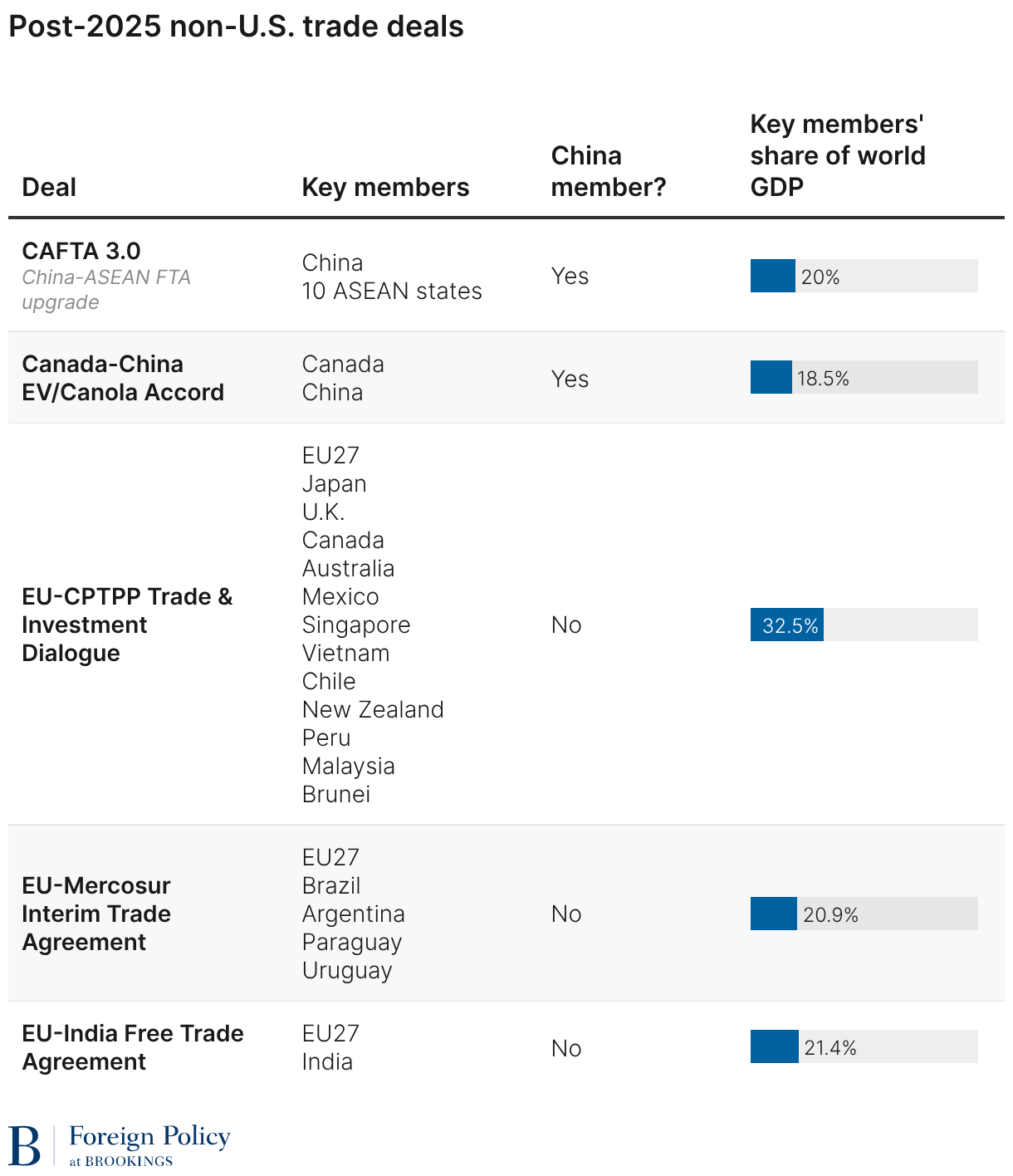

What remains to be seen is whether any of these dynamics reshape the security order. We are starting to see the middle powers forge small bilateral agreements on defense—between the U.K. and Norway, for example, to jointly develop the capacity to patrol the North and Norwegian Seas against Russian (and potentially Chinese) incursions and gray zone activities, and between Canada and Japan. Most importantly, we’ve begun to see movement around a wider European mechanism for nuclear deterrence, crucially in the French offer to expand the scale and scope of Paris’ nuclear deterrence and bring other countries under its framework. (All of the details of this remain to be negotiated.)
And what about China?
In all of this, China has been surprisingly quiet. Actually, perhaps it’s not surprising: if your primary adversary has set about the business of shredding the political basis of its alliance system, why interfere?
China has used the year to intensify its diplomatic campaign to pressure countries to join its four “global initiatives”: the Global Development Initiative, the Global Security Initiative, the Global Civilization Initiative, and the Global Governance Initiative. There are places where China has profited from Trump’s disruption—e.g., on resetting trade relations with Canada and Germany—and there may well be others soon. So far, though, a much wider cast of characters has been able to maneuver in this space, and China has seen less gain than many anticipated. In a review of its behavior, The Economist concluded that: “China, in fact, has shown disinterest in assuming America’s traditional leadership role in the international system and the responsibilities attendant to that role.”
It is worth stressing that expectations of Chinese gains from Trump’s break with the multilateral order were premised on a U.S. retreat. We have seen a retreat—from alliance management, leadership, financing, and public goods provision—from any of the features associated with U.S. leadership of the multilateral order. But this is not a retreat from U.S. power projection. Trump has proved at least as willing to project American power abroad as his predecessors. The difference, as the Venezuela and Iran episodes illustrate, lies in his willingness to act in the total absence of domestic or international legitimation. This is likely not what China was anticipating.
China’s response has been limited. Foreign Minister Wang Yi opened 2026 with a claim to Chinese leadership of the global system in Munich, but the speech was thin—a muted response to Trump and Trumpism. In parallel, China has continued its steady effort, especially with smaller European nations and Global South countries, to build support for its “four global initiatives,” including those on global governance and global security. These initiatives remain vague: their language is broadly consistent with the U.N. Charter, but it is infused with an apparent recognition of Chinese centrality. While many countries have signed on to China’s Global Development Initiative, many more are hesitant or skeptical about the security, civilization, and global governance equivalents. It will be instructive to see how many countries decide to overcome their reticence in the coming year.
This external restraint may reflect Xi Jinping’s preoccupation with internal consolidation, including sweeping purges of the People’s Liberation Army. Whether this indicates domestic instability or preparation for more assertive regional action—likely on Taiwan—remains to be seen.
China is not the only actor that can maneuver through the space left by Trump’s partial rupture with the West and his incoherent moves against the wider multilateral order. Various groupings of middle powers will likely continue reinforcing their positions, the EU faces a real test of its capacity to adapt, and India is on the march.
India’s trajectory may ultimately prove significant. Its initial response was cautious. New Delhi made a grand show of chairing the G20 in 2024, but the effort was largely overshadowed by the uncertainty in U.S. politics. Prime Minister Narendra Modi made no secret of his desire to see Trump return to the White House—only to be badly wrong-footed by the imposition of heavy U.S. sanctions. But as 2025 wound down, Delhi began to recalibrate. In 2026, it has managed to temper the tariff threat (at least for now), launch the EU-India trade deal, and host a very successful global summit on artificial intelligence. That summit drew a range of leaders, including those from Europe and Brazil—but not, notably, Trump. (And as we publish this piece, India had taken on the chair role of the BRICS—though its work got off to a rocky start with a public spat between newish members Iran and the United Arab Emirates.)
Where will the world order go from here?
The situation in front of us is fluid and unstable. As we finalized this report, the United States began a new, more extensive bombing campaign against Iran, killing Supreme Leader Ali Khamenei, and called for regime change. How that plays out will shape how we interpret the events that got us here, and those that follow. Nevertheless, there are several scenarios in front of us. In the broadest terms, they are as follows:
- Liberal order minus the United States. In this scenario, the rest of the West—Europe, Canada, and Japan—seek to preserve the foundational norms, or key operational components, of the liberal international order absent the United States. Some liberal or semi-liberal emerging powers may join forces or otherwise support such initiatives. Through coordinated action on issues such as global health and multilateral trade, these actors attempt to compensate for the absence of American leadership by forming issue-based coalitions to uphold global arrangements. It seems unlikely and infeasible that such groupings could meaningfully reshape the global security order, at least in the near to medium term. However, this framework is consistent with flexible and pragmatic groupings in which the United States participates, like the Quad (India, Japan, Australia, and the United States) and AUKUS (Australia, the U.K., and the United States).
- Regionalization of governance. In this scenario, the balance tilts decisively toward the regional level. Middle powers, such as Australia, Japan, Brazil, and Saudi Arabia, step into institutional voids by creating regional defense and management arrangements. Governance becomes more decentralized, adaptive, and issue-specific. Needless to say, this regionalized approach to governance, which remains more susceptible to multilateralism, differs from the “sphere of influence” framework of global order dictated by regional hegemons.3
- The ascendancy of BRICS Plus. Despite the internal contradictions, the rising costs from American unpredictability, tariffs, and military actions could create sufficient incentives for members of the BRICS to downplay their differences. In turn, they may support a more assertive and coordinated role for the BRICS bloc and its affiliates in reshaping global governance. These states promote alternative institutions and frameworks to reflect multipolar realities and counterbalance Western dominance. Their influence grows as they become more predictable and cohesive actors within the international system.
- Fragmentation and multipolar disorder. The baseline assumption has to be one of further disintegration. Multilateral institutions weaken further, and some even collapse altogether due to severe underfunding, political deadlock, and waning legitimacy. As cooperation frameworks unravel, states increasingly resort to coercive diplomacy and unilateral actions. Global collaboration becomes more sporadic and more intensely competitive.
Of course, over the medium term, much depends on the United States’ posture after the Trump presidency. A return to the status quo ante seems improbable and infeasible: a subset of the political dynamics that are reflected in the Trump governing coalition will remain (and some will intensify) after he leaves the political stage, and too much damage has been done to core alliances (Canada, Denmark, other Europeans) for them to simply move on. However, it is possible that the United States regains some portion of its former role as it seeks to constrain China’s rise. Rather than seeking to rebuild the liberal order wholesale, the United States would take an even more instrumental approach than in the past. In this scenario, Europe is unlikely to regain its privileged status within American diplomatic concepts.
Conclusion
As 2026 unfolds and we head toward U.S. midterm elections, we see certain patterns consolidating in the shape of the multilateral order. The argument put forward by Brazil, South Africa, and the rest of the Global South for a genuinely inclusive, formal multilateral order faces stiff headwinds; in truth, we do not see a sufficient coalition to advance it beyond the margins. U.S.-anchored, Western-led multilateralism is dead, at least for now and probably in perpetuity—wounded by global economic reality, killed by Trump. A dynamic of middle and major power innovation appears to be taking hold, and over the next year or two, we will follow, explore, and chart its progress and its limits. Whether the Trump administration moves aggressively enough to shatter what’s left of the multilateral order remains to be seen; there’s no evidence of what would replace it beyond unfettered American power. And Trump’s vision of a Trump-centered, or even a U.S.-centered, multilateral order will continue to unfurl but will not find more than a handful of adherents.
All this is unlikely to kill off the multilateral order’s core institutions. While Trump is in office, and while America chooses to not even pay lip service to the defining norms of restraint, these institutions will feel largely hollow. However, it is likely (and wise) that coalitions will emerge to keep them alive, for three reasons: first, because they can still perform important functions, even while the United States is behaving erratically; second, because at the margins, they can be useful as tools for de-escalation and deconfliction even in major regional conflicts or limited great power contests, as they have in the past; and third, because they might be needed in the future, should there be a walking away from the present path of deconstruction and conflict.
Authors


Contributors




-
Acknowledgements and disclosures
The authors would like to thank Adam Lammon for editing and Rachel Slattery for graphics and layout.
-
Footnotes
- In February 2026, the U.S. Supreme Court ruled against the legality of the Trump administration’s “Liberation Day” tariffs—thereby both providing a flickering sign of life in American domestic institutions and limiting (not eliminating) his room for maneuver in the trade space.
- There was a third process in 2025: the U.N.’s own “UN80,” an organization-wide effort to “reinforce the UN’s effectiveness and relevance.” Despite the claims, the initiative in practice is limited to a narrower set of internal reforms focused on cost-cutting and mandate consolidation. It does address some of the symptoms of institutional turmoil—including bureaucratic inefficiencies and duplication—and has been expanded to help cope with extensive U.S. financial cuts. (From extraordinarily high levels, as expressed as a share of costs.) But most commentators have shared the view that UN80 has done too little to set out arguments about where and how the U.N. can be relevant under conditions of geopolitical fragmentation. As a result, it has been critiqued within pro-multilateral circles and broadly ignored beyond them.
- Here, we recognize that regionalism has long been a part of global multilateralism; the question simply lies in the balance between regional and global arrangements.
The Brookings Institution is committed to quality, independence, and impact.
We are supported by a diverse array of funders. In line with our values and policies, each Brookings publication represents the sole views of its author(s).