The following is a summary of the special 52nd session of the Congressional Study Group on Foreign Relations and National Security, a program for congressional staff focused on critically engaging the legal and policy factors that define the role that Congress plays in various aspects of U.S. foreign relations and national security policy.
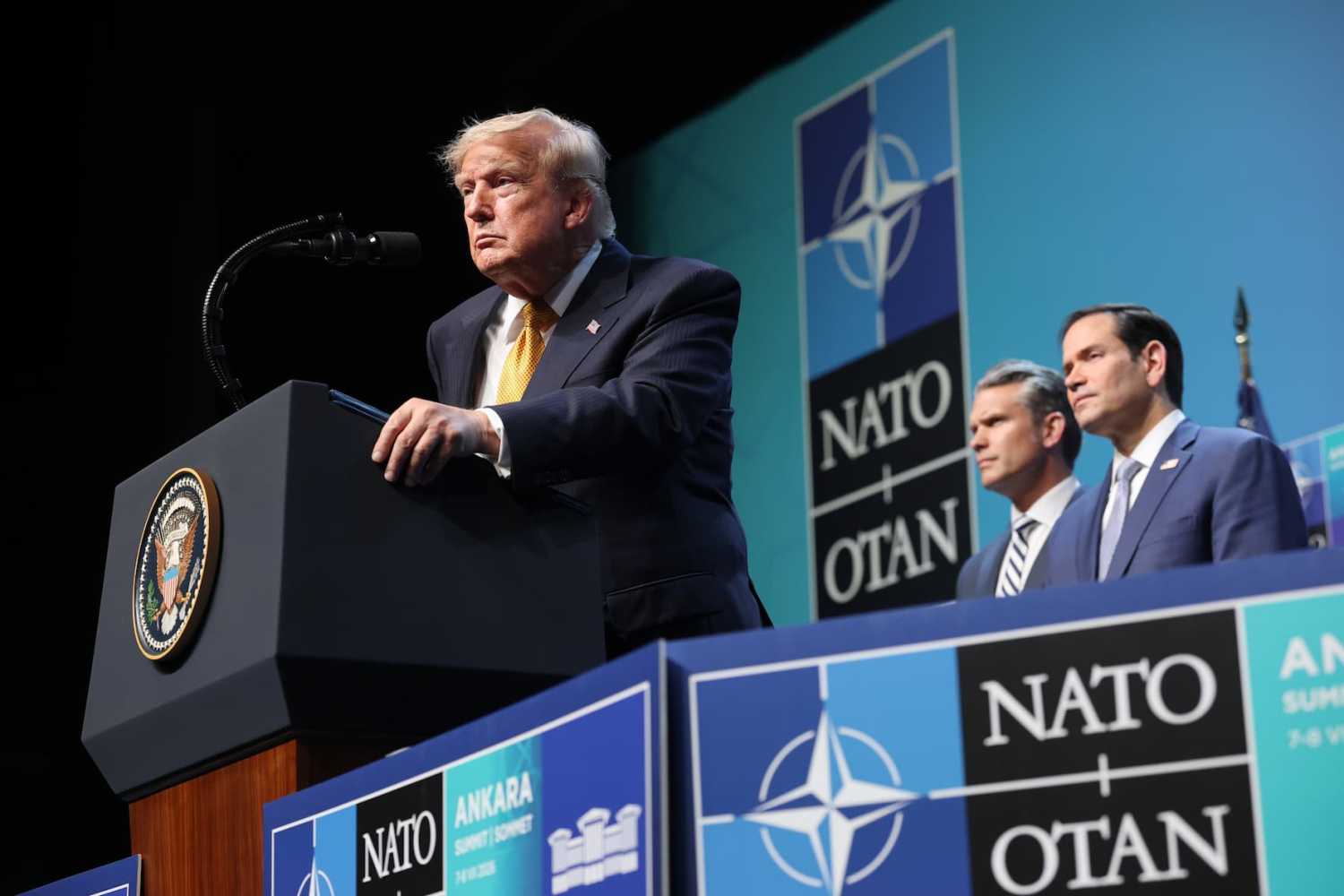
On July 24, 2026, the Congressional Study Group on Foreign Relations and National Security convened for a special half-day session at the Brookings Institution in Washington, D.C., to discuss what a legal challenge to an attempted U.S. withdrawal from the North Atlantic Treaty Organization (NATO) would look like. During his first term in office, President Trump is reported to have seriously considered withdrawing the United States from NATO. Congress responded in 2023 by enacting a novel statutory provision—now codified at 22 U.S.C. § 1928f, and commonly known as the Kaine-Rubio provision—that expressly prohibits the president from exiting the North Atlantic Treaty without prior congressional authorization. Because no one has ever sought to vindicate congressional authority over treaty exit in court, any attempt to leave NATO without complying with that provision would raise constitutional questions that may well require resolution by the Supreme Court—if, that is, a viable legal challenge can be mounted at all.
Departing from the study group’s usual format, this session brought congressional staff together with a diverse array of leading academic experts, former executive branch and congressional lawyers, and experienced public interest litigators for an extended working discussion organized around three sets of questions: the justiciability of a legal challenge to a hypothetical attempt to remove the United States from NATO, the constitutional merits of any such debate, and potential remedies. (A list of outside participants is available here.) Because the convening was structured as an open working discussion rather than a panel presentation, and because the entire session was held under the Chatham House Rule, the summary below reflects the substance of the conversation without attributing particular views to individual participants.
Justiciability
The discussion opened with the threshold question of whether a challenge to treaty withdrawal could be heard at all. Participants returned repeatedly to Goldwater v. Carter, the sole Supreme Court case to address the question, which was resolved on justiciability grounds rather than the merits—with Justice Powell concluding the dispute was not ripe and a plurality treating it as a nonjusticiable political question. Several participants argued that the political question barrier is weaker than it appears: The unmaking of a treaty is not textually committed to another branch, judicially manageable standards exist, and Zivotofsky v. Clinton has narrowed the operative Baker v. Carr factors in the foreign affairs context. More than one participant emphasized that Goldwater was decided on the emergency docket in 1979 without oral argument, involved a bilateral treaty terminated in accordance with its own terms, and says nothing about the termination of multilateral agreements in the face of a contrary statute—making it, in one view, a thin foundation for a claimed presidential power to exit thousands of treaties at will. Timing was also flagged as a strategic variable in its own right: A case would need to be brought with enough urgency to be taken seriously, but not so much urgency as to encourage the court to resolve it summarily.
Participants then mapped the temporal window in which a suit could realistically proceed. Article 13 of the North Atlantic Treaty permits withdrawal one year after notice is deposited, and § 1928f layers an additional 180-day notice requirement on top of that—though several participants doubted the executive branch would treat the statutory notice period as binding, pointing to the disregard of a comparable notice requirement in the 2020 withdrawal from the Open Skies Treaty. The practical effect, participants observed, is that the period after notice is deposited but before the year runs out is likely the only window in which ripeness and mootness problems can both be avoided. Others countered that if the withdrawal is unlawful under domestic law, the one-year clock is arguably not running at all—an argument that would counsel against rushing and could support a litigation timeline extending well past a year.
Turning to standing, participants noted that most of the United States’ institutional intersection with NATO runs through the executive branch itself, which eliminates a large share of potential plaintiffs at the outset. Three categories of private plaintiffs were identified as most promising: Americans employed directly by NATO, whose employment is conditioned on citizenship in a member state (a small group, perhaps fewer than 100 people, and one whose injury NATO could blunt through its own personnel policies); the state of Virginia, through Old Dominion University or the City of Norfolk, both of which appear to hold contracts with NATO’s Allied Command Transformation; and defense contractors holding agreements directly with NATO or a NATO support agency rather than through the U.S. government—a group with clear concrete injury but, participants cautioned, little appetite for litigation against the current administration. Smaller defense-technology firms with awards under NATO’s DIANA innovation initiative were suggested as more willing potential plaintiffs, given the larger share of revenue at stake. Participants added several further possibilities: individuals whose U.S. government positions are open to them only by virtue of NATO-member nationality; European contractors who would lose contracts; embedded journalists who might be excluded from access; a service member ordered to conduct an operation outside NATO channels; defense industry associations whose members’ interests are directly implicated; non-U.S.-person NATO employees with family and schooling ties in the United States, whose claims might proceed in the Court of Federal Claims; and NATO itself and other member states, whose participation—whether as parties or as amici—could carry considerable weight with a reviewing court.
Congressional standing drew extended attention. Participants agreed that Raines v. Byrd forecloses suits by individual legislators asserting institutional injury and canvassed the recognized exceptions: vote nullification under Coleman v. Miller, and suits brought by a legislator authorized to represent a chamber. On that reading, the strongest theory would have Congress authorize litigation on its own behalf—an approach that has apparently never been used and that would require majority support in both chambers. A more feasible alternative would be a single-chamber suit authorized by simple resolution, building on litigation over the Affordable Care Act, the border wall, and the D.C. Circuit’s decision in United States House of Representatives v. Mnuchin, which recognized chamber standing for Appropriations Clause violations—a theory with particular purchase here because § 1928f contains its own appropriations restriction. A third and more provocative theory would have 34 senators sue in their individual capacities on the ground that, because entry into an Article II treaty required the advice and consent of two thirds of the Senate, a matching minority holds the votes necessary to block exit and has therefore had its vote nullified. Participants noted the tension this creates with the statute itself, since the theory requires arguing that § 1928f is unconstitutional insofar as it purports to permit withdrawal on a simple majority of both chambers.
A related and recurring difficulty is that the case law suggests Congress cannot establish standing merely to enforce a statute, but must identify an underlying constitutional injury—which sits uncomfortably with the widely shared view that the statutory claim is the stronger claim on the merits. One participant offered a possible resolution: The argument is not simply that the statute should be enforced, but that the statute changes the underlying constitutional posture by placing the president in Youngstown Category Three, such that a plaintiff is vindicating a structural constitutional principle rather than a bare statutory interest. Participants also discussed the authority of the House’s Bipartisan Legal Advisory Group, tested but not resolved in United States v. Windsor, and noted pending D.C. Circuit litigation over congressional access to immigration detention facilities as a case to watch for developments on congressional standing generally. The group also considered why the mandatory litigation-authorization language that survived committee markup was ultimately dropped from the enacted provision, with participants describing a combination of institutional concerns about compelling litigation decades into the future and, more decisively, a hard conference-stage choice between dropping that language and losing the provision altogether.
Merits
On the merits, the discussion began from the premise that the Constitution is silent on the process for treaty exit, and as a result, every argument proceeds from text, structure, historical practice, or function. Textually, participants observed, the Constitution specifies how treaties are made and says nothing about how they are unmade, which throws the question back to the constitutional default. Structurally, the allocation of foreign affairs authority is one of shared power in which unilateral presidential authority is an exception, not the rule—counseling against a default rule of unilateral exit. Several participants framed the central stake in precisely those terms: whether the president may terminate any treaty at will, or whether the answer is context dependent.
Participants were notably skeptical that historical gloss and interbranch practice carry the weight typically assigned to them. Congressional approval for withdrawal was generally viewed as necessary well into the late nineteenth century, with the shift toward unilateral practice only solidifying around the time of the 1979 Taiwan treaty termination. Participants urged narrowing the relevant precedents to contested withdrawals rather than the many uncontroversial terminations the government would cite, and one recounted research showing that a frequently invoked State Department list of unilateral terminations consists largely of the Bancroft naturalization conventions, which were terminated in consultation with the Senate Foreign Relations Committee after Supreme Court decisions rendered them unenforceable—a tenuous foundation for a broad unilateral power. Participants also noted that Justice Brennan, the only justice in Goldwater to reach the merits, grounded his position in the president’s recognition power rather than any general withdrawal authority. INS v. Chadha was repeatedly offered as the closest analogy: There the court struck down the legislative veto on textual and structural grounds notwithstanding extensive uncontested practice to the contrary.
There was broad agreement that the Youngstown framework should be front and center. Withdrawal is not an inherent presidential power, and the existence of § 1928f places any unilateral exit squarely at the lowest ebb of presidential authority. One participant expressed confidence that the court would reject an originalist “mirror image” argument but would be receptive to a structural Youngstown analysis in the special case where a statute exists, and urged that this be the lead argument. Participants worked through which precedents the government would invoke and which should be resisted as inapposite—including Zivotofsky because it rests on an inherent textual power over recognition and concerned the narrow exercise of the diplomatic function, as well as the removal-power cases because the appointments analogy does not translate to treaties. Participants suggested the affirmative argument should run from the premise that a president cannot unilaterally repeal a statute, and therefore cannot repeal a congressional-executive agreement or a treaty approved by a supermajority of the Senate; Dames & Moore v. Regan was offered as a model for a narrow, fact-bound disposition.
The conversation turned to executive branch precedent, and in particular to two Office of Legal Counsel opinions from the first Trump administration addressing withdrawal from NAFTA and from the Open Skies Treaty. The NAFTA opinion took an expansive view of implied presidential authority and a narrow view of Congress’s foreign affairs powers, reasoning that a president who executes a treaty may also execute its withdrawal provision. The Open Skies opinion went further, treating treaty termination as an area of exclusive executive authority such that the statutory notice requirement was itself unconstitutional—a position participants characterized as untenable even under Youngstown Category Three, and one they suggested a future administration should formally withdraw. Participants observed that the current Office of Legal Counsel is, if anything, more aggressive than the office that produced those opinions. Against that backdrop, several noted the significance of the Biden administration’s decision, after internal debate, not to issue any statement questioning the constitutionality of the NATO provision when it was enacted—a decision described as resting on policy and political judgment as much as legal analysis, and one that supplies a meaningful argument of executive acquiescence, particularly before a court that has shown itself less deferential when it perceives the executive branch changing positions.
Functional and comparative considerations, participants argued, now cut against unilateral exit rather than for it. The classic justification—that a president may need to affect a rapid “divorce” from a treaty—has little purchase where there is no urgency, and the modern pattern in which each administration undoes its predecessor’s commitments makes it harder, not easier, for the United States to make credible treaty commitments in the future. Comparative constitutional practice was said to favor a mirror principle under which the legislative input required to exit should be commensurate with that required to enter, with the United Kingdom Supreme Court’s Brexit decision—requiring parliamentary approval before the executive could trigger Article 50—offered as the clearest illustration. One participant suggested that amending the statute to distinguish suspension from termination could strengthen both the functional and constitutional arguments, by ensuring that genuine exigencies have a remedy short of exit. Another pointed to the Supreme Court’s decision in Learning Resources, Inc. v. Trump as useful ammunition: a foreign affairs case in which the president lost and the court recognized an exclusive congressional power, which might support protecting particular categories of agreements—trade, tariffs, and defense—even if the mirror principle itself does not carry the day.
Two participants situated the discussion in current events. One urged the group not to lose sight of the Greenland episode, arguing that the threat of force against an ally implicated Congress’s war, funding, and rulemaking powers simultaneously, that such an order should have been treated by the military as facially illegal absent any national security rationale, and that any effort to extinguish Greenlandic self-determination would raise grave human rights concerns. Another, drawing on recent conversations in Europe, reported that allied governments are focused less on formal withdrawal than on the prospect of the United States rendering NATO dysfunctional in practice—by withholding key appointments, blocking exercises and decisions, or actively preventing a European response to Russian aggression—a set of scenarios closer to suspension than to exit.
Remedies
The final segment addressed remedies, beginning with the question of whom to sue. Suing the president directly raises well-known difficulties, and participants noted that the United States occupies an unusual position as depositary for the North Atlantic Treaty—a ministerial role of transmitting notices and maintaining the list of parties that is discharged by identifiable officials within the State Department. That role, participants suggested, may supply both a cleaner defendant and a more concrete litigation hook, allowing relief to run down the diplomatic chain of command without joining the president. Participants also flagged that a threshold fight over whether an injunction may issue against the president at all could be severed and resolved by the Supreme Court before it ever reached the underlying dispute—a prospect that strongly suggested structuring the case so that it does not become a fight about enjoining the president.
Largely for that reason, participants converged on declaratory relief as the preferred remedy: a declaration that the purported withdrawal was legally insufficient and that the United States therefore has not withdrawn. Participants pointed to the World Health Organization as an instructive parallel, where the organization has maintained that the United States has not validly withdrawn because the governing statute conditions exit on payment of outstanding dues, and asked whether the North Atlantic Council might rely on an analogous theory—invoking Article 46 of the Vienna Convention on the Law of Treaties, under which consent may be vitiated by a manifest violation of a rule of internal law of fundamental importance. Participants noted that this is ordinarily a very high bar, but that a judgment from a U.S. court would make it about as strong a case as could be constructed. The related question of reentry was described as genuinely untested: One view holds that a president cannot extinguish the Senate’s original resolution of advice and consent, so that a successor could simply rely on it to rejoin, while others cautioned that the examples usually cited involve organizations Congress has separately authorized the president to join. Participants also warned that a statement about “rejoining” could be read as conceding the validity of the original withdrawal, and that the safer framing is to affirm that the United States never left. The International Criminal Court and the so-called “Indonesian intermezzo”—in which an international organization simply disregarded a member’s absence and welcomed it back—were offered as the closer analogies.
On litigation posture, participants observed that the underlying facts would not be meaningfully in dispute, which should allow the parties to bypass preliminary proceedings and proceed directly to cross-motions for summary judgment, or to consolidate the preliminary injunction hearing with a trial on the merits under Rule 65. Several cautioned, however, that recent practice complicates this calculus: When this administration loses in the lower courts it now moves quickly to seek relief from the Supreme Court on the emergency docket, so litigants should assume from the outset that they may get only one fully briefed opportunity to present the merits. Participants also noted a practical limit on injunctive relief—that the North Atlantic Treaty obliges the United States to do very little affirmatively, so an administration determined to hollow out the alliance could comply with an injunction and still accomplish much of what it wanted.
The session closed on the relationship between the legal campaign and the political one. Participants emphasized that building a public constituency is not incidental to the litigation but a precondition for it, and that the message most likely to resonate—echoing both Youngstown and Learning Resources—is that no single person should be able to make a decision of this magnitude this quickly. Several stressed the importance of keeping the issue bipartisan, noting the provision’s bipartisan authorship and the continued Republican support for NATO reflected in recent legislation and accession protocols. There was some disagreement about how candidates should engage: One view held that candidates should avoid promising particular outcomes while litigation is pending and instead commit to respecting whatever the courts decide, while another responded that litigation is a long shot and that candidates will in practice have to state plainly that a purported withdrawal is unlawful and would not be recognized. Participants generally agreed that a future administration should be prepared to rescind the relevant Office of Legal Counsel opinions, and one sketched a concrete sequencing strategy: a transition team memorandum that becomes an OLC opinion, released alongside a day-one executive order stating that the purported withdrawal was a nullity and that cooperation with NATO continues uninterrupted—leaving any challenger to overcome a formal opinion of the executive branch’s own lawyers. Congressional staff participating in the session closed by noting that the law’s meaning has required patient explanation to allies and to NATO itself since enactment, and that continued public articulation of the legal arguments would be valuable heading into the next election cycle.
The Brookings Institution is committed to quality, independence, and impact.
We are supported by a diverse array of funders. In line with our values and policies, each Brookings publication represents the sole views of its author(s).