The search for relevant sources and light copyediting for this piece were provided by Copilot, a Microsoft generative AI tool. The output was reviewed and revised for factual accuracy by the author, copyedited again by a human, and checked for plagiarism prior to publication. The AI tool did not contribute any original ideas to the commentary.
After learning about the risks of AI-enabled cognitive offloading from school founder and Brookings Nonresident Fellow Urvashi Sahni, students at Study Hall School in Lucknow, India formed an AI task force. They researched AI’s benefits and risks, developed guidelines for responsible use, and are now helping shape school policy while facilitating peer dialogue.
In Austin, Texas, students led by high school junior Ruhan Gupta—with support from school leadership—have proposed SPARK (Student Policy Advisory for Responsible AI in K-12) to their district. The proposed council would engage its 12 high school members in a range of activities including testing and auditing AI tools, contributing to policy development, and leading engagement with peers and families.
These examples point to what is possible—but the broader opportunity is even more significant. As the 2026-2027 school year gets underway across the United States, schools would do well to try something new: establishing student AI councils. As these sample cases showcase, the goal should not be to occasionally consult students on AI-related ideas but to have students beta-test products, lead conversations around AI use, review procurement contracts, or test teachers’ assignments for AI hackability. And with student AI use—and AI dissatisfaction—growing, instating student councils could proactively address these issues and more.
Growth in student pushback and use of AI
Survey data have shown a steady increase in American students’ use of AI, with almost 85% of high schoolers using AI for schoolwork. At the same time, this past year saw unprecedented student pushback against AI. A recent survey by Gallup and the Walton Family Foundation found that Gen Z’s negative sentiments about AI are growing, with less than one in five young people feeling hopeful about the technology.
Students often express wide-ranging concerns about AI—from shrinking job opportunities to climate change. But one of the most striking worries is that of AI undermining their cognitive development. This concern is widespread. A 2025 global survey found that AI’s potential to “erode human intelligence, creativity, and critical thinking” is a top concern of young people alongside disruptions to work. Put simply, many young people worry that “AI is making us stupid.”
This tension between students’ AI worries and their use of it surfaces in most of my conversations with young people. It’s present in our Brookings Global Task Force on AI and Education research and in my focus groups with students today. Young people are eager to learn and develop, and they worry that generative AI could undermine that growth, creating cycles of dependency and disengagement. At the same time, they resort to AI use when they feel an assignment is busy work, when they are overwhelmed, have run out of time, or feel pressured to keep up with peers.
Students’ discomfort with using AI to do their schoolwork is well-founded. Struggle, effortful thinking, and learning from mistakes are central to developing critical and independent thinking. Brain development remains highly active through age 25, making the quality of learning experiences especially consequential. Students are right to question whether current uses of AI are eroding their cognitive development.
Designing student councils to center agency
There is an urgent need to break through this struggle with an approach that helps students avoid AI’s risks but harnesses its benefits. The central challenge is, as we concluded in the 17 Rooms education working group—which convened experts to discuss AI and education in relation to fulfilling Sustainable Development Goal 4 (Quality Education)—finding approaches that move students from ‘dependence to agency.’ One concrete step toward this goal is establishing a student AI council in every school.
Student councils alone do not automatically increase engagement or agency. Without clearly defined roles, meaningful influence, and visible pathways to change, they risk becoming tokenistic. Research also shows important equity gaps: Students in higher-income schools are more likely to participate in substantive decisionmaking, while those in lower-income schools are often limited to low-stakes activities such as organizing school dances and social events.
Yet when designed well, student councils can be powerful. They can strengthen schools’ effective decisionmaking, improve student engagement, build trust between students and educators, and contribute to better learning outcomes. Recent data from more than 9,500 young people collected globally show that youth are eager for a real seat at the table in reimagining education.
The key is to move from giving students voice to centering it. This shift means moving beyond consultation toward shared responsibility (see Figure 1 below). Centering student voice transforms councils from forums for sharing opinions into engines of co-creation—where students help define problems, design solutions, implement changes, and share responsibility for outcomes. It requires schools and educators to shift their perspective: their job is not to give students a voice but to transform spaces so their voices can meaningfully contribute to solving problems.
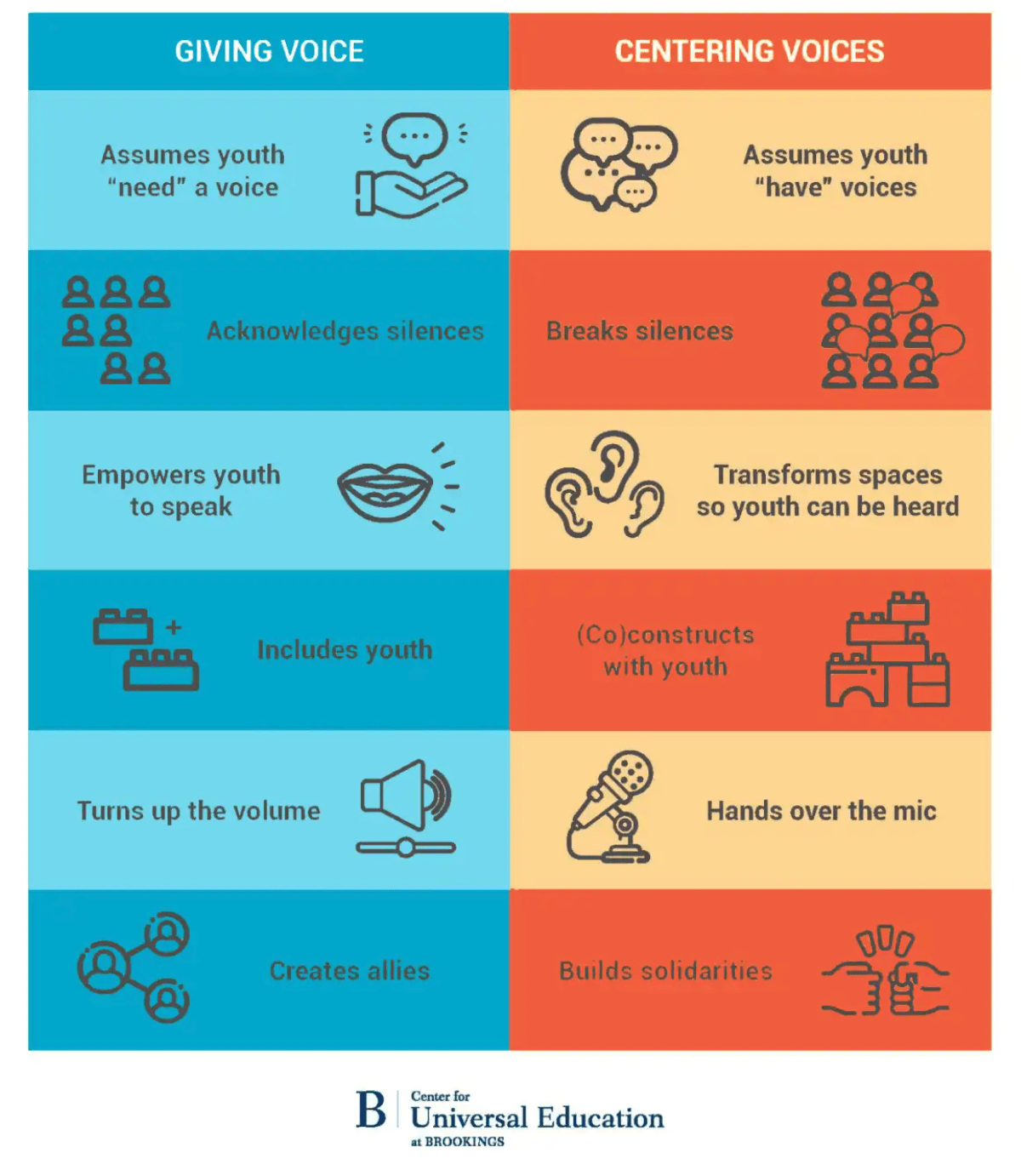
Source: Emily Markovich Morris and Omaer Naeem, 2023, ‘Handing over the mic: The difference between centering and giving youth voices in research and practice.’
The role of student AI councils
There are at least five ways in which student AI councils, when designed with centering student voice in mind, could contribute to charting a constructive path forward for quality learning in an AI world.
- Co-designing learning and enhancing trust
AI has strained trust between students and teachers, particularly when assignments can be easily completed—or cognitively offloaded—using AI tools. This creates a cycle of suspicion, inequity, and disengagement. Student AI councils could serve as advisory partners to teachers, helping redesign assignments that promote deep learning and cannot be easily bypassed by AI. This type of student-educator collaboration already exists some schools and systems: The New York City Consortium’s performance-based assessment practices demonstrate how student input can meaningfully shape assessments and learning experiences. - Beta-testing AI tools
Student councils can act as structured beta-testing groups, evaluating AI tools for effectiveness, unintended consequences, and real-world use. Through design sprints with educators and/or developers, students could provide rapid feedback, helping determine whether tools are fit for purpose and how they should be improved. - Leading AI literacy and dialogue
Student AI councils could curate accessible, student-friendly resources explaining what AI is, how it works, and its benefits and risks. They could also lead conversations among peers and families, helping demystify AI and create shared understanding—especially important given that many students themselves note they do not always know when they are encountering AI. - Shaping school-level AI policy
Students can play a meaningful role in co-developing and continuously updating school AI policies. Their involvement can help ensure policies are not only ethical and practical but also credible and widely understood by the school community. - Contributing to procurement decisions
As one student I spoke with put it: “We should be able to review procurement contracts—it’s our data.” Student AI councils could build student expertise in data privacy and safety, contributing to discussions about which technologies schools adopt and under what terms.
Student AI councils are not just a timely way engage students in charting the path of their own educational futures; they can serve as a quiet but powerful lever for rebalancing power in education. By positioning students as co-designers rather than passive recipients, they begin to shift long-standing assumptions about who holds expertise, who makes decisions, and whose voices count. In this sense, student AI councils could open the door to deeper transformation. What begins as a focused effort to address AI may ultimately catalyze broader redesign of schooling itself: from compliance to curiosity, from task completion to authentic learning, and from dependence to agency.
Author

The Brookings Institution is committed to quality, independence, and impact.
We are supported by a diverse array of funders. In line with our values and policies, each Brookings publication represents the sole views of its author(s).



Commentary
Enhancing student agency through school AI councils
August 18, 2026