



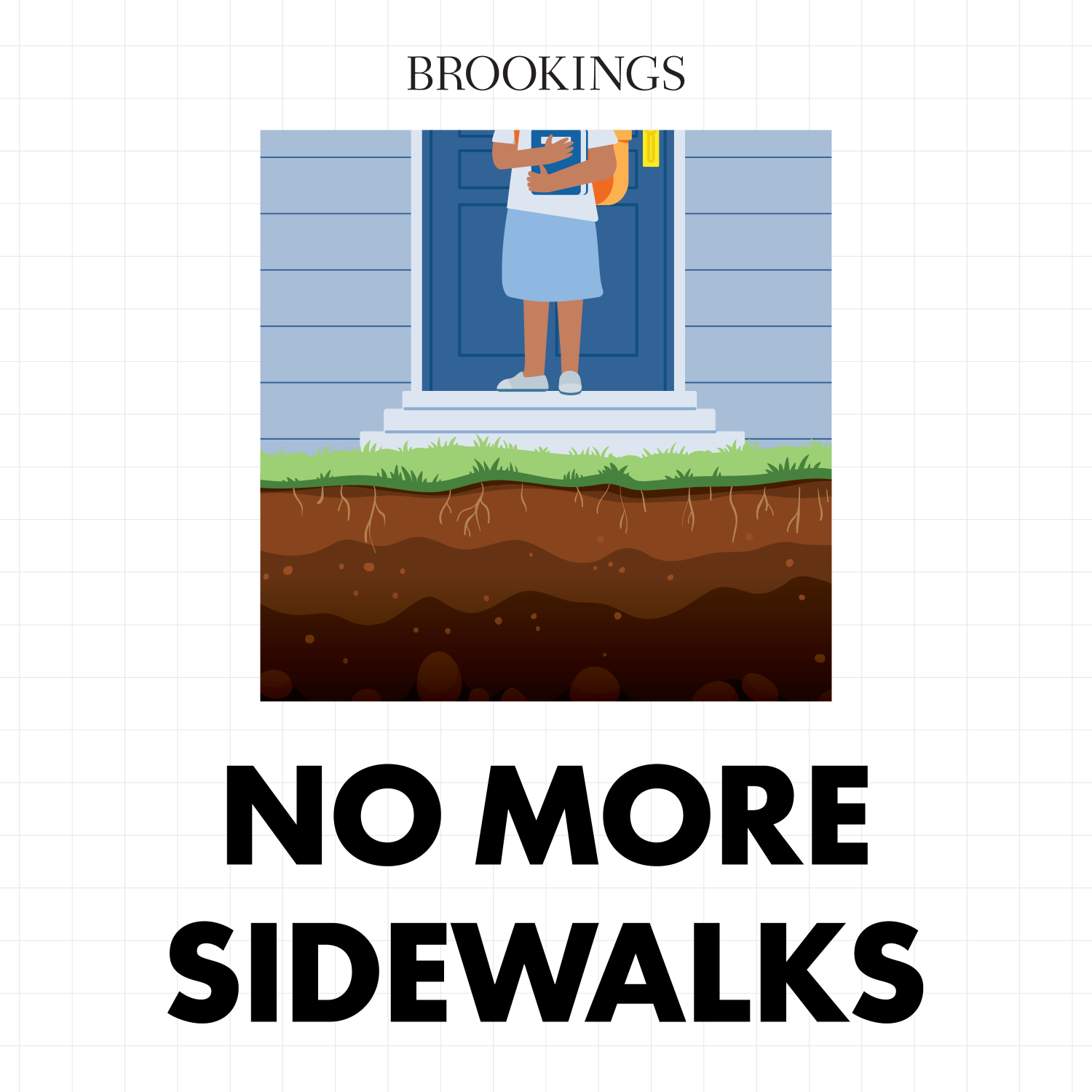
Screens have transformed how children learn, play, and build relationships. What happens when artificial intelligence enters the picture? In this episode, host Abby McCloskey speaks with social psychologist Jonathan Haidt, author of The Anxious Generation, about how smartphones, social media, and classroom technology have reshaped childhood—and why he sees AI as the largest disrupter of childhood yet. They discuss children’s mental health, attention, and learning, as well as steps parents and policymakers can take to protect children online and restore opportunities for independent, in-person play.
About the Host
 Abby M. McCloskey is a columnist for Bloomberg Opinion and the Dallas Morning News. She is a nonresident fellow in Economic Studies at the Brookings Institution. She is founder and principal of McCloskey Policy LLC, a research and consulting firm serving business and political leaders across the country.
About the Guest

Jonathan Haidt is a social psychologist at New York University’s Stern School of Business and the New York Times bestselling author of The Anxious Generation. In 2018, he set out to write a book on how social media was changing society, particularly how it was degrading democracy and our ability to function together. He intended to focus one chapter on children, but as he dug into the data, he discovered the profound effects on youth mental health – and that chapter became an entire book, the #1 New York Times bestseller, The Anxious Generation: How the Great Rewiring of Childhood is Causing an Epidemic of Mental Illness (2024).
- Listen to No More Sidewalks on Apple, Spotify, or wherever you like to get podcasts.
- Watch episodes on YouTube.
- Learn about other Brookings podcasts from the Brookings Podcast Network.
- Sign up for the podcasts newsletter for occasional updates on featured episodes and new shows.
- Send feedback email to [email protected].
Transcript
HAIDT: To grow up nowadays means the world is basically glass that you touch and look at. You don’t smell very much. You don’t move very much. You don’t get a lot of sunshine. You’re mostly just getting stuff through your eyes and ears, and you’re touching glass. And I I think this has pervasive developmental effects.
[music]
MCCLOSKEY: Welcome to, No More Sidewalks, where we talk about parenting today. I’m Abby McClosky. I remember the first time I saw my child engage with an iPad. He was silent and occupied, and it was the easiest plane ride we’d ever had. But I also felt that maternal instinct, that pang, of how easily this could become a crutch for me and addicting for my son.
And all a person has to do is look around a classroom, a park, a restaurant today to see that that’s exactly what it’s become. Kids are spending hours a day on screens instead of playing. Their socialization, schoolwork, leisure time, it all happens online.
And even as the harms of big tech’s impact on kids have come to light, public guardrails have been too few and far in between. Parents have been navigating the tech revolution largely on their own or in small groups with each other.
And now AI is shaking the snow globe all over again. As of 2026, nearly half, 42%, of American teens, report talking to AI chatbots as a friend or companion. The vast majority of students, 86%, report using AI during the school year. Even kids as young as five are using generative AI, and infants respond to AI robots with the same level of neurological activity as their own parents. AI is changing what it means to be a human child and what it means for those of us raising them.
Here to discuss this with me is none other than Jonathan Haidt. And truly, does he need any introduction? He is perhaps best known as The New York Times bestselling author of The Anxious Generation: How the Great Rewiring of Childhood Is Causing an Epidemic of Mental Illness. Jon is a social psychologist at NYU Stern School of Business. He runs the After Babel Substack, has done multiple TED Talks, has written more than 100 academic articles and many other books as well, including a new release, which we can talk about.
Jon, welcome.
HAIDT: Thank you, Abby. A pleasure to be with you.
[2:07]
MCCLOSKEY: Jon, every generation of parents worries about the impact of a new technology on their children. Why is it worth panicking this time with respect to AI and kids?
[2:18]
HAIDT: So yeah, the main argument against me has been, “Oh, this has been a moral panic because there have been moral panics in the past.” And that’s a perfectly good argument, and it’s up to me to say, “No, this is different.” And there are a lot of reasons that why we know this is different from, say, the panic over comic books or rap music lyrics.
One is because the kids themselves say it. When you talk to older Gen Z, you find no gratitude to social media and smartphones. They actually support raising the age. They think it it stole their childhood. There’s a lot of resentment. That wasn’t true for comic books or rap music or any previous situation like this.
Another is that it’s never happened that a technology was introduced and at that very moment mental health plummeted, that there was such a big change, and it was global, not just in the United States.
And so, I think while I don’t want to use the word panic, panic doesn’t help, but to be extremely alarmed to the point where we need vigorous, vigorous social responses, individual level responses, legislative responses, judicial responses, I think is entirely appropriate. In fact, I would say that’s even an underreaction given what has happened both to the mental health and the educational status of young people on this planet.
[3:27]
MCCLOSKEY: Okay, so I want to dig into that with AI as the culmination of this multi-phased process that you laid out in a recent TED Talk, starting with the seeds of it 20 years ago with the introduction of the smartphone and social media. And you mentioned just now that all of a sudden we saw a raft of changes in children’s mental health after the introduction of these things.
Can you just detail for those of us who have trouble with the specifics of what those changes are, what you saw, what you heard from kids that led to your writing of The Anxious Generation?
[3:58]
HAIDT: So, I’ve been a professor since 1995. I’m a social psychologist. I was a professor in the psychology department at the University of Virginia. I taught Psych 101. I had graduate students. I thought I understood my students. They were Gen X when I first started, but really Millennials the whole way through.
And then I moved to New York University, to the Stern School of Business in 2011, and I was again teaching Millennials, MBA students, and undergrads. And then all of a sudden, around 2014, 2015, the students were very different. They were much more anxious. They saw threats everywhere, threats in books, speakers, words, ideas. This led me to write an article with Greg Lukianoff called “The Coddling of the American Mind,” because we could see that wait, wait, something’s happening here. We’ve overprotected kids. They’re now seeing books as threats, books as violence.
So, we were puzzled about that, and we dug into it, and we found that overprotection is clearly a piece of this. But at the time, in 2015, and then we turned it into a book in 2018, we didn’t have evidence that technology was a major contributor, so we didn’t say much about it. But in the years after 2018, the evidence started coming in that social media is harming mental health, especially for girls.
And so, the way to understand it is this: if you’re a millennial, that means, by definition almost, you went through puberty with a Motorola Razr, which was a flip phone, which was only useful as a communication device. That’s all you could do. You could call your friends and family, you could text them, and then I guess there was a game called Snake that the millennials all played. That was it.
[5:23]
MCCLOSKEY: I don’t remember that. I’m a millennial.
[5:25]
HAIDT: But you did not go through puberty with an iPhone. The definition I believe of Gen Z is that they went through puberty with an iPhone. Puberty is an extraordinary period of rapid brain development, rapid neurological, you know, axon—dendrites finding axons. And it’s a sensitive period for all sorts of things.
And so, when social life used to be face-to-face, girls used to spend a lot of time talking on the phone, which is great, one-on-one to a friend, and then all of a sudden they’re not doing that. In 2010, they were all doing that. In 2010, almost no teens had an iPhone. By 2015, almost all teens had an iPhone.
And so, when you get such a rapid transformation of the social relations, and social relations are the most important part of a teen’s life, and at the exact same time that that happens, you get a plunging of mental health, and it’s correlated with degree of use. The heavy users were doing worse. And it was the girls worse than the boys. And it was all over the English-speaking countries. And now we know it was all over the the Nordic countries and Western Europe.
So, this is a mystery and a, a like the outbreak of COVID. Like, if suddenly a disease is breaking out all over the world, you might kinda wanna know what’s happening, what’s causing it.
And so, my proposal in The Anxious Generation, this is also drawing on Jean Twenge’s work earlier and and other psychologists, is that it was this rapid transformation of childhood from a play-based childhood up through the ‘90s to a phone-based childhood after 2010.
So that’s my argument. That’s my proposal. I I think we’ve gathered seven different lines of evidence. I think we’ve shown that it’s causal, it’s not just a correlation, and that’s where we are.
[6:53]
MCCLOSKEY: And how do you respond? Because there still is a point of view today. There was a recent, New York Times article by a child psychologist. It says, This is all mental illness, and things like screens can exacerbate it in the way drugs might or other things. But tell me again the evidence for why it is causation and not just correlation.
[7:11]
HAIDT: Sure. So, we’ve gathered … if you go to afterbabel.com, is my Substack, we have a recent article titled “The Many Lines of Evidence That Social Media is Not Safe for Teens.” And if you go to techandsocietylab.org, we also have it there. So, there is clearly a correlation. That that is not disputed. Heavy users are doing worse, and that’s true for most of these technologies.
But that doesn’t show causation. And some people say, “Oh, how can you tease that apart? How could we ever show causation?”
MCCLOSKEY: Right.
HAIDT: Well, guess what? That’s what we do for a living in the social sciences. Like, that’s our job, okay? You know, what are the hypotheses? For which one is there more evidence of causation? And so, in brief, it goes like this. The place we first turn to is RCTs. When you have randomized controlled trials, when you have a hundred young adults assigned to reduce their social media use and a hundred who don’t, and then you find out that in study after study, as long as it goes longer than a week—this is where the debate is—as long as you get people off for more than a week, and you look at measures of anxiety and depression, almost all of them find that mental health improves on those measures.
Even Meta, and here’s one of the kickers. We’ve gathered 35 studies that Meta did, internal studies, based on Frances Haugen’s revelations and others. Even they did an RCT, and even they found that when when people quit Instagram or or Facebook, they got better. I’m not gonna say that settles the matter, but that’s the the first place we look.
And you’ll find there is one meta-analysis that says like, Oh, there’s no effect. That’s because they have one day, one day extension. If you get someone off an addictive drug for one day—
MCCLOSKEY: —that seems tough—
[8:41]
HAIDT: —well, for one day, you don’t get happy after one day off heroin. Like, it takes a while for, you know. If if you’ve got a dopamine distortion going on in your brain, the first few days are hell. So anyway, so RCTs, that’s pretty persuasive.
But it’s not just RCTs. The next line is natural experiments. We found nine studies where they looked at what happened to mental health when high-speed internet comes in, because only then can you have video-based, you can be on, you can be on Instagram all day. Whereas before then, if you remember, it took photographs a long time to load long ago.
MCCLOSKEY: Oh, yeah.
[9:10]
HAIDT: So, once you get high-speed internet, nine studies have looked, eight studies found that mental health got worse, especially for girls and young women. So, this has a lot of ecological validity, even though it’s a little harder to be—not as controlled, but boy, does this have ecological validity. So that’s another line, which shows clear evidence of causality, not correlation, causality.
And then there’s the testimony of the people who know the most about it. We psychologists, we get crappy data. We get these studies in which you, you know, on a one to five scale, how’s your mental health? On a one to five scale, how much social media you use? Oh, let’s look at that. Like, our data is such low resolution.
But the people who know the most about this are the young people themselves and the researchers at Meta. They have the best data. And what do they say? Young people overwhelmingly say that it harms them. About 35% of young women say that it’s hurt their own mental health, not in general, like their own mental health. If there was any other consumer product where 35% said, “This hurt my mental health,” they would be sued out of existence.
MCCLOSKEY: Right.
[10:12]
HAIDT: And of course, Meta’s researchers say the same thing. We have all kinds of posts showing showing their quotes. And I could I could go on and on. There are so many different lines of evidence. So, when people say, “Oh, it’s just correlation,” that’s really beginning to verge into just denialism because there’s so much different kinds of evidence out there, and I’d I’d love it if people would rebut it. I’d love it if other researchers would say, “Well, let’s go through Haidt’s evidence, and let’s show where he got it wrong.” But I I haven’t seen that yet.
[10:37]
MCCLOSKEY: And Jon, is your sense of the main driver of mental illness just the substitution effect of being on a screen, and thus you’re not looking at a friend face to face or outside playing, or is it specific uses of social media, porn, gaming, that type of thing?
HAIDT: Well, first, just to be clear, I’m not saying that all mental health problems are caused by this.
MCCLOSKEY: No.
[10:58]
HAIDT: What I was trying to study was why were levels of depression, anxiety, et cetera, pretty stable from the ‘90s through 2010, even 2011. There’s no sign of anything. And then all of a sudden, there’s a synchronized increase. So, my my argument is not that this explains mental illness. My argument is this explains the synchronized global increase, especially in girls’ mental illness problems, especially internalizing disorders, depression and anxiety. That is what my hypothesis is about.
But to answer your question, at first I focused on social media because that’s where the evidence was best, and then also video games, but that’s murkier. It’s harder to make clear causal statements about video games.
But now I’ve come to see that it’s all of it. It’s the digital immersion, especially for boys. For girls, you can say—you can point to five different ways that social media messes them up. It’s not just the substitution. It’s the social comparison. It’s the perfectionism. It’s the sexual harassment. It’s the contagion of emotions. Girls are more open to each other’s emotions than boys are. So, there are many ways that social media harms girls’ mental health.
For boys, it’s not so clearly social media. For boys and also for girls, what I’ve come to see is it’s the whole damn thing. It’s that we evolved to live in a physical world where we use our bodies, and we have eye contact, and we smell each other, and we touch each other. We’re mammals. We’re primates. This is the way we’re supposed to grow up.
And all of a sudden, between 2010 and 2015, take all that away. To grow up nowadays means the world is basically glass that you touch and look at. You don’t smell very much. There’s not much to smell. You don’t move very much. You don’t get a lot of sunshine. You’re mostly just getting stuff through your eyes and ears, and you’re touching glass.
And I I think this has pervasive developmental effects. It’s the digital immersion. So, it’s the porn, it’s the gambling, it’s the it’s the extremist content, it’s the social… it’s all of it.
[12:40]
MCCLOSKEY: And this is, you know, 2010, 2015. Obviously, that stream has continued to flow. But then on top of it, starting around 2015 through COVID, all of a sudden classwork became screen-based. I saw this with my kids at public school. When we toured public schools, there was a computer lab. By the time my son was in kindergarten, he was distributed his own iPad, and this is prevalent.
This also is kind of a door that seemed to open, and now people are continuing to walk through it. Like, even prestigious private schools brag about having a one-to-one relationship between
HAIDT: That’s right
MCCLOSKEY: a child and tech. So why did that door open as we already saw some of the harms piling up from a screen-immersed childhood?
[13:19]
HAIDT: This is worth going deeply. Let’s talk about this because … so, we’re gonna win on social media. Ages are going up around the world. Parents are organized. we’re winning on social media, and the next battle is going to be all the the Chromebooks and iPads in schools, where it seems as though they are harming education, they’re not helping.
So how do we get there? This is my reading of how it happened. Computers are amazing things, and when computers came out, personal computers became common in the ‘80s and ‘90s, and some kids were drawn to them, and they weren’t hurt by them. Steve Jobs called the computer “a bicycle for the mind,” and a lot of kids, especially boys, were drawn to the hardware, and they learned how to build computers. They learned about the motherboard and the hard disk drive and all that. And that’s all good. They learned a skill, and it was—boy, was it useful, and some of them started companies, got rich. So, we all thought computers are good, and it’ll make you smarter, and it did.
MCCLOSKEY: But we also had ours, like, in the family room—
HAIDT: —exactly—
MCCLOSKEY: —where there was, like, one single dial up. It just felt very different than—
[14:16]
HAIDT: —well, that’s right. Well, let’s—that’s right. So, let’s get to the internet. So, then the internet comes in. It gets even more interesting. And we were all amazed by it, and we thought it was gonna be the best friend of democracy, and we thought it was gonna help education. And it had that potential, but it’s kinda backfired on many of those promises.
And so, one way to think about it is the original stuff was not addictive. The the IBM PC was not designed to give you quick dopamine to keep you tinkering with your IBM PC, nor was the Apple IIe. The early internet was not designed so that you could go to a website, and it would somehow reward you so that you had to keep going to that website all day long. There was no variable ratio re-reward schedule. There were no behaviorist principles. It was amazing, and and all of us who remember the ‘90s, I mean, it was the most magical, wonderful thing.
During this time also, we see the potential for for individualized tutoring. You could write a computer program that gives a kid just the math problems that they’re ready for. So, we’ve been told since the ‘90s, Oh, computers will be a boon to education. It’ll be personalized tutoring. Look at all these things it could do. We’re still waiting. It hasn’t done it yet. It’s been thirty years. But we thought, Well, the rich kids all have computers. Poor kids don’t. We better give computers to the poor kids. And lots of philanthropists stepped up to donate millions of dollars. Let’s get a computer for everybody.
But it still wasn’t harmful. In the days of the early internet, computers were not harmful. They were super interesting. A lot of kids benefited from, a lot of kids have fond—a lot of millennials have fond memories of computers in their childhood.
Everything changes, around 2010. So, in 2007, the the iPhone comes out, and it’s expensive. Kids don’t have it. But in the early 2010s, everything moves to iPhones, and now you get high-speed internet coming in. Now that you’ve got high-speed internet coming in, now tech firms are saying, Oh, personalized tutoring. Boy, now we can deliver it, you know—
MCCLOSKEY: —right to you—
[16:02]
HAIDT: —to everybody at scale. And so, they start pushing. Google in particular pushes Google Classroom, Chromebooks. So, these are tech companies that don’t know anything about children, don’t know anything about education, don’t care about children, don’t care about education. But there’s a lot of money to be made.
So, they’re pushing this stuff into school. There’s no evidence. They don’t show any data that this helps. Just, it could help. It should help. So, they push and push and push, and it starts spreading in the 2010s.
And then COVID comes, and one of the things that, I think it was under the Biden administration, but it might have been late Trump, I can’t remember, huge amounts of money made available to schools if they could act quickly. Well, okay, what are you gonna do? If you get—if you can get millions of dollars if you act quickly, what are you gonna do? Buy computers. That’s like the quickest thing to do.
So, I I believe that the biggest effect of COVID on kids, obviously COVID was a terrible threat to elderly people, but the virus didn’t do anything to children, basically. But what the COVID epidemic, what the pandemic, what the reaction did is it pushed kids from being largely on screens to being overwhelmingly on screens. That happened during COVID at home and then, remote school.
So, so by the time you get to the 2020s, now so much of education is on screens. And this is where I need to bring in the PISA data. I’m sorry I’m talking for so long on this, but this is such an important part of the story.
MCCLOSKEY: Please. The PISA data is extremely alarming.
[17:20]
HAIDT: So, let me tell you about the PISA scores. The Program for International Scholastic Assessment, it’s like the world’s report card given to 15-year-olds in I think 90 countries by now. A huge number of countries.
And so, we can track their progress. And what we see is that beginning after 2012, it began to go down. Now, IQ has been had been rising for 50 years in the late 20th century, the Flynn effect. Scores were going up, as we see from the NAEP scores in the United States, the National Assessment of Educational Progress.
So, we’d always thought that each generation is getting smarter, but all of a sudden, after 2012, the NAEP shows a drop in the United States, and PISA shows a drop around the world. And it drops in the 2010s.
[17:56]
MCCLOSKEY: And I’m glad, Jon, that you’re pointing that out because so much gets blamed on COVID itself. But there started to be this eerie decline before there, which does fit so well with the theory of screens.
[18:06]
HAIDT: That’s right. So, everybody thought that the big drop was due to COVID, and it did drop faster between 20… I think it was 2019 and 2023 were the two PISA scores. it did drop a lot, and people thought it was COVID, and a few of us were pointing out, Wait a sec, guys, it started after 2012.
But then the amazing thing, the horrible thing that we learned last month is this: If you see a big drop between 2019 to 2022, and you assume it’s COVID, what do you think would happen between ‘22 and 2025? You’d expect it would bounce back. It should get better. Schools have been open for years now. You would assume that you’d get some recovery.
MCCLOSKEY: There was $20 billion surged to try to close a gap from COVID to public schools to try… Right.
HAIDT: That’s right. We spend a lot.
MCCLOSKEY: More than we ever had before.
[18:49]
HAIDT: Schools were opening. So, you’d think things would get better, but they actually got worse. And on the reading scores, the decline actually accelerated slightly, probably not statistically significant. My point is there’s no sign of recovery.
In fact, Just look, PISA reading scores. Look that up, and what you will see is a a curve dropping down. You cannot find a COVID effect in that curve. When you look at those curves, you do not see any effect of COVID. You see a gradual drop that accelerates and keeps accelerating.
That I think is consistent with a social media effect. The more they get on social media, and then it switches from Instagram, which is about social comparison destroying girls’ mental health, to TikTok. Short videos I think are devastating for anybody’s ability to pay attention. So, I think the curves you see are very consistent with the spread of social media and then short-form video.
There’s no sign that COVID mattered. Of course, it did matter, but, like, it doesn’t show up in the PISA scores.
[19:38]
MCCLOSKEY: Right. And, you know, tracking back a decade-plus ago, there was this digital divide, that low-income households had less computer access than high-income households. That was part of the juice behind getting more screens into more kids’ hands to create a more of an equilibrium.
But now, of course, it’s the complete reverse, that low-income households spend more time online than children from those households—
HAIDT: —exactly—
MCCLOSKEY: —than upper-income households. We’re seeing continued decline in reading and mathematics scores. So, what is your sense, why have screens stayed so sticky in the classrooms? Like, why is it still the case that 81% of kindergartners have their own school-sponsored iPad, even if at home their parents don’t want them to be exposed to those things?
[20:21]
HAIDT: Because That’s harder to change than phones in school. So, let’s just walk through what happened with phones in school. So, phones in school are devastating. The teachers have hated it since the beginning. A lot of teachers quit, a lot of college professors quit. It’s not fun to be a teacher when everyone’s on their phone. My kids go to go to New York City public schools. They said everyone’s on their phone. You sit in the back row, you put in a book, everyone’s on their phone. It’s ridiculous.
And so, it turns out, once we suggested, You know what? Let’s get phones out of schools. Phones do not belong in school. Once we started talking about that and pushing that, and governors responded—42 states have passed legislation to restrict phones in school. Twenty-two of them did it right, which is the full day. You have to get them out for the full day, otherwise they’re still texting between classes and—
MCCLOSKEY: —you mean like in your locker, and it’s not actually in some sort of rack?
[21:04]
HAIDT: Yeah. Ideally, it should be in a special phone locker, but most people are using Yondr pouches, or they have a backpack policy, which is not as good.
It looks like, it looks like if you keep them just in your, the student’s locker, that is a much better policy than anything else, it seems, because it’s physically out of reach. So, what I’m saying is, it was super easy to get phones out of school. There was no loss, and it it didn’t disrupt anything. It really helped, and that’s happening at lightning speed around the world. Okay.
So, but then what do they do? If you wanna watch porn or play video games, now you have to use your computer because you don’t have your phone anymore. So, some of the use has transferred to computers. Now, the computers have been super distracting all along. And so, the obvious thing to do is, Well, let’s get the computers out. But that’s a lot harder because many states mandate, they mandate that all exams must be done on a computer, and therefore, even kindergartners have to have a computer to take state exams.
And there’s no sign that this stuff helps. There’s almost no evidence that any of this stuff helps, and it looks like it hurts. And so, the way that I look at it is this: We spent tens and tens and tens of billions of dollars on the technology, and the best possible reading of the situation is that it was the most expensive mistake in the history of education. That’s the optimistic view, that all it did is waste money.
But I think it’s much worse than that. I think it it it was the most expensive self-inflicted injury we’ve ever had in education, in that it literally, it literally stopped students from learning. It it blocked learning. It certainly has blocked reading. Kids are having a very hard time reading books. If your whole day is gamified, or if even a quarter of your day is gamified, maybe you’ll pay more attention to math if that is gamified.
But then what happens? Then you close the computer, and you have to listen to a teacher, and she’s not super interesting every moment. And it becomes very hard to pay attention. And then you’re supposed to read a book? Come on. A book is like lots of paragraphs, and some of them aren’t that interesting.
And so that’s what the PISA test shows us. It’s not that they don’t know how to read. Of course, they can read. What they can’t do is read three paragraphs continuously. That is—I shouldn’t say can’t. It’s much harder for a student these days to read three paragraphs continuously and to extract meaning.
MCCLOSKEY: I think for adults too, it’s across the
[23:08]
HAIDT: Actually, you’re right. There is some research showing that it’s adults too. So, our attention is fried, our attention is fragmented. Without attention, you can’t really have education.
So again, my view is that edtech was not just the biggest waste of money in the history of education, but possibly the biggest self-inflicted injury in the history of of modern education.
[23:26]
MCCLOSKEY: Well, and how do you respond, Jon? Because, you know, maybe there is a really good singular app at math, and it could be limited to a short amount of time or whatever. There could be good pieces of this, but at the same time, the device itself is still connected to Google, has a camera, you’re getting alerts.
But that seems to be in some ways weaponized as an argument of why we should keep the whole thing, because this 2% over here can be helpful for some kids’ engagement.
[23:51]
HAIDT: So that’s right. So, what you’re, what you’re doing there is you’re sort of applying the the FOMO idea to technology. So, Cal Newport, who wrote the book Deep Work and Slow Productivities—
MCCLOSKEY: —great book—
HAIDT: —is really, really insightful on these things. He says that most people make what he calls the any benefit fallacy. Well, you know, if I’m, if I’m on Instagram, like, there could be something good. Like, there might be something good. But what you should be thinking about, is it worth it? Is it worth giving up so much of your attention for this one thing that might be good?
What I do with my students, say, Look, you don’t need notifications from all these newspapers and magazines. Well, but, but what if I miss something? Yeah, you might miss something, but if you commit to missing nothing, then you miss everything.
And in the same way, they’ve been telling us for twenty or thirty years that this, that this could be helpful. There’s all these things that could be done. Yeah, they could be done. Haven’t been done yet.
And this will take us into AI. There’s all these things it could do. My advice is never, ever believe a technologist who tells you about the potential benefits. They’ve been selling that for thirty years. They’re not materializing. The harms are materializing. So sure, you know… I mean, look, look, Khan Academy, I think, is a good thing, and I’ve had this debate with Sal Khan. If somebody would invent a device that only did Khan Academy and that was all—
MCCLOSKEY: —right—
[25:00]
HAIDT: —that would probably be an addition to education. But nobody does that. They put it on a computer. And if you put a computer in front of a kid, kids are on computers all day long. They know how to get to video games and porn. They know how to get around the school’s blocker programs. So, if you put Khan Academy on a computer, yeah, the Khan Academy is good, but everything else is bad, and the net effect is scores go down and down and down and down.
Whatever we’re doing, there’s no precedent for us doing it so badly. There’s no precedent for us driving down ability. So, we gotta make some major changes here, and I say the first step was get rid of the phones. Second step is get rid of the computers In elementary for sure. Uh, elementary I’m pretty confident. Like, there’s there’s no real benefit. Kids need to learn to write with their hands. They learn to read books. So, let’s get it all out of elementary school. And I suspect middle school. High school is more complex. I don’t know what to say about high school. But elementary school, just get it out.
And yes, there might be something good. Let them prove it. Let them show evidence that there’s something good, and then we can bring it back in.
But what they did to us is stuff everything full of computers and screens, quick dopamine. We have a global decline in human ability and intelligence. This is a, this is a disaster.
[26:07]
MCCLOSKEY: Well, and isn’t this, Jon, what’s happening with AI? There’s been widespread adoption, including by children, without the promise that it might actually deliver good things, and instead we’re starting to see strange things like infants responding with their brain to the same as robot as they would to a parent.
So, in your TED Talk that was just so powerful you did recently, it feels bad enough to have kind of the smartphone, the short videos, social media, edtech. And now kind of as parents are struggling to keep up with it all, policymakers are starting to chip away at the social media pieces. We have AI.
HAIDT: That’s right.
MCCLOSKEY: Widespread use of children of all ages. Can you talk to me about why you find this scary?
[26:47]
HAIDT: So, the best way to convey why it’s so scary is the movie The Incredibles. I assume that, uh, anybody who’s a parent—
MCCLOSKEY: —I love that movie.
HAIDT: It’s one of the best movies ever made. Incredible movie.
So, the, you know, the central idea in The Incredibles is that there’s an evil genius who, um, lures superheroes to his island and has them fight a robot. And, if they win, then he learns how to make the killer robot stronger. And then he brings in other superheroes, and then they fight it out.
So, social media was the first one, and it was a giant experiment done on the world’s children, damaged them, especially the girls. And now it’s very hard to very hard to get rid of it. But we’re working on it. We’re getting there. But then they hit us with edtech. Edtech is damaging education and and we’re fighting it.
I think that next year, I think 2027 is gonna be the year in which we start ripping the the computers and iPads that… there’s, there’s so much public disgust, and You know…
I think, I think the PISA score is such a shock. That was such a global shock that there was no recovery. So, I think 2027, I think we’re gonna win against the second robot, which is edtech.
And then they hit us with a third, which is much more powerful. This is the giant killer robot that you see at the end of The Incredibles. That’s AI. And there’s a lot to be said about this giant killer robot and its power over society, but let’s just focus on the kids.
MCCLOSKEY: Please.
HAIDT: They already did a mass experiment on our kids with no safety and no liability. You know, they did all this to our kids with protection from Section 230. We couldn’t even sue them until this last year. There were no successful lawsuits, ever against social media companies. So, they did all that to our kids, and now it’s hell to rip it out, but we’re doing it.
With AI, okay, what do we know so far? What we know so far is that very quickly, very, very quickly, kids do cognitive offloading. If you can ask the AI, you do ask the AI. And we’re seeing it too. I no longer Google things. I just… It’s just easier. Just, just tell me the answer. Just tell me the answer.
MCCLOSKEY: Or even if you try to Google it, the AI summary is gonna come up first, so you’re gonna… right.
HAIDT: Exactly.
MCCLOSKEY: You’re thwarted.
[28:39]
HAIDT: That’s right. Because Google realized if people are using ChatGPT, Google better get in on the act.
But my point is, it’s it’s very, very clear. And I am surprised how rapidly this is showing up in experiments. When kids have access to AI, they produce a superior product through the AI, but then as soon as you test them without the AI, they are worse than they were before. They’re worse than the control group. This is happening over and over again.
So, AI… the more you use AI, the less capable you become. The more you use AI, the less you can think. The more you use AI, the less educated you will become. So, it’s already damaging their educational abilities. Let’s do a giant experiment where we let Google literally push it into every classroom because Google Classroom is almost everywhere. So, there’s the educational damage, which is sure to happen, I think. Well, I can’t say sure, but, like, it seems very likely that the same pattern will repeat.
So, AI is gonna damage their educations. Why not spread it everywhere? And then there’s the there’s the psychosis. So, if you—if, the chatbots… look, remember, these are not programmed. There is no instruction where they can make it not do crazy talk. These are grown. These are trained, like the way you would raise a dog. They’re not programmed. And apparently, all the the crazy psychotic cases, like where they tell the kid to kill themselves or, You should kill the Queen of England, you know, these things are happening all over the world.
Oh, but it’s only when there’s thousands of rounds. Like, you know, they’re—th-they don’t do that in the first hundred rounds of a conversation. But after thousands of rounds, yeah, they… you know, nobody understands what they’re doing.
How about we let all kids have thousands and thousands of rounds of conversation with AIs? How about we let them have it from the age of eight? This is insane. This is completely insane.
So, the psychotic dangers, I think, are pretty severe. And that, that on its own should be enough to say no no chatbots under 18. Now I wish we could say no ChatGPT, no chatbots at all. I think that would probably be the best, but I understand that’s unrealistic that they can’t ever use it. I’m not saying that.
But the worst of the worst is the relational chatbots. And so, you know, Replica and Character AI, all of these that are designed to be your friend, your therapist, and increasingly your sex partner. We already have a sex recession, a love recession, a marriage recession. We already have boys who are lacking in social skills, who are watching porn all day long. And now they’re gonna have AI lovers? This is, again, completely insane that we’ve allowed this.
So, I think any chatbot that can be turned into a a person, into a relationship, there I think we need legislation to block it for under 18. I think this is one of the most important policy things we can do. Of course, ChatGPT can be turned into a lover, there’s been a lot of writing about that. But there at least they could put guardrails on to to reduce the sex talk. They could make it less about sex.
[31:13]
MCCLOSKEY: Do you, do you feel like ChatGPT for teens does that? Because there have been recent studies by Common Sense Media and others that actually, again, these are really hard to control. And even if you’re targeting—
HAIDT: —that’s right—
MCCLOSKEY: —the AI for kids ages 13 to 17, turns out there’s a bunch of loopholes even then.
[31:30]
HAIDT: So, I think, you know, I I I now use Claude in part because I think the ethical support in Anthropic, I think is is better than OpenAI, and certainly X or Meta, which are are companies that have shown over and over again they don’t give a damn about kids.
So, I don’t, I don’t know the latest on ChatGPT and teens, but I I think we can say these are minds, they’re artificial minds, whether you call them life or not. But they are minds, and they think, and we don’t know how they think, and we can’t really control them. So, I would guess, given the history of the field, that if you put your teen on on these things, all kinds of weird stuff is gonna happen, and there’ll be a lot of psychological damage.
So, I would strongly urge, and this is not not law, this would just be a parental policy. I’m not saying keep your kid entirely away from from AI, or ChatGPT, or Claude, but I would say never let them use it in their bedroom. Like, have a computer, you know, have a computer in the living room.
They can use it, but it’s when they get deep into the relate—like, the suicides, that’s when, you know, that’s when they’re spending hours a day, and the, and the AI supports them in their decision. And in, in a few horrific cases, the AI tells them, “Don’t tell your parents. Keep this our secret.” I mean—
MCCLOSKEY: —that’s awful.
HAIDT: Again, whether you wanna call this a mind or not, I think these are minds. They’re minds that we don’t understand. They’re minds we’ve conjured up out of sand, as it were. But this is not normal technology. This is not just like, you know, the record player.
[32:52]
MCCLOSKEY: Well, this podcast is called No More Sidewalks because even though this wave, these various waves of technology are now over 20 years old, there are still relatively few, things are changing, relatively few guardrails to protect kids and families. So, I wanna just go through in kind of a rapid-fire round. We’ve talked about some of them, but kind of in Jon Haidt’s dream world, how this, how this works.
You mentioned an age limit on On AI?
HAIDT: Yeah.
MCCLOSKEY: Akin to an age limit on social media?
[33:20]
HAIDT: Well, an age limit of 16 on social media. Social media is an intrinsically adult activity. It ought to be 18, but I thought the crucial thing is that we get a norm, and so I I chose 16 as an age that I thought was achievable, and that seems to be working around the world. Not yet in the U.S., but it’s working around the world. So, age limit there.
And we have to understand that a lot of stuff online needs to be age-gated. And that doesn’t mean identity authentication.
MCCLOSKEY: Right.
[33:41]
HAIDT: It just means there, there are a lot of ways. There’s there’s hardware-based solutions that preserve, that perfectly preserve privacy, don’t risk it. So, age limit of 16 for social media.
I think an age limit of 18 for any kind of relational AI, in terms of policy. Phone-free schools. About 30 states need to either enact policy or improve it has to be full day. I think by by law, we should… I think we should get one-to-one devices out of elementary school. They can be there in a computer room. There can be a cart. But we need to get these devices off kids’ desks and not mandate testing on devices.
So, there’s a whole set of solutions around reducing the technology, but the thing we haven’t touched on, and that’s actually in your, in in the title of your podcast. Uh, what is it? Build More Sidewalks? Like, what’s the, what’s the title of the podcast? Build More Sidewalks?
MCCLOSKEY: Yeah, we need more sidewalks. More walk- Yeah. But there aren’t any, right?
[34:29]
HAIDT: Exactly, yeah. So so, an important point about The Anxious Generation was that it wasn’t primarily a book about technology, it was a book about childhood. And my diagnosis was that we used to have a play-based childhood for literally millions of years. That’s what mammals need. All mammals need to play a lot. If you have a puppy or a kitten, they need to play a lot.
So, we need play-based childhood, and the technology and other factors took it very rapidly between 2010 and 2015.
So, we have to roll back the technology, but then we have to give the kids ways to play. And that means we have to let them out, and there have to be places for them to go, and there have to be other kids there. And so, this is the one that’s expensive. I mean, the the technology fixes, they cost, like, nothing. It’s it’s the biggest bang you can ever get.
MCCLOSKEY: Sunk costs, the investment we’ve made, and then just… yeah.
[35:12]
HAIDT: But giving kids more places to play. Well, now there are some really cheap ideas, and so if listeners would go to letgrow.org, an organization I started with Lenore Skenazy and with Peter Gray, a a psychologist who studies free play. And we have some free solutions.
The big problem in America, one of the big problems, is the loss of trust, the loss of social capital. This is, this is the Bowling Alone, Robert Putnam’s book. We don’t really trust our neighbors, and that’s the tragedy. But we do trust the schools and the school playground.
And so, if schools would just keep the—just open the playground from seven to eight AM, let kids get dropped off earlier, let them play, play, play. And then after school, keep it open from three to five, let them sign up for a day when they, each kid, like, This is my day on the play… for unsupervised.
MCCLOSKEY: Right.
HAIDT: It needs to be unsupervised, unstructured, not adult-led, free play. It costs very, very little. Just you need one adult nearby, not even supervising. And and so we have a—so letgrow.org, we have a lot of policy solutions.
One of our most important is what we we call reasonable childhood independence laws. Fifteen states have now passed laws saying that you cannot be arrested for giving your kid freedom. If you let your kid walk to the store, they can’t arrest you, can’t be considered child abuse, unless there’s other evidence of child abuse.
MCCLOSKEY: Sure.
[36:22]
HAIDT: But independence cannot be considered evidence of neglect. That, if this is a Brookings podcast, that’s one of the main things I’d say. Only fifteen states have done it. The other 35 states, get going. Pass a reasonable childhood independence law and start encouraging parents to let their kids out.
Crime rates are extraordinarily low. It used to be that, you know, the kids were at some very, very slight risk of murder and not much risk of suicide. Now they’re at much lower risk of murder and much higher risk of suicide. So, we need to let our kids out. You know, if you think your kid is safe sitting upstairs in their bedroom on their computer rather than being outside, I’m sorry, but that’s unfortunately wrong. So, we do need policy help there.
A lot more sidewalks would help than, um, you know, there are a lot of neighborhoods in which kids really can’t walk to their friend’s house.
MCCLOSKEY: Right.
HAIDT: So, so this is super expensive, but this has to be done. We have to have walkable neighborhoods.
MCCLOSKEY: Right. Parks, libraries.
HAIDT: Yes.
[37:11]
MCCLOSKEY: Kind of public commons.
Just to close, Jon, where we started, one of the fascinating things to me is this gap in how much parents think their children are on AI and screens and how much children actually are. And so just to close to parents, what do you wish they knew about kids and AI?
[37:30]
HAIDT: That this is the most powerful and dangerous technology ever invented, that its effects on kids are already coming into light. We already have evidence of the harms. That we must all stand together and say, “No, Silicon Valley, you ran an experiment on our kids with social media and hurt our kids. You ran an experiment with edtech, and you hurt our kids. Goddammit, we’re not gonna let you do it again with AI.”
And so again, you know, don’t let your kid have devices, especially not overnight in the bedroom. If you have young kids, the the policy should be, We have a computer in our living room or kitchen, and you can use that sometimes, especially on weekends.
But what we have to stop is the digital immersion. The longer you can protect your child from digital immersion and get them outside playing with friends, the healthier they’re gonna be. Get them through puberty. This is why I focus on the age 16. I mean, the brain isn’t kinda done developing till 25, but the period from about 11 or 12 through 16 is the really intense part of puberty. Let’s protect our kids then from zero through 16.
MCCLOSKEY: Jon Haidt, thank you so much.
HAIDT: My pleasure, Abby. Thanks for having me on.
[music]
MCCLOSKEY: I’m Abby McCloskey from the Brookings Institution, and this is No More Sidewalks: Parenting Today. This podcast is produced by the Brookings Podcast Network and the Center for Economic Security and Opportunity at Brookings.
Thanks to the production team, including Ike Blake, supervising producer, Fred Dews, producer, and Daniel Morales and Teddy Wansink, video editors, and Chris Chang, audio editor.
Plus, thanks to Tara Watson, director of the Center for Economic Security and Opportunity, Stephanie Holzbauer and Tyler Hernandez for their support. Daniel Morales also designed the show artwork. You can find all episodes of No More Sidewalks wherever you get your podcasts and on the Brookings website.
And finally, find research on family policy and security at Brookings dot edu slash CESO.
Thanks for listening.
The Brookings Institution is committed to quality, independence, and impact.
We are supported by a diverse array of funders. In line with our values and policies, each Brookings publication represents the sole views of its author(s).

Commentary
PodcastParenting in an AI revolution
October 29, 2026
Listen on
No More Sidewalks: Parenting Today